
How Next-Generation Liquid Cooling is Solving the Cloud's AI Energy Crisis
As artificial intelligence pushes data center power demands to record highs, cloud providers are abandoning traditional air conditioning for liquid immersion and AI-driven thermal management, slashing energy waste by up to 50%.
By Factlen Editorial Team
- Hyperscale Cloud Providers
- Focus on the economic and performance imperatives, arguing that liquid cooling is the only physically viable way to run next-generation AI hardware.
- Sustainable Infrastructure Advocates
- View liquid cooling and heat reuse as critical milestones, but stress that these technologies must be paired with 24/7 carbon-free energy sourcing.
- Environmental Skeptics
- Warn of the Jevons Paradox, arguing that efficiency gains are simply being used to justify building even larger, more power-hungry AI models.
What's not represented
- · Local municipalities hosting data centers
- · Grid operators managing power distribution
Why this matters
The exponential growth of AI threatened to overwhelm global power grids and derail climate goals. The rapid commercialization of liquid cooling proves that the tech industry can scale massive computational power while simultaneously collapsing its environmental footprint.
Key points
- Global data center energy consumption is projected to double by 2026, driven largely by the massive power requirements of AI chips.
- Traditional air conditioning is physically failing to cool high-density AI server racks, forcing a shift to liquid cooling.
- Liquid immersion cooling submerges servers in non-conductive fluid, cutting facility energy waste by up to 50%.
- Closed-loop liquid systems eliminate the need for evaporative cooling towers, saving millions of gallons of water.
- Cloud providers are increasingly capturing the waste heat from liquid systems to warm nearby homes and agriculture.
- AI is being used to optimize its own infrastructure, with predictive software lowering baseline cooling energy by 20% to 30%.
For the past three years, the artificial intelligence boom has been on a collision course with the limits of global energy infrastructure. As hyperscale cloud providers raced to build massive clusters of GPUs to train next-generation models, the physical reality of thermodynamics caught up with them. Traditional data centers, which rely on massive industrial air conditioning units to blow chilled air across server racks, simply cannot remove heat fast enough to keep modern AI chips from melting down.[1][4]
The scale of the challenge is staggering. Global data center energy consumption is projected to reach an estimated 1,000 terawatt-hours in 2026, doubling from 2022 levels. In a standard air-cooled facility, up to 40% of that electricity isn't even used for computing—it is entirely wasted on running the fans and compressors required to keep the room cold. But out of this physical bottleneck, a profound engineering shift has emerged: 2026 has become the year the cloud transitions to liquid.[4][6]
Liquid cooling is not a new concept—supercomputers and PC enthusiasts have used it for decades—but deploying it at the scale of a commercial cloud data center requires a massive architectural overhaul. Today, two primary methods are rapidly becoming the industry standard. The first is direct-to-chip cooling, where a closed loop of liquid coolant is pumped through microscopic channels in a cold plate attached directly to the silicon of the CPU or GPU. Because liquid is vastly more efficient at transferring heat than air, this method intercepts the thermal load at its source.[1][5]

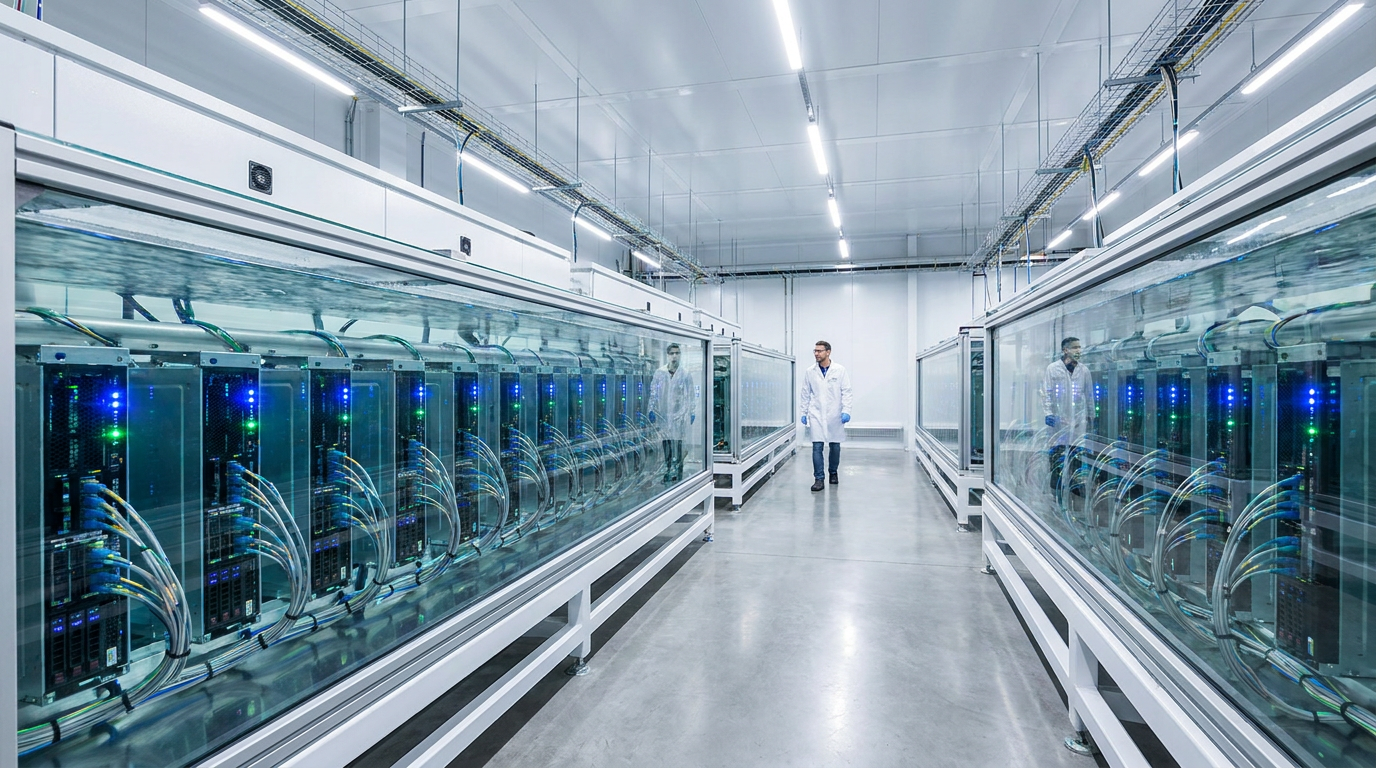
The second, more radical approach is single-phase liquid immersion. In these facilities, entire server racks are lowered horizontally into sealed vats filled with a specialized dielectric fluid. This synthetic oil is thermally conductive but electrically insulating, meaning the bare electronics can operate completely submerged without short-circuiting. As the servers generate heat, the fluid absorbs it and circulates through a heat exchanger, silently and efficiently carrying the thermal energy away.[3][5]
The efficiency gains are transformative. The industry measures data center efficiency using Power Usage Effectiveness (PUE), where a perfect score of 1.0 means every watt of power goes directly to computing. Traditional air-cooled facilities typically hover around a PUE of 1.50. According to 2026 benchmarking data, optimized liquid immersion facilities are achieving PUE ratios as low as 1.03 to 1.05. For a high-density AI cluster, this translates to a 40% to 50% reduction in total facility energy consumption.[3]

Beyond electricity, liquid cooling is quietly solving the cloud's hidden water crisis. Traditional evaporative cooling towers consume millions of gallons of fresh water daily to dissipate heat into the atmosphere. Closed-loop liquid systems effectively eliminate this requirement. Recent economic analyses show that immersion cooling can reduce a data center's water footprint by 95% to 98%, saving up to 45 million gallons of water annually for a standard 10-megawatt facility.[2][3]
Beyond electricity, liquid cooling is quietly solving the cloud's hidden water crisis.
While hardware engineers redesign the physical racks, software engineers are deploying AI to optimize the facilities themselves. Modern data centers are increasingly utilizing predictive optimization software—essentially using AI to cool AI. By analyzing thousands of sensors tracking temperature, airflow, and workload scheduling in real-time, these systems dynamically adjust cooling intensity before a temperature spike occurs. Peer-reviewed research confirms that these usage-based controls can reduce baseline energy consumption by an additional 20% to 30%.[2][6]
The most elegant aspect of this transition is what happens to the heat after it is removed. In an air-cooled system, low-grade warm air is vented into the atmosphere and wasted. Liquid cooling, however, produces a concentrated stream of hot water that is highly valuable. In 2026, a growing number of cloud providers are integrating heat-recovery infrastructure, piping this thermal byproduct into municipal district heating networks to warm nearby homes, agricultural greenhouses, and industrial facilities.[2][5]
The economics of this green transition have finally reached a tipping point. Historically, the high capital expenditure (CapEx) required to install liquid cooling kept it relegated to niche high-performance computing. But as AI pushes rack densities past 50 kilowatts, air cooling is no longer just inefficient—it is physically incapable of doing the job. Total Cost of Ownership (TCO) analyses now show that for high-density AI workloads, liquid immersion breaks even with traditional air cooling in just over two years, driven by massive savings on electricity.[3][7]

Software architecture is also evolving to support these physical changes through "carbon-aware computing." Cloud orchestration platforms now monitor the carbon intensity of regional power grids in real-time. If the wind stops blowing in Texas but solar production is peaking in Nevada, the cloud automatically shifts flexible workloads—like AI model training or batch data processing—to the data center running on cleaner energy, seamlessly balancing the grid.[1][6]
Challenges remain, primarily in the realm of retrofitting. While new "greenfield" data centers are being purpose-built for liquid cooling, upgrading the thousands of existing legacy facilities is a logistical nightmare. Many older buildings lack the reinforced floors required to support the immense weight of liquid-filled immersion tanks, forcing operators to rely on hybrid air-and-liquid solutions in the interim.[1][5]

There is also the looming specter of the Jevons Paradox—the economic principle that as a resource becomes more efficiently used, overall demand for it increases. Environmental advocates warn that while liquid cooling drastically reduces the energy wasted on temperature control, the absolute power drawn by the AI chips themselves continues to climb. Efficiency alone cannot offset the exponential growth of compute demand if models continue to scale indefinitely.[1][6]
Despite these hurdles, the rapid mainstreaming of liquid cooling represents a rare, unequivocal win for both the technology sector and the climate. The physical limits of silicon forced the cloud computing industry to abandon its most wasteful practices. By embracing liquid immersion, AI-driven optimization, and heat reuse, the infrastructure of the internet is becoming fundamentally greener—not just out of corporate goodwill, but out of pure operational necessity.[1][2][7]
How we got here
Pre-2023
Liquid cooling remains a niche technology reserved primarily for bespoke supercomputers and high-frequency trading.
2023–2024
The generative AI boom triggers a massive buildout of GPU clusters, pushing traditional air cooling to its physical limits.
2025
Hyperscale cloud providers begin large-scale pilot programs for direct-to-chip and immersion cooling in new facilities.
2026
Liquid cooling reaches an economic tipping point, becoming the default standard for new high-density AI data center builds.
Viewpoints in depth
Hyperscale Cloud Providers
Focus on the economic and performance imperatives of liquid cooling.
For the companies building the physical backbone of the internet, the transition to liquid cooling is less about environmental altruism and more about the laws of physics. As AI chips draw increasingly massive amounts of power, they generate heat that air simply cannot carry away fast enough. Cloud operators argue that without liquid immersion and direct-to-chip cooling, the next generation of AI models literally cannot be trained. Furthermore, the economic math has shifted: the massive electricity savings of running a facility at a 1.05 PUE now quickly offset the higher upfront costs of installing liquid infrastructure.
Sustainable Infrastructure Advocates
View liquid cooling as a critical, but incomplete, step toward green computing.
Environmental technologists and green-cloud advocates celebrate the death of the evaporative cooling tower and the massive water savings that closed-loop liquid systems bring. They also champion the rise of heat-reuse networks that turn data center waste into municipal heating. However, they stress that extreme efficiency is only half the battle. This camp argues that true sustainability requires pairing these ultra-efficient liquid-cooled facilities exclusively with 24/7 carbon-free energy grids, ensuring that the power going into the chips is as clean as the cooling system surrounding them.
Environmental Skeptics
Warn that efficiency gains are being erased by the sheer scale of AI growth.
A vocal contingent of climate researchers points to the Jevons Paradox to explain their apprehension. They argue that by making it cheaper and physically easier to cool massive GPU clusters, the industry is simply enabling the creation of even larger, more power-hungry AI models. While the percentage of energy wasted on cooling has plummeted, the absolute terawatt-hours demanded by the tech sector continue to skyrocket. From this perspective, hardware efficiency is a band-aid; the real solution requires algorithmic breakthroughs that make AI models fundamentally less compute-intensive to train.
What we don't know
- How quickly legacy air-cooled data centers can be retrofitted for liquid cooling without causing massive service disruptions.
- Whether the absolute energy demand of AI will eventually outpace the efficiency gains provided by liquid cooling and carbon-aware software.
- The long-term environmental impact of manufacturing and disposing of the synthetic dielectric fluids used in immersion cooling.
Key terms
- Power Usage Effectiveness (PUE)
- A standard metric for data center efficiency; a perfect score of 1.0 means all power goes to computing, while 1.5 means 50% is wasted on cooling and overhead.
- Liquid Immersion Cooling
- A thermal management technique where computer hardware is fully submerged in a non-conductive fluid to absorb and remove heat.
- Direct-to-Chip Cooling
- A method that pumps liquid coolant through a metal block attached directly to a high-heat processor, intercepting heat before it enters the air.
- Carbon-Aware Computing
- The practice of automatically shifting software workloads to different data centers based on where renewable energy is most abundant at that exact moment.
- Jevons Paradox
- An economic concept where technological progress increases the efficiency of a resource, but the resulting drop in cost actually increases overall demand for it.
Frequently asked
Is it safe to submerge servers in liquid?
Yes. Immersion cooling uses a specialized synthetic dielectric fluid that conducts heat but does not conduct electricity, preventing short circuits.
How much water does liquid cooling save?
Because it uses a closed-loop system rather than evaporative cooling towers, liquid cooling can reduce a data center's water consumption by up to 98%.
Why didn't data centers use this sooner?
Traditional air cooling was sufficient and cheaper for standard web servers. It is only the extreme heat generated by modern AI chips that has made liquid cooling economically necessary.
What happens to the heat absorbed by the liquid?
In modern facilities, the hot water is often piped into municipal district heating systems to warm nearby homes, greenhouses, or industrial buildings.
Sources
Source coverage
7 outlets
3 viewpoints surfaced







[1]Factlen Editorial Team
Synthesis by Factlen editorial team
Read on Factlen Editorial Team →[2]World Economic ForumSustainable Infrastructure Advocates
How data centres can tackle the energy crunch
Read on World Economic Forum →[3]Energy Solutions IntelligenceSustainable Infrastructure Advocates
Data Center Cooling 2026: Liquid Immersion vs Air Economics
Read on Energy Solutions Intelligence →[4]JLLHyperscale Cloud Providers
2026 Global Data Centre Outlook
Read on JLL →[5]CoreSiteHyperscale Cloud Providers
Liquid Cooling Goes Mainstream in 2026
Read on CoreSite →[6]ResearchGateEnvironmental Skeptics
Green Cloud Computing and AI for Energy Optimization: A 2026 Survey
Read on ResearchGate →[7]AccentureHyperscale Cloud Providers
Data Centre Trends Report 2026
Read on Accenture →
Every angle. Every day.
Get technology stories with full source coverage and perspective breakdowns delivered to your inbox.