
How Next-Generation Geothermal Energy Works (And Why It's Suddenly Everywhere)
By borrowing horizontal drilling techniques from the oil and gas industry, enhanced geothermal systems are unlocking massive amounts of 24/7 clean energy from hot, dry rock deep underground.
By Factlen Editorial Team
- Clean Energy Advocates
- View EGS as the missing firm piece of the zero-carbon puzzle, capable of replacing coal and gas baseload power.
- Tech Industry Buyers
- View next-gen geothermal as the ideal solution to power energy-hungry AI data centers without violating corporate climate pledges.
- Oil & Gas Transitioners
- View EGS as a profitable pivot that utilizes existing horizontal drilling expertise, supply chains, and workforce.
- Risk-Cautious Environmentalists
- Support clean energy but urge strict regulation of EGS due to concerns over water consumption and induced micro-earthquakes.
What's not represented
- · Local communities near drilling sites
- · Water conservation authorities
Why this matters
As artificial intelligence and electrification push the power grid to its limits, enhanced geothermal systems offer a massive, untapped source of 24/7 clean energy. By turning the Earth itself into a limitless battery, this technology could replace fossil fuels as the backbone of the global electrical system.
Key points
- Enhanced Geothermal Systems (EGS) use oil and gas drilling techniques to tap heat from dry rock deep underground.
- Unlike solar and wind, EGS provides 24/7 clean baseload power, making it highly attractive to tech companies running AI data centers.
- Recent breakthroughs in horizontal drilling and fiber-optic sensors have dramatically reduced the cost of EGS deployment.
- Fervo Energy has successfully proven the technology at commercial scale with its Project Red facility in Nevada.
- Global investment in next-generation geothermal technologies surged to $2.2 billion in 2025.
- The U.S. Department of Energy estimates EGS could eventually unlock 5,500 gigawatts of clean energy capacity.
The global electrical grid is facing a demand shock unlike anything seen in decades. Driven by the rapid expansion of artificial intelligence data centers, the reshoring of heavy manufacturing, and the widespread electrification of vehicles and heating, power consumption is surging. While wind and solar power are being deployed at record rates, they suffer from a fundamental limitation: intermittency. The grid requires a constant, unwavering baseline of electricity to function, prompting a desperate search for "clean firm" power that can run twenty-four hours a day, seven days a week, regardless of the weather.[4]
For over a century, conventional geothermal energy has provided exactly that kind of reliable, zero-carbon baseload power. By tapping into naturally occurring underground reservoirs of hot water and steam, geothermal plants spin turbines day and night. However, this traditional approach is severely geographically constrained. It requires a rare geological trifecta—heat, fluid, and highly permeable rock—which is typically only found near tectonic fault lines or natural hot springs, such as in Iceland or California's Geysers. Most of the Earth's subterranean heat is locked away in dry, impermeable rock, rendering it completely inaccessible to conventional methods.[1][3]
That geographic limitation is now being shattered by a rapidly maturing technology known as Enhanced Geothermal Systems (EGS). Instead of hunting for the planet's rare natural radiators, engineers have figured out how to manufacture their own. By borrowing the advanced horizontal drilling and hydraulic fracturing techniques that fueled the shale oil and gas boom over the last two decades, EGS allows energy companies to create man-made geothermal reservoirs almost anywhere on the map, provided they are willing to drill deep enough.[1]

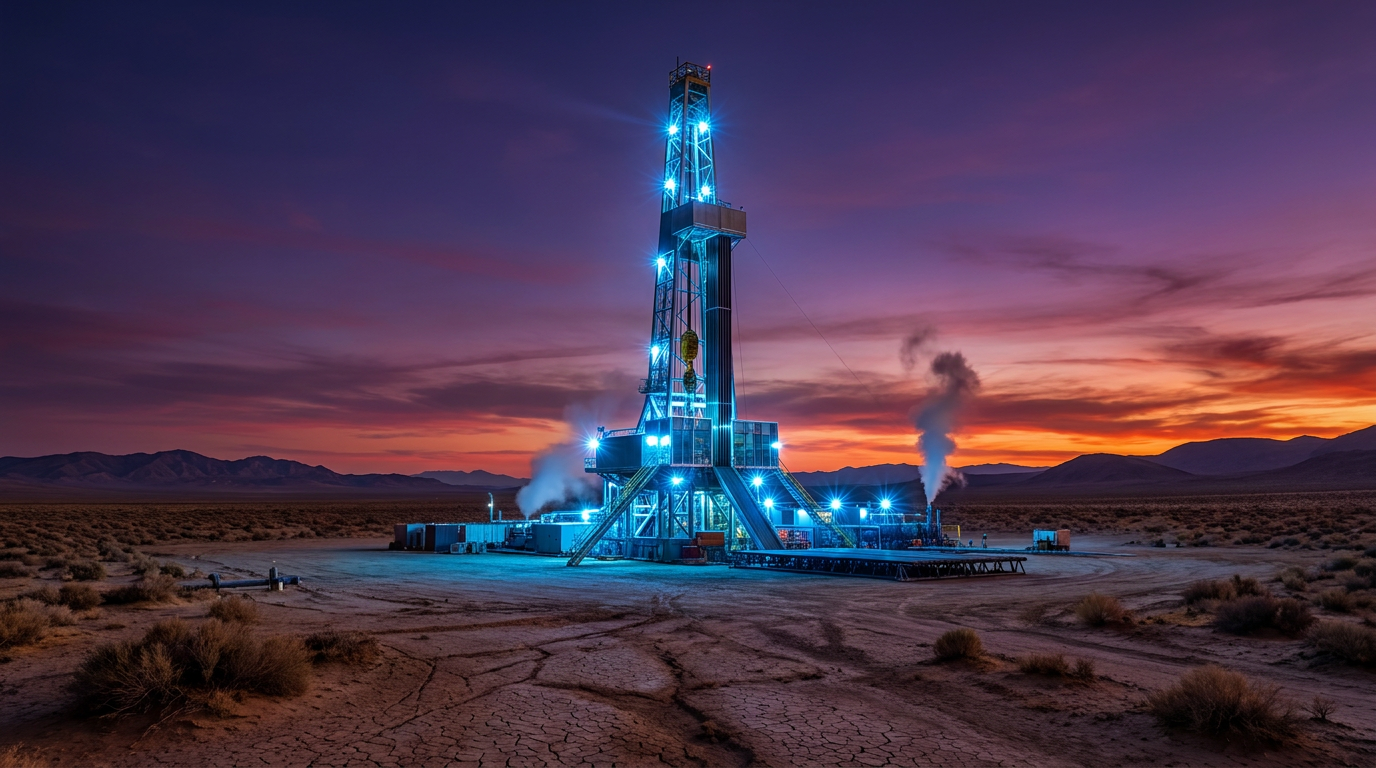
The mechanics of an Enhanced Geothermal System begin with a massive drilling operation. Engineers drill an injection well straight down into the Earth's crust—often reaching depths of three to ten kilometers (roughly two to six miles). At these extreme depths, the drill bit enters crystalline basement rock where temperatures easily exceed 150 degrees Celsius (300 degrees Fahrenheit). Unlike natural geothermal sites, this deep rock is entirely dry and lacks the natural permeability required for water to flow through it.[1]
To solve the permeability problem, operators employ a technique called hydro-shearing. High-pressure fluid is pumped down the injection well and forced into the rock face. Rather than violently shattering the rock, this pressure is carefully calibrated to gently pry open and expand pre-existing, dormant fractures in the subterranean formation. This creates a vast, interconnected web of tiny cracks spread across a large volume of hot rock, effectively transforming a solid block of granite into a highly porous, underground sponge.[1][3]
Once the fracture network is established, a second well—the production well—is drilled nearby, intentionally steered to intersect the newly created web of cracks. This completes the underground circuit. Cold water is continuously pumped down the injection well, where it is forced through the labyrinth of hot rock fractures. As the water travels through this massive geological radiator, it absorbs the Earth's ambient heat. The superheated fluid is then drawn up the production well to the surface.[1][6]
At the surface power plant, the superheated water flashes into steam—or is used to heat a secondary working fluid with a lower boiling point—which spins a turbine to generate electricity. Crucially, this is a closed-loop system. After the fluid releases its thermal energy to the turbine, it is cooled and immediately pumped back down the injection well to repeat the cycle. The result is a continuous, emissions-free power plant that runs indefinitely, fueled solely by the inexhaustible heat of the Earth's core.[1]
For decades, EGS was considered a theoretical pipe dream, plagued by exorbitant drilling costs and technical failures. The turning point arrived when geothermal startups began aggressively recruiting talent from the oil and gas sector. By adopting polycrystalline diamond compact (PDC) drill bits, precise horizontal steering technology, and distributed fiber-optic acoustic sensors, these companies dramatically improved their ability to navigate and manipulate hard rock at extreme temperatures.[6]

For decades, EGS was considered a theoretical pipe dream, plagued by exorbitant drilling costs and technical failures.
The theoretical promise of EGS has now been proven in the real world. In 2026, Fervo Energy published two years of operational data from Project Red, a commercial-scale EGS facility in Nevada. The data represented a watershed moment for the industry, confirming that the system could deliver reliable, round-the-clock power with zero thermal decline during its first year of steady-state operations. The project validated the fundamental physics of EGS, proving that engineered reservoirs do not rapidly cool down or collapse under commercial production loads.[6]
Building on that success, the industry is scaling up at a blistering pace. Fervo is currently constructing Cape Station in Utah, a massive facility designed to put 100 megawatts of continuous geothermal power on the grid by the end of 2026, with plans to expand to 500 megawatts by 2028. This rapid commercialization is being supported by the Department of Energy's Frontier Observatory for Research in Geothermal Energy (FORGE), a dedicated field laboratory in Utah where researchers have demonstrated drilling speeds that are 500 percent faster than they were just three years ago.[2][5][6]
Operating at these extreme depths and temperatures requires entirely new classes of diagnostic equipment. In early 2026, geophysicists from the Lawrence Berkeley National Laboratory achieved a major breakthrough by successfully deploying custom-built, high-temperature seismometers nearly 7,000 feet underground at the Cape Station site. These sensors continuously monitored microseismic activity at 338 degrees Fahrenheit for seven straight months, providing operators with unprecedented, real-time visibility into how the underground fracture networks behave under stress.[5]
The financial markets have taken notice of these technical milestones. According to the International Energy Agency, global investment in next-generation geothermal technologies reached $2.2 billion in 2025. This represents an 80 percent increase year-over-year and a staggering leap from the mere $22 million invested in the sector in 2018. As drilling costs continue to fall and operational risks are retired, debt-based financing is becoming increasingly available, signaling that EGS is transitioning from a speculative venture capital play into a mature infrastructure asset.[2]

This influx of capital is being driven by intense market demand, particularly from the technology sector. Major tech conglomerates, desperate to secure reliable electricity for their expanding fleets of AI data centers without violating their corporate climate pledges, are signing massive power purchase agreements (PPAs) with EGS developers. These long-term contracts guarantee a buyer for the electricity at a premium price, providing the revenue certainty required to finance the high upfront capital costs of drilling deep geothermal wells.[4]
If the current trajectory holds, the macroeconomic impact of EGS could be staggering. A recent analysis by Princeton University suggests that if deployment costs continue to fall along expected learning curves, enhanced geothermal could supply up to 20 percent of all electricity in the United States by 2050. The Department of Energy is even more optimistic, estimating that the total geological resource available for next-generation geothermal in the U.S. could provide 5,500 gigawatts of capacity—roughly 140 times the capacity of the country's existing conventional geothermal fleet.[3][4]
Despite the immense promise, significant hurdles remain before EGS can achieve global scale. The technology is still highly capital-intensive, with drilling and well construction often accounting for up to 80 percent of a project's total cost. While these costs have plummeted in recent years, they must fall further for EGS to compete on price with cheap natural gas or fully amortized coal plants in unsubsidized energy markets. Furthermore, navigating the complex web of federal and state permitting for deep-well drilling remains a major bottleneck for developers.[2]
Environmental and safety concerns also require careful management. Because EGS relies on hydro-shearing to create underground reservoirs, the process inherently induces micro-seismicity—tiny earthquakes caused by the rock fracturing. While these events are typically far too weak to be felt at the surface, improper site selection or over-pressurization can theoretically trigger larger tremors. Consequently, continuous deep-well monitoring and strict regulatory oversight are critical to ensuring that EGS projects operate safely near populated areas.[5]

Looking beyond the current generation of EGS, researchers are already mapping out the next frontier: Superhot Rock (SHR) geothermal. Innovators at institutions like MIT are developing advanced drilling technologies, such as millimeter-wave energy beams, designed to vaporize rock and reach depths where temperatures exceed 375 degrees Celsius. At these extreme conditions, water enters a "supercritical" state, possessing the properties of both a liquid and a gas, which allows it to carry exponentially more thermal energy to the surface.[1][7]
For now, the successful deployment of Enhanced Geothermal Systems represents a profound irony in the story of the energy transition. The very same drilling technologies, supply chains, and engineering expertise that unlocked the fossil fuel shale boom are now being repurposed to harvest the Earth's internal heat. By turning the oil and gas industry's greatest tools toward a zero-carbon future, next-generation geothermal is poised to transform the planet itself into a limitless, always-on battery.[7]
How we got here
2018
Global investment in next-generation geothermal sits at just $22 million, with the technology viewed as a speculative niche.
2021
The U.S. Department of Energy's FORGE initiative drills its first deep wells in Utah, accelerating research into hard-rock drilling.
Oct 2023
Fervo Energy's Project Red in Nevada achieves commercial operations, sending the first EGS-generated electrons to the grid.
Early 2026
Lawrence Berkeley National Laboratory successfully deploys high-temperature sensors to continuously monitor EGS reservoirs at 338°F.
Viewpoints in depth
The Grid Reliability View
Focuses on the critical need for 24/7 clean power to balance intermittent renewables.
Grid operators and tech companies argue that wind and solar, while cheap, cannot solve the grid's baseload problem alone. Because batteries remain too expensive for long-duration storage, the grid desperately needs 'clean firm' power that generates electricity around the clock. For this camp, the premium upfront cost of EGS is justified because it prevents the need to keep carbon-emitting natural gas plants online as backups.
The Industry Pivot View
Focuses on repurposing fossil fuel expertise for clean energy.
Veterans of the shale revolution view EGS as the ultimate pivot for the oil and gas industry. They point out that the specialized workforce, heavy machinery, and supply chains required for deep horizontal drilling already exist. By transitioning these assets from extracting hydrocarbons to harvesting subterranean heat, this perspective argues that the fossil fuel industry can profitably lead the transition to a zero-carbon economy rather than fighting it.
The Subsurface Risk View
Focuses on the environmental and seismic risks of deep-rock fracturing.
Environmental watchdogs and risk-cautious geologists support the goal of clean baseload power but urge strict regulatory oversight of EGS. They highlight that hydro-shearing consumes significant amounts of water and inherently induces micro-earthquakes. This camp argues that without rigorous site selection, transparent public data sharing, and continuous deep-well seismic monitoring, the industry risks triggering larger, felt earthquakes that could turn public opinion against geothermal energy.
What we don't know
- Whether drilling costs can fall fast enough for EGS to compete with natural gas in unsubsidized energy markets.
- How quickly federal and state permitting processes can be streamlined to allow for rapid, large-scale deployment.
- If Superhot Rock (SHR) geothermal systems can successfully manage the extreme corrosive properties of supercritical water.
Key terms
- Enhanced Geothermal Systems (EGS)
- A man-made geothermal reservoir created by drilling into hot, dry rock and injecting fluid to create permeability.
- Hydro-shearing
- The process of injecting high-pressure fluid to gently reopen natural, dormant fractures in underground rock.
- Baseload Power
- The minimum amount of electric power needed to be supplied to the electrical grid at any given time, requiring 24/7 reliability.
- Supercritical Fluid
- A substance at a temperature and pressure where distinct liquid and gas phases do not exist, allowing it to carry massive amounts of thermal energy.
- Micro-seismicity
- Very small, localized earthquakes induced by fracturing rock, typically too weak to be felt at the surface.
Frequently asked
Does enhanced geothermal cause earthquakes?
EGS relies on creating micro-fractures in deep rock, which induces very small seismic events. These are typically too weak to be felt at the surface, but projects use continuous deep-well monitoring to manage the risk and prevent larger tremors.
How is EGS different from oil and gas fracking?
Both use high-pressure fluid to fracture rock, but EGS uses it to circulate water in a closed loop to harvest heat, rather than extracting fossil fuels. EGS also targets deeper, harder crystalline rock rather than sedimentary shale.
Where can EGS power plants be built?
Unlike conventional geothermal, which requires natural hot springs, EGS can theoretically be built anywhere if you drill deep enough. However, early projects target areas where hot rock is closer to the surface to minimize drilling costs.
Sources
Source coverage
7 outlets
4 viewpoints surfaced







[1]Department of EnergyClean Energy Advocates
Enhanced Geothermal Systems
Read on Department of Energy →[2]International Energy AgencyOil & Gas Transitioners
Investment in next-generation geothermal is surging. Policies are key to further growth
Read on International Energy Agency →[3]Princeton EngineeringClean Energy Advocates
Enhanced geothermal systems: An underground tech surfaces as a serious clean energy contender
Read on Princeton Engineering →[4]McKinsey & CompanyTech Industry Buyers
Is geothermal energy ready to make its mark in the US power mix?
Read on McKinsey & Company →[5]Lawrence Berkeley National LaboratoryRisk-Cautious Environmentalists
Scientists Develop New Technology to Continuously Monitor Geothermal Energy Operations
Read on Lawrence Berkeley National Laboratory →[6]Fervo EnergyOil & Gas Transitioners
Enhanced Geothermal Has Been Proven at Scale. Here's What Two Years of Production Data Show.
Read on Fervo Energy →[7]Factlen Editorial Team
Synthesis by Factlen editorial team
Read on Factlen Editorial Team →

More in guides
See all 52 stories →Local AI
How to Run AI Models Locally: The 2026 Guide to Digital Independence
7 sources

Exercise Science
The Science of Zone 2 Training: Why the Slowest Cardio Builds the Strongest Engine
7 sources

Battery Tech
How Solid-State Batteries Work—And Why They Are Finally Ready to Change EVs
7 sources
AI Developer Tools
Cursor vs. GitHub Copilot vs. Codeium: The 2026 AI Coding Assistant Trade-Offs
8 sources

Every angle. Every day.
Get guides stories with full source coverage and perspective breakdowns delivered to your inbox.