
How Neuroaesthetics is Turning Interior Design into a Science of Brain Health
Advancements in neuroscience are revealing exactly how room shapes, lighting, and textures alter our brain chemistry. Interior design is shifting from an intuitive art form to an evidence-based tool for lowering stress and boosting cognitive performance.
By Factlen Editorial Team
- Neuroscience Researchers
- Focuses on empirical data, brain imaging, and measurable biological metrics like cortisol levels and heart rate.
- Workplace Strategists
- Prioritizes how environmental design impacts cognitive performance, employee productivity, and mental fatigue in commercial settings.
- Healthcare Architects
- Emphasizes the role of spatial design in accelerating patient healing, reducing anxiety, and supporting aging in place.
- Evidence-Based Designers
- Advocates for moving interior design away from pure intuition toward scientifically validated, human-centered practices.
What's not represented
- · Traditional interior decorators who prioritize historical or cultural aesthetics over biological metrics.
- · Budget-conscious developers who may view neuroaesthetic interventions as cost-prohibitive.
Why this matters
For decades, interior design was treated as a luxury or a matter of subjective taste. By proving that our physical environments directly alter our heart rates, stress hormones, and cognitive abilities, neuroaesthetics empowers individuals and companies to build spaces that actively improve daily mental and physical health.
Key points
- Neuroaesthetics uses brain-scanning technology to measure how interior design physically alters human biology.
- Viewing natural elements like wood grain can measurably lower heart rates and blood pressure.
- Curvilinear spaces activate the brain's pleasure centers, while sharp angles can induce subtle stress.
- Commercial offices using biophilic design report a 15% increase in employee productivity.
- Hospitals are utilizing these principles to accelerate patient healing and reduce the need for pain medication.
- The industry is shifting from intuitive decoration to evidence-based, health-focused design.
Have you ever walked into a room and felt an immediate, inexplicable sense of calm? Or conversely, stepped into an office and felt your shoulders tense? For decades, interior designers attributed these reactions to an intuitive sense of "good taste" or aesthetic harmony. But a rapidly growing scientific discipline is proving that our response to physical spaces is not just cultural or subjective—it is deeply biological.[1]
Welcome to the era of neuroaesthetics in interior design. Born from the intersection of neuroscience, psychology, and architecture, neuroaesthetics is the study of how the human brain and nervous system respond to aesthetic experiences. Rather than relying solely on a designer's intuition, this field uses advanced brain-scanning technology to measure exactly how light, shape, texture, and color alter our physiological state.[4][6]
The premise is simple but revolutionary: humans do not merely occupy spaces; we experience them on a cellular level. When we encounter a beautifully designed environment, our bodies undergo measurable changes. Heart rates slow, blood pressure drops, and the brain's chemistry shifts to release "happy hormones" like serotonin, dopamine, and oxytocin.[2][4][6]
To understand how this works, researchers point to three primary neural networks that shape human-building interactions. The sensory-motor system processes the physical features of a room, the knowledge-meaning network interprets the cultural or personal significance of the space, and the emotion-valuation network assigns a feeling to the experience. When these networks align positively, the environment actively reduces the production of cortisol, the body's primary stress hormone.[5][7]

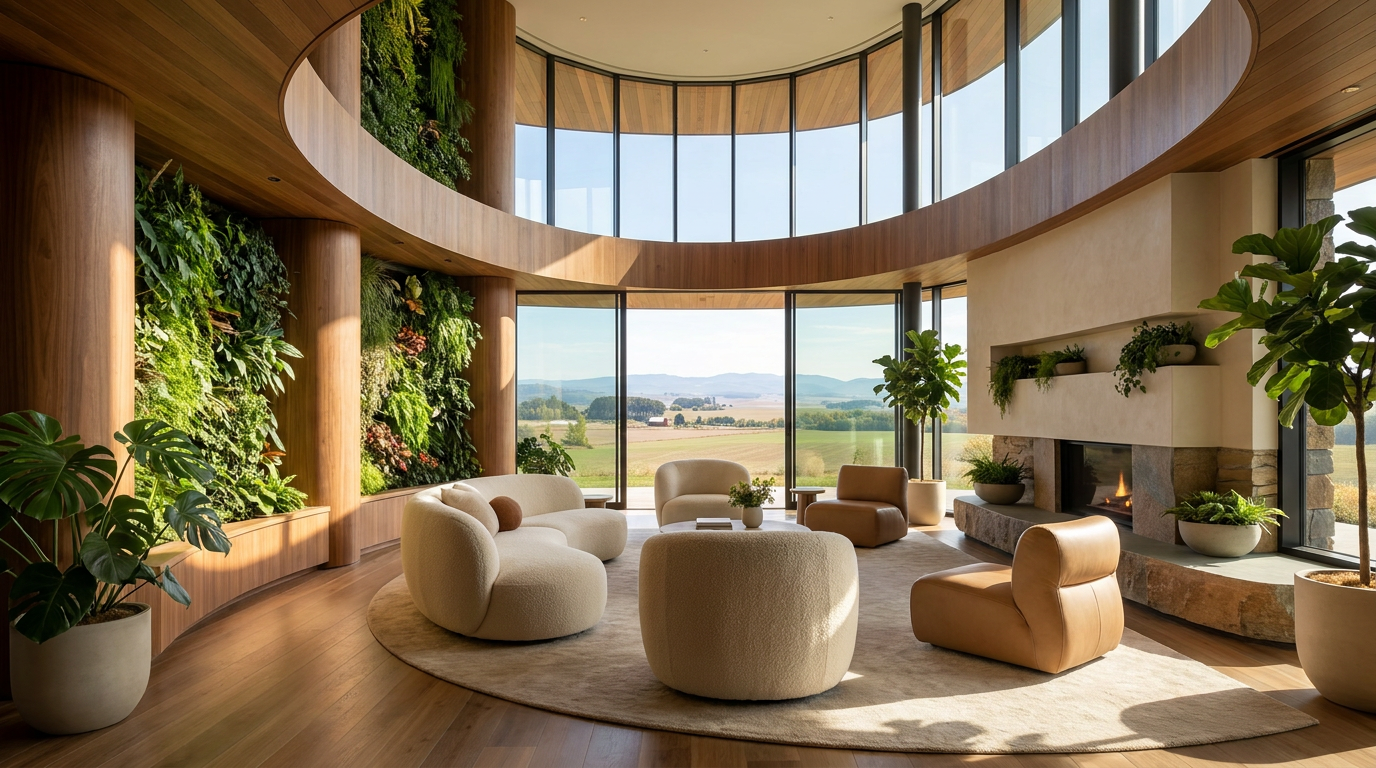
One of the most heavily researched pillars of neuroaesthetics is biophilic design—the integration of natural elements into the built environment. Evolutionary psychology suggests that human brains are hardwired to seek out nature, a trait that modern indoor living has severely deprived. Reintroducing nature doesn't just mean adding a potted plant; it involves mimicking natural systems, utilizing earthy color palettes, and maximizing natural light.[5][9]
The biological impact of biophilia is startlingly precise. Scientific studies have demonstrated that simply viewing wood grain—whether real or accurately mimicked—can reduce a person's heart rate by an average of five beats per minute. Furthermore, visual access to greenery and natural daylight has been shown to lower anxiety, improve working memory, and restore depleted attention spans.[3][8]
Beyond nature, the physical geometry of a room plays a critical role in our mental state. Functional magnetic resonance imaging (fMRI) and electroencephalogram (EEG) studies reveal that the brain strongly prefers curves over sharp angles. Curvilinear spaces and rounded furniture activate the orbitofrontal cortex—the region of the brain associated with pleasure, reward, and emotional regulation.[3][5]

Beyond nature, the physical geometry of a room plays a critical role in our mental state.
Conversely, environments dominated by sharp, jagged angles and rigid linearity can trigger a low-level threat response, making occupants feel subtly uncomfortable or on edge. By incorporating calculated asymmetries and sweeping curves, designers can create a sense of flow that the brain interprets as safe and welcoming.[5][9]
Tactility and texture also serve as powerful neurological triggers. The somatosensory cortex, which processes touch, responds highly favorably to natural, varied textures. Smooth, cool surfaces might signal cleanliness, while soft, woven fabrics and warm woods stimulate feelings of comfort and belongingness. Engaging multiple senses prevents an environment from feeling sterile, grounding the occupant in the present moment.[3][7]
The commercial sector has been quick to adopt these evidence-based design principles, driven by the clear return on investment in human capital. Workplaces designed with neuroaesthetic principles—specifically those incorporating dynamic circadian lighting and biophilic elements—report significant boosts in cognitive performance. Research indicates that employees in biophilic offices exhibit a 15 percent increase in productivity and report substantially lower rates of mental fatigue.[3][5][7]

In healthcare, the stakes are even higher. Hospitals and clinics are utilizing neuroaesthetics as a form of preventive mental healthcare. Patients recovering in rooms with ample daylight and views of nature have been shown to heal faster and require less pain medication compared to those in standard, windowless clinical environments. The design of the room itself becomes an active participant in the medical treatment.[3]
The residential sector is also experiencing a paradigm shift, particularly in the realm of "aging in place." As older adults seek to remain in their homes, designers are looking beyond basic physical accessibility—like grab bars and ramps—to focus on the emotional dimensions of the space. By creating environments that consistently evoke positive emotional responses, neuroaesthetic design helps combat the isolation and anxiety often associated with aging.[8]
As the field matures, the concept of inclusive design is expanding to encompass neurodiversity. Because sensory processing varies wildly from person to person, a space that feels stimulating and energizing to one individual might feel overwhelming to someone with sensory sensitivities. Neuroaesthetics challenges designers to create adaptable environments that cater to a full spectrum of neurological needs, offering both collaborative zones and quiet, low-stimulus refuges.[2][7]

Looking ahead, the integration of artificial intelligence and smart home technology promises to make neuroaesthetic spaces even more responsive. AI systems can monitor how a space is being used and automatically adjust lighting temperatures, acoustic dampening, and climate controls to optimize the biological comfort of the occupants in real-time.[7][9]
Ultimately, neuroaesthetics represents a profound shift in how we value the spaces we inhabit. It moves interior design away from the realm of superficial decoration and positions it as a critical component of public health and personal well-being. By bridging the gap between art and biology, we are learning to build environments that don't just look beautiful, but actively help us thrive.[1][2][4]
How we got here
1990s
Advancements in fMRI and PET scan technology allow researchers to measure real-time biological responses to aesthetic stimuli.
2014
Functional imaging studies confirm that aesthetically pleasing spaces positively activate the brain's emotional regulation centers.
2021
Publication of foundational academic frameworks detailing the specific neural networks involved in human-building interactions.
2024–2026
Neuroaesthetics moves from academic theory to mainstream commercial and residential interior design practice.
Viewpoints in depth
Neuroscience Researchers
Focuses on the empirical biological data behind human-building interactions.
For neuroscientists, the value of interior design lies in its measurable impact on the human nervous system. Using fMRI scans, EEG readings, and biometric tracking, researchers in this camp have proven that aesthetic experiences are not subjective luxuries, but biological imperatives. They point to hard data showing that specific spatial configurations—such as curvilinear geometry and biophilic textures—directly lower cortisol production and stimulate the release of dopamine and oxytocin. Their goal is to establish universal, evidence-based baselines for human habitats.
Workplace Strategists
Views neuroaesthetics as a tool for optimizing human capital and cognitive performance.
Commercial designers and corporate strategists approach neuroaesthetics through the lens of productivity and employee retention. By implementing circadian lighting, acoustic dampening, and natural elements, they aim to reduce the cognitive load and mental fatigue associated with traditional office environments. This camp frequently cites studies showing 15 percent productivity increases in biophilic spaces, arguing that the upfront cost of neuro-optimized design is quickly offset by the long-term return on investment in employee health and focus.
Healthcare Architects
Utilizes spatial design as an active component of medical treatment and preventive care.
In the healthcare sector, architects view neuroaesthetics as a form of preventive and restorative medicine. This perspective emphasizes how environments can either hinder or accelerate the body's natural healing processes. By designing hospital rooms with access to natural daylight, views of greenery, and soothing textures, they aim to lower patient anxiety and reduce the need for pain medication. This camp is also pioneering the 'aging in place' movement, designing residential homes that emotionally support older adults through positive sensory engagement.
What we don't know
- How to perfectly standardize neuroaesthetic principles across highly diverse populations with differing sensory processing needs.
- The long-term, multi-decade health impacts of living entirely in neuro-optimized environments versus traditional spaces.
- How the rapid integration of AI-driven adaptive environments will affect human psychological resilience to less-controlled outdoor spaces.
Key terms
- Neuroaesthetics
- The scientific study of how the brain and nervous system respond to beauty, art, and spatial design.
- Biophilic Design
- An architectural approach that integrates natural elements, light, and organic patterns into the built environment to satisfy human evolutionary needs.
- Orbitofrontal Cortex
- The region of the brain associated with emotion and reward, which is highly activated by curved and aesthetically pleasing spaces.
- Somatosensory Cortex
- The part of the brain that processes tactile sensations, responding favorably to natural and varied interior textures.
- Circadian Lighting
- Artificial lighting systems designed to mimic the natural progression of sunlight throughout the day to support human biological rhythms.
Frequently asked
What is neuroaesthetics in interior design?
It is an evidence-based approach that uses neuroscience to understand how elements like light, color, and shape physically affect our brain chemistry and nervous system.
Can the shape of a room really change my mood?
Yes. Brain imaging shows that curvilinear spaces and rounded furniture activate the brain's pleasure centers, while sharp, jagged angles can trigger subtle stress responses.
How does biophilic design improve health?
Integrating natural elements like wood grain, plants, and sunlight has been biologically proven to lower cortisol levels, reduce blood pressure, and improve cognitive focus.
Is this only for commercial offices and hospitals?
While widely adopted in commercial spaces to boost productivity and healing, neuroaesthetic principles are increasingly used in residential homes to reduce daily anxiety and support aging in place.
Sources
Source coverage
9 outlets
4 viewpoints surfaced









[1]Factlen Editorial TeamEvidence-Based Designers
Synthesis by Factlen editorial team
Read on Factlen Editorial Team →[2]BIFMAWorkplace Strategists
A New Frontier in Design Thinking: Neuroaesthetics in the Built Environment
Read on BIFMA →[3]Pearl AcademyNeuroscience Researchers
Neuroaesthetics in Interior Design: How Spaces Shape Mood, Memory, and Mental Health
Read on Pearl Academy →[4]Science in DesignNeuroscience Researchers
The Complete Guide to Neuroaesthetics for Interior Designers: How Science Validates Design
Read on Science in Design →[5]M Moser AssociatesWorkplace Strategists
Neuroaesthetics: Transforming Commercial Spaces Through Thoughtful Design
Read on M Moser Associates →[6]Studio 10 Interior DesignHealthcare Architects
How Neuroaesthetics is Changing the Way We Design
Read on Studio 10 Interior Design →[7]ModulyssWorkplace Strategists
Neuroaesthetics: Transforming Commercial Spaces Through Thoughtful Design
Read on Modulyss →[8]AltroHealthcare Architects
Enriching lives through biophilic design and neuroaesthetics
Read on Altro →[9]Connections by FinsaEvidence-Based Designers
5 keys to take advantage of neuroaesthetics in interior design
Read on Connections by Finsa →
Every angle. Every day.
Get home stories with full source coverage and perspective breakdowns delivered to your inbox.