
How Neuroaesthetics is Turning Interior Design into a Biological Science
Advances in neuroscience reveal that our response to interior spaces is a measurable biological event, transforming how we design homes and workplaces for mental well-being.
By Factlen Editorial Team
- Neuroaesthetics Researchers
- Focus on the biological imperative, arguing that measuring biomarkers proves design is a matter of health, not just taste.
- Architectural Practitioners
- Focus on translating scientific findings into practical, beautiful, and healing spaces for clients.
- Industry Standards Advocates
- Focus on embedding evidence-based design principles into corporate, educational, and public policy.
- Factlen Editorial Team
- Synthesizes the emerging science to provide actionable insights for the general public.
What's not represented
- · Neurodivergent individuals navigating legacy spaces
- · Low-income housing developers
Why this matters
Understanding how your environment affects your nervous system empowers you to make intentional design choices that actively reduce stress, improve focus, and support your daily mental health.
Key points
- Neuroaesthetics is the scientific study of how the brain and nervous system respond to beauty, art, and spatial design.
- Advances in brain imaging reveal that harmonious environments can measurably lower heart rates and reduce stress hormones.
- Biophilic design leverages our evolutionary preference for safe, natural habitats by integrating organic shapes and light.
- The design industry is shifting from purely visual aesthetics to neuro-inclusive spaces that accommodate diverse sensory needs.
- Experts argue that evidence-based interior design should be viewed as a biological intervention and preventive mental healthcare.
Walking into a room and feeling instantly calm—or inexplicably anxious—is a universal human experience. For decades, the interior design industry treated this phenomenon as an intangible art, a matter of personal taste, intuition, and stylistic flair. If a space felt good, it was simply deemed "well-decorated."[6]
But the conversation is fundamentally shifting. A rapidly growing field known as neuroaesthetics is proving that our reaction to a room is not just a subjective preference; it is a measurable, physiological event. By bridging biology and architecture, researchers are uncovering exactly how our surroundings shape our internal state.[6]
"Design isn't an aesthetic choice. It's a biological intervention," explains Kay Sargent, director of thought leadership for interiors at the global design firm HOK. When we cross a threshold, our brains and bodies begin processing spatial data and adjusting our nervous system before conscious thought even catches up.[1]
Neuroaesthetics sits at the intersection of neuroscience, cognitive psychology, and architecture. It uses advanced diagnostic tools like functional MRI (fMRI) and biometric sensors to observe how the built environment impacts human biology in real time, moving design from guesswork to evidence-based science.[5]
The origins of this discipline trace back to the 1990s, when advances in brain scanning technology first allowed researchers to see what happens physiologically when humans encounter beauty. Today, institutions like the International Arts + Mind Lab at Johns Hopkins University are pioneering translational research to apply these clinical findings to everyday spaces.[3][5]
The core mechanism relies on how the brain processes environmental stimuli. According to recent neuro-architectural frameworks, human-building interactions are governed by three primary neural networks: the sensory-motor system, the knowledge-meaning network, and the emotion-valuation system.[6]

The sensory-motor system processes physical features—how light hits a surface, the acoustics of a hallway, or the tactile feedback of a floor. The knowledge-meaning network interprets what the space represents, while the emotion-valuation system determines whether the environment feels safe, rewarding, or threatening.[6]
When these networks encounter a harmonious environment, the physiological response is profound. Heart rates slow, blood pressure drops, and the production of stress hormones like cortisol decreases. Conversely, harsh lighting, sharp angles, and excessive visual clutter can trigger a low-grade fight-or-flight response.[5]
When these networks encounter a harmonious environment, the physiological response is profound.
One of the most powerful tools in the neuroaesthetic arsenal is biophilic design—the integration of natural elements into the built environment. Evolutionary biology suggests our brains are hardwired to seek out environments that supported human survival in the natural world, making us inherently responsive to organic cues.[2]
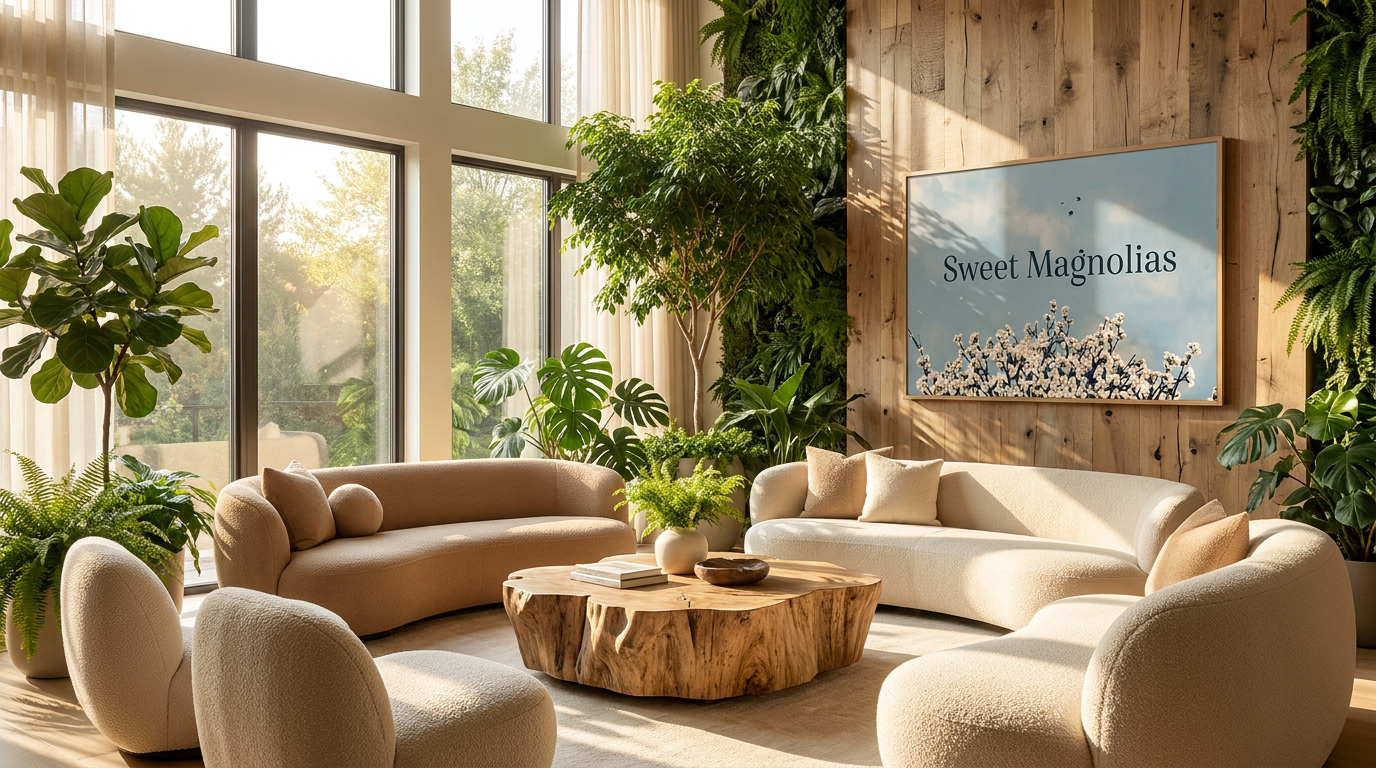
Visual access to greenery, organic shapes, and natural light doesn't just look pleasant; it actively lowers anxiety and improves working memory. Curvilinear spaces and soft, rounded furniture have been shown in EEG studies to activate brain regions associated with pleasure and comfort, mimicking the safety of natural refuges.[2]
Color psychology, long a staple of interior decoration, is also being validated by hard science. Different wavelengths of light stimulate specific areas of the brain related to emotional processing. Soft blues and greens promote focus and serenity, while warm tones like terracotta can stimulate energy and social interaction.[2]
But neuroaesthetics extends far beyond the traditional five senses. Researchers now recognize that humans possess anywhere from 21 to 53 distinct senses, including proprioception (the awareness of body position) and thermoception (temperature perception). A truly optimized space accounts for how a room sounds, how it regulates heat, and how effortlessly a body can move through it.[2]

The applications of this science are moving rapidly from residential living rooms to large-scale commercial and public spaces. The Business and Institutional Furniture Manufacturers Association (BIFMA) recently highlighted how neuroaesthetics is reshaping schools and offices to foster empathy, equity, and cognitive performance.[4]
In educational settings, co-creating spaces with students using neuroaesthetic principles—such as specific color palettes and acoustic dampening—has been linked to increased feelings of safety and improved focus. In healthcare, patients with access to daylight and views of nature have been documented to heal faster and require less pain medication.[4]

Despite the robust data, the field must navigate the inherent subjectivity of human experience. While certain biological responses to nature and light are nearly universal, aesthetic preferences are also heavily shaped by cultural background, personal history, and individual neurology.[2][6]
What feels like a cozy, stimulating environment to a neurotypical individual might feel overwhelmingly chaotic to someone who is neurodivergent. This is why leading designers are pivoting toward "neuro-inclusive" design, which prioritizes flexibility, quiet zones, and user control over rigid, one-size-fits-all aesthetic mandates.[1]

The ultimate promise of neuroaesthetics is a democratization of well-being. It reframes interior design from a luxury service focused on status and visual perfection into a vital, accessible tool for public health and daily emotional regulation.[6]
As we spend an estimated 90 percent of our lives indoors, the stakes for how we build those interiors have never been higher. By designing with the brain in mind, we can create homes, workplaces, and public squares that actively care for the people inside them.[6]
How we got here
1990s
Neurobiologists begin using advanced brain imaging to observe physiological responses to beauty, laying the groundwork for neuroaesthetics.
2014
Johns Hopkins University establishes the International Arts + Mind Lab to accelerate translational research in neuroarts.
2021
Researchers formally map the three distinct neural networks that govern human-building interactions.
2025
Major architectural firms and industry bodies begin formally integrating neuro-inclusive standards into commercial design.
Viewpoints in depth
Neuroaesthetics Researchers
Focus on the biological imperative of human environments.
Researchers in this camp argue that humans are fundamentally shaped by their environments at a cellular level. By measuring biomarkers like cortisol, heart rate variability, and brain wave activity, they aim to prove that design is a matter of public health, not just taste. Their goal is to establish empirical data that can guide everything from hospital construction to urban planning.
Architectural Practitioners
Focus on translating scientific theory into practical, healing spaces.
For working architects and interior designers, neuroaesthetics provides the vocabulary and evidence needed to justify design choices to clients. They emphasize moving from theory to practice, using these scientific insights to create spaces that actively improve the daily lives, productivity, and emotional resilience of the people who occupy them.
Neuro-inclusive Advocates
Focus on equity, diversity, and sensory accommodation.
This camp highlights that because brains process sensory input differently, spaces must offer flexibility rather than imposing a one-size-fits-all aesthetic. They advocate for environments that include quiet zones, adjustable lighting, and sensory control to accommodate neurodivergent individuals, ensuring that "good design" works for everyone.
What we don't know
- How to perfectly balance universal biological responses with highly individualized cultural and personal aesthetic preferences.
- The long-term, compounding neurological effects of spending decades in environments optimized specifically for neuroaesthetics.
- How rapidly these evidence-based standards will be adopted into municipal building codes and public housing policies.
Key terms
- Neuroaesthetics
- The scientific study of how the brain and nervous system respond to beauty, art, and spatial design.
- Biophilic Design
- An architectural approach that connects building occupants to nature through natural lighting, organic shapes, and greenery.
- Proprioception
- The body's subconscious ability to perceive its own position and movement in space.
- Neuro-inclusive Design
- Creating environments that accommodate diverse neurological needs and sensory processing profiles.
- fMRI
- Functional magnetic resonance imaging, a technology used to observe how environments activate specific neural pathways in real time.
Frequently asked
Do I need a large budget to apply neuroaesthetics?
No. Core principles like maximizing natural light, reducing visual clutter, and incorporating natural textures or houseplants can be achieved on any budget.
How does color actually affect the brain?
Different wavelengths of light stimulate specific brain areas related to emotional processing; blues often promote calmness, while warm tones can boost energy.
Is neuroaesthetics just a passing design trend?
Unlike stylistic trends, neuroaesthetics is rooted in biology and neuroscience, focusing on measurable physiological responses rather than subjective taste.
Can interior design really improve mental health?
Yes. Evidence-based design has been shown to lower stress hormones, improve sleep quality, and foster a sense of safety and emotional regulation.
Sources
Source coverage
6 outlets
4 viewpoints surfaced






[1]HOKArchitectural Practitioners
HOK Forward 2026: Neuroaesthetics and the Built Environment
Read on HOK →[2]LivingEtcArchitectural Practitioners
Neuroaesthetics is the interior design trend that will make you happier at home
Read on LivingEtc →[3]Johns Hopkins International Arts + Mind LabNeuroaesthetics Researchers
Center for Applied Neuroaesthetics
Read on Johns Hopkins International Arts + Mind Lab →[4]BIFMAIndustry Standards Advocates
The Science of Feeling: What Is Neuroaesthetics?
Read on BIFMA →[5]Science in DesignNeuroaesthetics Researchers
The Complete Guide to Neuroaesthetics for Interior Designers
Read on Science in Design →[6]Factlen Editorial TeamFactlen Editorial Team
Synthesis by Factlen editorial team
Read on Factlen Editorial Team →
Every angle. Every day.
Get home stories with full source coverage and perspective breakdowns delivered to your inbox.