
How 'Neuroaesthetics' is Rewiring Interior Design for Mental Health
A growing field at the intersection of brain science and architecture is proving that interior design choices trigger measurable biological responses, transforming how we build spaces for well-being.
By Factlen Editorial Team
- Neurodesign Researchers
- Scientists focused on empirical data and measurable biological responses to spatial design.
- Wellness-Focused Designers
- Practitioners translating scientific principles into practical applications for homes and offices.
- General Public & Homeowners
- Everyday individuals seeking to create happier, more comfortable living spaces.
- Factlen Editorial
- Synthesizing the intersection of biology and interior design into actionable insights.
What's not represented
- · Traditional Decorators
- · Real Estate Developers
Why this matters
As humans spend roughly 90 percent of their lives indoors, understanding how room shapes, lighting, and textures biologically alter our stress levels empowers us to design homes and workplaces that actively improve our mental health.
Key points
- Neuroaesthetics is the scientific study of how spatial design and beauty affect the human brain and nervous system.
- Brain imaging shows that curved forms and natural textures activate pleasure centers, while sharp angles can trigger alertness.
- Biophilic design, which brings elements of nature indoors, has been shown to reduce stress hormones by up to 20 percent.
- Lighting that mimics the natural circadian rhythm is critical for regulating mood, focus, and sleep cycles.
- Researchers are developing standardized indices to measure and optimize the health impacts of built environments.
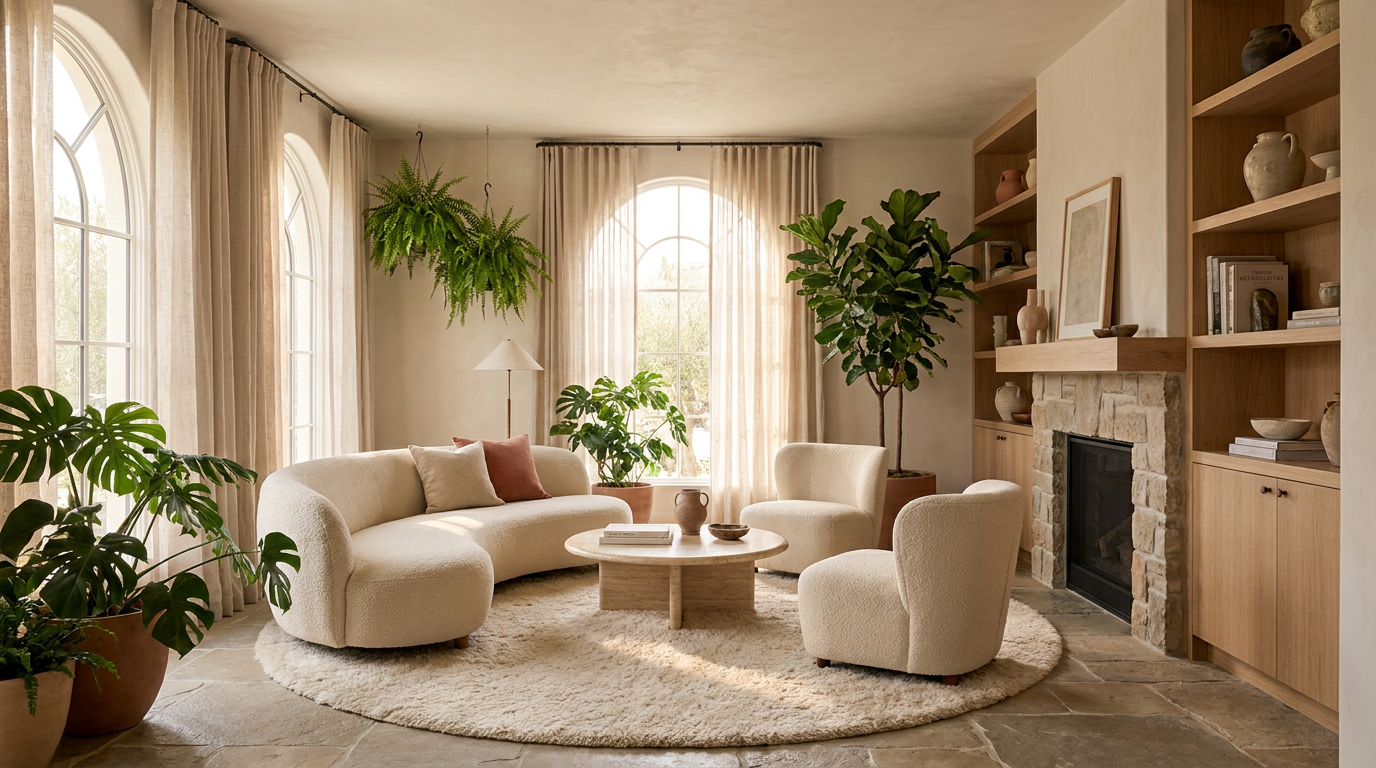
You know the feeling: you walk into a specific room and instantly feel your shoulders drop, your breathing slow, and your mind clear. For decades, interior designers attributed this to good taste, intuition, or a vague sense of spatial harmony. But modern science is proving that this phenomenon is not purely subjective—it is a deeply ingrained biological response. Welcome to the emerging field of neuroaesthetics, the scientific study of how beauty, nature, and spatial design affect the human brain and body.[1][3]
Neuroaesthetics is shifting interior design from a purely decorative art into a measurable wellness practice. By utilizing brain-scanning technology like functional magnetic resonance imaging (fMRI) and electroencephalography (EEG), researchers can now observe exactly what happens in our neural pathways when we encounter different spatial environments. The results are profound: design decisions directly influence heart rate, blood pressure, cortisol levels, and serotonin production.[2][3][6]
"When you create a beautiful space, you're not just satisfying aesthetic preferences; you're creating documented health outcomes," notes Science in Design, an organization dedicated to educating professionals on these principles. This realization is transforming how architects and designers approach everything from corporate offices and hospitals to private living rooms. We spend roughly 90 percent of our time indoors, meaning our built environments are constantly sending subconscious signals to our nervous systems.[1][3][6]
To understand how neuroaesthetics works, we have to look at the brain's evolutionary history. The human brain has not evolved significantly since our ancestors lived in natural, outdoor environments. Consequently, our sensory-motor and emotion-valuation networks are still hardwired to seek out conditions that historically signaled safety, sustenance, and shelter. When a room mimics these natural conditions, our limbic system—the emotional and memory center of the brain—signals the body to relax.[5][6]

One of the most studied mechanisms in neuroaesthetics is the impact of spatial geometry, particularly curvilinear forms. Studies using fMRI have demonstrated that curved shapes, smooth lines, and organic contours activate the brain regions associated with pleasure and comfort. These forms mimic the natural world—the arc of a river, the shape of a leaf—and are perceived by the subconscious as non-threatening.[4]
Conversely, sharp, angular forms and harsh geometric lines can trigger low-level tension or alertness. While a highly angular, minimalist room might look striking in an architectural magazine, it can inadvertently keep the nervous system in a state of mild vigilance, making it difficult to truly unwind at the end of the day.[4][6]
Ceiling height also plays a surprising role in cognitive function. Research into spatial proportion has revealed what psychologists call "freedom-oriented processing" versus "confinement-oriented processing." Higher ceilings tend to promote abstract, creative, and expansive thinking. Lower ceilings, on the other hand, encourage concrete, detail-focused tasks and can create a sense of cozy intimacy.[3]
Ceiling height also plays a surprising role in cognitive function.
Then there is the profound impact of biophilic design—the practice of bringing elements of nature indoors. Visual access to greenery, natural light, and organic materials like wood and stone has been shown to lower anxiety and improve working memory. The brain responds positively not just to actual plants, but to "fractal patterns"—the repeating geometric shapes found in nature, such as the branching of trees or the veins of a leaf.[4][5]

Even the representation of nature can trick the brain into a state of calm. Incorporating natural textures, earthy color palettes, and botanical motifs can deliver similar neurological benefits to actual outdoor exposure. This is why a room rich in natural wood grain and woven fibers often feels inherently more grounding than a room dominated by synthetic plastics and polished metals.[5][6]
Lighting is another critical pillar of neuroaesthetic design. Light is the primary synchronizer of the human circadian rhythm. When light enters the eye, it stimulates direct neural pathways to the brain regions managing mood, energy, and stress responses. Dynamic lighting that mimics the natural progression of the sun—bright, cool-toned light in the morning to stimulate focus, and warm, dim light in the evening to promote melatonin production—is essential for biological harmony.[3][6]
The measurable impacts of these design choices are striking. Research consistently demonstrates that thoughtfully designed spaces can lead to a 15 to 20 percent reduction in stress hormones. In workplace environments, employees in biophilic offices have reported 15 percent higher productivity and significantly lower fatigue. In healthcare settings, patients with access to daylight and natural views have been shown to heal faster and require less pain medication.[3][4]

To standardize and quantify these benefits, organizations like the Research Institutes of Sweden (RISE) are developing tools like the NeuroDesign and NeuroArchitecture Index (NDIX). By combining brain imaging technologies with biomarkers such as heart rate variability (HRV), researchers can establish a baseline "health check-up" for physical environments, measuring how different elements impact cognitive performance and mental recovery.[2]
"We know that the surrounding environment has a significant impact on people's quality of life and mental health. The problem has been the lack of reliable methods to measure these effects," explains Isabelle Sjövall, a neurodesigner and brain researcher at RISE. Tools like NDIX aim to help municipalities and organizations make smarter, evidence-based investments in the built environment.[2]
However, the application of neuroaesthetics is not without its uncertainties and nuances. The primary challenge lies in individual neurological differences. A level of visual complexity that feels perfectly stimulating and cozy to one person might feel chaotic and overwhelming to someone who is neurodivergent or highly sensitive to sensory input.[6]

Furthermore, the field must balance the desire for biological optimization with personal expression. Neuroaesthetics does not mandate a single, monolithic style of decorating. As wellness-focused designers point out, it is about understanding the underlying mechanisms of the brain so that bold colors, maximalist art, or unique architectural features can be incorporated without accidentally triggering sensory fatigue.[6][7]
Ultimately, the rise of neuroaesthetics represents a deeply empowering shift in how we view our homes and workplaces. It validates the intuitive understanding that our surroundings matter deeply to our well-being. By translating the subconscious language of the brain into actionable design principles, we can transform our spaces from mere shelters into active participants in our mental and physical health.[1][6]
How we got here
1990s
Advances in brain scanning technology (fMRI) allow researchers to observe real-time neural responses to aesthetic stimuli.
2014
Landmark studies in functional imaging link aesthetically pleasing environments to positive activation in the orbitofrontal cortex.
2020
The global pandemic accelerates interest in how indoor environments directly impact mental health and cognitive load.
2024
Major news outlets begin covering neuroaesthetics as a mainstream interior design trend for homeowners.
2026
Tools like the NeuroDesign Index (NDIX) emerge to quantify and standardize the health impacts of built environments.
Viewpoints in depth
Neurodesign Researchers
Scientists focused on empirical data and measurable biological responses to spatial design.
This camp relies on hard data gathered from fMRI scans, EEGs, and biometric sensors like heart rate monitors. They argue that architecture and interior design should be treated as public health variables. By quantifying exactly how light, acoustics, and geometry affect cortisol levels and cognitive load, researchers aim to create standardized metrics—like the NeuroDesign Index—that can guide urban planning, hospital construction, and school design to optimize human flourishing.
Wellness-Focused Designers
Practitioners translating scientific principles into practical applications for homes and offices.
For these professionals, neuroaesthetics is the ultimate validation of their craft. They focus on the practical implementation of biophilia, circadian lighting, and spatial flow to create environments that actively reduce client stress. They argue that while the science is complex, the application can be as simple as choosing curvilinear furniture, maximizing natural light, and incorporating tactile, natural materials to soothe the nervous system.
General Public & Homeowners
Everyday individuals seeking to create happier, more comfortable living spaces.
Consumers are increasingly viewing their homes not just as shelters or status symbols, but as active tools for mental health recovery. Driven by post-pandemic remote work trends, this group is less concerned with the clinical data and more focused on the tangible benefits: sleeping better, feeling less anxious, and creating a sanctuary from an overstimulating world.
What we don't know
- How to perfectly calibrate neuroaesthetic principles for neurodivergent individuals who process sensory input differently.
- The long-term, multi-generational physiological impacts of living in fully optimized, AI-adaptive neuroaesthetic environments.
Key terms
- Neuroaesthetics
- The study of the neural basis for the contemplation and creation of a work of art, extending to how built environments affect biological functions.
- Biophilic Design
- An architectural concept that connects occupants to the natural environment through direct nature, indirect nature, and space conditions.
- Limbic System
- A complex system of nerves and networks in the brain concerned with instinct and mood, which controls basic emotions and drives.
- Circadian Rhythm
- The natural, internal process that regulates the sleep-wake cycle and repeats roughly every 24 hours, heavily influenced by light exposure.
- Fractal Patterns
- Complex geometric shapes that look similar at any scale, commonly found in nature (like snowflakes or tree branches) and proven to be visually soothing.
Frequently asked
What exactly is neuroaesthetics?
Neuroaesthetics is the scientific study of how the human brain and nervous system respond to beauty, art, and spatial design.
How does ceiling height affect the brain?
Research shows that higher ceilings promote abstract, creative thinking, while lower ceilings encourage detail-oriented focus and a sense of intimacy.
Do I need real plants for biophilic design to work?
While real plants offer air-quality benefits, the brain also responds positively to representations of nature, such as botanical patterns, natural wood grains, and earthy colors.
Can neuroaesthetics actually help with stress?
Yes. Studies indicate that spaces designed with neuroaesthetic principles—incorporating natural light, curves, and natural textures—can reduce stress hormones by 15 to 20 percent.
Sources
Source coverage
7 outlets
4 viewpoints surfaced







[1]The Washington PostGeneral Public & Homeowners
How to use 'neuroaesthetics' to design a happier home
Read on The Washington Post →[2]Research Institutes of Sweden (RISE)Neurodesign Researchers
Neurodesign and Neuroarchitecture Index measures spaces' health impact
Read on Research Institutes of Sweden (RISE) →[3]Science in DesignWellness-Focused Designers
Neuroaesthetics for Interior Designers
Read on Science in Design →[4]Journal of Environmental PsychologyNeurodesign Researchers
Impact of interior design on mental well-being and productivity
Read on Journal of Environmental Psychology →[5]BiofilicoWellness-Focused Designers
Neuroaesthetics in Interior Design
Read on Biofilico →[6]Factlen Editorial TeamFactlen Editorial
Synthesis by Factlen editorial team
Read on Factlen Editorial Team →[7]Connections by FinsaWellness-Focused Designers
Neuroaesthetics in interior design
Read on Connections by Finsa →

Every angle. Every day.
Get home stories with full source coverage and perspective breakdowns delivered to your inbox.