
How Neuroaesthetics and Biophilic Design Are Rewiring Modern Architecture
Architects are increasingly using brain science and nature-inspired design to create spaces that actively lower stress and boost cognitive performance.
By Factlen Editorial Team
- Neuro-Design Advocates
- Architects and researchers arguing that evidence-based biological design must become the new baseline for all construction.
- Public Health & Academic Researchers
- Medical and psychological professionals focusing on the measurable cognitive and physiological outcomes of spatial environments.
- Real Estate & Commercial Developers
- Real estate professionals balancing the proven ROI of wellness design against the premium construction costs and market demands.
What's not represented
- · Public housing authorities managing tight construction budgets
- · Construction labor unions adapting to new sustainable materials
Why this matters
As humans spend up to 90% of their lives indoors, the shift toward biologically restorative architecture offers a scalable way to combat chronic stress and mental fatigue. By treating spatial design as a form of preventative healthcare, this trend has the potential to fundamentally improve daily well-being in offices, schools, and homes.
Key points
- Neuroaesthetics uses brain-imaging technology to measure how architectural spaces affect human biology.
- Biophilic design integrates natural elements to lower cortisol levels and improve cognitive performance.
- Neuro-inclusive design is emerging as a standard to accommodate diverse sensory and cognitive needs in workplaces.
- Advocates are pushing to make evidence-based architectural wellness a public health standard rather than a luxury.
Humans are biological creatures, yet in the modern era, we have effectively become an indoor species. On average, people spend a staggering 90 percent of their lives inside climate-controlled boxes, illuminated by artificial screens and the sterile hum of HVAC systems. This radical departure from our evolutionary habitat has quietly fueled a global crisis of chronic stress and mental fatigue. For decades, the architectural response to this environment was largely aesthetic or purely functional—spaces were designed to look impressive or maximize square footage. But a profound shift is underway in how we conceive the built environment.[4][8]
Enter neuroaesthetics, an emerging scientific discipline that bridges neuroscience and design. Rather than relying on intuition or subjective taste, neuroaesthetics uses advanced brain-imaging technologies like functional magnetic resonance imaging (fMRI) and electroencephalography (EEG) to measure exactly how our bodies and minds respond to spatial environments. It asks a fundamental question: what happens to our biology when we enter a room?[5][7]
The answers are reshaping the architecture and interior design industries. Researchers have discovered that human-building interactions are shaped by complex neural networks involving sensory-motor functions, meaning-making, and emotional valuation. When a space is aesthetically pleasing and biologically aligned, it positively stimulates the orbitofrontal cortex—the brain region linked to emotional regulation and decision-making.[4][5]
"Form follows feeling" has become the new mantra for forward-thinking architects. By understanding the physiological components of design, creators are moving beyond the concept of a room simply "looking nice" to engineering spaces that actively lower blood pressure, reduce anxiety, and foster cognitive clarity. This evidence-based approach is transforming buildings into active participants in preventative healthcare.[2][7]

A central pillar of this neuro-architectural revolution is biophilic design. Rooted in the "biophilia hypothesis" popularized by biologist E.O. Wilson in the 1980s, the concept posits that humans possess an innate, genetic need to connect with nature and living systems. Biophilic design is the practice of weaving nature back into the fabric of our artificial environments to satisfy this biological craving.[4]
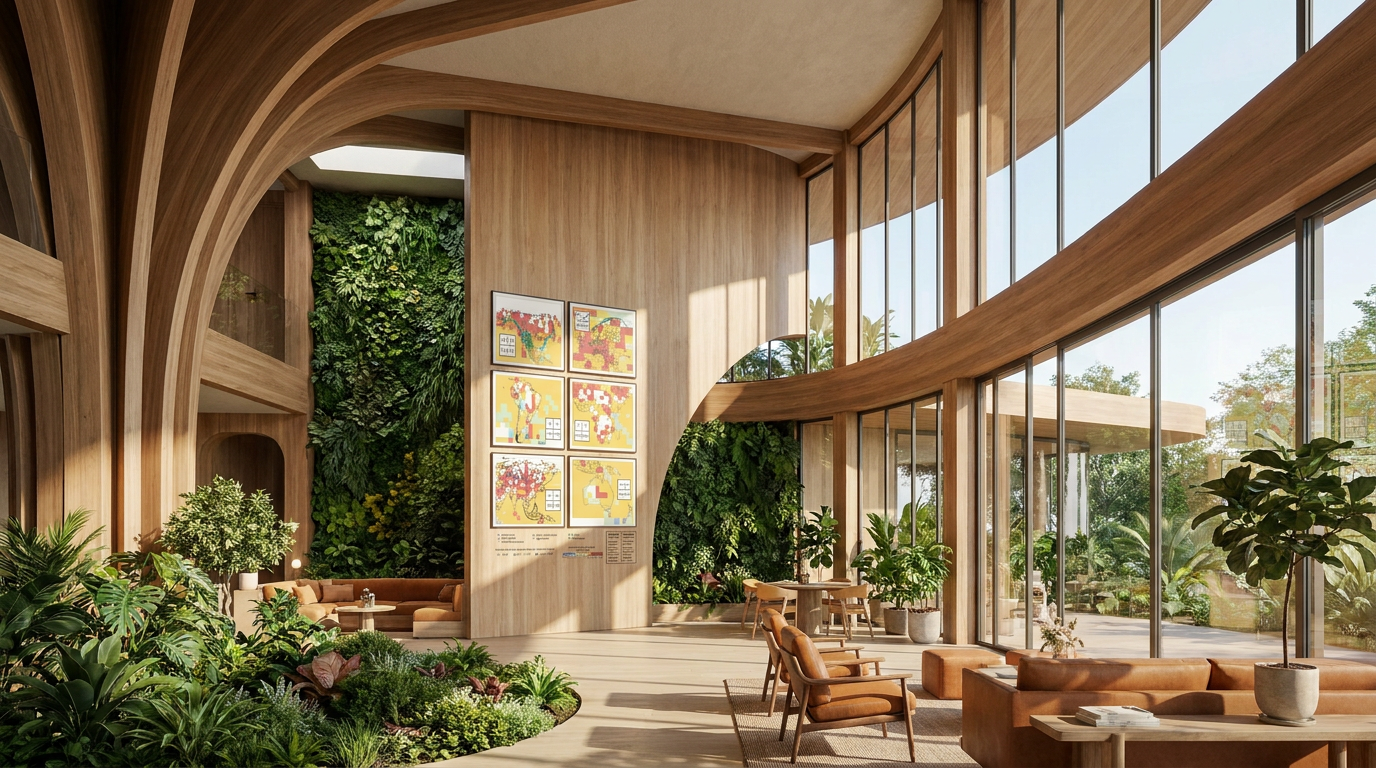
This goes far beyond placing a potted plant on a desk. True biophilic design operates on multiple sensory levels. Direct connections involve maximizing natural daylight, incorporating flowing water features, and ensuring natural ventilation. Indirect connections are equally powerful; they utilize natural materials like timber and stone, and incorporate fractal patterns—the repeating geometric shapes found in leaves, snowflakes, and tree branches.[4][8]
The measurable health impacts of these interventions are striking. Studies consistently demonstrate that thoughtfully designed biophilic spaces can reduce stress hormones, such as cortisol, by 15 to 20 percent. Heart rates slow down, and serotonin levels elevate. In commercial settings, employees working in environments optimized for neuroaesthetics report up to a 20 percent increase in cognitive performance and significantly lower rates of mental fatigue.[7]
The measurable health impacts of these interventions are striking.
The medical field has been one of the earliest and most compelling proving grounds for these concepts. Decades of research, beginning with landmark studies in the 1980s, have shown that hospital patients with access to natural light and views of greenery recover from surgery faster and require less pain medication than those staring at brick walls. The brain's unconscious sense of refuge, triggered by organic forms, accelerates the body's healing processes.[4][5]

Beyond nature, the geometry of a space profoundly influences our psychological state. Neuroaesthetic research reveals that curvilinear spaces—rooms with rounded edges, arches, and flowing layouts—activate brain areas associated with pleasure and comfort. Conversely, environments dominated by sharp angles, harsh artificial lighting, and excessive visual noise can trigger low-level, continuous stress responses, draining cognitive reserves over time.[5]
This understanding has given rise to the concept of "neuro-inclusive design," a major trend highlighted by the American Society of Interior Designers (ASID) for 2025 and beyond. Neuro-inclusive design acknowledges that people process sensory information differently. A modern office or school must accommodate a diverse array of neurological needs, offering a spectrum of environments ranging from highly stimulating, collaborative zones to acoustically dampened, low-light quiet areas for deep focus.[2][6]
Technology is also playing a crucial role in the evolution of neuroarchitecture. Smart building systems powered by artificial intelligence are now capable of creating adaptive environments. These systems monitor how spaces are used and automatically adjust dynamic lighting to mimic natural circadian rhythms, while fine-tuning temperature and air quality to reduce the cognitive load on occupants. The building itself becomes a responsive organism.[1]
Furthermore, the push for neuroaesthetics aligns seamlessly with global sustainability goals. The built environment is currently responsible for nearly 39 percent of global energy-related carbon emissions. Biophilic design inherently champions sustainable practices by prioritizing natural ventilation, maximizing daylight to reduce electricity use, and utilizing sustainable, low-VOC (volatile organic compound) materials like sustainably harvested wood and preserved moss walls.[4]

Despite the overwhelming evidence of its benefits, the widespread adoption of neuroarchitecture faces significant hurdles. Currently, the most advanced applications of these principles are often found in elite corporate headquarters, luxury residential developments, and high-end wellness retreats. The sophisticated materials, dynamic lighting systems, and custom architectural curves can carry a premium price tag.[2]
This disparity has sparked a debate within the design community about equity and social responsibility. Advocates argue that if specific design elements have proven physiological and cognitive benefits, they should not be treated as luxury goods. There is a growing movement to embed neuroaesthetic principles into public policy, affordable housing, and public school construction, ensuring that environments that promote human flourishing are accessible to all demographics.[2][3]

As the data continues to mount, the era of designing purely for visual impact or cost-efficiency is drawing to a close. The convergence of neuroscience, biology, and architecture has provided a new, empirical vocabulary for the built environment. In the coming years, the success of a building will increasingly be measured not just by its carbon footprint or its aesthetic acclaim, but by its measurable impact on the human nervous system.[8]
How we got here
1964
Psychologist Erich Fromm coins the term "biophilia" to describe humanity's innate love for living systems.
1984
Biologist E.O. Wilson popularizes the biophilia hypothesis, arguing that human genetics are wired to connect with nature.
1990s
Advancements in fMRI and EEG technology allow scientists to measure real-time brain responses to aesthetic stimuli, birthing neuroaesthetics.
2019
The "A Space for Being" installation at Milan Design Week showcases how design choices trigger measurable biological responses.
2025
Major design organizations like ASID and BIFMA declare neuro-inclusive and biophilic design as mainstream industry standards.
Viewpoints in depth
Neuro-Design Advocates
Architects and researchers arguing that evidence-based biological design must become the new baseline for all construction.
This camp views traditional, purely aesthetic architecture as outdated and potentially harmful. By pointing to fMRI data and physiological studies, they argue that spaces lacking natural light, organic geometry, and acoustic comfort actively drain cognitive resources and elevate baseline stress. For these advocates, integrating biophilic and neuro-inclusive principles is not a design trend but a moral imperative. They believe that "form follows feeling" should replace "form follows function," and that the success of a building should be judged by the biological health of its occupants.
Public Health Experts
Medical and psychological professionals focusing on the measurable cognitive and physiological outcomes of spatial environments.
Public health researchers approach neuroarchitecture through the lens of preventative medicine. They cite decades of data showing that hospital patients in biophilic rooms recover faster and require less pain medication. This camp is particularly interested in how spatial design can mitigate the modern epidemic of chronic stress and mental fatigue. They advocate for expanding neuroaesthetic research to understand how different demographics—particularly neurodivergent individuals and children in educational settings—are uniquely impacted by lighting, acoustics, and spatial geometry.
Commercial Developers
Real estate professionals balancing the proven ROI of wellness design against the premium construction costs and market demands.
While commercial developers acknowledge the benefits of neuroaesthetics, their primary focus remains on economic viability. Integrating advanced circadian lighting systems, custom curvilinear architecture, and high-quality natural materials significantly increases upfront construction costs. However, this camp is increasingly adopting biophilic design because it offers a tangible return on investment: premium lease rates, higher tenant retention, and proven boosts to employee productivity. The challenge for developers is finding cost-effective ways to scale these luxury features into mid-tier and affordable projects.
What we don't know
- How quickly neuroaesthetic principles can be scaled down to fit the budgets of affordable public housing projects.
- The long-term psychological effects of AI-driven, dynamically shifting environments on human occupants.
- Whether the real estate market will eventually mandate biological wellness certifications alongside environmental sustainability ratings.
Key terms
- Neuroaesthetics
- The scientific study of how the human brain responds to beauty, art, and spatial environments.
- Biophilic Design
- An architectural approach that connects building occupants more closely to nature through direct and indirect natural elements.
- Neuro-inclusive Design
- Creating spaces that accommodate a diverse array of sensory and cognitive needs, ensuring comfort for neurodivergent individuals.
- Circadian Lighting
- Artificial lighting systems designed to mimic the natural progression of daylight to support the human body's internal biological clock.
- Orbitofrontal Cortex
- The region of the brain involved in emotional regulation and decision-making, which is positively stimulated by pleasing environments.
Frequently asked
What is the difference between neuroaesthetics and biophilic design?
Neuroaesthetics is the overarching science of how the brain reacts to beauty and spatial environments. Biophilic design is a specific architectural strategy within that field, focusing on our biological need to connect with nature.
Do I need real plants to get the benefits of biophilic design?
While real plants are ideal, research shows the brain also responds positively to "indirect" nature. This includes fractal patterns, natural wood grains, and even images of natural landscapes.
Is neuroarchitecture only for luxury buildings?
Currently, these principles are most common in high-end commercial and residential projects due to cost. However, advocates are pushing to integrate evidence-based design into public housing, schools, and hospitals as a standard of health equity.
Sources
Source coverage
8 outlets
3 viewpoints surfaced








[1]ForbesNeuro-Design Advocates
Neuroarchitecture, Neurodesign And Neuroaesthetics Are All Important To Creating Healthy Buildings
Read on Forbes →[2]Untapped JournalNeuro-Design Advocates
ASID's trend report for 2025 emphasized the importance of neuro-inclusive design
Read on Untapped Journal →[3]BIFMAReal Estate & Commercial Developers
Designing for the Mind: How Neuroaesthetics is Reshaping the Built Environment
Read on BIFMA →[4]University of the Built EnvironmentPublic Health & Academic Researchers
What is biophilia? The benefits of biophilic design
Read on University of the Built Environment →[5]Pearl AcademyPublic Health & Academic Researchers
Neuroaesthetics in Interior Spaces: Designing for Mental Well-Being and Productivity
Read on Pearl Academy →[6]LivablReal Estate & Commercial Developers
Wellness Design Became Mainstream in 2025 Home Design
Read on Livabl →[7]Science in DesignNeuro-Design Advocates
What is Neuroaesthetics? Where Science Meets Style
Read on Science in Design →[8]Factlen Editorial TeamPublic Health & Academic Researchers
Synthesis by Factlen editorial team
Read on Factlen Editorial Team →

Every angle. Every day.
Get culture stories with full source coverage and perspective breakdowns delivered to your inbox.