
How NASA's ACS3 Solar Sail is Revolutionizing Propellant-Free Spaceflight
By harnessing the momentum of photons, next-generation composite solar sails are proving that deep-space exploration no longer requires heavy chemical rockets.
By Factlen Editorial Team
- Space Agencies & Mission Planners
- Focused on utilizing propellant-free propulsion to lower mission costs and enable early-warning space weather monitoring.
- Aerospace Materials Scientists
- Focused on the structural engineering challenges of deploying massive, ultra-thin membranes using lightweight composite booms.
- Orbital Dynamicists
- Focused on the physics of photon momentum and the complex, non-Keplerian trajectories made possible by continuous low thrust.
What's not represented
- · Commercial satellite operators
- · Deep-space laser propulsion advocates
Why this matters
Freeing spacecraft from the weight of chemical fuel drastically lowers the cost of deep-space missions and enables continuous, early-warning monitoring of solar storms that threaten Earth's power grids.
Key points
- NASA's ACS3 mission has successfully demonstrated the use of lightweight composite booms to deploy an 80-square-meter solar sail in orbit.
- Solar sails generate thrust without fuel by harnessing the momentum of photons bouncing off a highly reflective membrane.
- The composite booms are 75% lighter than traditional metal and resist thermal warping, solving a major engineering bottleneck.
- NOAA is funding a massive 1,653-square-meter solar sail to position space weather monitoring instruments closer to the Sun.
- Propellant-free propulsion allows for continuous acceleration and complex orbital maneuvers impossible for chemical rockets.
Space exploration has always been bound by a fundamental, frustrating equation: to go further or faster, a spacecraft must carry more fuel, which makes it heavier, which requires even more fuel to launch. This tyranny of the rocket equation has limited humanity's reach across the solar system. But a quiet revolution in orbital propulsion is unfolding above Earth, relying not on explosive chemical reactions, but on the gentle, relentless push of sunlight.[6]
At the center of this shift is NASA's Advanced Composite Solar Sail System (ACS3), a technology demonstration mission that recently celebrated its first full year in orbit. Launched in April 2024 and fully deployed by August of that year, ACS3 is proving that next-generation materials can turn the science-fiction concept of "sailing on light" into a practical, scalable reality for deep-space missions.[1][4]
The underlying mechanism of a solar sail often confuses those familiar with classical mechanics. How can sunlight push a physical object if light is composed of photons, which have zero mass? The answer lies in quantum mechanics and the nature of electromagnetic radiation. While photons lack resting mass, they carry energy and momentum.[3]
When a photon strikes a highly reflective surface and bounces off, it transfers a tiny fraction of its momentum to that surface. This phenomenon, known as solar radiation pressure, exerts a force that is microscopic in the short term. However, in the frictionless vacuum of space, this continuous microscopic push accumulates, providing a steady, inexhaustible acceleration without a single drop of liquid propellant.[3][5]

The concept itself is not new. The theory that light could exert pressure was established by James Clerk Maxwell in the 1860s, and space agencies have factored solar radiation pressure into the trajectory calculations of interplanetary probes for decades. In 2010, Japan's IKAROS probe became the first to successfully demonstrate solar sailing in deep space, followed by The Planetary Society's crowdfunded LightSail 2 in 2019, which proved that a small satellite could change its orbit using sunlight alone.[5]
However, the bottleneck for solar sailing has always been structural engineering. To capture enough photons to generate meaningful thrust, a sail must be enormous. Yet, it must also be incredibly lightweight and capable of folding into a tiny payload fairing for launch. Historically, the metallic booms used to unroll and support these sails were heavy and prone to warping under the extreme temperature fluctuations of low Earth orbit.[4]
This is where ACS3 represents a breakthrough. The mission, built in collaboration with Kongsberg NanoAvionics, utilizes novel carbon fiber reinforced polymer (CFRP) booms. These composite structures are 75 percent lighter than traditional metallic booms and 100 times less susceptible to thermal warping.[1][3][4]
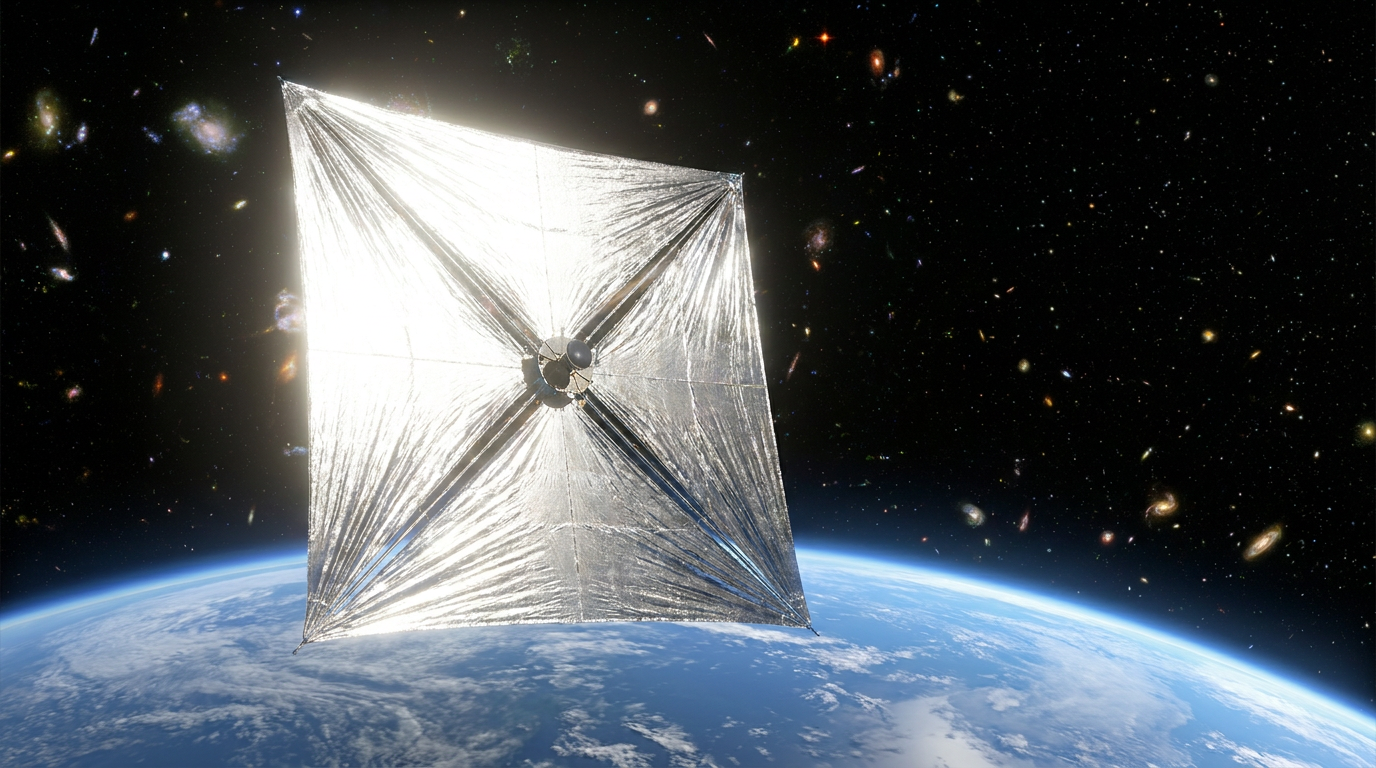
The entire ACS3 spacecraft is a 12U CubeSat—roughly the size of a microwave oven. Yet, from this compact chassis, the composite booms unspooled like tape measures, pulling taut an 80-square-meter (860-square-foot) reflective polymer sail. The sail material, an ultra-thin polyimide coated in aluminum, forms a kite-like square about half the size of a tennis court.[1][3]

The entire ACS3 spacecraft is a 12U CubeSat—roughly the size of a microwave oven.
The deployment was not without its uncertainties. Shortly after the sail unfurled in August 2024, mission operators detected a slight bend in one of the 7-meter composite booms, likely caused by the tension of pulling the membrane taut. The spacecraft experienced a period of slow tumbling as engineers worked to reengage its attitude control system.[1]
Despite these early mechanical hiccups, the structural validation of the CFRP booms has been hailed as a major success. The materials held up to the harsh radiation and thermal environment of space, proving that composite deployables can support large-scale orbital architecture. NASA is already evaluating these same lightweight composite tubes for use in deployable communication towers and modular habitats on the lunar surface.[4]
The true promise of ACS3, however, lies in its scalability. Because the composite booms performed as designed, aerospace engineers are now looking toward the next generation of solar sails, which could be exponentially larger. The acceleration a solar sail achieves is directly proportional to its surface area and inversely proportional to the mass of the spacecraft.[3][5]
This scaling up is already underway. In May 2026, the National Oceanic and Atmospheric Administration (NOAA), in partnership with NASA and private industry, announced significant progress on the Space Storm Solar Sail Sentinel (S5) mission concept. NOAA has funded the development of a state-of-the-art solar sail membrane that dwarfs ACS3.[2]
When fully deployed, the proposed S5 membrane will cover 1,653 square meters (17,792 square feet)—roughly the size of four basketball courts. The goal of the S5 mission is to use solar sail propulsion to position space weather monitoring instruments much closer to the Sun than conventional rockets would allow, maintaining an artificial orbit that hovers upstream of Earth.[2]

By placing a sentinel closer to the solar surface, NOAA's Space Weather Prediction Center could gain crucial additional lead time to detect coronal mass ejections and geomagnetic storms. These early warnings are vital for protecting terrestrial power grids, satellite communications, and aviation infrastructure from catastrophic solar events.[2]
Beyond space weather monitoring, the maturation of solar sail technology opens up unprecedented trajectories for planetary science. Because they do not need to carry fuel, solar sails can execute maneuvers that are mathematically impossible for chemical rockets, such as cranking a spacecraft's orbit out of the ecliptic plane to study the Sun's poles, or hovering stationary above a planet's night side.[5]
There are, of course, limitations to the technology. The force of solar radiation pressure follows the inverse-square law, meaning it diminishes rapidly as a spacecraft travels further from the Sun. While a solar sail is highly effective in the inner solar system, its acceleration drops off significantly past the orbit of Jupiter, making it less viable for outer-planet exploration unless paired with powerful Earth-based targeting lasers—a concept known as beam sailing.[3][5]

Furthermore, navigating a solar sail requires precise attitude control. Just as a terrestrial sailboat must tack against the wind, a solar sail spacecraft must continuously adjust its angle relative to the Sun to steer. If the attitude control wheels fail, the sail becomes a derelict kite, pushed blindly by the solar wind.[1][5]
Despite these challenges, the successful first year of ACS3 marks a definitive turning point in propulsion physics. We are moving from the era of theoretical photon momentum into the era of operational light-craft. As space agencies look to reduce the cost and complexity of deep-space exploration, the gentle push of sunlight is poised to become the heavy lifter of the next century.[6]
How we got here
2010
Japan's IKAROS probe becomes the first spacecraft to successfully demonstrate solar sailing in deep space.
2019
The Planetary Society's LightSail 2 proves that a small CubeSat can change its orbit using only sunlight.
April 2024
NASA launches the Advanced Composite Solar Sail System (ACS3) aboard a Rocket Lab Electron rocket.
August 2024
ACS3 successfully deploys its 80-square-meter reflective polymer sail in low Earth orbit.
May 2026
NOAA announces funding for a massive 1,653-square-meter solar sail membrane for the upcoming S5 space weather mission.
Viewpoints in depth
Space Agencies & Mission Planners
Focused on utilizing propellant-free propulsion to lower mission costs and enable early-warning space weather monitoring.
For organizations like NASA and NOAA, the primary appeal of solar sailing is the elimination of the rocket equation. Without the need to carry heavy chemical propellants, spacecraft can be built smaller, launched cheaper, and operated indefinitely. NOAA's interest in the S5 mission highlights a critical practical application: by using a solar sail to hover upstream of Earth, space weather instruments can provide earlier warnings for coronal mass ejections, protecting vulnerable terrestrial power grids and satellite networks.
Aerospace Materials Scientists
Focused on the structural engineering challenges of deploying massive, ultra-thin membranes using lightweight composite booms.
The physics of solar sailing have been understood for over a century, but the materials science is only just catching up. Engineers view the ACS3 mission primarily as a structural triumph. Traditional metallic booms were too heavy and warped easily under the extreme temperature swings of orbit. The successful deployment of carbon fiber reinforced polymer (CFRP) booms proves that massive structures can be folded into tiny CubeSats and deployed reliably, paving the way for sails measuring thousands of square meters.
Orbital Dynamicists
Focused on the physics of photon momentum and the complex, non-Keplerian trajectories made possible by continuous low thrust.
For physicists and orbital dynamicists, solar sails open up entirely new realms of astrodynamics. Chemical rockets rely on short, violent bursts of acceleration, limiting spacecraft to standard Keplerian orbits. A solar sail, however, provides a continuous, gentle thrust that allows a spacecraft to execute non-Keplerian maneuvers—such as hovering in place above a planet's pole or cranking its orbit out of the solar system's ecliptic plane. The challenge lies in precisely managing the sail's attitude control to "tack" against the solar wind.
What we don't know
- Whether the composite boom technology can scale up to the 2,000-square-meter sizes required for heavy-payload deep space missions without structural failure.
- How long the ultra-thin polyimide sail material can withstand the degrading effects of micrometeoroids and intense solar radiation before losing reflectivity.
Key terms
- Solar radiation pressure
- The mechanical pressure exerted upon any surface due to the exchange of momentum between the object and the electromagnetic field of light.
- Photon momentum
- The property of light particles that allows them to exert a physical force when they strike and reflect off an object, despite having no physical mass.
- CubeSat
- A class of miniaturized spacecraft made up of multiple cubic modules (each 10x10x10 cm), often used for technology demonstrations.
- Carbon fiber reinforced polymer (CFRP)
- A strong, extremely lightweight composite material used in the ACS3 booms to prevent warping under the extreme temperatures of space.
- Polyimide
- A highly durable, heat-resistant polymer film used as the base material for the reflective solar sail membrane.
Frequently asked
How can light push a spacecraft if photons have no mass?
While photons lack resting mass, quantum mechanics dictates that they carry energy and momentum. When they bounce off a reflective surface, they transfer a tiny fraction of that momentum, creating a physical push.
How fast can a solar sail go?
Because there is no friction in space, a solar sail accelerates continuously as long as sunlight hits it. Over months or years, this constant microscopic push can build up to speeds far exceeding those of chemical rockets.
What happens when a solar sail gets far from the Sun?
The force of sunlight follows the inverse-square law, meaning it drops off significantly as the spacecraft moves outward. Past Jupiter, sunlight is generally too weak to provide meaningful acceleration without the help of Earth-based lasers.
Can a solar sail travel back toward the Sun?
Yes. By angling the sail to push against its orbital direction, the spacecraft can slow down its orbital velocity, allowing gravity to pull it closer to the Sun.
Sources
Source coverage
6 outlets
3 viewpoints surfaced






[1]NASASpace Agencies & Mission Planners
Advanced Composite Solar Sail System (ACS3)
Read on NASA →[2]NOAASpace Agencies & Mission Planners
NOAA, in partnership with NASA, develops state-of-the-art solar sail
Read on NOAA →[3]The Planetary SocietyAerospace Materials Scientists
NASA's Advanced Composite Solar Sail System
Read on The Planetary Society →[4]Orbital TodayAerospace Materials Scientists
NASA's ACS3 Solar Sail Celebrates One Year in Orbit
Read on Orbital Today →[5]ResearchGateOrbital Dynamicists
Overview of the NASA Advanced Composite Solar Sail System (ACS3) Technology Demonstration Project
Read on ResearchGate →[6]Factlen Editorial TeamOrbital Dynamicists
Synthesis by Factlen editorial team
Read on Factlen Editorial Team →
Every angle. Every day.
Get science stories with full source coverage and perspective breakdowns delivered to your inbox.