
How Mass Timber is Turning Skyscrapers into Carbon Sinks
Engineered wood products like Cross-Laminated Timber are replacing concrete and steel in high-rise construction, offering a sustainable alternative that sequesters carbon and resists fire.
By Factlen Editorial Team
- Sustainable Architecture Advocates
- Architects and urban planners who view mass timber as the key to decarbonizing cities.
- Forestry & Climate Researchers
- Scientists focused on the ecological impact of scaling up timber demand.
- Structural Engineering Experts
- Engineers and safety regulators focused on material performance and building codes.
What's not represented
- · Traditional concrete and steel manufacturers
- · Indigenous communities managing forest lands
Why this matters
The built environment is responsible for nearly 40% of global carbon emissions, largely driven by concrete and steel production. Transitioning to mass timber could transform cities from massive climate polluters into active carbon sinks, fundamentally altering the environmental impact of urban growth.
Key points
- Mass timber uses engineered wood panels, like Cross-Laminated Timber (CLT), to build high-rise structures that rival the strength of concrete and steel.
- Because trees absorb carbon dioxide as they grow, mass timber buildings act as massive carbon sinks, sequestering emissions for decades.
- Unlike traditional lumber, mass timber is highly fire-resistant due to a 'charring effect' that insulates the structural core from extreme heat.
- The environmental benefits depend heavily on sustainable forestry; sourcing wood from poorly managed forests can negate the climate advantages.
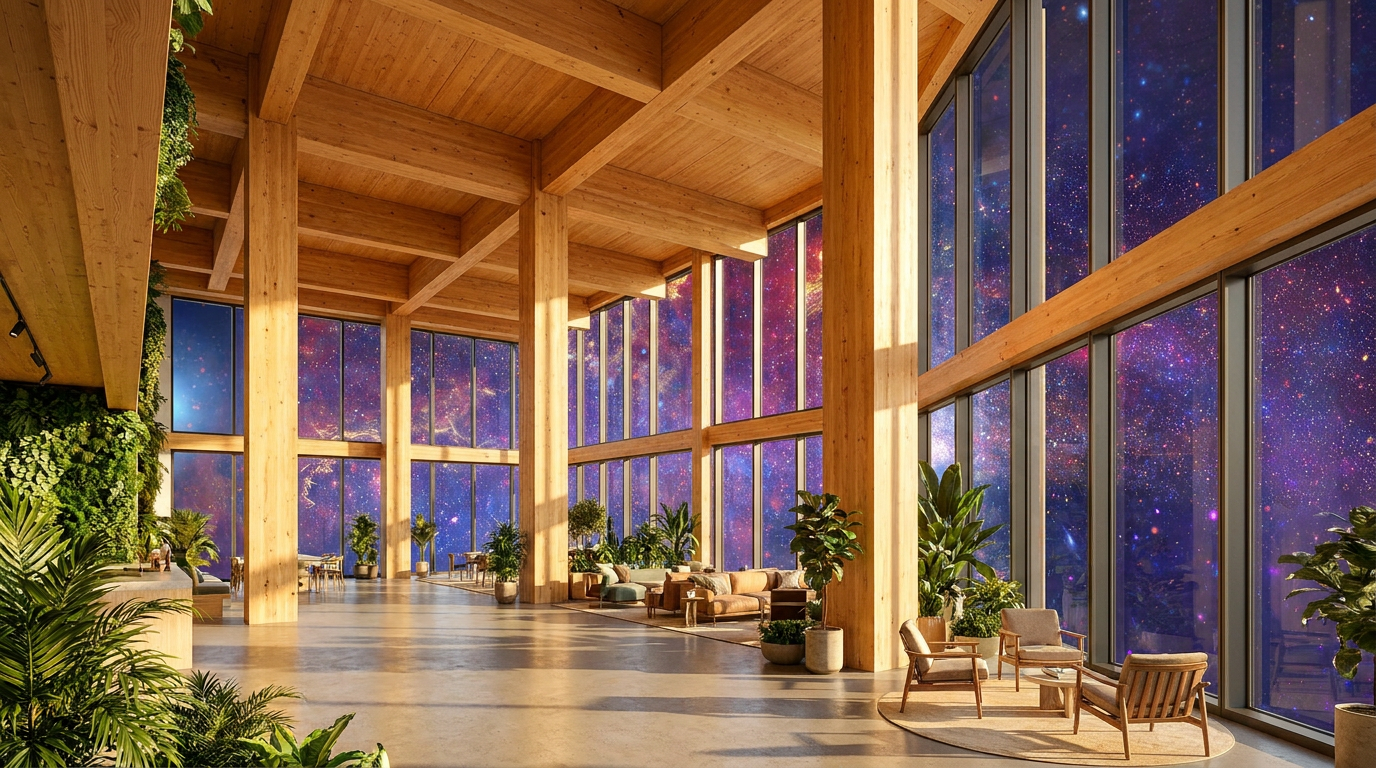
The skyline of the 21st century is quietly shifting from gray to a warm, organic brown. In Milwaukee, a 31-story tower named The Edison is currently rising to a projected height of 375 feet, while in Sydney, the 40-story Atlassian headquarters is redefining the urban canopy with a sweeping hybrid design. These are not traditional steel-and-glass monoliths; they are "plyscrapers," built primarily from wood. For over a century, concrete and steel have been the undisputed, carbon-heavy kings of high-rise construction. But the architectural world is currently undergoing a profound "timber revolution," driven by a class of highly engineered materials collectively known as mass timber. This shift represents one of the most significant changes to commercial building practices since the invention of the elevator, promising to fundamentally alter how cities look, feel, and interact with the global climate.[1][2][3]
Mass timber is a far cry from the familiar two-by-four lumber used to frame suburban houses. It refers to massive, solid wood panels engineered in factories for extraordinary load-bearing strength. The most common variant, Cross-Laminated Timber (CLT), is created by stacking layers of wood—typically spruce, pine, or fir—at right angles and gluing them together under immense pressure. This perpendicular layering gives CLT exceptional dimensional stability and two-way spanning capability, allowing it to rival the sheer compressive strength of concrete. Another crucial variant, Glue-Laminated Timber (Glulam), aligns the wood grain in a single direction to create massive, continuous beams and columns capable of supporting towering structures without buckling. Together, these materials form a structural toolkit that allows architects to design soaring, open-plan spaces entirely supported by wood.[2][6][8]
The primary driver behind this architectural renaissance is the urgent math of climate change. The built environment is responsible for a staggering portion of global emissions, with concrete and steel production alone accounting for roughly 10% of all greenhouse gases worldwide. The manufacturing of cement requires heating limestone to over 2,600 degrees Fahrenheit, a process that releases massive amounts of carbon dioxide. Mass timber flips this environmental equation on its head. As trees grow, they naturally absorb carbon dioxide from the atmosphere through photosynthesis. When that wood is harvested and locked into a building's structure, the carbon remains safely sequestered for decades or even centuries, keeping it out of the atmosphere.[4][5]

The life-cycle emissions data for mass timber presents a compelling case for widespread adoption. A comprehensive review of 27 different studies found that replacing traditional materials with mass timber can reduce a large building's overall carbon footprint by up to 40%. Instead of emitting carbon during the production of its core materials, a mass timber building effectively acts as a massive, urban carbon sink. For example, a mid-rise timber building can store thousands of metric tons of carbon dioxide within its walls and floors. As cities race to meet aggressive net-zero emissions targets by 2050, urban planners are increasingly viewing plyscrapers not just as architectural novelties, but as essential climate infrastructure.[1][5][7][8]
The life-cycle emissions data for mass timber presents a compelling case for widespread adoption.
Despite the environmental benefits, the most common question raised by the public, insurers, and regulators alike is visceral: What happens when a wooden skyscraper catches fire? The idea of a 30-story timber tower naturally evokes fears of catastrophic urban infernos. However, structural engineers point to a counterintuitive, built-in defense mechanism known as the "charring effect." When exposed to intense heat, the outer layer of a massive timber beam burns and turns to a thick layer of char. Because char is a poor conductor of heat, this blackened outer crust acts as a highly effective insulator, protecting the structural core of the wood from the flames and preventing the interior from reaching ignition temperatures.[1][6]

This predictable charring behavior gives mass timber a distinct advantage in severe fires. Unlike steel, which can rapidly lose its structural strength and suddenly buckle under high temperatures, or concrete, which can violently spall and crack as trapped moisture expands, mass timber burns at a slow, mathematically predictable rate. In rigorous, full-scale fire tests conducted by safety regulators, exposed CLT panels and Glulam beams have maintained their load-bearing integrity for hours without the aid of sprinklers, safely exceeding stringent commercial building code requirements. When paired with modern active fire suppression systems, mass timber buildings offer a life-safety profile that rivals or exceeds traditional construction.[1][6]
Beyond environmental and safety metrics, mass timber is radically transforming the logistics of the construction site itself. Because CLT panels are prefabricated in off-site factories to millimeter precision—complete with pre-cut openings for doors, windows, electrical conduits, and plumbing—they arrive on-site ready to be slotted together like a massive piece of flat-pack furniture. This modular approach drastically reduces construction time. Developers report that mass timber projects can be completed up to 20% faster than traditional concrete builds, with vastly less on-site waste, noise pollution, and heavy machinery traffic. Furthermore, the lighter overall weight of the timber means buildings require smaller, less resource-intensive concrete foundations, generating additional cost and carbon savings.[4][7][8]

Yet, the mass timber revolution is not without its critical caveats. Climate researchers and ecologists warn that the environmental benefits of plyscrapers depend entirely on the origin of the wood. If the timber is sourced from clear-cut old-growth forests or poorly managed, ecologically barren plantations, the carbon math quickly collapses. Aggressive logging releases stored carbon from the soil and threatens vital biodiversity. For mass timber to function as a true climate solution rather than a driver of deforestation, the industry must rely strictly on certified, sustainably managed forests where new trees are continuously planted to replace the harvested biomass, ensuring a steady, regenerative cycle of carbon drawdown.[4][5][7]
As building codes globally adapt to permit taller wooden structures, the transition from niche experiment to mainstream standard is accelerating. Jurisdictions across North America and Europe have recently updated their regulations to allow timber buildings to reach up to 18 stories without special exemptions, paving the way for a new generation of sustainable development. Mass timber offers a rare convergence in modern architecture: a material that is structurally sound, economically viable, aesthetically warm, and fundamentally regenerative. If the supply chain can be managed with rigorous ecological oversight, the cities of tomorrow may look less like concrete jungles and more like literal extensions of the forest.[1][2][8]
How we got here
Late 1980s
Engineered wood products like Cross-Laminated Timber (CLT) are developed in Europe for commercial use.
March 2019
Mjøstårnet is completed in Norway, becoming the world's tallest all-timber building at 18 stories.
July 2022
Ascent MKE opens in Milwaukee, claiming the title of the tallest mass timber hybrid building at 25 stories.
June 2025
Ground is broken on The Edison in Milwaukee, projected to reach 31 stories and set a new height record for plyscrapers.
Viewpoints in depth
Sustainable Architecture Advocates
Architects and urban planners who view mass timber as the key to decarbonizing cities.
This camp argues that the construction industry cannot meet global climate goals while relying on concrete and steel. They highlight that mass timber not only eliminates the massive emissions associated with traditional materials but actively turns buildings into carbon sinks. Beyond the environmental math, these advocates emphasize the aesthetic and psychological benefits of 'biophilic design'—incorporating natural wood into human spaces to improve well-being—and the logistical advantages of rapid, quiet, prefabricated construction.
Forestry & Climate Researchers
Scientists focused on the ecological impact of scaling up timber demand.
While acknowledging the carbon sequestration potential of mass timber, this group warns against treating it as a silver bullet. They argue that the climate benefits are entirely dependent on the supply chain. If the surge in demand for CLT leads to the logging of old-growth forests or the replacement of biodiverse ecosystems with monoculture tree plantations, the net environmental impact could be negative. They advocate for strict certification standards and lifecycle tracking to ensure the wood is genuinely regenerative.
Structural Engineering Experts
Engineers and safety regulators focused on material performance and building codes.
This perspective is primarily concerned with the physics of plyscrapers. Engineers emphasize that mass timber is a highly predictable, engineered material that behaves fundamentally differently from traditional lumber. They focus on educating regulators and insurers about the 'charring effect' and the material's seismic flexibility. Their goal is to update antiquated building codes that restrict timber heights, using rigorous, full-scale fire and earthquake testing to prove that mass timber can safely match or exceed the performance of steel.
What we don't know
- Whether the global supply chain of sustainably certified timber can scale fast enough to meet the surging demand from the construction industry.
- The long-term ecological impact of dedicating vast tracts of forest land specifically for mass timber harvesting over the next century.
Key terms
- Mass Timber
- A category of engineered wood products made by binding layers of lumber together to create exceptionally strong panels and beams.
- Cross-Laminated Timber (CLT)
- A wood panel made by stacking layers of timber at right angles and gluing them together, providing strength comparable to concrete.
- Glulam
- Glue-laminated timber, created by aligning wood grain in a single direction to form massive, load-bearing beams and columns.
- Charring Effect
- A natural fire-resistance mechanism where the outer layer of thick wood burns and turns to char, insulating and protecting the inner core.
- Embodied Carbon
- The total greenhouse gas emissions generated by the extraction, manufacturing, transportation, and assembly of building materials.
Frequently asked
Is a wooden skyscraper safe in a fire?
Yes. Mass timber relies on the 'charring effect.' In a fire, the outer layer of the thick wood panels chars, creating an insulating barrier that protects the structural core from burning, allowing it to maintain its strength for hours.
Will building with wood lead to more deforestation?
It can, if poorly managed. For mass timber to be environmentally beneficial, the wood must be sourced from certified sustainable forests where new trees are continually planted to replace those harvested.
Is mass timber cheaper than concrete and steel?
While the raw material can sometimes be more expensive, the overall project cost is often lower. Mass timber is prefabricated, which speeds up construction time by up to 20% and reduces labor costs and foundation requirements.
Sources
Source coverage
8 outlets
3 viewpoints surfaced








[1]Factlen Editorial TeamStructural Engineering Experts
Synthesis by Factlen editorial team
Read on Factlen Editorial Team →[2]DezeenSustainable Architecture Advocates
Dezeen guide to mass timber in architecture
Read on Dezeen →[3]ArchDailySustainable Architecture Advocates
The World's Tallest Hybrid Timber Tower is Under Construction in Sydney, Australia
Read on ArchDaily →[4]USDA Forest ServiceForestry & Climate Researchers
CROSS-LAMINATED TIMBER AND GREEN BUILDING
Read on USDA Forest Service →[5]MIT Climate PortalForestry & Climate Researchers
How does the climate impact of cross-laminated timber compare to steel or concrete?
Read on MIT Climate Portal →[6]WoodWorksStructural Engineering Experts
What is mass timber?
Read on WoodWorks →[7]American UniversityForestry & Climate Researchers
Fact Sheet: Mass Timber Construction
Read on American University →[8]EcochainSustainable Architecture Advocates
CLT Environmental Impact Assessment and Green Compliance
Read on Ecochain →


Every angle. Every day.
Get culture stories with full source coverage and perspective breakdowns delivered to your inbox.