
How Mass Timber is Rewriting the Rules of Modern Architecture
Engineered wood products like cross-laminated timber are replacing concrete and steel in commercial construction, offering a faster, lower-carbon way to build city skylines.
By Factlen Editorial Team
- Sustainable Architects & Developers
- Advocates focused on reducing embodied carbon and improving construction efficiency.
- Fire Safety & Building Regulators
- Officials and engineers tasked with ensuring life safety in tall buildings.
- Forestry & Land Managers
- Stakeholders focused on the ecological and economic impacts of timber harvesting.
What's not represented
- · Traditional concrete and steel manufacturers facing market disruption
- · Urban residents living near mass timber construction sites
Why this matters
The built environment is responsible for 40% of global carbon emissions. Shifting from concrete and steel to sustainably harvested mass timber could drastically reduce the climate impact of our cities while creating healthier, more beautiful spaces to live and work.
Key points
- Mass timber uses engineered solid wood panels, like CLT, to replace concrete and steel in commercial construction.
- Replacing traditional materials with mass timber can reduce a building's embodied carbon footprint by up to 70%.
- During a fire, thick timber panels char on the outside, insulating the core and maintaining structural integrity.
- Prefabricating timber components off-site allows for faster construction timelines and requires smaller, lighter foundations.
The skyline of the twenty-first century is undergoing a quiet, structural revolution. For over a hundred years, the recipe for urban density has relied almost exclusively on two highly carbon-intensive ingredients: steel and concrete. But a new generation of architects, engineers, and developers is turning to a material that is grown rather than mined or forged. It is known as mass timber, and it represents a fundamental shift in how buildings are designed, fabricated, and assembled. Moving far beyond the experimental phase, engineered wood is now being used to construct high-rise apartments, sprawling corporate headquarters, and expansive university campuses, challenging the long-held assumption that modern cities must be built from stone and metal.[10]
The urgency behind this architectural shift is driven by stark environmental math. The built environment is currently responsible for approximately 40 percent of annual global carbon dioxide emissions. While much of that footprint comes from operating buildings—heating, cooling, and lighting the spaces we inhabit—a significant portion, roughly 13 percent, is classified as "embodied carbon." This refers to the massive emissions generated from extracting, manufacturing, and transporting heavy building materials. Concrete and steel are notoriously energy-intensive to produce, requiring blast furnaces and chemical processes that release vast amounts of greenhouse gases. Mass timber offers a viable pathway to drastically reduce this initial carbon penalty.[5][6]
To understand mass timber, one must discard the image of traditional light-wood framing commonly used in single-family suburban homes. Mass timber refers to a family of highly engineered, solid wood panels and beams capable of supporting immense structural loads. These components are large, dense, and meticulously designed to replace concrete floor slabs and steel I-beams in mid-rise and high-rise commercial construction. By engineering smaller pieces of wood into massive structural elements, the industry has unlocked the ability to build taller and stronger than ever before using renewable resources.[1]
The flagship material of this movement is Cross-Laminated Timber, universally referred to in the industry as CLT. Often described by architects as "super plywood," CLT is manufactured by taking layers of kiln-dried lumber and stacking them at alternating right angles. These layers—typically three, five, or seven plies thick—are bonded together with advanced structural adhesives under immense pressure. This crosswise arrangement gives the resulting panels exceptional strength, stiffness, and two-way spanning capability, making them ideal for massive floor plates, roof decks, and load-bearing walls.[1][3]

While CLT forms the broad surfaces of these new buildings, it is usually paired with other engineered wood products to create a complete structural system. Glue-laminated timber, or glulam, consists of wood laminations oriented in the same direction, making it perfectly suited for heavy load-bearing columns and long-span beams. Other variations include Dowel-Laminated Timber (DLT), which uses friction-fit hardwood dowels instead of chemical adhesives, and Parallel-Strand Lumber (PSL) for specialized high-strength applications. Together, these components form a versatile toolkit that can match or exceed the structural capabilities of traditional materials.[1][3][4]
The primary environmental argument for mass timber rests on its unique ability to act as a long-term carbon sink. Trees naturally absorb carbon dioxide from the atmosphere as they grow, using the carbon to build their cellular structure while releasing oxygen. When that timber is harvested and engineered into a building, the carbon remains locked inside the wood fibers for the lifetime of the structure. European manufacturer Stora Enso estimates that replacing concrete and steel with CLT can cut a building's embodied emissions by up to 70 percent, effectively turning city skylines into massive carbon storage facilities.[4][6]
However, this environmental benefit is entirely dependent on the rigorous principles of sustainable forestry. If timber is harvested faster than it is replenished, the carbon math collapses and ecosystems degrade. Researchers at Texas A&M University emphasize that a strong, regulated market for mass timber can actually incentivize sustainable land management. By giving private landowners a reliable economic return on their timber, it encourages them to keep their land forested and invest in long-term stewardship, rather than selling the acreage off for carbon-intensive urban sprawl or agricultural conversion.[2]
However, this environmental benefit is entirely dependent on the rigorous principles of sustainable forestry.
Beyond the environmental metrics, mass timber is fundamentally changing the logistics of the construction site. It represents a definitive shift away from messy, site-built structures toward precision off-site manufacturing. Mass timber buildings are meticulously designed in detailed 3D models, and the structural elements are fabricated in specialized facilities using computer numerical control (CNC) machinery. These massive robotic routers mill connection points, window openings, and utility channels into the wood with millimeter-level accuracy before the panels ever leave the factory floor.[1]

When these prefabricated components arrive at the construction site, they are assembled much like a massive piece of flat-pack furniture. This precision drastically reduces construction timelines and labor costs. According to the construction firm Skanska, an entire building floor can sometimes be installed in a single day. Furthermore, because mass timber is significantly lighter than concrete, buildings require smaller foundations. This translates to less excavation, drastically fewer concrete mixer trucks clogging city streets, and significantly reduced noise and disruption to the surrounding neighborhood.[5][6]
Despite these clear advantages, the most common question raised by the public and regulators alike is deeply instinctual: What happens in a fire? The idea of building a timber skyscraper seems counterintuitive to modern fire safety standards, evoking fears of historic urban conflagrations. However, fire protection engineers emphasize that mass timber behaves very differently in a blaze than the thin light-wood framing of a typical house. The sheer density of the material completely alters its combustion profile.[7][8]
When exposed to intense heat, the outer layer of a massive timber panel chars. This blackened, charred layer acts as a natural, highly effective insulator. It protects the unburned structural core of the wood from the heat, cutting off the oxygen supply and preventing the inner wood from losing its load-bearing capacity. Engineers can calculate this "char rate" with high precision, allowing them to design timber columns and panels that are intentionally oversized so they maintain their structural integrity even after hours of direct fire exposure.[7][8]

To validate this performance, organizations like the National Institute of Standards and Technology (NIST) have conducted rigorous, full-scale compartment fire tests on multi-story CLT structures. These tests, which simulate severe residential fires without any sprinkler intervention or firefighting assistance, have consistently demonstrated that mass timber can meet strict life-safety and property-protection requirements. The fires often burn themselves out without compromising the building's structural envelope, proving that the charring mechanism works exactly as engineered under extreme, real-world conditions.[8]
The industry is also continuously refining its materials to improve safety margins. In North America, the manufacturing standard for CLT was recently updated to require the use of advanced adhesives that provide even greater resistance to heat, ensuring that the alternating layers of wood do not delaminate during a fire. Meanwhile, in the United Kingdom, the Fire Protection Association and major construction firms are actively testing and certifying specialized cavity barriers for CLT. These standardized solutions eliminate the technical uncertainties that have historically slowed down timber projects and frustrated design teams.[7][9]
Building codes are rapidly adapting to reflect this growing body of scientific evidence. The International Building Code (IBC), which serves as the baseline regulatory framework for most jurisdictions in the United States, has been progressively updated to accommodate taller wood structures. Recent iterations of the code now allow mass timber buildings to reach up to 18 stories in height, provided they meet specific encapsulation and safety requirements. This regulatory shift has opened the floodgates for a new wave of tall timber architecture across North America and Europe.[1]

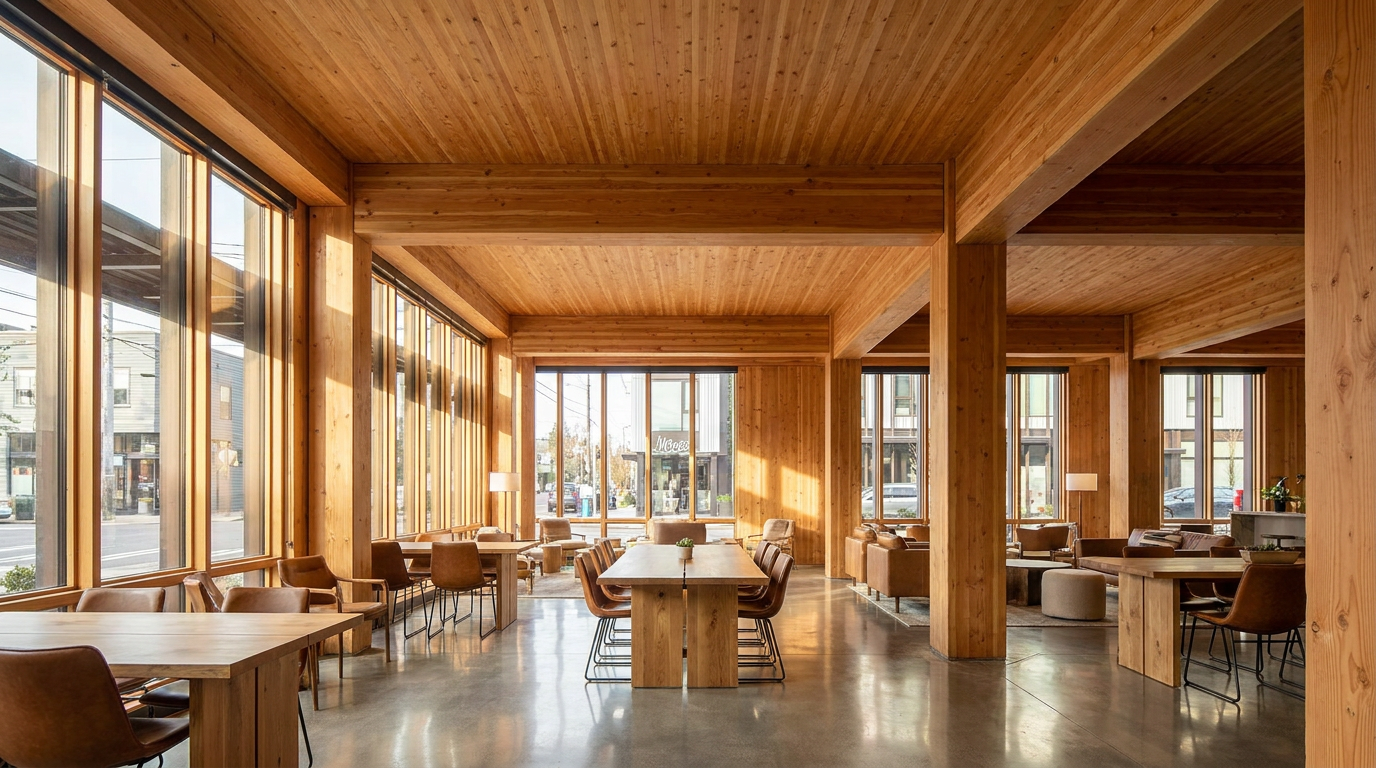
Finally, architects are championing mass timber for its profound impact on the people who inhabit these buildings. The concept of biophilic design suggests that humans have an innate, evolutionary affinity for natural materials. Studies have shown that exposing the natural grain of structural timber in offices, schools, and hospitals can lower occupants' blood pressure, reduce stress levels, and improve overall thermal comfort and productivity. Unlike sterile drywall and cold steel, wood brings a tactile warmth to interior spaces that fundamentally changes how a building feels.[5][6]
As the global construction industry grapples with its outsized role in the climate crisis, mass timber offers a rare convergence of environmental sustainability, construction efficiency, and aesthetic warmth. While it will not entirely replace concrete and steel—which remain essential for deep foundations and certain structural cores—engineered wood is rapidly moving from a niche architectural experiment to a mainstream, scalable solution. By turning buildings into carbon sinks rather than carbon emitters, the industry is proving that the future of the urban skyline might just be grown in a forest.[10]
How we got here
Late 1980s
Cross-laminated timber (CLT) is first developed and utilized for commercial construction in Europe.
2015
CLT is officially recognized as a structural building component in the US International Building Code (IBC).
2021
North American manufacturing standards are updated to require highly heat-resistant adhesives in all CLT panels.
2024
Updated building codes allow mass timber structures to reach up to 18 stories in height under specific safety conditions.
Viewpoints in depth
Sustainable Architects & Developers
Advocates focused on reducing embodied carbon and improving construction efficiency.
This camp views mass timber as the most viable immediate solution to decarbonize the built environment. They point to the drastic reduction in concrete use, the speed of prefabricated assembly, and the biophilic benefits of exposed wood interiors. For developers, the faster speed-to-market and lighter foundation requirements often offset the premium cost of the timber panels themselves.
Forestry & Land Managers
Stakeholders focused on the ecological and economic impacts of timber harvesting.
Forestry experts argue that a robust mass timber market is essential for forest conservation. By providing a high-value market for timber, it incentivizes private landowners to actively manage their forests, thin out overgrowth that fuels wildfires, and replant trees rather than selling the land for agricultural or urban development. They emphasize that mass timber is only sustainable if the supply chain is rooted in certified, regenerative forestry practices.
Fire Safety & Building Regulators
Officials and engineers tasked with ensuring life safety in tall buildings.
Historically skeptical of combustible building materials, this camp relies entirely on empirical testing and predictable physics. They focus heavily on the "char rate" of thick timber panels and the performance of the adhesives holding the wood together. While recent full-scale compartment tests have largely satisfied their safety requirements, regulators continue to mandate strict encapsulation rules (such as covering some timber with fire-rated drywall) for the tallest wood structures to ensure safe egress during emergencies.
What we don't know
- The long-term durability of mass timber skyscrapers over centuries compared to ancient stone or concrete structures.
- The ultimate scalability of sustainable forestry if mass timber captures the majority of global commercial construction.
Key terms
- Cross-Laminated Timber (CLT)
- A massive engineered wood panel made by gluing layers of lumber at alternating right angles, providing immense two-way structural strength.
- Glulam
- Glue-laminated timber, created by bonding layers of wood with the grain running in the same direction, typically used for load-bearing columns and beams.
- Embodied Carbon
- The total greenhouse gas emissions generated by the extraction, manufacturing, transportation, and assembly of building materials.
- Char Rate
- The predictable speed at which the outer layer of mass timber burns, creating an insulating barrier that protects the structural core during a fire.
- Biophilic Design
- An architectural approach that seeks to connect building occupants more closely to nature, often by incorporating natural lighting and exposed organic materials like wood.
Frequently asked
Is mass timber the same as the wood framing in my house?
No. Traditional homes use light-wood framing (like 2x4s). Mass timber uses massive, engineered solid wood panels and beams designed to support the heavy loads of commercial high-rises.
Isn't it dangerous to build tall buildings out of wood because of fire?
Mass timber behaves differently than light wood in a fire. The thick panels char on the outside, which insulates the inner core and allows the building to maintain its structural integrity for hours.
Does using timber for buildings cause deforestation?
When sourced from certified, sustainably managed forests, mass timber can actually incentivize landowners to plant more trees and maintain forested land rather than selling it for urban development.
Sources
Source coverage
10 outlets
3 viewpoints surfaced










[1]WoodWorksSustainable Architects & Developers
Mass Timber Products and Systems
Read on WoodWorks →[2]Texas A&M UniversityForestry & Land Managers
The Quiet Revolution of Cross-Laminated Timber
Read on Texas A&M University →[3]DezeenSustainable Architects & Developers
The Dezeen guide to mass timber in architecture
Read on Dezeen →[4]Stora EnsoForestry & Land Managers
Building the future with cross-laminated timber
Read on Stora Enso →[5]SkanskaSustainable Architects & Developers
Four benefits to using mass timber that go beyond sustainability
Read on Skanska →[6]WoodsureSustainable Architects & Developers
10 Advantages of Building with Mass Timber
Read on Woodsure →[7]Construction ExecutiveFire Safety & Building Regulators
Mass Timber Construction – What About Fire?
Read on Construction Executive →[8]National Institute of Standards and Technology (NIST)Fire Safety & Building Regulators
Cross Laminated Timber Compartment Fire Tests
Read on National Institute of Standards and Technology (NIST) →[9]The Fire Protection AssociationFire Safety & Building Regulators
Timber tests aim to plug fire safety gap
Read on The Fire Protection Association →[10]Factlen Editorial Team
Synthesis by Factlen editorial team
Read on Factlen Editorial Team →
Every angle. Every day.
Get home stories with full source coverage and perspective breakdowns delivered to your inbox.