
How Mass Timber is Reshaping the Urban Skyline
Engineered wood is replacing concrete and steel in high-rise construction, offering faster build times and a lower carbon footprint. But as 'plyscrapers' reach new heights, researchers are scrutinizing their true environmental impact.
By Factlen Editorial Team
- Mass Timber Developers
- Argue that engineered wood is the key to decarbonizing the construction industry while improving building speed and aesthetics.
- Fire Safety Researchers
- Focus on empirical testing to prove that mass timber can safely meet or exceed the fire-resistance standards of traditional materials.
- Environmental Skeptics
- Warn that the climate benefits of mass timber are overstated due to production waste and the realities of commercial forestry.
- Neutral Analysts
- Provide objective synthesis of the architectural trends, regulatory shifts, and competing claims.
What's not represented
- · Local communities near commercial logging operations
- · Concrete and steel industry lobbyists
Why this matters
The construction industry is responsible for nearly 40% of global carbon emissions, largely driven by concrete and steel. Mass timber offers a viable, fast-building alternative that could fundamentally decarbonize our cities—if the forestry supply chain can be managed sustainably.
Key points
- Mass timber uses engineered wood products like Cross-Laminated Timber (CLT) to build high-rises, replacing carbon-intensive concrete and steel.
- The material is highly fire-resistant; the outer layer chars in a fire, insulating the structural core and preventing collapse.
- Prefabricated timber components allow developers to build up to 25% faster with significantly fewer workers on site.
- While developers champion the carbon sequestration of wood, environmental researchers warn that production waste creates a decades-long carbon debt.
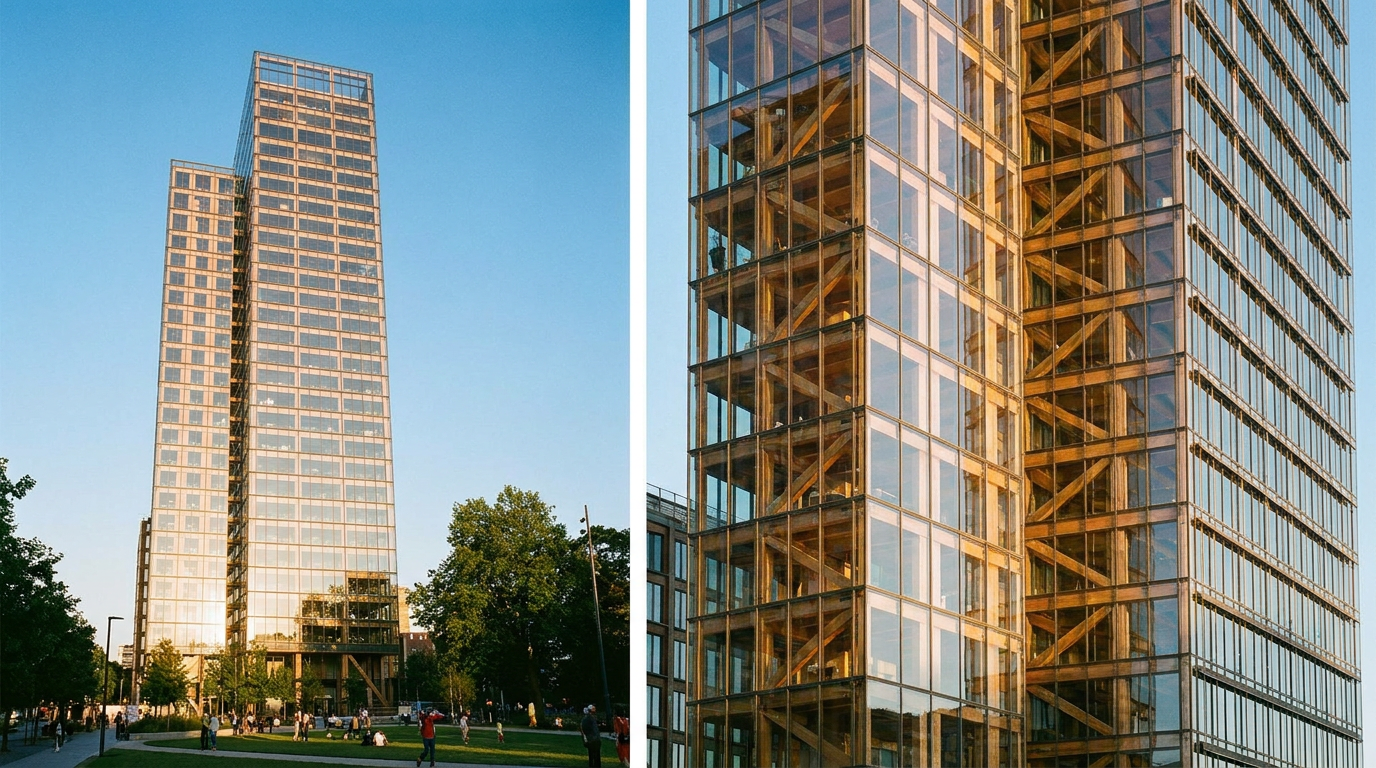
The modern urban skyline has long been defined by the cold, gray dominance of steel and concrete. But across North America and Europe, a radically different aesthetic is taking root. Architects and developers are increasingly turning to wood to construct high-rises, sparking a revolution in how cities are built. These "plyscrapers" are not just architectural novelties; they represent a fundamental shift toward decarbonizing the built environment.[7]
The scale of this shift is becoming impossible to ignore. In 2022, a 25-story luxury apartment building named Ascent opened in Milwaukee, Wisconsin, claiming the title of the world's tallest timber building at 284 feet. Yet, that record is already being eclipsed as the technology scales and developers grow more ambitious.[2]
Construction is currently underway on Neutral Edison, a 31-story, 362-foot mixed-use tower just blocks away from Ascent in Milwaukee. Meanwhile, in Sydney, Australia, the Atlassian Central tower has surpassed 39 levels, becoming the tallest hybrid timber structure on the globe. These mega-projects prove that wood is no longer confined to single-family homes or low-rise commercial spaces.[1][7]
To understand how a wooden skyscraper is structurally possible, it is necessary to separate mass timber from the traditional "stick-frame" lumber used in residential housing. Mass timber is an umbrella term for a class of engineered wood products that are bonded together to create exceptionally strong, load-bearing panels and beams.[6]
The most common of these materials is Cross-Laminated Timber (CLT). CLT is manufactured by taking standard wooden boards and stacking them in alternating, perpendicular layers—much like a giant Jenga tower—before bonding them with high-strength structural adhesives. This cross-hatching of the wood grain neutralizes the material's natural tendency to warp and gives it immense rigidity in all directions.[7]

Alongside CLT, builders rely on Glued Laminated Timber, or "glulam," which involves stacking wood grains parallel to one another. Glulam is typically used to form the massive columns and beams that serve as the skeleton of the building, while CLT panels are laid across them to form the floors and walls. Together, they offer a strength-to-weight ratio that rivals traditional mineral materials.[5]
The primary driver behind the mass timber boom is its promised environmental benefit. The cement and steel industries are notoriously energy-intensive, accounting for a massive share of global greenhouse gas emissions. By swapping these materials for engineered wood, developers aim to drastically reduce a building's "embodied carbon"—the emissions generated during the manufacturing and transportation of building materials.[6]
Proponents argue that mass timber goes a step further by actively sequestering carbon. As trees grow, they absorb carbon dioxide from the atmosphere. When those trees are harvested and locked into a building's structure, that carbon remains trapped for the lifespan of the building. A single wooden tower like Ascent can sequester thousands of metric tons of CO2, equivalent to removing thousands of cars from the road for a year.[2]
Proponents argue that mass timber goes a step further by actively sequestering carbon.
However, this pristine environmental narrative faces rigorous pushback from climate researchers. Analysts at the World Resources Institute caution that the climate benefits of mass timber are often overstated due to the realities of commercial forestry. When a tree is harvested, a significant portion of its biomass—roots, small branches, and bark—is left behind to decompose or is actively burned, releasing carbon back into the atmosphere.[3]
Furthermore, the milling process generates substantial waste in the form of sawdust and wood chips. Because of these inefficiencies, researchers argue that replacing concrete with wood creates a "carbon debt" that can take decades of forest regrowth to repay. For mass timber to be genuinely climate-friendly, it requires highly optimized, sustainable forestry practices that do not currently scale to meet global construction demands.[3]

Beyond the environmental debate, the most common intuitive hurdle for mass timber is fire safety. The idea of living or working in a 30-story wooden tower naturally evokes fears of catastrophic fires. Yet, structural engineers and fire safety researchers have spent the last decade proving that engineered wood behaves very differently in a fire than standard lumber.[7]
The secret to mass timber's fire resistance lies in a phenomenon known as "charring." When exposed to intense heat, the outermost layer of a massive wooden beam burns and turns to char. This charred layer acts as a highly effective thermal insulator, protecting the unburned wood inside from the heat and cutting off its oxygen supply.[4]
Recent full-scale fire tests have repeatedly validated this mechanism. In comprehensive testing programs, exposed glulam columns and CLT assemblies have been subjected to temperatures exceeding 1,800 degrees Fahrenheit for over three hours. In these tests, the structural core of the timber remained intact and continued to bear its designed load, safely exceeding the stringent fire-resistance ratings required for high-rise construction.[5]
Ironically, mass timber can offer more predictable fire performance than unprotected steel. In a severe fire, steel beams rapidly conduct heat and can suddenly buckle or melt, leading to a catastrophic collapse. Mass timber, by contrast, burns at a slow, measurable rate, allowing structural engineers to precisely calculate how thick a beam needs to be to survive a multi-hour fire while allowing occupants time to evacuate.[4][7]

Aside from carbon and fire safety, developers are flocking to mass timber for its sheer efficiency. Because CLT panels and glulam beams are prefabricated in highly controlled factory environments, they arrive at the construction site ready to be slotted into place. This turns the construction process into an exercise in precision assembly rather than raw fabrication.[6]
The logistical benefits of this prefabrication are staggering. Developers report that mass timber projects require up to 75% fewer workers on site and can be completed 25% faster than comparable concrete structures. The construction sites are also significantly quieter and generate far less local truck traffic, making them highly attractive for dense urban infill projects.[2][6]
Once the building is complete, the aesthetic qualities of the wood offer tangible benefits to the occupants. The practice of leaving the timber structure exposed—known as biophilic design—has been shown to reduce stress, lower heart rates, and improve cognitive function. In a competitive commercial real estate market, these warm, natural interiors are highly prized by tech companies and luxury renters alike.[2]

The regulatory landscape is rapidly evolving to keep pace with the technology. A major milestone occurred when the International Building Code was updated to permit mass timber structures up to 18 stories, provided certain safety and encapsulation measures were met. For ultra-tall projects like Neutral Edison, developers work closely with local authorities to secure special variances based on custom fire modeling.[1][6]
As the industry looks to the future, the primary bottleneck is no longer engineering or safety, but supply chain capacity. Advanced manufacturing facilities are coming online across North America and Europe to produce the massive volume of engineered wood required to meet demand. If the forestry sector can sustainably manage the harvest, the plyscraper revolution is poised to permanently alter the horizon.[7]
How we got here
2011
FPInnovations publishes the first Canadian CLT Handbook, standardizing early mass timber practices.
2021
The International Building Code is updated to permit mass timber structures up to 18 stories.
2022
The Ascent tower opens in Milwaukee, becoming the world's tallest timber building at 25 stories.
2025
Construction begins on the 31-story Neutral Edison tower in Wisconsin, designed to break the height record.
2026
Atlassian Central in Sydney surpasses Ascent to become the tallest hybrid timber structure globally.
Viewpoints in depth
Mass Timber Developers
Argue that engineered wood is the key to decarbonizing the construction industry while improving building speed and aesthetics.
This camp, which includes major architecture firms, real estate developers, and the timber industry, views mass timber as a rare "win-win" material. They point to the massive carbon footprint of the cement and steel industries as an existential threat to global climate goals. By shifting to prefabricated wood, they argue that developers can slash on-site labor costs, accelerate construction timelines by up to 25%, and create biophilic environments that command premium rents. They heavily emphasize the carbon sequestration properties of the wood, framing every new plyscraper as a long-term carbon sink.
Environmental Skeptics
Warn that the climate benefits of mass timber are overstated due to production waste and the realities of commercial forestry.
Organizations like the World Resources Institute caution against viewing mass timber as a silver bullet. They argue that the carbon accounting used by developers often ignores the massive waste generated during harvesting and milling. Because up to a third of a tree's biomass is left in the forest to rot, and bark and sawdust are frequently burned, the immediate carbon emissions of harvesting can be severe. This camp argues that replacing concrete with wood creates a "carbon debt" that takes decades of regrowth to neutralize, meaning mass timber could actually increase atmospheric carbon in the crucial short term unless forestry practices are radically overhauled.
Fire Safety Researchers
Focus on empirical testing to prove that mass timber can safely meet or exceed the fire-resistance standards of traditional materials.
Structural engineers and fire scientists have spent years battling the intuitive fear that wooden skyscrapers are inherently dangerous. Through rigorous, full-scale testing, this camp has documented the predictable "charring" behavior of thick timber members. They emphasize that unlike steel, which can rapidly lose its structural integrity and buckle under intense heat, a properly sized glulam column will form an insulating char layer that protects its load-bearing core. Their data has been instrumental in convincing regulators to update international building codes to permit high-rise timber construction.
What we don't know
- How the global timber supply chain will handle the massive surge in demand without incentivizing deforestation or monoculture plantations.
- The exact long-term lifecycle carbon footprint of mass timber buildings once end-of-life demolition and disposal are factored in.
Key terms
- Cross-Laminated Timber (CLT)
- An engineered wood panel made by gluing layers of solid sawn lumber together, with each layer oriented perpendicular to the adjacent one for maximum strength.
- Glued Laminated Timber (Glulam)
- A structural engineered wood product comprising a number of layers of dimensioned timber bonded together with durable, moisture-resistant adhesives, typically used for columns and beams.
- Embodied Carbon
- The total greenhouse gas emissions generated by the extraction, manufacturing, transportation, and assembly of building materials.
- Char Rate
- The predictable speed at which the outer layer of a mass timber element burns and turns to insulating carbon during a fire.
- Biophilic Design
- An architectural approach that seeks to connect building occupants more closely to nature, often by incorporating exposed natural materials like wood.
Frequently asked
What is the difference between mass timber and regular wood framing?
Regular wood framing uses standard lumber (like 2x4s) for low-rise buildings. Mass timber uses engineered panels and beams, created by bonding layers of wood together under pressure, making it strong enough for skyscrapers.
How does a wooden skyscraper survive a fire?
Mass timber relies on a process called charring. In a fire, the outer layer of the thick wood burns and turns to char, which acts as a thermal insulator that protects the unburned structural core from the heat.
Is mass timber cheaper than concrete and steel?
The raw materials can be cost-neutral or slightly more expensive, but mass timber saves money by drastically reducing construction time and requiring up to 75% fewer workers on site.
Does harvesting trees for skyscrapers cause deforestation?
It depends on the supply chain. Sustainable mass timber relies on responsibly managed forests and thinning operations, but critics warn that scaling the industry globally could incentivize harmful logging practices.
Sources
Source coverage
7 outlets
4 viewpoints surfaced







[1]Construction DiveMass Timber Developers
World's tallest mass timber building breaks ground in Wisconsin
Read on Construction Dive →[2]Green Builder MediaMass Timber Developers
For Milwaukee's world record-setting wooden high rise, 'Sky's the Limit' means more than its height
Read on Green Builder Media →[3]World Resources InstituteEnvironmental Skeptics
5 Reasons Wood Is Not a Climate-Friendly Building Material
Read on World Resources Institute →[4]MDPIFire Safety Researchers
Review of Experimental Fire Testing of Mass Timber Structures
Read on MDPI →[5]FPInnovationsFire Safety Researchers
Fire performance of cross-laminated timber assemblies
Read on FPInnovations →[6]Zurich InsuranceMass Timber Developers
Mass timber: Insuring the future of sustainable construction
Read on Zurich Insurance →[7]Factlen Editorial TeamNeutral Analysts
Synthesis by Factlen editorial team
Read on Factlen Editorial Team →

Every angle. Every day.
Get culture stories with full source coverage and perspective breakdowns delivered to your inbox.