
How Local AI is Turning Everyday Laptops Into Private, Offline Supercomputers
A new wave of highly compressed open-source models and user-friendly software is allowing anyone to run powerful artificial intelligence entirely on their own devices. This shift to 'on-device AI' guarantees absolute privacy and zero subscription costs, fundamentally changing how we interact with machine learning.
By Factlen Editorial Team
- Open-Source Developers
- Values the freedom to build, customize, and experiment with AI without API rate limits or corporate censorship.
- Privacy & Security Advocates
- Prioritizes keeping sensitive personal and corporate data strictly on-device to prevent external breaches and surveillance.
- Enterprise IT Leaders
- Focuses on the long-term cost efficiency of avoiding recurring cloud API fees and simplifying regulatory compliance.
What's not represented
- · Cloud AI Providers
- · Hardware Manufacturers
Why this matters
Running AI locally gives you complete ownership over your digital assistant. It guarantees that your private data never leaves your computer, eliminates monthly subscription fees, and ensures your AI tools work flawlessly even when you have no internet connection.
Key points
- Local AI allows users to run large language models directly on their personal devices without an internet connection.
- The technology guarantees absolute privacy, as user prompts and data never leave the physical hardware.
- Techniques like quantization compress massive AI models so they can fit into standard laptop memory.
- Running models locally eliminates the recurring API costs and subscription fees associated with cloud AI.
- User-friendly tools like Ollama and LM Studio have made installing and running local AI accessible to non-developers.
The era of paying a monthly subscription to rent a cloud-based brain is facing a quiet but massive disruption. For the past few years, interacting with artificial intelligence meant sending your private thoughts, code, and data to server farms owned by tech giants. Today, a rapidly growing movement is bringing that power directly to the user's desk.[7]
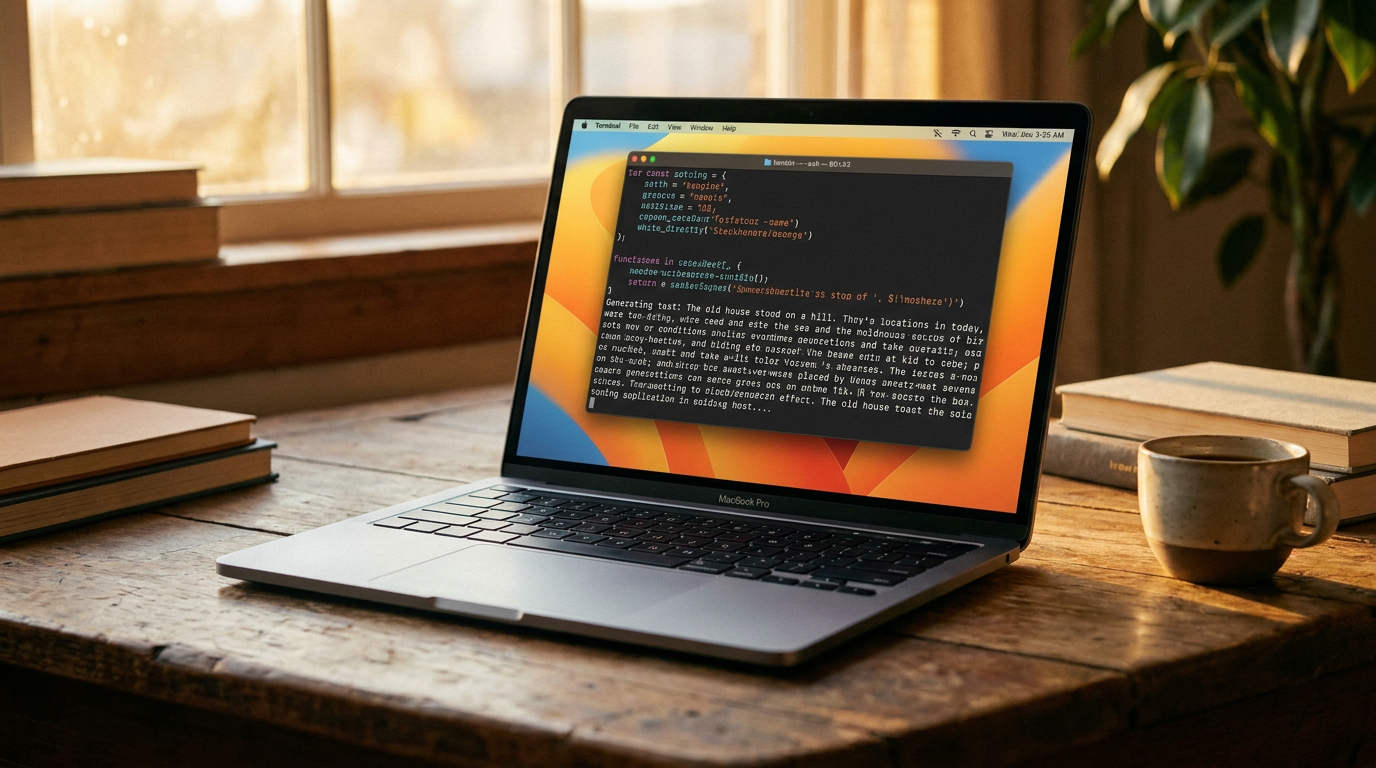
This shift is known as "local AI" or "on-device AI," and it represents a fundamental change in how we interact with large language models (LLMs). Instead of relying on an internet connection and an API key, users are downloading powerful AI models directly onto their laptops, phones, and desktop computers. Once downloaded, these models run entirely offline, generating text, writing code, and analyzing documents without ever pinging a remote server.[6]
This transition is not merely a hobbyist experiment; it is a paradigm shift driven by the convergence of open-weight models and specialized hardware. In 2026, running an AI locally is no longer restricted to developers with massive, expensive graphics cards. Thanks to highly optimized software and the widespread inclusion of Neural Processing Units (NPUs) in consumer electronics, everyday users are turning their personal devices into private AI servers.[4][6]

The mechanism that makes this possible relies heavily on a mathematical technique called quantization. In their raw form, frontier AI models are massive, requiring hundreds of gigabytes of memory to operate. Quantization mathematically compresses these models—reducing the precision of their internal weights from 16-bit to 4-bit or even lower—without suffering a catastrophic loss in reasoning ability.[3]
This compression means a highly capable model, such as Meta's 8-billion parameter Llama 3, can be shrunk down to a file size of roughly 4.7 gigabytes. At that size, it comfortably fits into the standard 8 to 16 gigabytes of RAM found in a typical modern laptop, allowing the device's CPU or GPU to process the model's neural network locally.[1][3]

To actually run these compressed files, a new ecosystem of user-friendly software has emerged, replacing complex command-line setups with intuitive interfaces. Tools like Ollama have become the standard for developers, allowing users to download and run models with a single terminal command. Ollama operates quietly in the background, serving as a local engine that other applications can tap into.[1][3]
For those who prefer a graphical interface, applications like LM Studio provide a polished, desktop-native experience. Users can browse a built-in directory of open-source models, download them with a click, and chat with them in a familiar, messaging-style window. These tools have effectively democratized local AI, removing the steep technical barriers that existed just a couple of years ago.[2]
For those who prefer a graphical interface, applications like LM Studio provide a polished, desktop-native experience.
The most immediate and profound benefit of on-device AI is absolute privacy. When a user queries a cloud-based model, their prompt—whether it contains proprietary corporate code, sensitive medical questions, or personal financial data—is transmitted across the internet. With local AI, the data never leaves the physical device.[5][6]
This localized architecture is proving invaluable for enterprise IT leaders and healthcare professionals. Researchers have demonstrated that self-hosted, offline AI chatbots can achieve competitive accuracy while providing strong privacy guarantees that comply with strict regulatory frameworks like HIPAA and GDPR. By keeping data on-device, organizations eliminate the risk of external data breaches or unauthorized model training.[5]
Beyond privacy, local AI fundamentally alters the economics of artificial intelligence. Cloud AI operates on a meter, charging users or developers a fraction of a cent for every "token" (roughly a syllable) generated. Over time, or at scale, these API costs can become prohibitive. Local models, by contrast, cost exactly zero dollars per query after the initial hardware investment.[4][6]

This cost efficiency is empowering developers to build AI-integrated applications without the fear of runaway cloud bills. A developer can set up a local coding assistant that autocompletes thousands of lines of code a day, or a researcher can feed hundreds of PDF documents into a local summarization tool, all without paying a subscription fee or hitting a rate limit.[3][4]
Furthermore, the offline nature of on-device AI unlocks new use cases in environments where internet connectivity is unreliable or non-existent. From scientists working in remote field locations to travelers on airplanes, users can now access a highly capable digital assistant anywhere in the world. The AI is always available, responding with zero network latency.[6]

However, the local AI ecosystem does come with inherent trade-offs. While models like Llama 3 and Mistral are remarkably capable, they do not yet match the raw reasoning power of massive, trillion-parameter frontier models hosted in the cloud. For highly complex logic puzzles, advanced mathematics, or cutting-edge creative writing, cloud models still hold a noticeable edge.[7]
Additionally, running a neural network locally is computationally intensive. When an AI is generating text, it maxes out the device's processor, which can lead to increased heat generation and rapid battery drain on laptops and mobile devices. Users must balance their desire for privacy and offline access against the physical limitations of their hardware.[3][4]
Despite these constraints, the trajectory of on-device AI is clear. As hardware manufacturers continue to dedicate more silicon to AI processing and open-source models become increasingly efficient, the gap between cloud and local performance is narrowing. The ability to carry a private, brilliant, and free AI in your backpack is no longer science fiction—it is the new baseline for personal computing.[6][7]
How we got here
Late 2022
Cloud-based AI chatbots launch, establishing a paradigm where AI requires constant internet access and remote servers.
Early 2023
The weights for early open-source models leak online, sparking a grassroots movement to run AI locally on consumer hardware.
Mid 2024
User-friendly tools like Ollama and LM Studio are released, replacing complex command-line setups with simple 1-click installers.
2025
Major hardware manufacturers begin shipping laptops and smartphones with dedicated Neural Processing Units (NPUs) specifically for edge AI.
2026
Highly optimized local models match the performance of early cloud frontier models, making offline, private AI a mainstream utility.
Viewpoints in depth
Open-Source Developers
Values the freedom to build, customize, and experiment with AI without API rate limits or corporate censorship.
For the open-source community, local AI represents a return to the decentralized roots of computing. Developers argue that relying on centralized cloud providers creates a dangerous bottleneck where a handful of corporations control access to intelligence. By running models locally, developers can fine-tune AI for highly specific tasks, bypass corporate safety filters that might overly restrict legitimate research, and build applications without worrying about sudden API price hikes or rate limits.
Privacy & Security Advocates
Prioritizes keeping sensitive personal and corporate data strictly on-device to prevent external breaches and surveillance.
Security professionals view cloud-based AI as a massive data exfiltration risk. When employees paste proprietary code, financial documents, or patient records into a cloud chatbot, that data becomes vulnerable to interception, server breaches, or unauthorized use in future model training. Privacy advocates argue that on-device AI is the only architecture that can mathematically guarantee data security, making it an essential requirement for healthcare, finance, and legal sectors.
Enterprise IT Leaders
Focuses on the long-term cost efficiency of avoiding recurring cloud API fees and simplifying regulatory compliance.
From a business perspective, the shift to local AI is driven by unit economics. As organizations scale their AI usage, the pay-per-token model of cloud providers quickly becomes one of their largest IT expenses. Enterprise leaders argue that investing in edge-capable hardware (like laptops with built-in NPUs) is a one-time capital expenditure that effectively reduces the marginal cost of AI inference to zero, while simultaneously simplifying their compliance with data residency laws.
What we don't know
- Whether local hardware advancements can outpace the growing size and complexity of future frontier models.
- How cloud providers will adjust their pricing models to compete with the zero-marginal-cost reality of local AI.
Key terms
- Local LLM
- A large language model that runs entirely on a user's personal device rather than on a remote cloud server.
- Quantization
- A compression technique that reduces the precision of an AI model's internal weights, allowing massive models to fit into standard consumer RAM.
- Inference
- The process of an AI model actively generating a response or prediction based on a user's prompt.
- NPU (Neural Processing Unit)
- A specialized hardware chip designed specifically to accelerate artificial intelligence tasks efficiently without draining the battery.
- Open-Weights Model
- An AI model whose underlying architecture and parameters are made publicly available for anyone to download, use, and modify.
Frequently asked
Can I run a local AI on my current laptop?
Yes, most modern laptops with at least 8GB of RAM can run smaller, quantized models like Llama 3 8B. However, 16GB of RAM and a dedicated GPU or NPU will provide much faster response times.
Is a local AI as smart as ChatGPT?
Local models are highly capable for everyday tasks like drafting emails, summarizing documents, and writing basic code. However, the largest cloud-based frontier models still hold an edge in highly complex reasoning and advanced mathematics.
Do I need an internet connection to use it?
Only once. You need an internet connection to initially download the model file and the software (like Ollama or LM Studio). After that, the AI runs 100% offline.
Is it really completely free?
Yes. Once you have the hardware, running the model locally costs nothing. There are no subscription fees, no API costs, and no limits on how many questions you can ask.
Sources
Source coverage
7 outlets
3 viewpoints surfaced







[1]OllamaOpen-Source Developers
Meta Llama 3: The most capable openly available LLM to date
Read on Ollama →[2]LM StudioOpen-Source Developers
Discover, download, and run local LLMs
Read on LM Studio →[3]DataCampOpen-Source Developers
How to Run Llama 3 Locally
Read on DataCamp →[4]RunAnywhereEnterprise IT Leaders
Running LLMs Offline in 2026
Read on RunAnywhere →[5]ZenodoPrivacy & Security Advocates
Development of a Self-Hosted, Offline AI Chatbot using Llama 3
Read on Zenodo →[6]PicovoicePrivacy & Security Advocates
Why On-Device AI Matters in 2026 and Beyond
Read on Picovoice →[7]Factlen Editorial TeamEnterprise IT Leaders
Synthesis by Factlen editorial team
Read on Factlen Editorial Team →

More in ai
See all 5 stories →On-Device AI
How Local AI Replaced the Cloud: Running Frontier Models on Your Laptop
0 sources

Enterprise AI
The Rise of Small Language Models: How Enterprises Are Running AI Locally in 2026
0 sources

Drug Discovery
New AI Model Accelerates Molecular Simulations 10,000-Fold, Slashing Drug Discovery Timelines
0 sources

Every angle. Every day.
Get ai stories with full source coverage and perspective breakdowns delivered to your inbox.