
How Learning Physically Rewires the Adult Brain
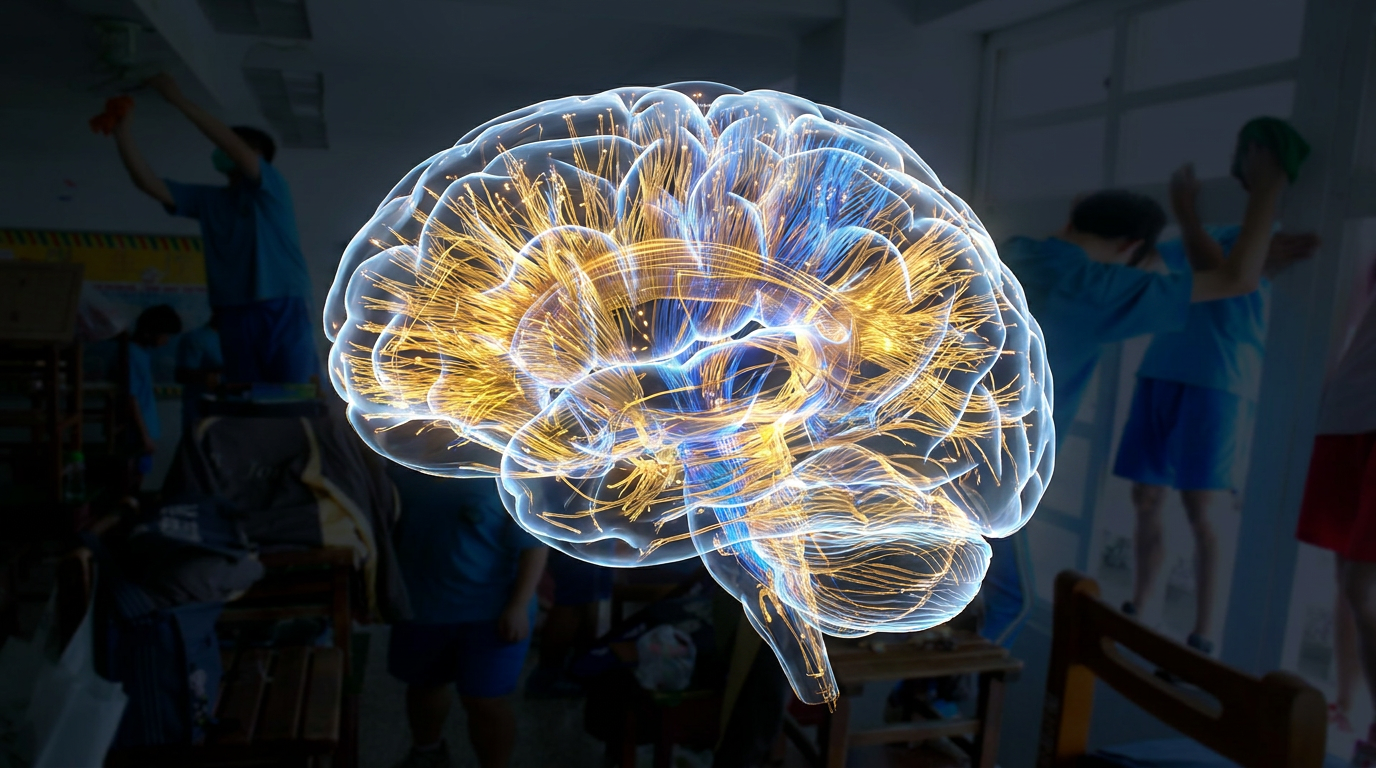
Modern neuroimaging reveals that the adult brain is not fixed, but continuously remodels its physical architecture—thickening white matter and forging new pathways—in response to learning and cognitive challenges.
By Factlen Editorial Team
- Structural Plasticity Researchers
- Focus on the measurable changes in white and gray matter as the primary drivers of adult learning.
- Neurogenesis Researchers
- Debate whether the adult brain can birth entirely new neurons, or if it relies solely on rewiring existing ones.
- Cognitive Aging Specialists
- Emphasize how lifelong learning and neuroplasticity build cognitive reserve against decline.
What's not represented
- · Neurological rehabilitation patients
Why this matters
Understanding that the brain remains physically malleable throughout adulthood shatters the myth of age-related cognitive stagnation. It proves that sustained learning and novel challenges actively fortify the brain's hardware, offering a biological mechanism for preserving cognitive health.
Key points
- The adult brain continuously remodels its physical structure in response to learning.
- Learning new skills actively thickens the myelin sheaths of white matter tracts.
- White matter reorganization occurs in distinct phases depending on the skill being learned.
- Structural brain changes operate on a 'use it or lose it' basis without sustained practice.
For decades, a persistent myth dominated both popular culture and neuroscience: the idea that the human brain becomes "fixed" in its mid-twenties. According to this outdated model, early childhood was a magical window of rapid development, followed by a long, slow decline where neurons simply died off and cognitive pathways rigidly set.[1]
Modern neuroimaging has thoroughly dismantled that assumption. We now know that the adult brain is a highly dynamic, physically malleable organ that continuously remodels its own architecture in response to the demands placed upon it. This phenomenon, known as adult neuroplasticity, means that learning a new skill does not just add "software" to the mind; it physically alters the "hardware" of the brain.[1][2][5]
The most robust evidence for this lifelong adaptability comes from observing changes in white matter. If gray matter represents the brain's processing centers, white matter acts as the fiber-optic network connecting them. These tracts are coated in myelin, a fatty substance that insulates nerve fibers and accelerates signal transmission.[3][6]
When adults engage in sustained learning, the brain actively thickens the myelin along the specific pathways being used. A landmark study published in the Journal of Neuroscience tracked sighted adults over eight months as they learned to read tactile Braille. Using diffusion MRI, researchers measured the microstructural strength of the participants' white matter at five different time points.[3]
The results revealed a highly dynamic, phased rewiring process. White matter in the brain's somatosensory areas—responsible for processing touch—strengthened steadily from the very beginning of the training. The brain was physically reinforcing the cables needed to feel and interpret the tiny raised dots.[3][6]
However, white matter in the visual cortex did not begin to reorganize until halfway through the eight-month program. Researchers noted that this secondary structural shift coincided exactly with the point when the Braille patterns began to take on semantic meaning—when the participants stopped just feeling bumps and started reading words.[3][6]

However, white matter in the visual cortex did not begin to reorganize until halfway through the eight-month program.
This structural plasticity is not permanent by default; it operates on a strict "use it or lose it" economy. In the Braille study, once the training ended, the newly fortified white matter tracts returned to their pre-training baseline within two and a half months. Yet, subsequent research suggests that once a pathway has been myelinated, reactivating it later requires significantly less practice, akin to muscle memory.[3][6]
Beyond tactile skills, complex motor learning and language acquisition trigger similar macroscopic changes. Functional MRI studies demonstrate that when adults learn complex motor sequences, the resting-state connectivity between sensorimotor networks fundamentally shifts. The brain optimizes its resting state to better support the newly acquired skill, proving that learning alters the brain even when it is not actively performing the task.[5]
Similarly, adults who learn a second language exhibit increased cortical thickness in frontal and temporal regions, alongside enhanced white matter integrity. While adults may not acquire languages through the same effortless mechanisms as toddlers, their brains compensate by recruiting prefrontal regions and executive control networks, forging entirely new functional pathways to achieve fluency.[2]

While the evidence for white matter and synaptic plasticity is universally accepted, a fierce debate continues over another potential mechanism: adult neurogenesis. This is the question of whether the adult human brain can actually birth brand-new neurons, particularly in the hippocampus, a region critical for memory and learning.[4]
For years, the consensus was a firm no. Then, studies using carbon-14 dating of human tissue—taking advantage of the atmospheric spike in radioactive carbon during Cold War nuclear testing—suggested that adults might generate up to 700 new hippocampal neurons daily. Other researchers, using rapid-autopsy tissue, have reported finding thousands of immature neurons in the brains of healthy individuals in their seventies.[4]
Yet, this remains one of neuroscience's most contested frontiers. Skeptics point to equally rigorous postmortem studies showing that the production of new neurons drops to near-zero after childhood. They argue that the "immature" neurons detected in adults might simply be mature cells expressing unusual proteins, or that methodological differences in how brain tissue is preserved account for the conflicting results.[4]

Regardless of whether the adult brain mints new neurons or simply rewires its existing billions, the practical implications remain identical. The architecture of the mind is not a fixed inheritance but a lifelong construction project.[1]
Engaging in novel, challenging cognitive tasks—whether learning a language, mastering an instrument, or navigating a new physical environment—forces the brain to adapt its physical structure. By understanding that our neural hardware remains deeply malleable, we can approach adult learning not as a fight against inevitable decline, but as an ongoing process of biological self-directed evolution.[1][2][5]
How we got here
1998
Researchers publish the first major evidence suggesting adult humans can generate new neurons in the hippocampus.
2013
A landmark study using carbon-14 dating estimates that adults add roughly 700 new hippocampal neurons daily.
2018
A major postmortem study challenges the neurogenesis consensus, finding that new neuron production drops to near-zero after childhood.
2021
Longitudinal MRI research demonstrates that learning complex skills like Braille physically alters adult white matter in distinct, phased timelines.
Viewpoints in depth
Structural Plasticity Researchers
Focus on the measurable changes in white and gray matter as the primary drivers of adult learning.
This camp relies heavily on advanced neuroimaging, such as diffusion tensor imaging (DTI), to track how the brain's physical architecture changes in real-time. They argue that the thickening of myelin sheaths and the reorganization of white matter tracts are the most critical mechanisms for adult skill acquisition. From their perspective, the brain operates on a strict supply-and-demand economy: pathways that are actively used are physically reinforced, while neglected pathways are pruned.
Neurogenesis Skeptics & Proponents
Debate whether the adult brain can birth entirely new neurons, or if it relies solely on rewiring existing ones.
The debate over adult hippocampal neurogenesis is one of the most active in modern neuroscience. Proponents point to carbon-14 dating and rapid-autopsy tissue samples that show thousands of immature neurons in older adults, suggesting that new cells play a vital role in memory formation. Skeptics counter that these 'immature' markers may be artifacts of how tissue is preserved, and that rigorous postmortem studies show neurogenesis dropping to near-zero after childhood. Both sides agree, however, that overall brain plasticity remains robust.
Cognitive Aging Specialists
Emphasize how lifelong learning and neuroplasticity build cognitive reserve against decline.
For specialists focused on aging, the exact cellular mechanisms of plasticity are secondary to the functional outcomes. They view learning, physical exercise, and novel environmental challenges as essential tools for building 'cognitive reserve.' By continuously forcing the brain to forge new functional connections and reinforce white matter, adults can create a neurological buffer that delays or offsets the symptoms of age-related cognitive decline.
What we don't know
- Whether the adult human hippocampus definitively generates new neurons, or if observed markers represent a different cellular process.
- The exact threshold of practice required to make learning-induced white matter changes permanent.
Key terms
- Neuroplasticity
- The brain's ability to reorganize itself by forming new neural connections and altering its physical structure in response to learning and experience.
- White Matter
- The tissue in the brain composed of nerve fibers (axons) that connect different regions, acting as the brain's communication network.
- Myelin
- A fatty substance that coats and insulates nerve fibers, allowing electrical signals to travel faster and more efficiently.
- Neurogenesis
- The biological process by which new neurons are generated from neural stem cells.
- Hippocampus
- A complex brain structure embedded deep in the temporal lobe that plays a major role in learning and memory.
- Diffusion Tensor Imaging (DTI)
- An advanced MRI technique used to map and measure the microscopic structure of white matter tracts in the brain.
Frequently asked
Can adults learn new skills as easily as children?
Adults learn differently than children, relying more on prefrontal regions and executive control rather than effortless absorption. However, their brains remain fully capable of physically rewiring to master complex new skills.
Does the adult brain grow new neurons?
This is highly debated. While some studies suggest the hippocampus generates hundreds of new neurons daily, other rigorous studies indicate that new neuron production drops to near-zero after childhood.
How long does it take to physically change the brain?
MRI studies show that structural changes in white matter can begin within weeks of intensive practice, but these changes require sustained effort over months to fully consolidate.
Are brain changes from learning permanent?
No. Neuroplasticity operates on a 'use it or lose it' basis. If a newly learned skill is abandoned, the reinforced white matter tracts can return to their baseline within a few months.
Sources
Source coverage
6 outlets
3 viewpoints surfaced





[1]Factlen Editorial TeamCognitive Aging Specialists
Synthesis by Factlen editorial team
Read on Factlen Editorial Team →[2]MDPICognitive Aging Specialists
Adult Neuroplasticity in Second Language Learning and Cognitive Training
Read on MDPI →[3]Journal of NeuroscienceStructural Plasticity Researchers
Dynamic Nature of Learning-Induced Brain Plasticity During Braille Acquisition
Read on Journal of Neuroscience →[4]Exploration of Neuroprotective TherapyNeurogenesis Researchers
Adult Hippocampal Neurogenesis in Humans: A Critical Review
Read on Exploration of Neuroprotective Therapy →[5]NeuroImageStructural Plasticity Researchers
Teaching an adult brain new tricks: structural plasticity in humans
Read on NeuroImage →[6]Psychology TodayStructural Plasticity Researchers
Learning Braille Changes White Matter Brain Structure Over Time
Read on Psychology Today →
Every angle. Every day.
Get science stories with full source coverage and perspective breakdowns delivered to your inbox.