
How Indie Creators Are Building Studio-Quality Video Workflows With Local AI
Open-source video models and node-based tools are allowing independent filmmakers to run cinematic AI generation locally, bypassing expensive cloud subscriptions and vendor lock-in.
By Factlen Editorial Team
- Open-Source Advocates
- Argue that public model weights and local execution are essential for creative freedom, privacy, and preventing corporate monopolies over generative art.
- Indie Filmmakers
- Value the dramatic reduction in visual effects costs and the ability to maintain consistent, proprietary visual styles without paying recurring API fees.
- Commercial Cloud Providers
- Emphasize that cloud-based APIs offer superior out-of-the-box quality, seamless multimodal integration, and zero hardware maintenance for users who just want to create.
What's not represented
- · Traditional VFX Artists
- · Copyright Regulators
Why this matters
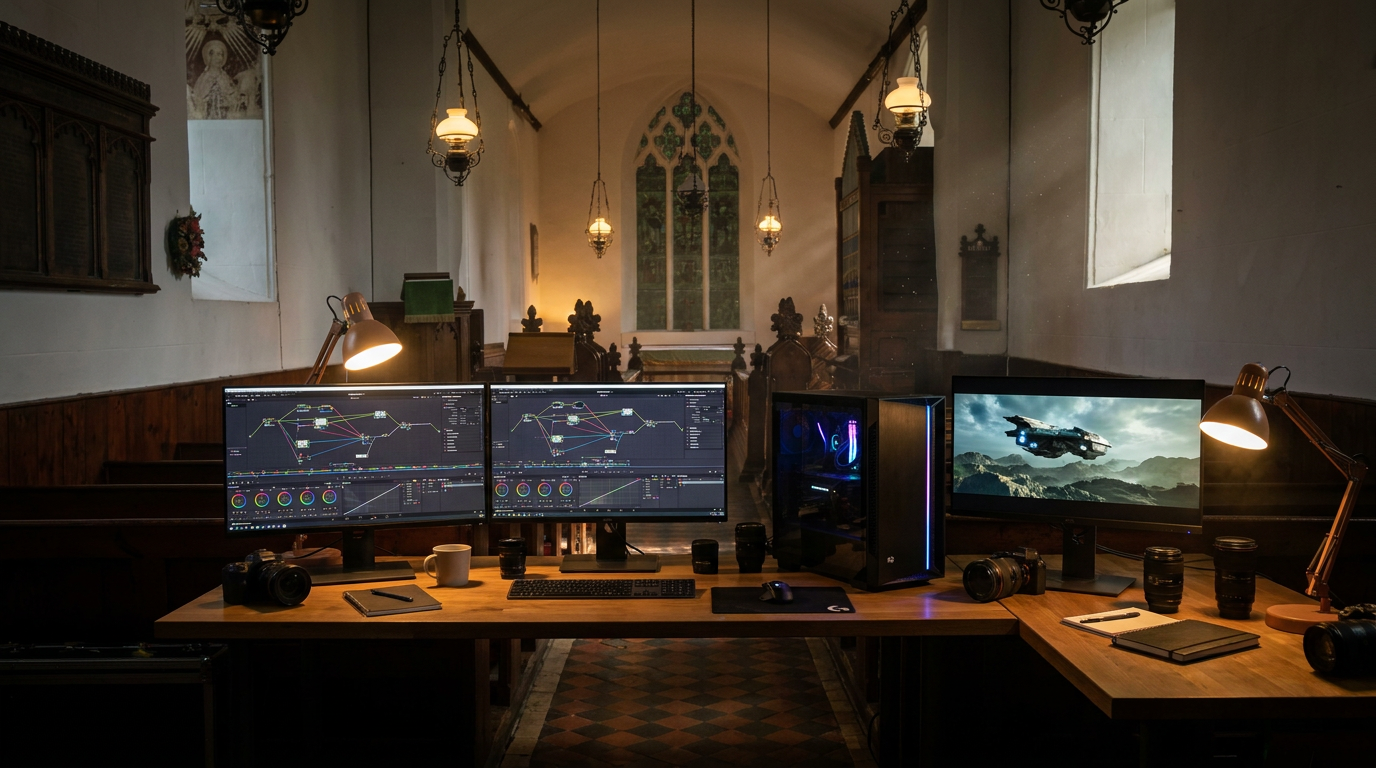
By moving AI video generation to local hardware, creators gain absolute control over their intellectual property, avoid recurring API costs, and can fine-tune models on their own proprietary visual styles. This effectively democratizes high-end visual effects, allowing solo artists to produce work that previously required a dedicated studio.
Key points
- Indie creators are increasingly moving AI video generation from cloud APIs to local hardware.
- Open-source models like Wan 2.2 now rival commercial platforms in cinematic quality.
- Local generation eliminates per-render token costs and bypasses strict corporate moderation filters.
- Node-based interfaces like ComfyUI allow creators to build highly customized, modular workflows.
- Running models locally enables creators to fine-tune AI on their own proprietary character designs.
- Hardware acceleration from NVIDIA and AMD is making massive AI models viable on consumer GPUs.
The era of the cloud-only AI video monopoly is fracturing. In 2026, independent filmmakers, animators, and digital creators are increasingly pulling their generative workflows offline. For the past two years, the narrative around artificial intelligence in Hollywood was dominated by massive, proprietary cloud models. Creators uploaded their prompts to remote servers, paid a fee per generation, and hoped the output matched their vision. But a quiet revolution is taking place in home studios and indie production houses. Empowered by a new generation of open-weight models and sophisticated local interfaces, creators are building their own studio-quality rendering pipelines. This shift is democratizing visual effects, allowing solo artists to produce sequences that would have required a dedicated post-production team just a few years ago.[8]
The migration away from closed APIs is driven by a combination of economics, privacy, and creative control. While commercial platforms offer undeniable convenience, they operate on a pay-per-token model that quickly drains independent budgets during the iterative process of filmmaking. Furthermore, these closed systems enforce strict moderation filters that can arbitrarily block creative prompts, and they offer no mechanism for creators to fine-tune the underlying model on their own proprietary character designs or visual styles. For professionals who care about intellectual property ownership and absolute control over their frames, the tradeoff of renting cloud infrastructure no longer makes sense.[6][7]
The catalyst for this local renaissance is the arrival of open-source video generation models that have finally crossed the cinematic quality threshold. Industry analysts note that the best self-hosted models now produce output that rivals commercial cloud APIs. Because the model weights are publicly available, organizations can audit inference behavior, eliminate per-render API costs permanently, and integrate the AI directly into their private pipelines. This represents a fundamental shift from open source as a novelty to open source as production infrastructure.[6]
Leading this open-source charge is Wan 2.2, a model developed by Alibaba's Tongyi Lab that has become a cornerstone of local video generation. Released under a permissive Apache 2.0 license, it gives developers full access to its architecture for both commercial and research use. Wan 2.2 utilizes a highly efficient Mixture-of-Experts (MoE) architecture, boasting 27 billion total parameters. However, it only activates 14 billion parameters during any single inference step. This design allows the model to deliver massive capacity and cinematic fidelity—excelling in controlled color grading and realistic camera motion—without requiring a proportional increase in computing power.[5][7]

While Wan 2.2 focuses on maximum visual fidelity, the open-source ecosystem offers specialized tools for different production needs. Models like LTX-Video prioritize speed and workflow efficiency, capable of generating 30-frames-per-second video faster than real-time on capable hardware. This makes it highly practical for rapid content creation and iterative prompt testing. Meanwhile, alternatives like Mochi 1 and HunyuanVideo provide deep architectural flexibility, allowing technical creators to modify the generation pipeline to suit highly specific animation or live-action integration tasks.[7]
But raw AI models are simply engines; they require a chassis to be driven effectively. For the vast majority of creators, that chassis is ComfyUI. Originally popularized for image generation, ComfyUI is a node-based visual programming interface that has become the industry standard for local AI workflows. Instead of typing commands into a terminal, users build complex generation pipelines by visually connecting blocks—or nodes—that represent different diffusion models, custom scripts, video editing steps, and multimodal inputs. This modularity allows creators to build workflows exactly the way they want them, without waiting for a closed platform to add a specific feature.[1][4]
But raw AI models are simply engines; they require a chassis to be driven effectively.
Recognizing the complexity of managing these node-based systems, developers are actively working to lower the operational friction. In June 2026, Comfy Org rolled out Comfy Desktop, a unified application designed to manage these environments across local, portable, and remote setups. This release signals that open-source AI tooling is moving firmly through its productization phase. By allowing users to keep different instances isolated for different jobs and easily recover from workflow clashes, tools like Comfy Desktop are making powerful local AI usable enough for real production teams to adopt without turning every project into an engineering chore.[1]
Running these sophisticated workflows locally requires serious silicon, and hardware manufacturers are aggressively courting the creator market. NVIDIA's RTX ecosystem currently dominates the local AI landscape. The company has heavily optimized the open-source software stack, providing CUDA libraries and advanced quantization techniques that compress massive AI models so they can fit inside the Video RAM (VRAM) of consumer and prosumer graphics cards. This hardware acceleration is what makes running a 14-billion parameter video model on a desktop computer physically possible.[2]

Simultaneously, the hardware ecosystem is diversifying to prevent a single-vendor monopoly. The AMD ROCm ecosystem is rapidly maturing, offering a more cost-effective alternative for local AI acceleration. Developers are building isolated backend services that connect interfaces like ComfyUI to AMD GPUs, turning previously experimental and fragile setups into stable, diagnosable video generation pipelines. This layered architectural approach ensures that as new, more powerful open-source models are released, the underlying hardware infrastructure is ready to support them across different silicon platforms.[3]
The true advantage of this localized infrastructure extends far beyond saving money on API calls; it is about achieving unprecedented creative consistency. One of the greatest challenges in AI filmmaking is maintaining character identity and environmental consistency across multiple shots. By running models locally, creators can utilize techniques like Low-Rank Adaptation to fine-tune the AI on their own specific character sheets, architectural renders, or brand guidelines. The model essentially learns the creator's proprietary visual language, ensuring that a character looks identical in a close-up dialogue scene and a wide action shot.[6][8]
Advanced creators are pushing these local systems even further by integrating them with workflow automation tools like n8n. This is where local AI transitions from a simple rendering tool into an automated virtual studio. A creator can build a system where a local language model analyzes a script, automatically generates a detailed shot list, passes those prompts to ComfyUI, and queues the video rendering jobs to run overnight. Instead of manually babysitting the generation process, the filmmaker wakes up to a folder full of rendered clips ready for the editing timeline.[4]

Despite the massive strides in local generation, the future of indie filmmaking is not entirely offline. Most professional creators are adopting a hybrid approach that leverages the strengths of both paradigms. Cloud AI services remain incredibly convenient for rapid brainstorming, complex multimodal reasoning, or generating initial concept art from a laptop in a coffee shop. However, when it comes time for final rendering, fine-tuning, and handling privacy-sensitive intellectual property, the workflow moves to the local workstation.[4][8]
Ultimately, the rise of local AI workflows is doing for visual effects what the digital camera revolution did for cinematography two decades ago. It is dismantling the financial barriers to high-end production. By placing studio-quality rendering power directly on the desks of independent creators, the industry is shifting its center of gravity. The competitive advantage in filmmaking is no longer defined by who has the largest rendering budget or the most expensive cloud subscription, but by who has the most compelling story to tell and the vision to bring it to life.[8]
How we got here
Late 2025
Cloud-based video generators like Sora and Veo dominate the market, establishing high benchmarks for AI video quality.
Early 2026
Open-source models like Wan 2.2 and LTX-Video cross the cinematic quality threshold, making local generation viable.
June 2026
Comfy Org releases Comfy Desktop, significantly lowering the operational friction of managing local node-based workflows.
Viewpoints in depth
Open-Source Advocates
Champions of decentralized technology who believe AI infrastructure should be publicly accessible.
This camp argues that the future of generative art must not be controlled by a handful of massive tech corporations. By keeping model weights open and allowing local execution, they believe the industry can prevent monopolistic pricing and arbitrary censorship. For these advocates, open-source AI is about ensuring that the foundational tools of digital creation remain in the public domain, allowing anyone to audit the code, improve the architecture, and build upon the technology without asking for permission.
Indie Filmmakers
Independent creators focused on maximizing production value while minimizing costs.
For independent filmmakers, local AI is a purely practical revolution. Operating on tight budgets, they cannot afford the recurring API costs associated with cloud platforms, especially when iterating through dozens of prompts to get a single usable shot. More importantly, local workflows allow them to fine-tune models on their own specific character designs and art styles—a critical requirement for narrative consistency that closed cloud systems currently struggle to provide. To them, local AI is the ultimate democratizer of high-end visual effects.
Commercial Cloud Providers
Companies offering proprietary, subscription-based AI generation services.
Commercial providers emphasize that while local AI is powerful, it requires significant technical expertise, constant troubleshooting, and expensive upfront hardware investments. They argue that cloud APIs offer superior out-of-the-box quality, seamless integration with other multimodal tools, and zero hardware maintenance. For creators who want to focus entirely on storytelling rather than managing Python environments and GPU drivers, cloud providers maintain that their platforms offer the most frictionless path from idea to final render.
What we don't know
- How traditional Hollywood studios will integrate these open-source local workflows into their massive, established pipelines.
- Whether future consumer GPUs will be able to keep pace with the rapidly expanding parameter counts of next-generation video models.
- How copyright law will adapt to creators fine-tuning open-source models on a mix of public and proprietary data.
Key terms
- Mixture-of-Experts (MoE)
- A machine learning architecture that divides a model into specialized sub-networks, activating only the relevant 'experts' for a given task to save compute power.
- Node-based interface
- A visual programming method where users connect blocks (nodes) representing different functions or models to build a custom workflow without writing code.
- Inference
- The process of running live data or prompts through a trained AI model to generate an output, such as a video clip.
- VRAM (Video RAM)
- The dedicated memory on a graphics card used to store image data and AI model weights during the generation process.
Frequently asked
Why are creators moving away from cloud AI video tools?
Cloud tools often charge per generation, impose strict content filters, and do not allow creators to fine-tune the models on their own proprietary art styles or character designs.
What hardware is needed for local AI video generation?
Running high-fidelity models locally typically requires a consumer or prosumer GPU with substantial Video RAM (VRAM), such as an NVIDIA RTX card or a compatible high-end AMD GPU.
What is ComfyUI?
ComfyUI is a popular open-source, node-based interface that allows users to build and manage complex AI generation pipelines by visually connecting different models, scripts, and tools.
Sources
Source coverage
8 outlets
3 viewpoints surfaced








[1]Startup FortuneIndie Filmmakers
Local AI workflows need hardware, storage, model management and security discipline
Read on Startup Fortune →[2]NVIDIA Developer
Developing Robust Local AI Workflows on NVIDIA RTX
Read on NVIDIA Developer →[3]CSNet
Architecture notes for running local AI workloads with .NET, FastAPI, ComfyUI ROCm
Read on CSNet →[4]GetPromptingIndie Filmmakers
Local AI Workflows Are Where Things Get Interesting
Read on GetPrompting →[5]SiliconFlowOpen-Source Advocates
Our definitive guide to the top open source AI video generation models of 2026
Read on SiliconFlow →[6]FitGapOpen-Source Advocates
Open source AI video generation has crossed a threshold
Read on FitGap →[7]PixazoOpen-Source Advocates
The most relevant open-source AI video generation models in 2026
Read on Pixazo →[8]Factlen Editorial TeamIndie Filmmakers
Synthesis by Factlen editorial team
Read on Factlen Editorial Team →
More in ai
See all 5 stories →On-Device AI
How Local AI Replaced the Cloud: Running Frontier Models on Your Laptop
0 sources

Enterprise AI
The Rise of Small Language Models: How Enterprises Are Running AI Locally in 2026
0 sources

Drug Discovery
New AI Model Accelerates Molecular Simulations 10,000-Fold, Slashing Drug Discovery Timelines
0 sources

Every angle. Every day.
Get ai stories with full source coverage and perspective breakdowns delivered to your inbox.