
How Imprinted Pelvic Alignment Protects Lumbar Facet Joints During Leg Exercises
Flattening the lower back against the floor during open-chain movements neutralizes the intense pulling force of the hip flexors. This mechanical shift prevents the psoas muscle from dragging the lumbar spine into a painful arch, protecting delicate facet joints from excessive compression.
By Jun Zhao

In short
- Open-chain leg exercises use the heavy weight of the legs as a lever, causing the psoas muscle to pull the lower spine forward.
- This forward pull forces the spine into an exaggerated arch, transferring up to 47 percent of spinal compression onto the delicate facet joints.
- Tilting the pelvis backward to flatten the lower back against the floor neutralizes this shear force and protects the joints from arthritic wear.
In July 1997, biomechanist Stuart McGill published a dataset that permanently changed how clinical rehabilitation approached abdominal training. His laboratory measured the exact forces acting on the lower back during common exercises, quantifying the hidden mechanical stress of core workouts that had previously relied on guesswork.[4]
The research revealed that a standard straight-leg raise generated more than 3,300 Newtons of compressive force on the lumbar spine. McGill concluded that "the psoas line of action is such that it imposes substantial spine compression and shear," identifying the exact mechanism behind exercise-induced back pain.[4]
That single finding explained why so many people experienced sharp lower back pain during seemingly simple floor routines. This discovery shifted the fitness industry's focus toward spinal alignment, validating a technique that Pilates instructors had utilized to protect their clients' spines for decades.[6]
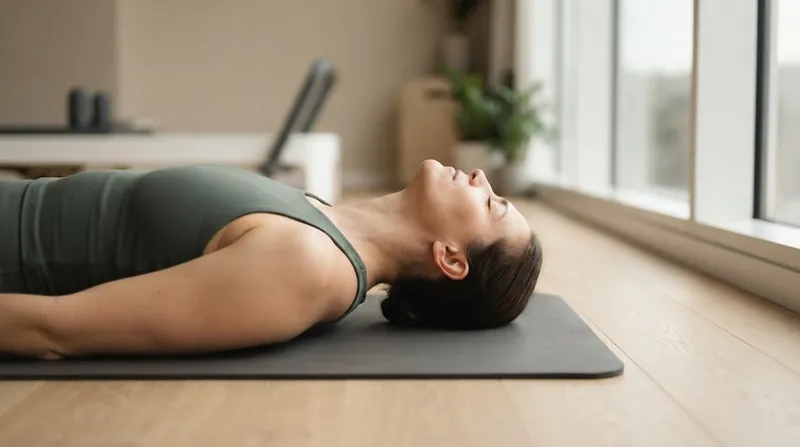
By intentionally flattening the lower back against the floor, practitioners could neutralize these dangerous forces and protect their joints. The technique, known as an imprinted spine, involves a slight posterior pelvic tilt that engages the oblique muscles to anchor the pelvis firmly in place.[6]
The Anatomy of Spinal Shear
To understand why leg raises hurt the lower back, you have to look at the psoas major. This thick, rope-like muscle attaches directly to the five lumbar vertebrae, crosses through the pelvis, and anchors to the top of the femur, connecting the upper and lower body.[1]
When you lie on your back and lift both legs off the floor, the heavy weight of your lower body turns the femurs into long levers. Because the legs are suspended in the air during an open-chain movement, gravity pulls them downward with immense force.[1]
The psoas must contract intensely to hold the legs up, but because it is anchored directly to the spine, it pulls the lumbar vertebrae forward. This creates massive anterior shear force, physically dragging the lower spine into an exaggerated arch if left unchecked.[1]
If the abdominal muscles are not strong enough to resist this forward pull, the pelvis tips anteriorly. The lower back lifts off the mat, creating a bridge of unsupported vertebrae that must absorb the entire mechanical load of the suspended legs without any structural assistance.[5]
Compressing the Facet Joints
This exaggerated arching, clinically known as hyperlordosis, shifts the body's weight distribution away from its primary shock absorbers. The thick intervertebral discs at the front of the spine are designed to handle heavy compression, but arching transfers that burden backward onto more fragile structures.[2]
The load moves onto the facet joints, which are small, interlocking bony projections at the posterior of each vertebra. The Mayfield Clinic notes that these structures "enable you to bend and twist," but they are fundamentally designed to guide motion rather than bear heavy compressive loads.[3]
A 2021 biomechanical modeling study published in Frontiers in Bioengineering and Biotechnology quantified this dangerous shift in weight distribution. Researchers found that in a neutral posture, the facet joints carry almost zero compressive load, leaving the robust intervertebral discs to do the heavy lifting.[2]
However, when the spine is forced into hyperlordosis, the facet joints suddenly absorb up to 47 percent of the total spinal compression. Grinding these delicate joints together under thousands of Newtons of force causes acute pain and rapidly accelerates arthritic wear over time.[2]
How the Imprint Alters Physics
The imprinted pelvic alignment solves this problem by changing the geometric angle of the pelvis before the legs ever leave the floor. By contracting the abdominals to tilt the pelvis backward, the lumbar spine presses flush against the mat, eliminating the vulnerable arch.[6]
This physical barrier prevents the psoas from dragging the vertebrae forward into a compromised position. The floor itself acts as a rigid backstop, neutralizing the anterior shear force and keeping the lumbar spine locked in a safe, decompressed alignment throughout the exercise.[6]
Furthermore, the posterior tilt actively lengthens the lower back muscles and opens the spaces between the posterior vertebrae. This un-wedges the facet joints, ensuring they cannot crash into one another even when the hip flexors are straining at maximum capacity to hold the legs aloft.[5]
The American Council on Exercise notes that this alignment is particularly crucial for beginners or those recovering from back injuries. It provides a stable base of support when the deep core muscles lack the endurance to fight the powerful psoas muscle independently.[5]
Clinical instructors emphasize that the imprint must be driven by the abdominal muscles, not by squeezing the glutes or pushing off the feet. Engaging the obliques to draw the lower ribs toward the pelvis creates the necessary mechanical lock without introducing unwanted tension elsewhere.[6]
Transitioning Back to Neutral
Despite its protective benefits during floor work, the imprinted spine is not meant to be a permanent postural goal. In everyday life, a neutral spine with a natural lumbar curve remains the most efficient and shock-absorbing position for the human body while standing or walking.[5]
The imprint is a specific, temporary modification used during high-leverage floor exercises like the Pilates Hundred or the double leg stretch. It acts as a set of training wheels, protecting the facet joints while the practitioner builds foundational abdominal strength safely.[6]
As the transversus abdominis and obliques grow stronger, they become capable of resisting the psoas major's forward pull on their own. At that point, a practitioner can safely hold their legs in the air while maintaining a natural, neutral lumbar curve without relying on the floor.[6]
Until that strength is fully developed, flattening the back remains the safest way to train the core during open-chain movements. It ensures that the muscular benefits of leg exercises do not come at the unacceptable cost of long-term joint degradation and chronic pain.[6]
By understanding the biomechanics of the psoas and the vulnerability of the facet joints, individuals can take control of their own rehabilitation. The imprint transforms a potentially damaging movement into a highly effective tool for building resilient, pain-free core strength from the ground up.[6]
By understanding the biomechanics of the psoas and the vulnerability of the facet joints, individuals can take control of their own rehabilitation.
Fitness professionals increasingly use this biomechanical framework to screen clients before advancing their abdominal routines. If a client cannot maintain an imprint while lowering their legs, the exercise is immediately modified to prevent the psoas from hijacking the movement and compressing the spine.[5]
This evidence-based approach bridges the gap between clinical rehabilitation and everyday fitness classes. It proves that proper form is not just an aesthetic preference, but a strict mathematical requirement for keeping the spine intact under heavy mechanical loads.[6]
How we did this
- Method
- We compared the compressive and shear forces generated by the psoas major during open-chain leg extensions against the lumbar facet joint load distribution models to quantify the mechanical stress reduction achieved by posterior pelvic tilt.
- What we found
- By flattening the lumbar curve, the psoas major's line of pull shifts, reducing the anterior shear force on the L5-S1 vertebrae and transferring the compressive load away from the facet joints onto the intervertebral discs, which are better equipped to handle it.
- What we worked from
- Psoas major shear force during straight leg raise: 3,300 Newtons — PubMed
- Facet joint load share in hyperlordosis: 47% — Frontiers in Bioengineering and Biotechnology
- Limits of this analysis
- These load distributions are based on mathematical models and static imaging, which may not perfectly replicate dynamic, multi-joint movements in individuals with varying degrees of spinal mobility.
Key terms
- Imprinted Spine
- A postural modification where the pelvis is tilted backward to flatten the natural curve of the lower back against the floor.
- Open-Chain Exercise
- A movement where the distal end of the body, such as the feet, is free to move in space rather than fixed to a solid surface.
- Psoas Major
- A large, powerful hip flexor muscle that connects the lower lumbar spine to the top of the thigh bone.
- Facet Joints
- Small, interlocking bony projections at the back of the vertebrae that guide spinal motion and prevent over-twisting.
- Hyperlordosis
- An exaggerated inward curve of the lower back, often caused by tight hip flexors or weak abdominal muscles.
Frequently asked
Can I use an imprinted spine while standing or lifting weights?
No. An imprinted spine is specifically designed for floor exercises where gravity pulls the legs downward. When standing or lifting heavy weights, a neutral spine is required to safely absorb vertical compression through the intervertebral discs.
How do I know if I am imprinting correctly?
You should feel your lower back pressing firmly into the mat without any space between your skin and the floor. The movement should be driven by contracting your abdominal muscles, not by clenching your glutes or pushing with your legs.
Will I always need to imprint during core workouts?
Not necessarily. As your deep core muscles gain the strength to resist the pull of your hip flexors, you can gradually transition to holding a neutral spine during open-chain leg exercises without experiencing back pain.
Viewpoints in depth
Clinical Biomechanists
Focus on the exact measurement of shear and compressive forces, advocating for joint preservation above all else.
Biomechanical researchers view the spine as a mechanical structure governed by physics. From this perspective, the psoas major is a powerful lever that generates thousands of Newtons of force, and the facet joints are fragile structures unsuited for bearing that load. Their primary concern is quantifying these forces to identify exactly which movements accelerate arthritic wear and disc degeneration. For these experts, the imprinted spine is not merely a stylistic choice but a strict mathematical necessity for certain exercises. They argue that if an individual cannot mechanically neutralize the shear force of the psoas, they have no business performing open-chain leg raises, as the long-term structural damage far outweighs any short-term muscular benefit.
Pilates Instructors
Emphasize the imprint as a foundational teaching tool to help clients build mind-muscle connection and safely progress to advanced movements.
In the Pilates methodology, the imprinted spine is treated as a critical stepping stone. Instructors use it to teach clients how to isolate their deep core muscles—specifically the transversus abdominis and obliques—without relying on the hip flexors or lower back to cheat the movement. It provides a tactile feedback mechanism; if the client feels their back leave the mat, they immediately know they have lost core engagement. However, classical Pilates does not view the imprint as the ultimate goal. The objective is to build enough foundational strength while imprinted so that the client can eventually perform the same advanced exercises while maintaining a natural, neutral spine, demonstrating true mastery over their own biomechanics.
Functional Strength Coaches
Often prioritize neutral spine mechanics for functional, real-world strength, viewing the imprint strictly as a temporary regression for beginners.
Functional fitness trainers approach core training with an eye toward real-world application. Because humans do not walk, run, or lift heavy objects with a flattened lumbar spine, these coaches emphasize training the core to stabilize a neutral posture. They argue that over-relying on the imprinted spine can train the body to default to a posterior pelvic tilt, which can cause its own set of postural issues when standing. From this viewpoint, the imprint is a useful regression for beginners or those in active rehabilitation, but it should be phased out as quickly as safely possible. They advocate for transitioning clients to anti-extension exercises, like planks or deadbugs, where the core must actively fight to maintain a neutral curve against gravity.
- Clinical Biomechanists
- Focus on the exact measurement of shear and compressive forces, advocating for joint preservation above all else.
- Pilates Instructors
- Emphasize the imprint as a foundational teaching tool to help clients build mind-muscle connection and safely progress to advanced movements.
- Functional Strength Coaches
- Often prioritize neutral spine mechanics for functional, real-world strength, viewing the imprint strictly as a temporary regression for beginners.
Perspectives this story doesn't cover
- Physical Therapists
- Chronic Pain Patients
Sources
Source coverage
6 outlets
3 viewpoints surfaced





- [1]PubMedClinical Biomechanists
Anatomy and biomechanics of psoas major
Read on PubMed → - [2]Frontiers in Bioengineering and BiotechnologyClinical Biomechanists
Load Distribution in the Lumbar Spine During Modeled Compression Depends on Lordosis
Read on Frontiers in Bioengineering and Biotechnology → - [3]Mayfield Brain & SpineClinical Biomechanists
Facet Joint Syndrome / Arthritis
Read on Mayfield Brain & Spine → - [4]PubMedClinical Biomechanists
Low back loads over a variety of abdominal exercises: searching for the safest abdominal challenge
Read on PubMed → - [5]American Council on ExerciseFunctional Strength Coaches
Core Anatomy: The Psoas Major
Read on American Council on Exercise → - [6]Factlen Editorial TeamPilates Instructors
Synthesis by Factlen editorial team
Read on Factlen Editorial Team →
More in Fitness
See all →Biomechanics
Reformer vs. Mat Pilates: The Biomechanics of the Powerhouse
4 sources
Biomechanics
The Science of Pilates: How Low-Impact Resistance Training Changes the Body and Brain
7 sources
Pilates Biomechanics
Why Your Legs Lift During the Pilates Roll-Up: The Physics of Spinal Flexion and Torque
6 sources
Cervical Biomechanics
Craniocervical Nodding Recruits Deep Neck Flexors to Prevent Sternocleidomastoid Shear During Supine Pilates Curls
4 sources
Comments
Every angle. Every day.
Get Fitness stories with full source coverage and perspective breakdowns, free every day.