
The Science of the Pilates Reformer: How Spring Resistance Alters Muscle Architecture
Clinical biomechanics reveal that the Pilates reformer's unique combination of variable spring tension and an unstable carriage drives muscle adaptation through eccentric contraction, challenging the misconception that it is merely a stretching tool.
By Maya Khalil

In short
- The Pilates reformer uses variable spring tension to maximize time under tension, challenging the assumption that it is merely a stretching tool.
- The machine's primary strength-building mechanism is eccentric contraction, which occurs when muscles lengthen while actively resisting the springs.
- Clinical studies demonstrate that using lighter springs on the sliding carriage actually increases core muscle activation by forcing the body to stabilize an unstable platform.
The most common misconception about the Pilates reformer is that it functions primarily as an elaborate stretching bed or a lighter, less effective version of traditional weightlifting. Because the machine relies on springs rather than heavy iron plates, many assume it cannot build substantial strength or fundamentally alter muscle architecture. This assumption often leads fitness enthusiasts to abandon the reformer when they want to see real strength gains, believing that true muscle adaptation only happens under the crushing weight of a barbell.
However, clinical biomechanics reveal a fundamentally different story. The reformer is not a compromised weightlifting alternative; it is a highly sophisticated tool engineered to create a specific type of muscle engagement that free weights struggle to replicate. By combining variable spring tension with a sliding, unstable carriage, the machine forces the body to adapt through continuous neuromuscular control. The evidence shows that you do not necessarily need to lift heavier weights to see profound changes in functional strength and joint stability—you simply need to change how the muscle experiences tension.[3]
The core mechanism driving this adaptation is eccentric contraction. In traditional weightlifting, the focus is overwhelmingly on the concentric phase—the shortening of the muscle, such as curling a dumbbell upward. Pilates, by contrast, heavily emphasizes the eccentric phase, which occurs when a muscle lengthens while still under tension.
When a practitioner slowly controls the carriage as it returns to its starting position against the pull of the springs, the muscle fibers are working intensely while elongating. Research consistently demonstrates that this eccentric loading is highly effective for increasing muscle strength, promoting lean tissue adaptation, and protecting joints from high-impact wear and tear.[3]
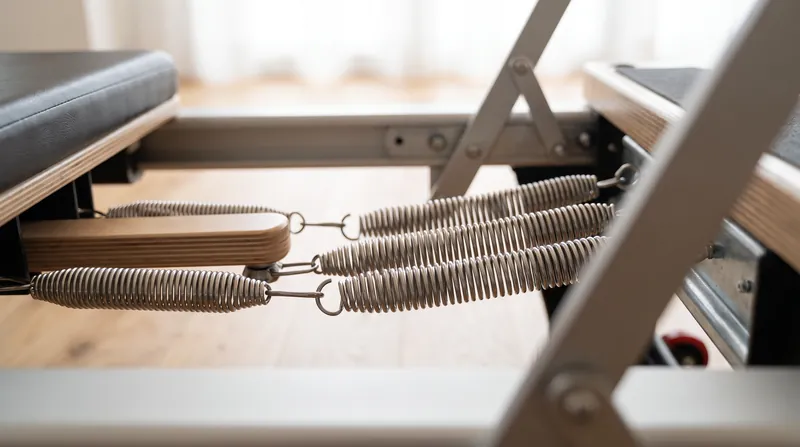
What makes the reformer uniquely suited for eccentric training is its use of variable resistance. Unlike a dumbbell, which provides a constant gravitational load throughout a movement, a spring's resistance changes dynamically. As the spring stretches further, the tension increases progressively, meaning the movement becomes harder at the exact point where the muscle is fully extended. This accommodating resistance ensures that the muscle remains engaged throughout the entire range of motion, maximizing time under tension and eliminating the "dead zones" where momentum often takes over in traditional lifting.[3]
This variable resistance is paired with the machine's defining feature: the sliding carriage. The carriage creates a deliberately unstable platform, which completely alters how the body recruits muscle fibers. A December 2024 study published in Healthcare investigated how different spring resistances on the reformer affect core muscle activity.
The researchers found that using a low-resistance spring actually increased core muscle activation significantly compared to a fixed, stable platform. Because the lighter spring provided less support, the body's deep stabilizing muscles had to work overtime to maintain balance and control the carriage.[1]
This finding translates directly into practical advice for anyone using a reformer: heavier springs do not automatically equate to a harder or better workout. While a heavy spring might challenge the larger, superficial muscles during a pushing movement, dropping to a lighter spring forces the deep core and stabilizing muscles to engage. Understanding this inverse relationship allows practitioners to target specific muscle groups simply by manipulating the machine's stability rather than just chasing heavier resistance.[1][3]
The benefits of this specialized training extend well beyond basic core strength. A 2025 study published in Frontiers in Physiology examined the effects of a 12-week Pilates reformer program on the biomechanics of Latin dancers. The researchers found that the training significantly enhanced joint angles, movement speeds, and overall muscle activation across all three axes of motion. By forcing the body to stabilize an unstable carriage against variable resistance, the reformer effectively retrains the nervous system, improving proprioception—the body's ability to sense its movement and location in space.[2]
This neuromuscular engagement is why Pilates often feels so mentally taxing. Controlling an eccentric contraction on a moving platform requires the brain to stay highly active, constantly sending micro-adjustments to the muscles to prevent the carriage from snapping back. This mind-body connection is not just a wellness buzzword; it is a measurable neurological demand that increases blood flow to the brain and creates a highly efficient neuromuscular retraining system.[3]
Despite these proven benefits, it is important to be honest about what the reformer cannot do. While it is exceptional at building functional strength, muscular endurance, and joint stability by targeting Type 1 slow-twitch muscle fibers, it is not a replacement for heavy progressive overload if the primary goal is maximum muscle hypertrophy. The springs cannot replicate the sheer mechanical tension required to build the massive Type 2 fast-twitch muscle fibers favored by bodybuilders.[3]
Ultimately, the science of the Pilates reformer offers a reassuring message: building a strong, resilient body does not require punishing joints with maximal loads. By focusing on the eccentric return phase, embracing the instability of lighter springs, and maintaining strict control over the carriage, practitioners can achieve profound structural changes. The magic of the machine lies not in how hard you can push the springs away, but in how skillfully you can resist them as they pull you back.[3]
Key terms
- Eccentric Contraction
- A type of muscle activation where the muscle lengthens while under tension, crucial for building strength and control.
- Variable Resistance
- Tension that changes throughout a movement's range of motion, such as a spring becoming harder to pull the further it stretches.
- Proprioception
- The body's ability to sense its movement, action, and location in space, which is heavily challenged by the reformer's unstable carriage.
- Type 1 Muscle Fibers
- Slow-twitch muscle fibers that are highly resistant to fatigue and are primarily targeted during endurance and stability exercises.
Frequently asked
Does Pilates build muscle like weightlifting?
It builds functional strength and endurance by targeting slow-twitch fibers through eccentric contraction, but it will not produce the bulky hypertrophy associated with heavy weightlifting.
Why do lighter springs sometimes feel harder?
Lighter springs provide less support for the sliding carriage, forcing your deep core and stabilizing muscles to work significantly harder to maintain balance.
What is an eccentric contraction?
It occurs when a muscle lengthens while still under tension, such as when you slowly control the reformer carriage as it returns to its starting position.
Viewpoints in depth
Clinical Biomechanists
Focus on the rehabilitative and joint-stabilization benefits of eccentric spring resistance.
From a clinical perspective, the reformer is viewed primarily as a tool for altering movement mechanics and stabilizing joints. Biomechanists emphasize that the variable resistance of the springs perfectly matches the natural strength curve of human muscle, providing support where the joint is weakest and maximum challenge where it is strongest. This makes it an ideal intervention for correcting postural imbalances and rehabilitating injuries without exposing the body to the sheer forces of gravity-based free weights.
Strength & Conditioning Coaches
View the reformer as an excellent tool for muscular endurance, but note it should be paired with heavy lifting for maximal hypertrophy.
Athletic coaches increasingly incorporate reformer work into their programming to build core stability, enhance proprioception, and improve the eccentric control necessary for deceleration in sports. However, they are quick to clarify its limitations. Because the springs cannot provide the maximal mechanical tension required to exhaust Type 2 fast-twitch muscle fibers, coaches argue that Pilates should supplement, rather than replace, traditional progressive overload if an athlete's goal is absolute power or significant muscle mass.
Physiotherapists
Emphasize the unstable carriage as a safe environment for retraining proprioception and core stability after injury.
For physical therapists, the magic of the reformer lies in the sliding carriage. The unstable surface forces the central nervous system to constantly recruit deep stabilizing muscles that are often dormant or bypassed during traditional exercises. By manipulating the spring tension to provide just enough support—or removing it to demand greater balance—therapists use the machine to safely retrain neuromuscular pathways, helping patients regain functional movement patterns after surgery or chronic pain.
- Clinical Biomechanists
- Focus on the rehabilitative and joint-stabilization benefits of eccentric spring resistance.
- Strength & Conditioning Coaches
- View the reformer as an excellent tool for muscular endurance, but note it should be paired with heavy lifting for maximal hypertrophy.
- Physiotherapists
- Emphasize the unstable carriage as a safe environment for retraining proprioception and core stability after injury.
Perspectives this story doesn't cover
- Traditional Bodybuilders
- Budget-Conscious Consumers
Sources
Source coverage
3 outlets
3 viewpoints surfaced



- [1]MDPI HealthcareClinical Biomechanists
Effect of Reformer Spring Resistance Modifications on Core Muscle Activity During Basic Core Muscle Exercises
Read on MDPI Healthcare → - [2]Frontiers in PhysiologyClinical Biomechanists
Effects of 12-week pilates reformer training on the biomechanics of Latin dance Cha-Cha circle chasing technique
Read on Frontiers in Physiology → - [3]Factlen Editorial TeamPhysiotherapists
Synthesis by Factlen editorial team
Read on Factlen Editorial Team →
More in Fitness
See all →Biomechanics
Reformer vs. Mat Pilates: The Biomechanics of the Powerhouse
4 sources
Biomechanics
The Science of Pilates: How Low-Impact Resistance Training Changes the Body and Brain
7 sources
Core Biomechanics
The Accommodating Resistance: How Reformer Springs Drive Higher Deep Core Co-Contraction Than Mat Pilates
5 sources
Rehabilitation Timelines
The 5-to-8 Week Threshold: How Long Pilates Must Last to Improve Chronic Low Back Pain
9 sources

Comments
Every angle. Every day.
Get Fitness stories with full source coverage and perspective breakdowns, free every day.