
Reformer vs. Mat Pilates: The Biomechanics of the Powerhouse
While the spring-loaded Reformer machine dominates social media, sports science reveals that traditional Mat Pilates often demands greater raw core activation. Here is how the two modalities compare.

Share this story
In short
- Both Mat and Reformer Pilates aim to strengthen the 'Powerhouse'—the deep stabilizing muscles of the core.
- Mat Pilates relies entirely on gravity, often resulting in higher deep core activation because there is no mechanical assistance.
- The Reformer uses springs to provide both assistance for beginners and progressive resistance for strength training.
The modern fitness landscape is currently dominated by the sleek, spring-loaded architecture of the Pilates Reformer. To a newcomer, the choice between a humble yoga mat and an intimidating, pulley-driven machine seems obvious: the expensive apparatus must offer a superior, more advanced workout. However, biomechanists and sports medicine professionals argue that the reality is far more nuanced, rooted deeply in how the human body interacts with gravity versus mechanical resistance.[4]
To understand the distinction, one must first understand the "Powerhouse." When Joseph Pilates developed his method—originally termed "Contrology"—in the early 20th century, he coined this term to describe the lumbo-pelvic cylinder. This region encompasses the transversus abdominis, the multifidus muscles along the spine, the diaphragm, and the pelvic floor.[2]
These deep stabilizing muscles act as an internal corset. Unlike the superficial "six-pack" muscles that merely flex the trunk, the Powerhouse stabilizes the spine and pelvis before any limb movement occurs. Both Mat and Reformer Pilates share the exact same primary goal: to strengthen this central cylinder so that all physical movement emanates from a stable, controlled core.[2][4]
Mat Pilates relies entirely on gravity and the practitioner's own body weight. Without any external equipment, the individual must generate one hundred percent of the muscular force required to lift, hold, and lower their limbs. There are no straps to hold the legs in the air and no springs to assist the torso in rolling off the floor.
Counterintuitively, this lack of equipment often makes Mat Pilates significantly harder for the deep core. A 2023 systematic review analyzing 27 studies found that Pilates protocols, including mat-only routines, significantly improved deep core muscle activation. In fact, electromyography (EMG) studies frequently demonstrate that Mat Pilates produces comparable or even greater core muscle activation than the Reformer for foundational exercises.[3]
"Without springs to support or guide movement, people often feel like they're 'bad' at Pilates," notes a fitness expert in recent industry coverage. In reality, the mat simply demands more internal organization, raw bodyweight awareness, and an uncompromising fight against gravity. The mat forces the body to create its own resistance.
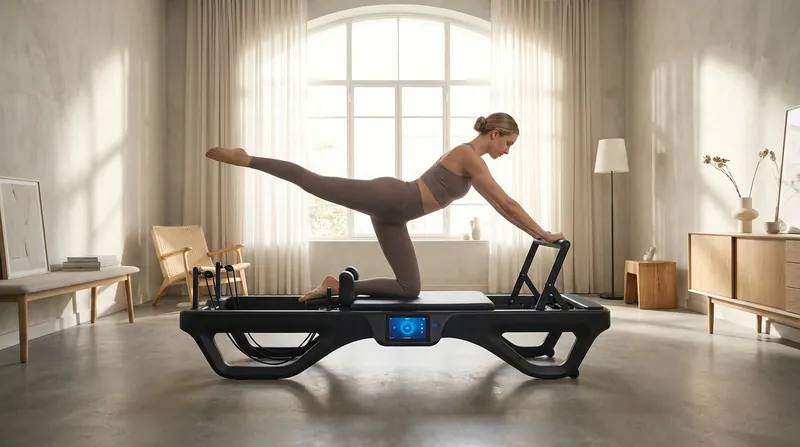
Reformer Pilates, conversely, introduces a sliding carriage, ropes, pulleys, and color-coded springs. This apparatus provides two simultaneous biomechanical forces that the mat cannot: resistance and assistance. The springs can be adjusted to either challenge a movement or support the body through it.[1]
The assistance aspect is crucial for beginners and for clinical rehabilitation. Springs can support the weight of the legs in the air, allowing a practitioner to focus on pelvic stability without their hip flexors fatiguing. Similarly, springs can assist the torso during a "roll-up," making the movement accessible to those who lack the raw core strength to perform it safely on a mat.[2]
This guided, supported movement reduces joint strain and compression. It is the primary reason the Reformer has become a staple in physical therapy clinics. For patients recovering from spinal injuries, managing osteoarthritis, or dealing with multiple sclerosis, the machine provides a safe, closed-chain environment to rebuild neuromuscular control.[1][2]
However, the Reformer's springs also provide progressive resistance. While the mat limits resistance to a person's body weight, the Reformer allows practitioners to load the muscles heavier over time. By adding heavier springs, users can drive muscular hypertrophy in the upper body, glutes, and legs—areas that are harder to overload on a mat.[1][4]
A 2025 study analyzing athletic performance found that Reformer Pilates was highly effective at improving explosive physical capacities. Soccer players utilizing the Reformer saw measurable improvements in standing broad jumps and short sprint times, directly attributable to the progressive resistance the machine provides to the lower extremities.
Flexibility gains also differ slightly between the two modalities. The Reformer's pulleys allow for deeper, assisted stretching, pulling limbs into a greater range of motion than active stretching on a mat might achieve. The machine essentially acts as a partner, gently coaxing the muscles into elongation.[1]
Yet, the mat remains a potent tool for mobility. Researchers working with physical therapy students found that Mat Pilates alone significantly improved hamstring flexibility without any static stretching. By optimizing pelvic alignment and strengthening the core, the nervous system naturally allows the hamstrings to release their protective tension.[2][4]
Ultimately, sports medicine professionals emphasize that the two modalities were never designed to compete. Joseph Pilates invented the Mat sequence first, later developing the apparatus specifically to help clients find the correct muscle engagement to take back to the mat.[2]
For those seeking maximum core activation, internal body awareness, and zero equipment cost, the mat remains an unparalleled tool. For those requiring joint support, targeted rehabilitation, or progressive resistance for the limbs, the Reformer is the optimal choice. The most comprehensive practice inevitably embraces both.[4]
Definitions
- Powerhouse
- The foundational concept in Pilates referring to the cylinder of deep core muscles, including the abdominals, lower back, and pelvic floor.
- Transversus Abdominis
- The deepest layer of abdominal muscle that wraps around the torso like a corset, crucial for spinal stability.
- Progressive Overload
- The gradual increase of stress placed upon the body during exercise, such as adding heavier springs, to continuously build strength.
- Carriage
- The sliding platform on a Reformer machine that moves back and forth along a track during exercises.
- Electromyography (EMG)
- A diagnostic procedure that evaluates the health condition of muscles and the nerve cells that control them, used to measure muscle activation.
Questions & answers
Is Reformer Pilates better for weight loss than Mat Pilates?
Neither form is primarily a cardiovascular weight-loss tool; both focus on strength, mobility, and body composition. However, the Reformer's added resistance can build slightly more muscle mass, which marginally increases resting metabolic rate.
Can I do Mat Pilates if I have lower back pain?
Yes, but with caution. Mat Pilates strengthens the deep core muscles that support the spine, but beginners with back pain often benefit from starting on a Reformer, where springs can support the body and ensure proper alignment.
How often should I practice to see results?
Most sports science studies observe significant improvements in core endurance, flexibility, and posture with two to three sessions per week over an 8-to-12-week period.
Analysis by camp
Classical Pilates Purists
Advocates who believe the Mat sequence is the ultimate test of true Pilates mastery.
This camp emphasizes that Joseph Pilates designed the Mat work as the foundation of his 'Contrology' method. They argue that machines can create a false sense of security or dependency. On the mat, there is nowhere to hide—practitioners must fight gravity and their own body weight, requiring intense mental concentration and raw internal strength to execute movements precisely without mechanical assistance.
Clinical Rehabilitation Specialists
Physical therapists and sports medicine professionals who utilize the Reformer for injury recovery.
For clinical practitioners, the Reformer is an invaluable medical tool. The machine's springs provide proprioceptive feedback and support the weight of injured limbs, allowing patients to rebuild strength without compressing vulnerable joints. They point to extensive data showing the Reformer's efficacy in treating lower back pain, multiple sclerosis, and post-surgical recovery, where the mat might be too aggressive.
Athletic Performance Coaches
Trainers who use Pilates to enhance explosive power and agility in competitive athletes.
This group values the Reformer's ability to provide progressive resistance. While they acknowledge the core benefits of Mat Pilates, they argue that athletes require the external load provided by heavy springs to drive muscular hypertrophy and improve metrics like sprint times and broad jumps. For them, the machine bridges the gap between core stability and traditional strength training.
- Classical Pilates Purists
- Focus on bodyweight mastery, internal awareness, and the foundational Mat practice.
- Clinical Rehabilitation Specialists
- Focus on joint support, injury prevention, and guided movement via the Reformer.
- Sports Science Researchers
- Focus on EMG muscle activation, progressive overload, and measurable biomechanical outcomes.
Perspectives this story doesn't cover
- Budget-conscious fitness consumers who rely exclusively on free at-home mat routines
- Pilates studio owners balancing equipment costs with class accessibility
Sources
Source coverage
4 outlets
3 viewpoints surfaced




- [1]Medical News TodayClinical Rehabilitation Specialists
Reformer vs. mat Pilates: What is the difference?
Read on Medical News Today → - [2]National Institutes of HealthSports Science Researchers
Pilates: What Is It? Should It Be Used in Rehabilitation?
Read on National Institutes of Health → - [3]Journal of Clinical MedicineSports Science Researchers
Systematic Review of Pilates Core Muscle Activation
Read on Journal of Clinical Medicine → - [4]Factlen Editorial TeamClassical Pilates Purists
Synthesis by Factlen editorial team
Read on Factlen Editorial Team →
More in Fitness
See all →Biomechanics
How Imprinted Pelvic Alignment Protects Lumbar Facet Joints During Leg Exercises
6 sources
Biomechanics
Pilates Reformers Build Strength Through Eccentric Contraction and Spring Tension
3 sources
Metabolic Health
Landmark Study Finds Pilates Significantly Improves Heart and Metabolic Health in Sedentary Women
5 sources
Fitness Tech
AI-Powered Reformers and Gen Z Adoption Drive Pilates From Niche Practice to Mainstream Fitness Powerhouse
2 sources
Comments
Every angle. Every day.
Get Fitness stories with full source coverage and perspective breakdowns, free every day.