
How Hydrogen-Powered Trains Are Decarbonizing the World's Railways
Hydrogen fuel cell trains are replacing diesel locomotives on non-electrified tracks, emitting nothing but water vapor. This explainer breaks down the technology, the economics, and the ongoing debate between hydrogen and battery-electric rail.
By Factlen Editorial Team
- Hydrogen Rail Advocates
- Believe hydrogen fuel cells are the ultimate zero-emission solution for long-distance and heavy-rail transport.
- Battery-Electric Proponents
- Argue that battery trains are more energy-efficient and cost-effective for the majority of regional rail networks.
- Infrastructure Pragmatists
- Emphasize that the success of hydrogen trains depends entirely on the costly development of green hydrogen production and refueling networks.
What's not represented
- · Fossil Fuel Industry Representatives
- · Local Transit Union Operators
Why this matters
Transportation is one of the largest sources of global carbon emissions. Hydrogen trains offer a viable, zero-emission alternative for the thousands of miles of rural and long-distance railways where traditional electrification is too expensive to build, paving the way for entirely green transit networks.
Key points
- Hydrogen trains use fuel cells to generate electricity on board, emitting only water vapor.
- They are designed to replace diesel locomotives on rural and long-distance routes where overhead electrification is too expensive.
- Most hydrogen trains are hybrids, using lithium-ion batteries to handle peak power demands and store braking energy.
- A single tank of hydrogen provides a range of up to 1,000 kilometers and can be refueled in 15 minutes.
- The technology's true environmental benefit relies on scaling up 'green hydrogen' produced via renewable energy.
- Industry experts view hydrogen and battery-electric trains as complementary tools rather than direct competitors.
For decades, rail travel has been championed as the poster child of sustainable transportation. Even a diesel-guzzling locomotive produces significantly fewer emissions per passenger kilometer than a fleet of cars or a commercial airliner. Yet, the rail industry harbors a dirty secret: a massive portion of the world's train networks still relies entirely on diesel combustion. Across the European Union, nearly 46 percent of the railway network remains non-electrified, while in North America, the sheer vastness of the continent makes continuous overhead wiring financially ruinous. As governments worldwide mandate aggressive net-zero targets, the rail sector faces a monumental challenge: how to decarbonize the thousands of miles of track where traditional electrification is impossible. The answer increasingly points to a technology that sounds like science fiction but is already carrying passengers today: the hydrogen-powered train, or "hydrail."[1][2][8]
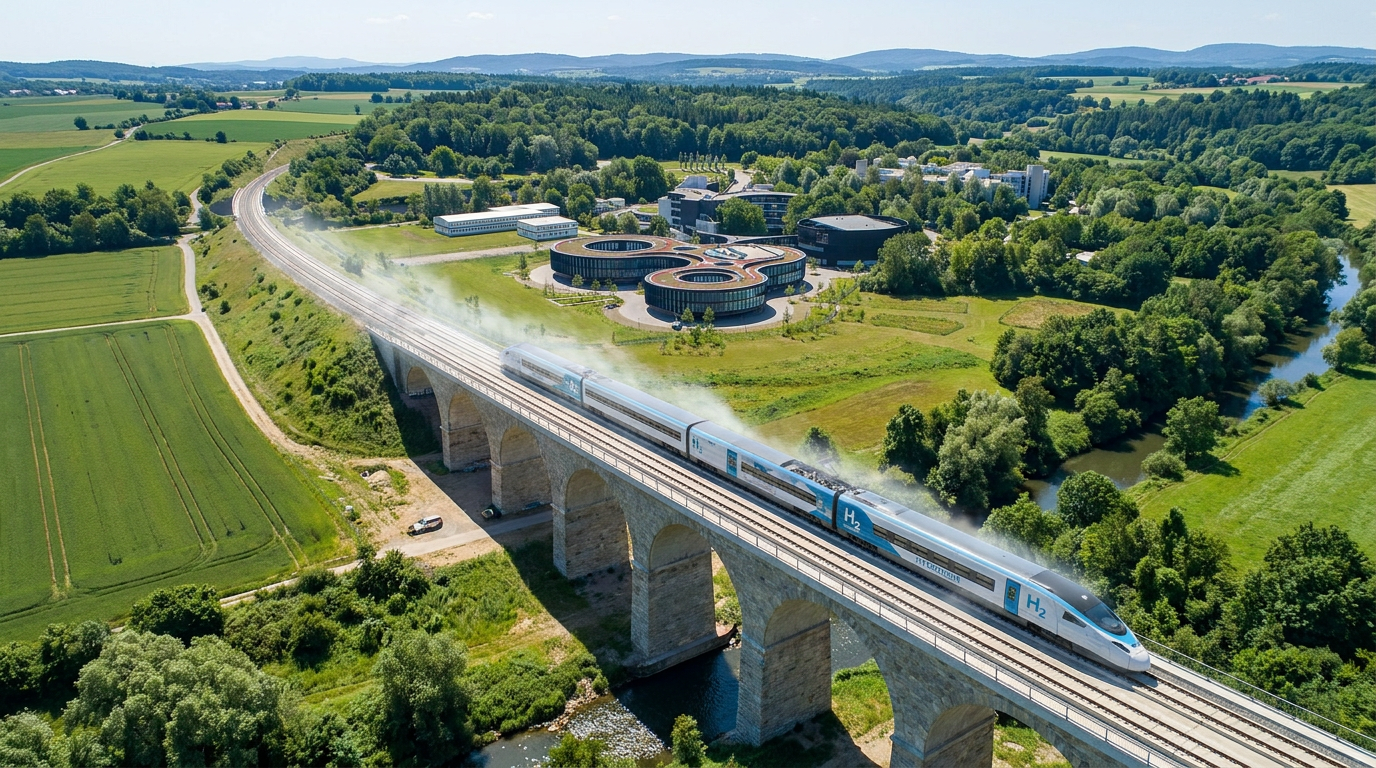
At its core, a hydrogen train is simply an electric train that carries its own power plant. Instead of drawing current from overhead catenary wires or a charged third rail, a hydrail vehicle generates electricity on board using hydrogen fuel cells. The process relies on a fundamental electrochemical reaction. High-pressure tanks stored on the roof of the train feed gaseous hydrogen into the fuel cell, where it meets oxygen drawn from the ambient air. Inside the cell, the hydrogen molecules are split into electrons and protons. The electrons are forced through a circuit, creating the electrical current that drives the train's traction motors. The only byproduct of this entire process is the combination of the remaining protons and oxygen: pure water vapor and heat. There is no combustion, no smoke, and virtually no engine noise.[3][4]
However, the fuel cell does not work alone. Almost all modern hydrogen trains are technically hybrids, pairing the hydrogen fuel cells with substantial lithium-ion battery packs. This architecture is crucial because rail traction is highly dynamic. A train requires massive surges of power to accelerate from a standstill or climb a steep gradient, but needs relatively little energy to cruise at a constant speed. The fuel cell operates most efficiently when providing a steady, continuous output. Therefore, the fuel cell constantly charges the onboard batteries, which then handle the sudden peaks in power demand. Furthermore, these batteries capture and store kinetic energy during regenerative braking, drastically improving the train's overall efficiency and ensuring no energy is wasted when the train slows down for a station.[3][7]

The theoretical promise of hydrail became a commercial reality thanks to the French rail manufacturer Alstom, which debuted the Coradia iLint at the InnoTrans trade fair in 2016. By 2018, the iLint had entered regular passenger service in Lower Saxony, Germany, marking the world's first commercial deployment of a hydrogen fuel cell train. The specifications of the Coradia iLint demonstrate why the technology is so appealing to regional transit authorities. A single tank of hydrogen provides a range of up to 1,000 kilometers (approximately 621 miles), allowing the train to operate for a full day on a single fueling. It can reach speeds of 140 kilometers per hour, matching the performance of the diesel regional trains it is designed to replace, while saving thousands of liters of diesel fuel each month.[1][5]
Since its debut in Germany, the Coradia iLint and its underlying technology have sparked a global wave of hydrail adoption. Alstom has successfully demonstrated the train in Poland, the Netherlands, and Austria, and recently completed a highly publicized passenger trial in Quebec, Canada—the first hydrogen train deployment in the Americas. The North American trial was particularly significant because the continent's sprawling, low-density rail networks are perfectly suited for hydrogen's long-range capabilities. Other manufacturers are rapidly entering the space; in the United Kingdom, a consortium developed the HydroFLEX, a retrofitted bi-mode train that can draw power from existing electrified rails and seamlessly switch to hydrogen power when the wires run out.[1][2][5]
Since its debut in Germany, the Coradia iLint and its underlying technology have sparked a global wave of hydrail adoption.
To understand why transit agencies are investing millions in hydrogen technology, one must look at the staggering economics of traditional rail electrification. Installing overhead catenary wires requires massive infrastructure overhauls, including raising bridges, modifying tunnels, and building electrical substations. In the United Kingdom, assessments have shown that electrifying a single kilometer of track can cost anywhere from £750,000 to £1 million. For dense, high-frequency commuter lines, that investment pays off. But for rural, low-density routes that only see a few trains a day, traditional electrification is a financial impossibility. Hydrogen trains allow operators to utilize the existing, un-electrified track infrastructure without pouring billions into overhead wires, effectively bridging the gap between economic reality and climate goals.[2][4]

Despite its momentum, hydrogen is not the only zero-emission alternative to diesel. The rail industry is currently engaged in a fierce debate between hydrogen fuel cells and battery-electric multiple units (BEMUs). Battery trains operate on a similar principle to electric cars, charging up at stations or via short stretches of electrified track. Proponents of battery technology, including major manufacturers like Siemens Mobility, point out that batteries are simpler, have fewer moving parts, and boast a higher overall energy efficiency. Because hydrogen must be converted from electricity to gas and then back to electricity, the "round-trip" efficiency of a hydrogen train is roughly 30 percent, compared to the much higher efficiency of direct battery storage. Furthermore, battery costs are falling rapidly, making them an increasingly attractive option for shorter regional routes.[6][7]
However, batteries have distinct limitations that hydrogen is uniquely positioned to solve. Current battery technology is heavy and offers a relatively limited range, requiring frequent recharging stops that can disrupt tight railway timetables. For long-distance routes, heavy freight operations, or corridors where charging infrastructure is impossible to build, hydrogen remains the superior choice. A hydrogen train can be refueled in roughly 15 minutes, mimicking the operational turnaround time of a traditional diesel locomotive. Industry experts increasingly view the two technologies not as zero-sum competitors, but as complementary tools: batteries for short, partially electrified commuter hops, and hydrogen for the long, grueling hauls across open country.[6][7]

The ultimate climate benefit of a hydrogen train, however, depends entirely on how the hydrogen is sourced. Hydrogen is an energy carrier, not a primary energy source, meaning it must be manufactured. Today, the vast majority of the world's hydrogen is "grey hydrogen," stripped from natural gas in a carbon-intensive process that defeats the purpose of a zero-emission train. For hydrail to be genuinely sustainable, it must be powered by "green hydrogen," which is produced through the electrolysis of water using renewable energy sources like wind or solar. While green hydrogen production is scaling up—such as the hydropower-sourced fuel used for the Quebec trials—it remains a bottleneck for the widespread adoption of the technology.[3][7]

Beyond the fuel itself, the logistical infrastructure required to support a hydrogen railway is immense. Transitioning from diesel to hydrogen requires building highly specialized, high-pressure refueling stations, establishing complex distribution networks, and implementing stringent new safety protocols to handle the volatile gas. Currently, the operational cost per kilometer for hydrogen fuel is estimated to be roughly three times that of battery-powered alternatives. Yet, as governments pour subsidies into the broader hydrogen economy and scale drives down production costs, these financial barriers are expected to shrink. The trains themselves have already proven that the technology works flawlessly; the next decade will determine whether the world can build the ecosystem needed to keep them running.[6][7][8]
How we got here
2016
Alstom unveils the Coradia iLint, the world's first hydrogen-powered passenger train, at the InnoTrans trade fair in Berlin.
2018
The Coradia iLint enters commercial passenger service in Lower Saxony, Germany.
2019
The UK launches the HydroFLEX, a retrofitted bi-mode train capable of running on both overhead wires and hydrogen power.
2023
Hydrogen passenger trains make their North American debut with a successful commercial trial in Quebec, Canada.
Viewpoints in depth
Hydrogen Rail Advocates
Believe hydrogen fuel cells are the ultimate zero-emission solution for long-distance and heavy-rail transport.
Proponents of hydrogen technology argue that batteries simply cannot meet the rigorous demands of long-distance passenger travel and heavy freight. They point to the 1,000-kilometer range of current hydrogen trains and their rapid 15-minute refueling times as proof that hydrail is the only viable 1:1 replacement for diesel locomotives. For these advocates, the massive upfront cost of building hydrogen refueling infrastructure is a necessary investment to unlock zero-emission transport across vast, un-electrified continents like North America and Australia.
Battery-Electric Proponents
Argue that battery trains are more energy-efficient and cost-effective for the majority of regional rail networks.
Critics of hydrogen rail often champion battery-electric multiple units (BEMUs) as a more pragmatic solution. They highlight the fundamental inefficiency of the hydrogen cycle: using electricity to create hydrogen, only to convert it back into electricity on the train, results in a massive loss of energy. Battery advocates argue that for the vast majority of regional commuter routes, trains can simply charge via short stretches of overhead wires or at station terminals, offering a cheaper, simpler, and more energy-efficient path to decarbonization.
Infrastructure Pragmatists
Emphasize that the success of hydrogen trains depends entirely on the costly development of green hydrogen production and refueling networks.
This camp views the train itself as the easiest part of the equation. Pragmatists argue that the real bottleneck for hydrail is the lack of "green hydrogen"—fuel produced using renewable energy rather than fossil fuels. They warn that until green hydrogen production scales up and the cost of specialized refueling stations comes down, hydrogen trains risk being an expensive niche rather than a global standard. They advocate for a mixed approach, deploying hydrogen only on specific corridors where batteries and overhead wires are strictly impossible.
What we don't know
- How quickly the cost of 'green hydrogen' production will fall to achieve price parity with diesel fuel.
- Whether future breakthroughs in solid-state battery technology will eventually render hydrogen trains obsolete by offering massive range without the need for fuel cells.
- How rapidly governments will fund the specialized, high-pressure refueling infrastructure required for widespread hydrail adoption.
Key terms
- Hydrail
- A portmanteau of 'hydrogen' and 'rail,' referring to any rail vehicle powered by hydrogen fuel cells.
- Fuel Cell
- A device that generates electricity through an electrochemical reaction between hydrogen and oxygen, producing only water as a byproduct.
- Electrolysis
- The process of using electricity to split water into hydrogen and oxygen, used to create zero-emission 'green hydrogen.'
- Catenary Wires
- The system of overhead electrical wires used to supply power to traditional electric trains.
- Regenerative Braking
- A mechanism that captures the kinetic energy normally lost during braking and stores it in the train's battery for later use.
Frequently asked
Do hydrogen trains produce any pollution?
No. The only byproducts of a hydrogen fuel cell are pure water vapor and heat. They produce zero greenhouse gas emissions during operation.
Are hydrogen trains safe?
Yes. While hydrogen is highly flammable, modern hydrail systems use heavily reinforced, crash-tested carbon-fiber tanks and advanced leak-detection sensors that make them as safe as traditional diesel trains.
How fast can a hydrogen train go?
Current passenger models like the Alstom Coradia iLint can reach speeds of 140 km/h (87 mph), matching the performance of the diesel trains they replace.
Why not just use battery-powered trains?
Battery trains are excellent for short routes, but they lack the range for long-distance travel and take longer to recharge. Hydrogen trains can travel up to 1,000 km and refuel in just 15 minutes.
Sources
Source coverage
8 outlets
3 viewpoints surfaced








[1]AlstomHydrogen Rail Advocates
Coradia iLint: The world's 1st hydrogen powered train
Read on Alstom →[2]RailTargetHydrogen Rail Advocates
The Coradia iLint, the world's first hydrogen fuel cell passenger train, debuts in Poland
Read on RailTarget →[3]TWI GlobalInfrastructure Pragmatists
How Do Hydrogen Powered Trains Work?
Read on TWI Global →[4]Luxfer CylindersHydrogen Rail Advocates
What are hydrogen trains? How it works
Read on Luxfer Cylinders →[5]SlashGearInfrastructure Pragmatists
Hydrogen Powered Trains Explained: Could They Be The Future Of Travel?
Read on SlashGear →[6]Rail ExpressBattery-Electric Proponents
Hydrogen vs battery-powered trains: Why both have a place in the future of rail
Read on Rail Express →[7]IlluminemInfrastructure Pragmatists
Hydrogen trains: a tool, not a silver bullet
Read on Illuminem →[8]Factlen Editorial TeamInfrastructure Pragmatists
Synthesis by Factlen editorial team
Read on Factlen Editorial Team →
Every angle. Every day.
Get automotive stories with full source coverage and perspective breakdowns delivered to your inbox.