
How Hydrofoil Technology is Solving the Electric Boating Range Problem
By lifting hulls above the water, a new generation of electric boats is cutting energy consumption by 80 percent and making long-range, zero-emission marine travel a reality.
By Factlen Editorial Team
- Hydrofoil Innovators
- Argue that lifting the hull is the only viable path to long-range electric boating.
- Commercial & Municipal Operators
- Focus on the economic and infrastructure benefits of foiling ferries for public transit.
- Conventional Hull Advocates
- Argue that hydrofoils are too fragile and complex for rugged, everyday boating.
- Marine Traditionalists
- Emphasize hybrid systems as the practical bridge for unpredictable real-world use.
What's not represented
- · Marine Wildlife Conservationists
- · Marina Infrastructure Developers
Why this matters
Marine transport accounts for roughly 3 percent of global greenhouse gas emissions. Hydrofoiling technology proves that waterways can be decarbonized today without waiting for next-generation battery breakthroughs, offering a faster, cheaper, and quieter alternative to coastal road traffic.
Key points
- Hydrofoil technology lifts a boat's hull out of the water, reducing hydrodynamic drag by up to 80 percent.
- This efficiency allows electric boats to achieve long ranges on relatively small battery packs.
- Active flight controllers adjust the underwater wings up to 100 times per second to ensure a smooth, stable ride.
- Commercial operators are adopting hydrofoil ferries to cut travel times and eliminate wake in urban waterways.
- Conventional hull advocates argue hydrofoils are too fragile for shallow waters and rugged recreational use.
The transition to electric mobility on the water faces a stubborn physics problem: water is incredibly dense. Pushing a hull through it requires immense, sustained energy. For decades, the marine industry solved this brute-force equation with massive diesel engines and huge fuel tanks. But as the world shifts toward electrification, boat builders have hit a wall dictated by battery density.[4][8]
Dropping a heavy lithium-ion battery into a traditional boat hull yields disappointing results. The constant drag of the water drains the battery rapidly, leading to severe range anxiety at anything above a slow crawl. As marine engineers like to point out, pushing a conventional hull through water at high speeds is aerodynamically equivalent to driving a car with a parachute deployed out the back.[5]
Enter the hydrofoil. While the concept of underwater wings is not new, the convergence of lightweight carbon fiber, high-density batteries, and aerospace-grade flight controllers has triggered a revolution in marine mobility. Companies like Sweden's Candela and the US-based Navier are treating boats less like ships and more like low-flying aircraft.[1][5]
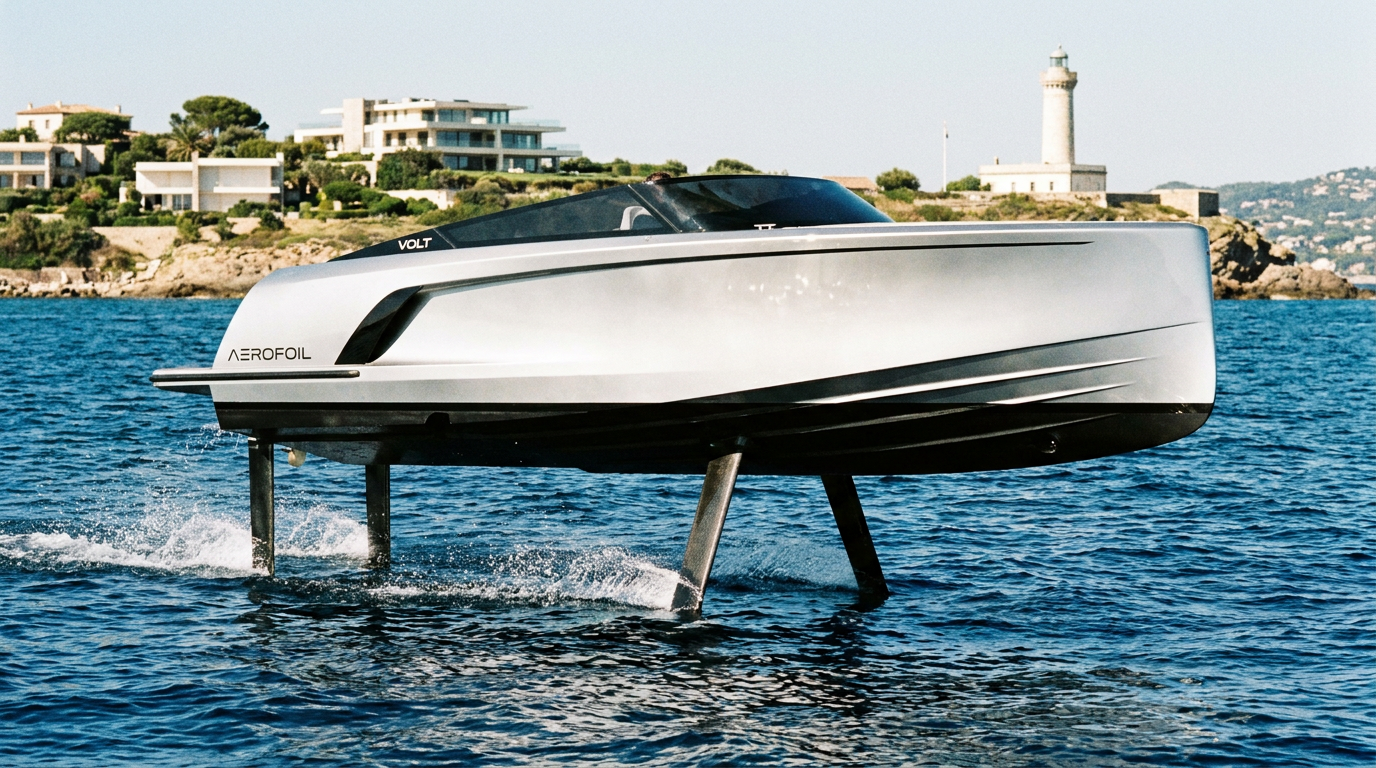
The mechanism is elegantly simple in theory but complex in execution. As the boat accelerates, underwater wings—called hydrofoils—generate lift, eventually raising the entire hull above the surface of the water. By replacing the large wetted surface area of a traditional hull with the slim profile of foil struts, these vessels reduce hydrodynamic drag by up to 80 percent.[1][3]

This massive reduction in drag is the "magic hack" that makes long-range electric boating viable. Without the constant friction of the water, a hydrofoiling boat can travel significantly further on a much smaller battery pack. For example, the Candela C-8 utilizes a 69-kilowatt-hour battery pack—borrowed from electric automaker Polestar—to achieve a cruising range of 57 nautical miles at 22 knots.[2][3]
The efficiency gains translate directly into operational cost savings. During a historic 2025 crossing of the Strait of Gibraltar—the first intercontinental voyage by an electric vessel—a Candela C-8 traveled from Europe to North Africa using just 40 kilowatt-hours of energy. The electricity cost roughly €8. A similarly sized gasoline-powered chase boat burned 50 liters of fuel for the exact same journey, costing around €90.[7]
Beyond range and cost, hydrofoiling fundamentally alters the passenger experience. Because the hull flies above the waves, the boat is immune to the constant pounding and slamming associated with choppy water. The ride is eerily smooth and nearly silent, with no engine roar and minimal wake left behind.[1][3]
Beyond range and cost, hydrofoiling fundamentally alters the passenger experience.
This smooth ride is maintained by sophisticated software. Modern electric hydrofoils rely on active flight controllers that function much like those in fighter jets. Sensors continuously monitor wave height, wind speed, and steering inputs, adjusting the angle of the underwater wings up to 100 times per second to keep the vessel perfectly balanced.[3]

The technology is now scaling beyond luxury recreational craft into the commercial sector. Urban centers with extensive waterways are recognizing that electric hydrofoils could revolutionize public transit. Stockholm recently deployed the Candela P-12, a 30-passenger electric hydrofoil ferry, into its public transport network.[7][8]
The P-12 ferry operates at speeds of 25 knots, cutting travel times in half compared to traditional diesel ferries. Because it produces almost no wake, it is exempt from the strict speed limits typically enforced in urban waterways to protect shorelines and moored vessels. Additional routes are already slated for Berlin, Lake Tahoe, and the NEOM development in Saudi Arabia.[7]
Market analysts project steep growth for this sector. The global electric hydrofoil boat market is forecast to grow at a compound annual growth rate of 13.4 percent, potentially reaching $2.7 billion by 2030. While recreational users currently make up the majority of unit sales, commercial adoption—particularly passenger ferries—is expected to surpass the leisure market in total value by 2028.[6]

Despite the optimism, hydrofoil technology is not a universal solution for the marine industry. The underwater wings add significant draft when not in flight, making them unsuitable for shallow waters or beaching. Furthermore, high-speed collisions with submerged debris—such as logs or shipping containers—pose a serious risk to the carbon-fiber struts, though manufacturers have engineered designated breaking points to protect the main hull from catastrophic damage.[1][7]
These limitations have fueled a diverging philosophy within the electric boat market. While the "hydrofoil efficiency class" pursues aerodynamic perfection, a separate segment of builders is doubling down on conventional hulls. Companies like Voltaic Marine argue that many boaters need rugged aluminum hulls capable of towing wakeboarders, navigating shallow rivers, and enduring rough-and-tumble use.[1]
For these conventional-hull advocates, the solution to the range problem is not flying above the water, but rather deploying massive, automotive-grade battery packs and accepting shorter operational ranges. They cater to the reality that most recreational boating happens on inland lakes, where daily distances are modest and charging can be centralized at local marinas.[1]

Meanwhile, traditional marine manufacturers are exploring hybrid systems as a transitional step. By combining electric propulsion for quiet, low-emission cruising with a combustion engine for extended range, hybrids offer a safety net for boaters operating in areas where fast-charging infrastructure remains scarce or unreliable.[4]
Ultimately, the electrification of the water will not follow the monolithic path of the automotive industry. The physics of the ocean demand specialized solutions for different use cases. But as battery costs continue to fall and fast-charging networks expand to coastal marinas, the sight of boats silently flying above the waves is poised to become a standard feature of the maritime landscape.[7]
How we got here
2019
Candela launches the C-7, proving the concept of a long-range electric hydrofoil leisure boat.
August 2021
The Candela C-8 is introduced, quickly becoming the best-selling electric boat in Europe.
September 2023
A Candela C-8 sets a 24-hour distance record, traveling 420 nautical miles to prove the viability of DC fast charging on the water.
2024
Stockholm begins trials of the P-12 electric hydrofoil ferry in its public transport network.
June 2025
An electric hydrofoil completes the first intercontinental crossing from Europe to Africa across the Strait of Gibraltar.
Viewpoints in depth
Hydrofoil Innovators
Argue that lifting the hull is the only viable path to long-range electric boating.
This camp, led by companies like Candela and Navier, views traditional boat hulls as fundamentally incompatible with current battery technology. They argue that the 80% reduction in drag achieved by foiling is a necessary "hack" to overcome the density limits of lithium-ion batteries. For these innovators, the future of marine transport looks more like aviation than traditional boating, relying on aerospace engineering and software to deliver silent, wake-free, and hyper-efficient travel.
Conventional Hull Advocates
Argue that hydrofoils are too fragile and complex for rugged, everyday boating.
Builders like Voltaic Marine and traditional boaters emphasize that hydrofoils fail in real-world conditions that require durability. Foils cannot be easily beached, struggle in shallow or debris-laden waters, and lack the torque needed for towing wakeboarders. This camp believes the solution lies in massive, automotive-grade battery packs and rugged aluminum hulls, accepting shorter ranges in exchange for the versatility and durability that average recreational boaters demand.
Commercial & Municipal Operators
Focus on the economic and infrastructure benefits of foiling ferries for public transit.
For port authorities and urban planners, the appeal of hydrofoils is purely economic and regulatory. Ferries like the Candela P-12 cut energy costs by up to 80% compared to diesel equivalents and produce zero wake, allowing them to operate at high speeds through heavily regulated urban waterways. This camp views hydrofoils not as luxury toys, but as a scalable solution to reduce road congestion and decarbonize coastal public transport.
What we don't know
- Whether the high initial cost of hydrofoil technology will drop enough to reach the mass recreational market.
- How quickly coastal marinas will deploy the high-voltage DC fast chargers required to support long-distance electric cruising.
Key terms
- Hydrofoil
- An underwater wing designed to generate lift, raising a boat's hull out of the water to reduce hydrodynamic drag.
- Wetted Surface Area
- The portion of a boat's hull that is submerged and in contact with the water, creating friction.
- Flight Controller
- The onboard computer system that uses sensors to continuously adjust the angle of the hydrofoils for stability.
- Draft
- The vertical distance between the waterline and the bottom of the boat's hull or lowest appendage.
- Planing Hull
- A traditional boat hull designed to rise up and glide on top of the water at higher speeds, though it still maintains significant contact and drag.
Frequently asked
What is an electric hydrofoil boat?
A boat that uses underwater wings to lift its hull out of the water as it accelerates, significantly reducing drag and allowing electric motors to achieve long ranges.
How much does an electric hydrofoil boat cost?
Premium recreational models like the Candela C-8 start around $340,000, though commercial ferries are expected to drive long-term economies of scale.
What happens if a hydrofoil hits a log?
Manufacturers engineer designated breaking points into the carbon-fiber struts, ensuring the foil breaks away before catastrophic damage occurs to the main hull.
Can you use a hydrofoil in shallow water?
Hydrofoils require deeper water when not in flight due to the draft of the underwater wings, making them less suitable for shallow rivers or beaching.
Sources
Source coverage
8 outlets
4 viewpoints surfaced








[1]EVWorld.comConventional Hull Advocates
Electric Boats in 2026: A Market at the Turning Point
Read on EVWorld.com →[2]PlugboatsHydrofoil Innovators
Candela C-8 smashes electric boat range record
Read on Plugboats →[3]Boote-MagazinHydrofoil Innovators
Candela C-8: Is this the electric future?
Read on Boote-Magazin →[4]YachtWorldMarine Traditionalists
The Rise of Electric Boats: A Boater's Guide
Read on YachtWorld →[5]The Green BoaterHydrofoil Innovators
Hydrofoil Technology: The Massive Hack for Efficiency
Read on The Green Boater →[6]Strategic Market ResearchCommercial & Municipal Operators
Electric Hydrofoil Boats Market Report 2024–2030
Read on Strategic Market Research →[7]Factlen Editorial TeamCommercial & Municipal Operators
Synthesis by Factlen editorial team
Read on Factlen Editorial Team →[8]EV MagazineMarine Traditionalists
Electrified boats won't leave you stranded
Read on EV Magazine →
Every angle. Every day.
Get automotive stories with full source coverage and perspective breakdowns delivered to your inbox.