
How Hydrofoil Technology is Solving Electric Boating's Range Problem
By lifting hulls above the water, computer-controlled underwater wings are reducing drag by up to 90%, finally making long-range electric boats viable.
By Factlen Editorial Team
- Marine Innovators
- Focuses on the technological breakthroughs and commercial potential of electric hydrofoils.
- Engineering & Physics
- Analyzes the fluid dynamics, structural requirements, and physical limitations of foilborne travel.
- Editorial Synthesis
- Provides a comprehensive overview of the environmental benefits and market challenges.
What's not represented
- · Commercial Fishermen
- · Marine Wildlife Biologists
- · Port Authority Regulators
Why this matters
Water's immense density has long kept electric boats tethered to the shore with severe range limitations. Hydrofoiling breaks this physical barrier, opening the door to zero-emission maritime transport, silent recreational boating, and high-speed commuter ferries that don't erode coastlines.
Key points
- Water's density creates massive drag for traditional hulls, severely limiting the range of electric boats.
- Hydrofoils use underwater wings to lift the hull completely out of the water, reducing energy consumption by up to 90 percent.
- Modern electric hydrofoils rely on aerospace-grade carbon fiber and advanced flight controllers to maintain stability.
- The technology eliminates wakes, protecting coastlines from erosion and allowing high-speed travel in restricted zones.
- High costs and the risk of striking submerged debris remain the primary hurdles to mainstream adoption.
The electrification of transportation has conquered the roads, but the water has proven to be a far more stubborn frontier. The fundamental barrier is physics: water is approximately 800 times denser than air.[1][6]
Pushing a traditional boat hull through this dense medium—known as displacement—requires an immense amount of energy. As a boat accelerates, it builds a bow wave that it must constantly climb over, creating massive hydrodynamic drag.[1]
For electric boats, this creates a vicious cycle. To achieve a usable range, a boat needs a massive battery pack. However, batteries are heavy, and adding weight pushes the hull deeper into the water, increasing displacement and drag, which in turn drains the battery faster.[6]
As a result, traditional electric boats have largely been relegated to slow-speed lake cruising, unable to match the range and utility of their fossil-fuel counterparts. But a quiet revolution is underway, driven by an old concept reimagined for the electric age: the hydrofoil.[4][6]
A hydrofoil is essentially an underwater wing attached to the hull by struts. It operates on the same fluid dynamics principles as an airplane wing, utilizing Bernoulli's principle to generate lift.[1]
As the boat accelerates, water flows over the curved upper surface of the foil faster than it flows under the flatter bottom surface. This creates a pressure differential—lower pressure on top, higher pressure on the bottom—that exerts a powerful upward force.[1]

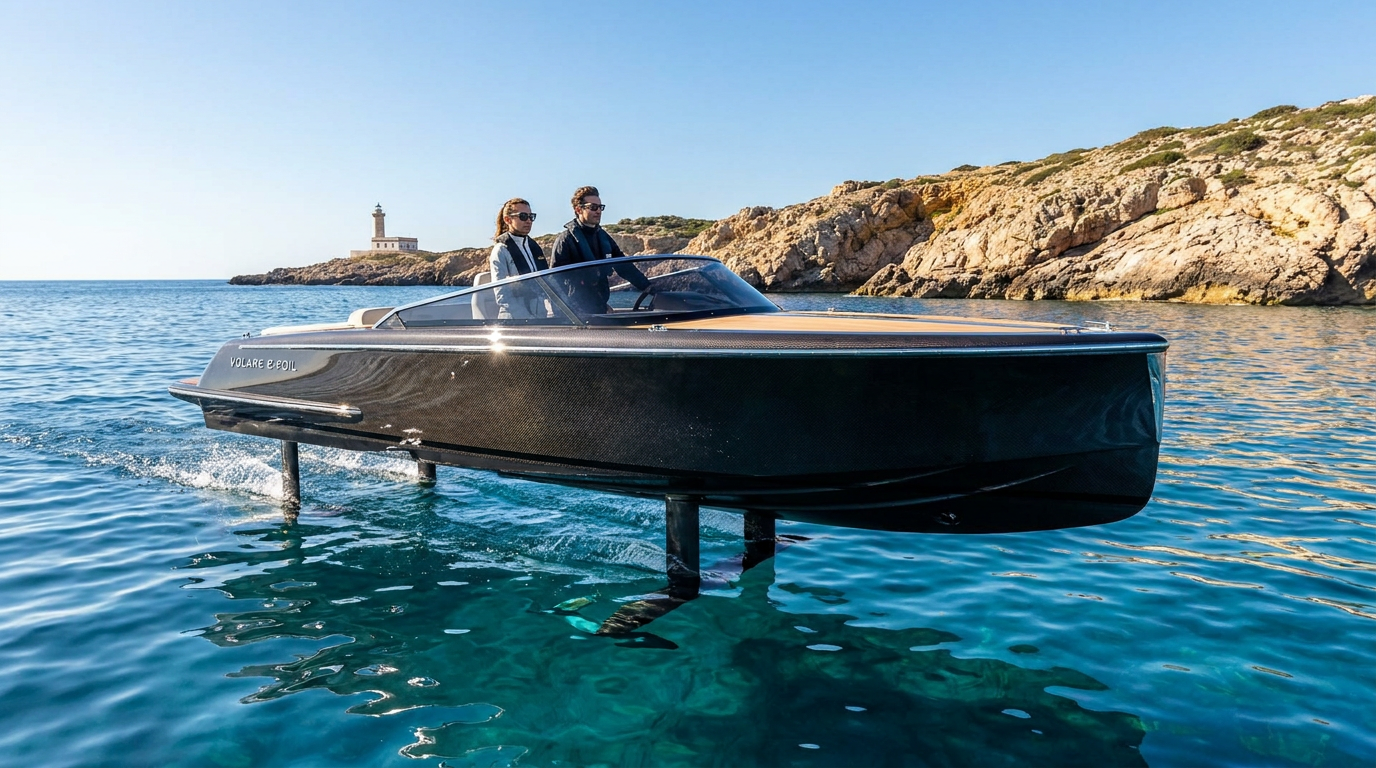
Once the vessel reaches a specific take-off speed, this lift overcomes the weight of the boat, raising the hull completely out of the water. Suddenly, the boat is no longer pushing through the water; it is flying above it.[1][2]
The efficiency gains are staggering. By eliminating hull drag, hydrofoiling reduces a boat's energy consumption by 80 to 90 percent.[4][6]
This aerodynamic efficiency is the missing key to electric boating. Leading manufacturers like Sweden's Candela and the California-based Navier are now producing electric hydrofoils that boast ranges of 50 to 90 nautical miles on a single charge, while cruising comfortably at 20 to 25 knots.[3][5]

This aerodynamic efficiency is the missing key to electric boating.
If the physics of hydrofoiling have been understood for over a century, why is this breakthrough happening now? The answer lies in the convergence of advanced materials and modern computing.[4][6]
Early hydrofoils were heavy and mechanically complex. Today, the marine industry is utilizing aerospace-grade carbon fiber to craft foils and struts that are incredibly strong yet light enough to maximize battery efficiency.[6]
More crucially, modern electric hydrofoils rely on sophisticated "fly-by-wire" software. Because a fully submerged foil system is inherently unstable—akin to balancing a pencil on your fingertip—it requires constant, microscopic adjustments.[2][6]
Onboard flight controllers use an array of sensors to read the water's surface and predict wave impacts. These computers adjust the angle of attack of the foils up to 100 times per second, maintaining perfect stability in roll, pitch, and yaw.[2][3]
This active stabilization does more than keep the boat upright; it fundamentally changes the passenger experience. By flying above the chop, hydrofoils deliver a remarkably smooth ride, eliminating the bone-jarring slamming and motion sickness associated with traditional hulls in rough water.[2][4]

The environmental benefits extend far beyond zero greenhouse gas emissions. Because the hull is entirely out of the water, hydrofoils produce virtually no wake.[4]
This lack of wake is a game-changer for coastal ecosystems, as it prevents the shoreline erosion typically caused by high-speed ferries and recreational boats. It also allows these vessels to maintain high speeds in restricted, no-wake zones.[3][4]
The technology is already scaling up to tackle commercial public transit. Companies like Artemis Technologies and Candela are launching electric hydrofoil passenger ferries in cities like Belfast, Stockholm, and San Francisco, promising to turn underutilized waterways into high-speed, zero-emission commuter networks.[3][5]

Despite the rapid progress, the industry faces significant hurdles. The initial capital cost is steep—Navier's N30, for instance, carries a price tag approaching $400,000—and the mechanical complexity of the retractable foils demands specialized maintenance.[3][4]
There is also the inherent risk of striking submerged debris at high speeds, a hazard that engineers are actively working to mitigate through forward-looking sonar and breakaway strut designs.[6]
Nevertheless, the integration of hydrofoils and electric propulsion has shattered the physical limitations that once held the marine industry back. By taking to the air, electric boats have finally found their sea legs.[6]
How we got here
1898
Italian inventor Enrico Forlanini begins work on early hydrofoil designs, utilizing a 'ladder' foil system.
2019
Swedish manufacturer Candela releases the C-7, its first luxury recreational electric hydrofoil.
2022
Navier unveils the N30, an electric hydrofoil boasting a 75-nautical-mile range and advanced autonomous features.
2023
Candela and Artemis Technologies launch pilot programs for electric hydrofoil passenger ferries in major cities.
Viewpoints in depth
Marine Engineers
Focuses on the fluid dynamics and efficiency gains that make hydrofoiling a necessity for electrification.
Engineers view the hydrofoil not as a luxury add-on, but as a physical prerequisite for marine electrification. Because water's density creates insurmountable drag for traditional hulls, engineers argue that attempting to brute-force electric boats with massive batteries is a dead end. Instead, they champion hydrofoiling as the elegant solution that bypasses the drag equation entirely, allowing battery technology to finally compete with combustion engines.
Environmental Advocates
Prioritizes the ecological benefits of zero emissions and wake reduction.
For environmentalists, the appeal of electric hydrofoils extends beyond the elimination of greenhouse gases and oil spills. The 'no-wake' characteristic is seen as a critical breakthrough for coastal preservation. Traditional high-speed boats generate massive wakes that erode shorelines and disrupt marine habitats. By flying above the surface, hydrofoils leave the water virtually undisturbed, offering a way to scale maritime transit without destroying the ecosystems they traverse.
Skeptics & Traditionalists
Highlights the high costs, mechanical complexity, and safety risks of foilborne travel.
Traditional boaters and maritime skeptics caution that hydrofoils are currently too fragile and expensive for mainstream adoption. They point to the catastrophic potential of striking a submerged log or shipping container at 30 knots while elevated on carbon-fiber struts. Furthermore, the reliance on complex fly-by-wire software and intricate retractable mechanisms raises concerns about long-term reliability and the high cost of specialized maintenance in harsh saltwater environments.
What we don't know
- How quickly manufacturing costs will decrease to make electric hydrofoils accessible to the average recreational boater.
- The long-term reliability and maintenance costs of complex fly-by-wire foil systems in harsh saltwater environments.
- Whether port authorities will universally exempt wake-free hydrofoils from traditional maritime speed limits.
Key terms
- Hydrofoil
- An underwater wing designed to generate lift as it moves through water, raising a boat's hull above the surface.
- Displacement Hull
- A traditional boat hull design that pushes through the water, creating significant drag and requiring immense energy to move.
- Flight Controller
- An onboard computer system that uses sensors to rapidly adjust the angle of the hydrofoils, maintaining the boat's stability.
- Drag
- The hydrodynamic resistance force caused by water friction against a boat's hull, which slows the vessel down.
- Angle of Attack
- The angle of the hydrofoil relative to the flow of water, which determines the amount of lift generated.
Frequently asked
How do hydrofoil boats handle rough water?
By flying above the surface, they avoid the impact of waves, providing a much smoother ride than traditional boats.
What happens if a hydrofoil hits submerged debris?
Striking debris at high speeds is a risk; manufacturers are developing advanced sensors and breakaway foil mechanisms to mitigate damage.
Are electric hydrofoil boats affordable?
Currently, they are premium products often costing upwards of $300,000, though prices are expected to drop as production scales.
Do hydrofoil boats create a wake?
Because the hull is lifted completely out of the water, they produce virtually no wake, which helps prevent shoreline erosion.
Sources
Source coverage
6 outlets
3 viewpoints surfaced






[1]Massachusetts Institute of TechnologyEngineering & Physics
How a Hydrofoil Works
Read on Massachusetts Institute of Technology →[2]CandelaMarine Innovators
Navigating Choppy Seas; How Hydrofoil Boats Handle Rough Water
Read on Candela →[3]ForbesMarine Innovators
Summer Travel: AI Takes Flight With High Speed Electric Hydrofoil Boats
Read on Forbes →[4]Fluid Edge DynamicsEngineering & Physics
The Future of Hydrofoil Propulsion
Read on Fluid Edge Dynamics →[5]Marketing MarinasMarine Innovators
Electric Hydrofoil Boats Are Here
Read on Marketing Marinas →[6]Factlen Editorial TeamEditorial Synthesis
Synthesis by Factlen editorial team
Read on Factlen Editorial Team →

Every angle. Every day.
Get automotive stories with full source coverage and perspective breakdowns delivered to your inbox.