
How Food Scientists Engineered the 'Delivery-Proof' French Fry
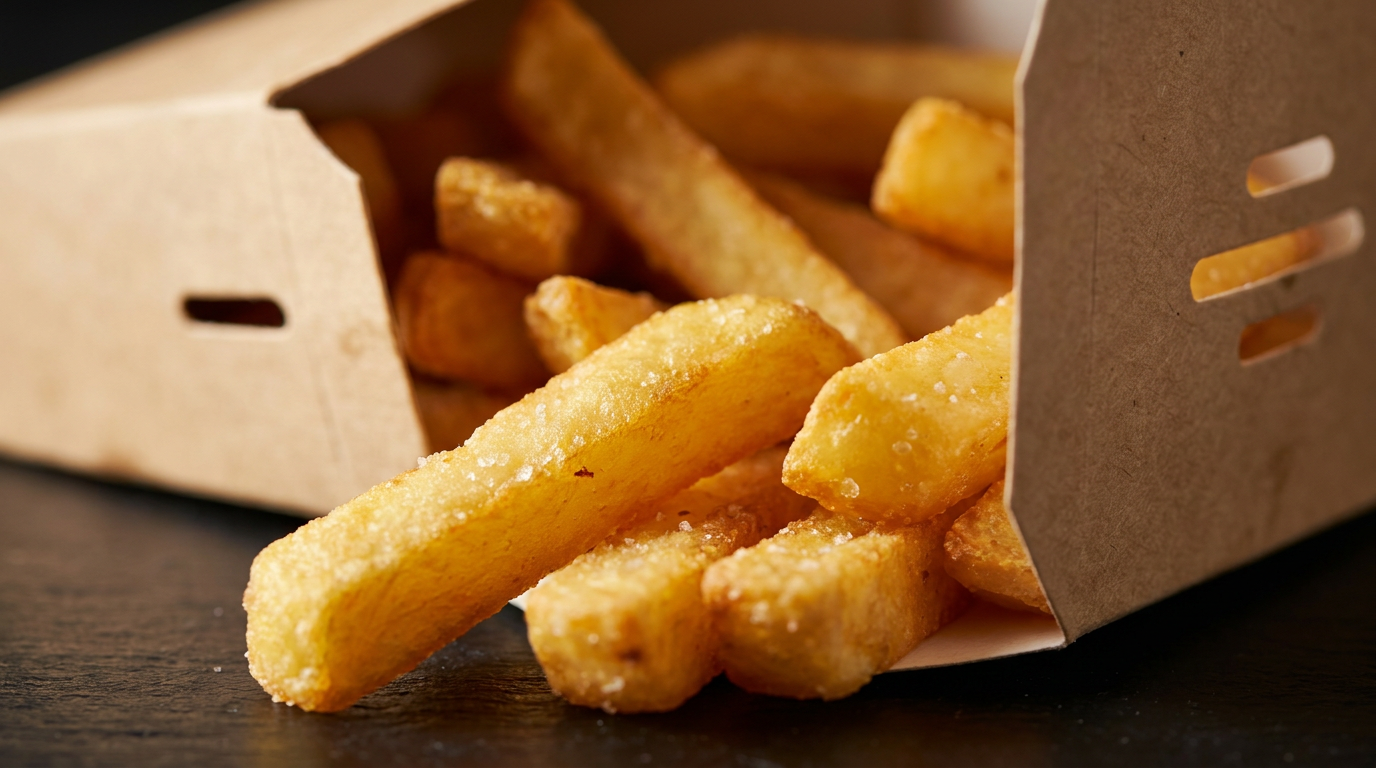
Fast-food chains and potato processors have spent years solving the ultimate takeout problem: soggy fries. Through starch-based clear coats and thermodynamically vented packaging, fries can now survive a 30-minute commute.
By Factlen Editorial Team
- Food Scientists & Processors
- Focus on altering the physical chemistry of the fry itself to withstand moisture.
- Packaging Engineers
- Focus on thermodynamics and managing the environment around the food during transit.
- Delivery Drivers & Consumers
- Focus on the practical realities of transport and the final eating experience.
- Editorial Synthesis
- Synthesizes the technological and logistical advancements solving the delivery fry problem.
What's not represented
- · Independent Restaurant Owners
- · Environmental Advocates on Packaging Waste
Why this matters
For years, the convenience of food delivery came with a soggy compromise. By engineering a fry that stays crispy for 30 minutes, food scientists have solved one of the most universal annoyances in modern dining.
Key points
- Fast-food fries were originally engineered to be eaten within 10 minutes, making them highly vulnerable to the 'sauna effect' of a sealed delivery bag.
- Potato processors developed an invisible 'clear coat' batter made of rice flour and dextrin that polymerizes in the fryer to lock out moisture.
- High-starch potatoes like the Russet Burbank are essential, as their expanding starch molecules help form a rigid microscopic crust.
- Packaging engineers designed patented fry cups with calculated vents that let steam escape while retaining radiant heat.
- Resting fries on a wire rack for a few minutes before boxing prevents the initial burst of steam from ruining the crust during transit.
For decades, the fast-food french fry was engineered for a very specific lifecycle: it was meant to be pulled from a 350-degree vat of oil, salted, and consumed within five to ten minutes. Whether eaten in a brightly lit dining room or immediately out of a drive-thru bag, the fry's delicate, crispy exterior was a fleeting marvel.[3]
But the explosion of app-based food delivery fundamentally broke this model. Suddenly, fries were expected to survive a 20-to-30-minute commute in the passenger seat of a gig worker's car. The result was a universal culinary disappointment: the soggy, limp delivery fry.[1]
The culprit is a simple matter of physics and thermodynamics, known in the industry as the "sauna effect." When hot fries are placed into a closed clamshell or a sealed paper bag, the moisture evaporating from the fluffy interior of the potato has nowhere to go.[1]
This trapped steam rapidly cools and turns into condensation on the inside of the packaging. Those water droplets then rain back down onto the fries, effectively steaming them. Within 12 minutes, the rigid, crispy crust acts like a sponge, absorbing the moisture and turning to mush.[1][2]

Recognizing that delivery was becoming a multi-billion-dollar permanent fixture, the fast-food industry and its massive agricultural suppliers realized they had to re-engineer their most popular side dish.[1]
The first line of defense begins with the potato itself. Food scientists rely heavily on high-starch varieties, most notably the Russet Burbank. During the frying process, these long starch molecules expand and burst, creating a rigid microscopic structure that forms the initial crust.[3]
However, natural potato starch alone cannot withstand a 30-minute commute in a humid bag. To solve this, food engineers at companies like Lamb Weston—a $3.1 billion potato processing giant—developed a groundbreaking solution: the "clear coat."[1][3]
The clear coat is an invisible, flavorless liquid batter applied to the fries at the factory before they are frozen. While the exact recipes are closely guarded trade secrets, they typically involve a highly calibrated suspension of potato starch, rice flour, and dextrin.[1][2]
The clear coat is an invisible, flavorless liquid batter applied to the fries at the factory before they are frozen.
When these coated fries hit the hot oil at the restaurant, the batter instantly polymerizes. It forms a glass-like, microscopic barrier around the potato.[2][5]

This invisible armor serves a dual purpose. First, it locks the potato's internal moisture inside, ensuring the center remains fluffy. Second, it acts as a shield against external ambient steam, preventing the fry from absorbing condensation while sitting in a delivery bag.[2][5]
The cooking method itself was also optimized for structural integrity. Most fast-food fries undergo a rigorous double-fry process. They are par-cooked at the factory to begin building the crust, flash-frozen, and then fried a second time at the restaurant to achieve the perfect golden-brown finish.[3]
Yet, even the most advanced clear-coat batter can be defeated by poor packaging. Lamb Weston's innovation team noted that putting hot fries into a closed plastic or cardboard box is the absolute worst-case scenario.[1]
This led to a secondary wave of innovation in packaging engineering. Designers created patented fry cups and cartons featuring strategically placed venting technology.[1][2]
These vents are mathematically calculated to strike a delicate thermodynamic balance. They must be large enough to allow excess steam to escape, preventing the sauna effect, but small enough to trap radiant heat so the fries don't arrive ice cold.[1][4]

Kitchen logistics have also adapted to protect the crunch. Best practices now dictate that workers should let fresh fries rest on a wire rack for three to five minutes before boxing them up.[4]
This brief resting phase allows the most aggressive, immediate burst of steam to dissipate into the open kitchen air, rather than forming a steam cloud inside the delivery bag.[4]
Consumers picking up their own takeout can replicate this science simply by leaving the top of their paper bag open on the drive home. While the fries might cool slightly faster, the open vent guarantees they will retain their crunch.[6]
The result of this multi-disciplinary effort—spanning agriculture, chemistry, and packaging design—is a fry that genuinely holds its texture for up to half an hour. It is a quiet triumph of food science, ensuring that the modern convenience of delivery doesn't have to come at the cost of a perfect bite.[1][2][7]
How we got here
Pre-2010s
Fries were optimized almost entirely for immediate dine-in or drive-thru consumption, with a crispness window of roughly 5 to 10 minutes.
2014
Food scientists observing the early boom of food delivery in Asia noted that sealed clamshells were destroying fry texture, prompting new R&D.
2018
Potato processing giant Lamb Weston introduced 'Crispy on Delivery,' a comprehensive system of battered fries and vented packaging.
2020–2022
The pandemic-driven surge in delivery apps forced nearly all major fast-food chains to adopt clear-coat batters and vented boxes.
Viewpoints in depth
Food Scientists & Processors
Focus on altering the physical chemistry of the fry itself to withstand moisture.
For agricultural and food scientists, the soggy fry is a problem of cellular structure and starch gelatinization. Companies like Lamb Weston approach the issue by engineering the potato's exterior. By developing proprietary 'clear coats' made of rice flour and dextrin, they create a microscopic armor that polymerizes in the deep fryer. This camp argues that no amount of packaging can save a naked potato from its own internal moisture, making the invisible batter the most critical innovation in delivery food.
Packaging Engineers
Focus on thermodynamics and managing the environment around the food during transit.
Packaging experts view the delivery bag as a volatile micro-climate. They point out that even the best-battered fry will turn to mush if subjected to the 'sauna effect' of a sealed clamshell. Their solution relies on thermodynamic venting—calculating the exact size and placement of holes in a carton to allow steam to escape while retaining enough radiant heat to keep the meal appetizing. To this camp, the structural integrity of the fry is only as good as the box carrying it.
Delivery Drivers & Consumers
Focus on the practical realities of transport and the final eating experience.
For the people actually transporting and eating the food, the science is secondary to the result. Delivery drivers have long stressed over handing customers cold, limp food, knowing it impacts their tips and ratings. Consumers, meanwhile, have learned practical workarounds, like keeping the takeout bag open on the drive home. This camp measures success purely by the 30-minute mark: if the fry snaps when bitten after a cross-town drive, the engineering worked.
What we don't know
- Whether the proprietary clear-coat batters alter the nutritional profile or calorie count of the fries compared to traditional naked frying.
- How the shift toward highly engineered, vented packaging will impact the industry's broader sustainability and zero-waste goals.
Key terms
- Clear Coat
- An invisible, starch-based batter applied to fries before freezing that polymerizes in the fryer to create a rigid, moisture-resistant crust.
- Par-cooking
- The process of partially cooking the potatoes at the factory before freezing, which begins building the fry's internal texture and external crust.
- The Sauna Effect
- An industry term for what happens when hot food is sealed in a container, causing its own steam to create a highly humid environment that ruins crispness.
- Dextrin
- A carbohydrate produced from starch that is often added to fry batters to enhance crispness and golden browning.
Frequently asked
Why do delivery fries usually get soggy?
Hot fries release steam. If placed in a sealed container or closed delivery bag, that steam turns into condensation, which soaks back into the fry and destroys its crispy exterior.
What is a 'clear coat' on a french fry?
It is an invisible, flavorless batter—often made from potato starch, rice flour, and dextrin—that creates a microscopic barrier to lock moisture inside while keeping external steam out.
How does venting help keep fries crispy?
Strategically placed holes in the packaging allow excess steam to escape, preventing the 'sauna effect' while trapping enough radiant heat to keep the food warm.
Can I keep my own takeout fries crispy on the drive home?
Yes. Leave the takeout bag open to let the steam vent. While the fries might cool down slightly faster, they will retain their crunch instead of turning into soggy sponges.
Sources
Source coverage
7 outlets
4 viewpoints surfaced







[1]MarketplaceDelivery Drivers & Consumers
The quest for french fries crisp enough to withstand delivery
Read on Marketplace →[2]Lamb WestonFood Scientists & Processors
Crispy on Delivery™ Fries
Read on Lamb Weston →[3]MashedFood Scientists & Processors
How Fast Food Restaurants Really Make Their French Fries Crispy
Read on Mashed →[4]MBPAKPackaging Engineers
How to Prevent Soggy Fries in Takeout Packaging
Read on MBPAK →[5]The Buffalo SpotFood Scientists & Processors
The Science of Crisp: How We Keep Fries Crunchy Under Sauce
Read on The Buffalo Spot →[6]Tasting TableDelivery Drivers & Consumers
The Trick For Keeping Your Takeout French Fries Fresh And Crispy
Read on Tasting Table →[7]Factlen Editorial TeamEditorial Synthesis
Synthesis by Factlen editorial team
Read on Factlen Editorial Team →
Every angle. Every day.
Get food drink stories with full source coverage and perspective breakdowns delivered to your inbox.