
How Flag Football Will Work at the LA 2028 Olympics
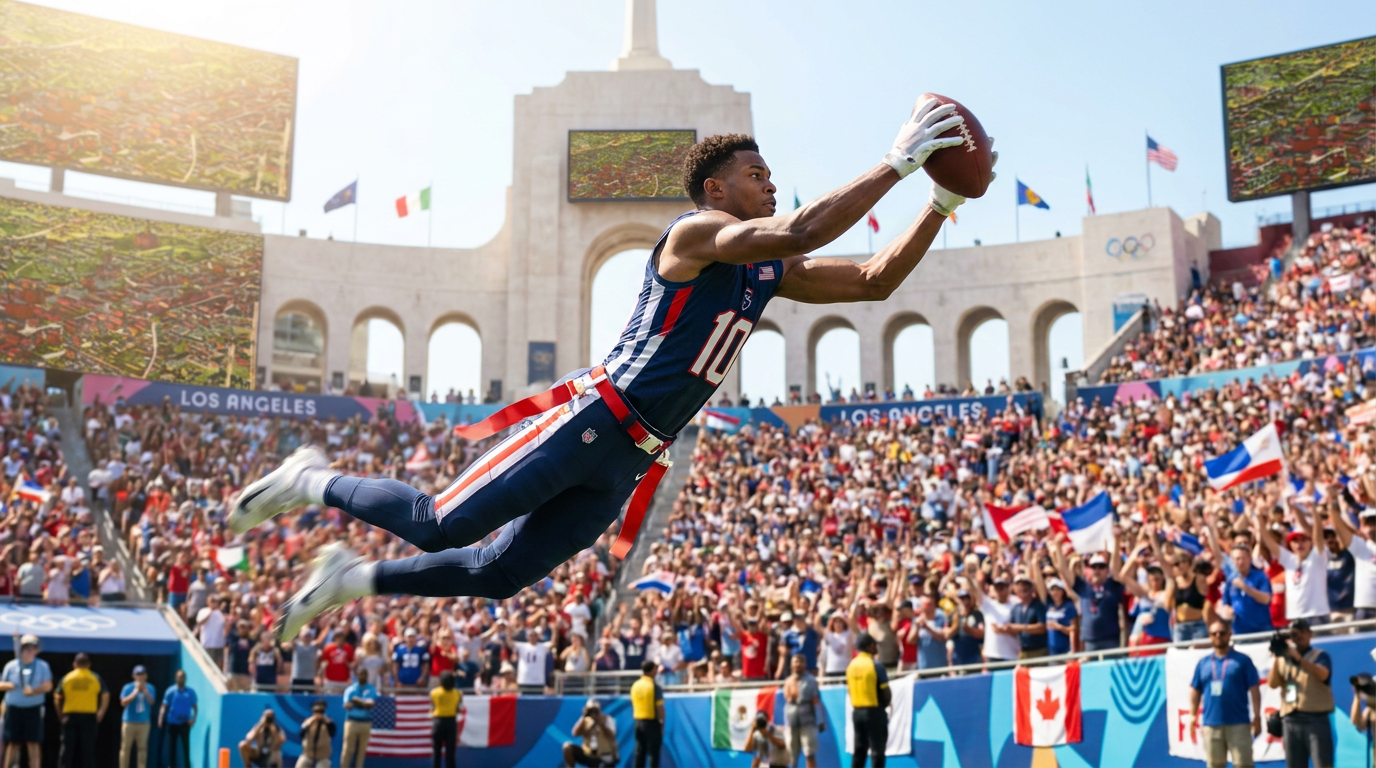
Flag football makes its Olympic debut in 2028 with a fast-paced 5v5 format, pitting specialized international flag athletes against interested NFL superstars.
By Factlen Editorial Team
- NFL Superstars & Advocates
- Believe elite tackle-football athleticism and speed will translate to Olympic gold, viewing the Games as the ultimate stage for the sport's biggest names.
- Flag Football Specialists
- Argue that flag is a distinct discipline requiring specific techniques—like flag pulling and spatial awareness without blocking—that tackle players lack.
- International Contenders
- View the 5v5, non-contact format as the great equalizer, allowing nations without tackle-football infrastructure to compete for medals on a level playing field.
- Neutral Analysts
- Focus on the logistical rollout, qualification pathways, and the broad global growth of the sport ahead of its Olympic debut.
What's not represented
- · NFL General Managers concerned about injury risks
Why this matters
The inclusion of flag football in the Olympics democratizes American football, allowing nations without massive tackle-football infrastructure to compete on the global stage. It also sets up a fascinating clash between specialized flag athletes and traditional NFL superstars.
Key points
- Flag football will make its Olympic debut at the LA 2028 Games with a fast-paced, non-contact 5v5 format.
- The tournament will feature six men's and six women's teams competing at BMO Stadium in Los Angeles.
- NFL owners have approved player participation, opening the door for superstars to join the US national team.
- Flag football specialists argue that tackle players will struggle with the sport's unique geometry and flag-pulling mechanics.
- International teams will compete for the remaining five spots per gender through a grueling two-year qualification cycle.
When the Olympic cauldron is lit in Los Angeles in July 2028, it will illuminate a sport making its historic debut on the global stage: flag football. The inclusion marks the culmination of a multi-year campaign to bring a variant of America's most popular game to the Olympic program. Unlike traditional gridiron football, which has long been deemed too dangerous and logistically complex for a two-week international tournament, flag football offers a fast-paced, non-contact alternative that has quietly exploded in global popularity over the last decade.[2][6]
The LA28 tournament will be highly exclusive, featuring just six men's teams and six women's teams competing for gold at BMO Stadium. This tight field means that simply qualifying for the Olympics will be a monumental achievement for international federations. The host nation, the United States, receives an automatic bid for both its men's and women's squads, leaving only five coveted spots per gender for the rest of the world to fight over during a grueling two-year qualification cycle.[2][5]
For viewers accustomed to Sunday NFL broadcasts, Olympic flag football will look fundamentally different. The game is played in a five-on-five format on a condensed field measuring 70 yards long by 25 yards wide, which includes two 10-yard end zones. Teams dress a maximum of 12 players for a match, allowing for specialized offensive and defensive units, but the sheer lack of bodies on the field creates a wide-open, high-scoring environment that prioritizes speed, agility, and precise route-running over brute strength.[2][6]

The rulebook strips away the most violent and specialized elements of tackle football. There are no offensive or defensive linemen, and blocking of any kind is strictly prohibited. Every offensive drive begins at the team's own five-yard line, with a center snapping the ball to the quarterback before immediately becoming an eligible receiver. Furthermore, there is no kicking or punting; teams must rely entirely on their offense to advance the ball, convert critical downs, and ultimately score points on every possession.[2][6]
The mechanics of advancing the ball are also streamlined to keep the game moving rapidly. An offense is given four downs to cross midfield. If they succeed, they earn a new set of four downs to reach the end zone. Touchdowns are worth six points, and teams can choose to attempt a one-point conversion from the five-yard line or a two-point conversion from the 10-yard line. To end a play, a defender must cleanly remove one of the two vinyl flags attached to the ball carrier's waist, a mechanic that requires immense precision in open space.[2]
The push to bring flag football to the Olympics was heavily bankrolled and lobbied by the National Football League, which partnered with the International Federation of American Football to launch a campaign dubbed 'Vision28.' For the NFL, the Olympics represent the ultimate vehicle for international expansion, offering a way to hook young athletes in Europe, Asia, and Africa on the sport without requiring expensive helmets, pads, or 100-yard fields. The league views the 2028 Games as a massive global commercial for American football.[4]
The NFL's commitment to the LA28 Games goes beyond marketing and financial support. League owners have formally approved a resolution allowing current NFL players to participate in the Olympics, clearing the bureaucratic hurdles that often prevent professional athletes from competing internationally. Superstars like Patrick Mahomes, Joe Burrow, and Tyreek Hill have already publicly expressed their desire to chase an Olympic gold medal, setting up the tantalizing prospect of a United States national team loaded with the most famous household names in the sport.[2][3]
The NFL's commitment to the LA28 Games goes beyond marketing and financial support.
However, the assumption that elite tackle-football players will effortlessly dominate the Olympic flag tournament is facing serious pushback from those inside the sport. Flag football is a highly specialized discipline with its own distinct nuances, and the skills that make a great NFL player do not always translate seamlessly to the non-contact game. The geometry of the field, the absence of blocking, and the specific mechanics of flag pulling require a completely different type of muscle memory and spatial awareness.[3]

Denver Broncos head coach Sean Payton recently highlighted this reality gap after watching a roster of professional flag football specialists dismantle a team of NFL players at a recent exhibition tournament. Payton noted that the tackle players struggled to defend against athletes who have spent years mastering the specific geometry of flag pulling and the art of protecting their flags while running. 'It's an entirely different game,' Payton observed, warning that NFL stars will need significant dedicated practice time if they hope to make the 12-man Olympic roster and avoid an embarrassing upset on the global stage.[3]
While the men's tournament will likely feature a heavy debate over NFL inclusion, the women's tournament is where the global democratization of the sport is most evident. Women's flag football has seen exponential growth worldwide, driven by the low barrier to entry and the sport's emphasis on speed and route-running. Without the historical infrastructure advantages that American men have in tackle football, the women's international field is remarkably competitive and diverse, setting the stage for thrilling matchups.[2][4]
The United States is not the undisputed powerhouse in the women's game. Mexico currently holds the number one ranking from the IFAF and boasts a deeply entrenched flag football culture that has produced some of the world's most technically gifted players. The rivalry between the United States and Mexico is expected to be the marquee storyline of the women's bracket, though European nations are rapidly closing the talent gap and preparing to challenge the North American dominance in Los Angeles.[2]
The pathway to secure one of the remaining five Olympic spots per gender was recently finalized by the International Olympic Committee. The qualification gauntlet begins at the IFAF Flag Football World Championships in Düsseldorf, Germany, in August 2026. The top two finishers in both the men's and women's brackets—excluding the already-qualified Americans—will punch direct tickets to Los Angeles, bypassing the rest of the grueling qualification cycle and securing their place in Olympic history two full years early.[5][7]

For nations that fall short in Germany, the journey continues through the 2027 IFAF Continental Championships. The top two teams from each continent will earn the right to advance to a final, high-stakes Olympic Qualifier Series in the spring of 2028. This 'last chance' tournament will feature ten men's and ten women's teams battling for the final three berths in the LA28 field, ensuring that only the most battle-tested rosters make it to the Games in California.[5][7]
The sheer scale of the qualification process underscores how massive the sport has become at the grassroots level. According to the IFAF, flag football is now played by roughly twenty million athletes across more than one hundred countries, making it one of the fastest-growing sports on the planet. This global footprint was a crucial factor in convincing the International Olympic Committee that the sport possessed the necessary universality to warrant inclusion on the official LA28 program.[4]

By stripping away the pads and the collisions, flag football has managed to export the strategic brilliance of the American gridiron to the rest of the world. When the first whistle blows at BMO Stadium in 2028, it will not just be a showcase of a new Olympic sport, but a profound test of whether traditional tackle-football athleticism can overcome years of dedicated flag-football technique. The world will be watching to see who truly owns the gridiron in its newest form.[1][3][4]
How we got here
1940s
Flag football emerges during World War II as a way for American military personnel to stay fit without risking tackle-related injuries.
2022
The NFL and IFAF launch the 'Vision28' campaign to aggressively lobby for the sport's inclusion in the Los Angeles Games.
October 2023
The International Olympic Committee officially approves flag football for the LA28 sports program.
May 2025
NFL team owners approve a resolution allowing current league players to participate in the 2028 Olympics.
February 2026
The IOC and IFAF finalize the two-year qualification pathway for international teams.
August 2026
The IFAF World Championships in Germany will award the first direct qualification spots for LA28.
Viewpoints in depth
NFL Superstars' View
The belief that raw athleticism and gridiron experience will dominate.
NFL players and advocates argue that the sheer speed, route-running ability, and processing power of elite quarterbacks and receivers will overwhelm international competition. They view the transition to flag as a minor adjustment compared to the athletic chasm between NFL pros and amateur players.
Flag Specialists' View
The reality that flag football is a unique sport with its own geometry.
Professional flag athletes point out that tackle players rely heavily on blocking and physical leverage—elements completely absent in 5v5 flag. They emphasize that the mechanics of pulling a flag in open space and defending without contact require years of specialized muscle memory that cannot be learned in a few weeks of training camp.
International Federations' View
The opportunity to democratize American football.
Nations like Mexico, Japan, and Austria see the 5v5 format as a way to bypass the massive financial and physical barriers of tackle football. By focusing on speed and agility, these countries have built robust grassroots programs that are already producing world-class talent, proving that American football no longer belongs exclusively to America.
What we don't know
- Whether top-tier NFL quarterbacks will actually be selected over specialized flag football quarterbacks for the US roster.
- How NFL teams will handle the injury risks and insurance logistics of allowing franchise players to compete in the Olympics.
- Which international teams will emerge from the 2028 qualifier series to claim the final tournament berths.
Key terms
- Vision28
- The joint campaign launched by the NFL and the International Federation of American Football to secure flag football's inclusion in the 2028 Olympics.
- IFAF
- The International Federation of American Football, the global governing body responsible for organizing international flag and tackle football competitions.
- Down
- A single play or attempt by the offensive team to advance the ball. In Olympic flag football, teams get four downs to cross midfield.
- Flag Pulling
- The defensive action of removing a vinyl flag from the ball carrier's waist to end a play, replacing traditional tackling.
Frequently asked
Can current NFL players compete in the 2028 Olympics?
Yes. NFL owners have approved player participation, though superstars will still need to earn a spot on the 12-man national roster.
Will there be a women's flag football tournament?
Yes. The LA28 Games will feature both men's and women's tournaments, with six nations competing in each bracket.
How do countries qualify for the LA28 tournament?
The US automatically qualifies as the host. Other nations will earn spots through the 2026 IFAF World Championships, 2027 Continental Championships, and a 2028 qualifier series.
Do teams use linemen or kickers in Olympic flag football?
No. The 5v5 format eliminates offensive and defensive linemen, as well as all kicking and punting plays.
Sources
Source coverage
7 outlets
4 viewpoints surfaced







[1]Factlen Editorial TeamNeutral Analysts
Synthesis by Factlen editorial team
Read on Factlen Editorial Team →[2]NBC OlympicsNeutral Analysts
Flag football set to make Olympic debut at LA 2028
Read on NBC Olympics →[3]CBS SportsFlag Football Specialists
2028 Olympic flag football: Sean Payton doubts NFL will have strong presence
Read on CBS Sports →[4]Sky SportsNFL Superstars & Advocates
Flag football's Olympic debut at LA 2028
Read on Sky Sports →[5]Inside the GamesInternational Contenders
LA28 flag football path now closer
Read on Inside the Games →[6]Olympics.comNeutral Analysts
Flag Football and the Olympics
Read on Olympics.com →[7]IFAFInternational Contenders
Olympic Qualification System for Flag Football in LA28
Read on IFAF →

Every angle. Every day.
Get sports stories with full source coverage and perspective breakdowns delivered to your inbox.