
How Flag Football is Being Engineered for the 2028 LA Olympics
Flag football is set to make its Olympic debut at the Los Angeles 2028 Games, introducing a fast-paced, non-contact 5v5 format to the global stage. Backed by the NFL and driven by explosive international grassroots growth, the sport aims to redefine American football for a new generation.
By Factlen Editorial Team
- Global Growth Advocates
- Emphasize flag football's accessibility, low cost, and gender inclusivity.
- NFL Expansion Strategists
- View the Olympics as a massive commercial vehicle to grow the NFL's international fanbase.
- Olympic Traditionalists
- Question the inclusion of highly commercialized, US-centric sports at the expense of traditional events.
What's not represented
- · Grassroots tackle football coaches
- · Insurance providers for professional athletes
- · Athletes from traditional Olympic sports facing quota cuts
Why this matters
The addition of flag football to the Olympics transforms a casual backyard game into a global spectacle, offering a safer, highly accessible entry point into American football. For fans, it promises a rare opportunity to see elite NFL athletes compete for international gold, while fundamentally reshaping how the sport is played and funded worldwide.
Key points
- Flag football will make its Olympic debut at the Los Angeles 2028 Games with a fast-paced 5v5 format.
- The sport eliminates tackling and linemen, requiring defenders to pull fabric flags from the ball-carrier's waist.
- The NFL has approved the participation of active professional players, setting up a potential showcase of global superstars.
- Women and girls are driving the sport's international growth, with Mexico emerging as a major powerhouse.
- The inclusion reflects the IOC's strategy to engage younger audiences and leverage American sports culture.
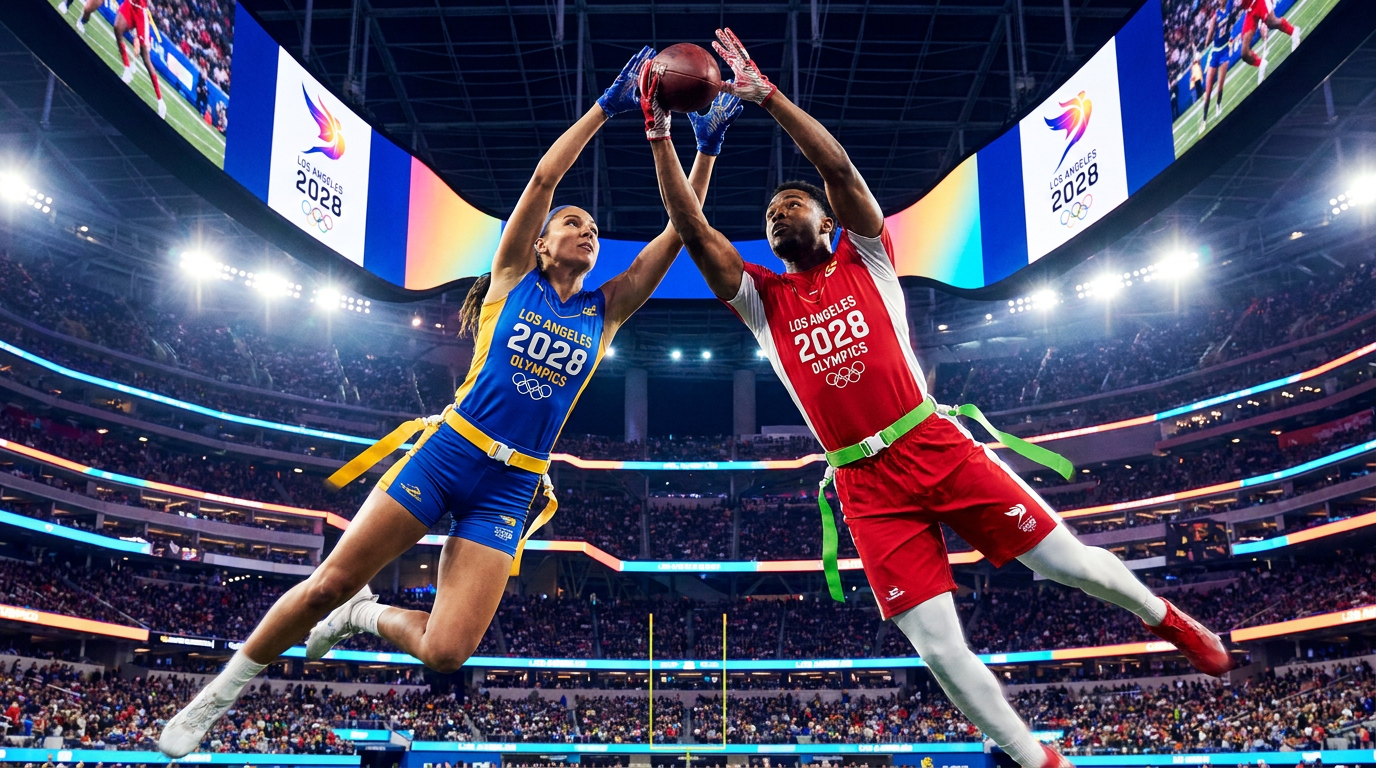
In the summer of 2028, the world's most lucrative domestic sports league will finally intersect with the globe's oldest athletic festival. When the International Olympic Committee (IOC) approved flag football for the Los Angeles 2028 Games, it marked the culmination of a decades-long effort to bring American football to the Olympic stage. Unlike the bruising, armor-clad spectacle of the National Football League (NFL), the Olympic variant strips the game down to its fastest, most accessible elements. The inclusion reflects a broader strategy by LA28 organizers to showcase sports deeply rooted in American culture while leveraging their massive commercial appeal.[1][6]
The journey to Olympic recognition was spearheaded by "Vision28," a joint lobbying campaign between the NFL and the International Federation of American Football (IFAF). For the NFL, the Olympics represent the ultimate vehicle for international expansion, offering a platform to reach the IOC's billions of global viewers. For the IFAF, which oversees 79 member nations, the LA28 bid was the validation of a sport that has quietly amassed 20 million players across more than 100 countries.[2][3]
But the sport that will debut at the Los Angeles Memorial Coliseum looks vastly different from traditional gridiron football. Olympic flag football is engineered for speed, agility, and continuous motion. The format approved for LA28 is a five-on-five game played on a condensed 50-yard field, with 10-yard endzones at either side. There are no offensive or defensive linemen, no blocking, and absolutely no tackling.[1][5]
Instead of bringing a ball-carrier to the ground, defenders must pull one of two fabric flags attached to the offensive player's waist. This single mechanical change transforms the sport's physical requirements. Without the need for 300-pound blockers, the game becomes a pure track meet of route-running, evasive footwork, and precision passing. It is a format that heavily favors quick-twitch athletes and creative play design over brute force.[1][5]

The rules of engagement are similarly streamlined to keep the pace relentless. A team takes possession at their own five-yard line and has four attempts—known as downs—to cross midfield. If successful, they earn a fresh set of four downs to reach the endzone and score a six-point touchdown. There is no kicking game; instead of kicking an extra point, teams must attempt a single play from the five-yard line for one point, or from the 10-yard line for two points.[5]
Matches consist of two 20-minute halves with a running clock, ensuring that games are completed in under an hour. This rapid-fire structure is highly appealing to Olympic broadcasters, allowing multiple games to be played back-to-back in a festival-style atmosphere. The LA28 organizing committee plans to host the tournament in a prime downtown location, capitalizing on the sport's high-scoring, highlight-heavy nature.[3][5]
The most intensely debated aspect of flag football's Olympic debut is the potential participation of active NFL superstars. In May 2025, NFL club owners voted to permit their players to compete in the 2028 Games, working alongside the NFL Players Association to establish qualification protocols. Commissioner Roger Goodell framed the decision as an opportunity for the league's biggest stars to represent their country on the pinnacle of the global sports stage.[2]
The most intensely debated aspect of flag football's Olympic debut is the potential participation of active NFL superstars.
However, the transition from professional tackle football to international flag football is not a guaranteed seamless pivot. The five-on-five format requires specialized skills that do not perfectly map onto NFL playbooks. While an elite NFL wide receiver possesses the requisite speed, the defensive strategies in flag football—which rely heavily on reading hips and snatching a moving fabric target—require distinct muscle memory.[5][7]
Furthermore, the inclusion of NFL players introduces significant financial and logistical uncertainties. NFL franchises invest hundreds of millions of dollars in their franchise quarterbacks. Whether a team will willingly release a star player to compete in a high-intensity summer tournament, risking a non-contact ligament injury just weeks before the NFL training camp begins, remains a looming question. The allure of an Olympic gold medal will inevitably clash with the risk-averse nature of professional sports contracts.[2][4]
Despite the heavy American influence, the international flag football landscape is surprisingly competitive, particularly in the women's division. The LA28 Games will feature both a six-team men's tournament and a six-team women's tournament, highlighting the sport's gender-equal growth. Women and girls are currently driving the fastest segment of flag football's global expansion, utilizing the sport's low barrier to entry to build robust grassroots leagues from Europe to Asia.[2][5]

The United States is not an undisputed juggernaut in this arena. At the 2022 World Games in Birmingham, Alabama, the Mexican women's national team, led by star quarterback Diana Flores, decisively defeated the heavily favored American squad to claim the gold medal. Flores has since become a global ambassador for the sport, starring in Super Bowl commercials and symbolizing the international parity that the IFAF hopes to showcase in Los Angeles.[5]
Other nations are also aggressively developing elite flag football programs. Japan's women's team and Austria's men's team have emerged as consistent podium threats in global competitions. In Great Britain, the sport is now played in over 1,000 schools, while participation rates in countries like Germany and China are reportedly doubling annually. The IFAF's strategy has been to bypass the massive infrastructure required for tackle football, instead dropping a football and a set of flags into communities worldwide.[3][5]
For the IOC, the addition of flag football—alongside cricket, squash, lacrosse, and baseball/softball—represents a calculated effort to modernize the Olympic program. By embracing sports with massive digital followings and deep ties to the host nation's culture, the Olympic movement aims to capture younger demographics that have increasingly tuned out traditional Olympic staples.[4][6]

The true test of flag football's Olympic viability will come when the first ball is snapped in 2028. If the tournament delivers the promised blend of high-flying athleticism and genuine international drama, it could cement its place in future Games, including the 2032 Olympics in Brisbane. But if the event feels like a heavily corporatized NFL exhibition, it may struggle to win over traditional Olympic purists.[3][4]
Ultimately, the engineering of Olympic flag football is a masterclass in sports adaptation. By distilling American football down to its most dynamic, accessible core, the NFL and IFAF have created a product that transcends borders and physical limitations. When athletes take the field in Los Angeles, they will not just be competing for gold; they will be introducing a century-old American pastime to a truly global audience.[2][5][6]
How we got here
2013
The International Olympic Committee grants provisional recognition to the International Federation of American Football.
July 2022
Flag football makes its major international debut at the World Games in Birmingham, Alabama.
October 2023
The IOC officially approves flag football for inclusion in the Los Angeles 2028 Olympic Games.
May 2025
NFL owners vote to permit active professional players to compete in the 2028 Olympics.
Viewpoints in depth
Global Growth Advocates
Emphasize flag football's accessibility, low cost, and gender inclusivity.
For international federations and grassroots organizers, flag football is the great equalizer. Because it requires no expensive helmets or pads, the sport can be deployed in any community with a ball and a set of flags. This low barrier to entry has fueled massive growth in countries without a traditional gridiron infrastructure. Advocates point to the thriving women's game—highlighted by Mexico's gold medal at the 2022 World Games—as proof that the sport has evolved far beyond its American roots.
NFL Expansion Strategists
View the Olympics as a massive commercial vehicle to grow the NFL's international fanbase.
The NFL has saturated the American sports market and is aggressively seeking international revenue. League strategists view the LA28 Olympics as a billion-dollar marketing opportunity. By putting their most recognizable stars on the Olympic stage, the NFL hopes to convert casual international viewers into lifelong consumers of the professional tackle game. The 'Vision28' lobbying effort was heavily bankrolled by the league, underscoring how critical global expansion is to their long-term financial strategy.
Olympic Traditionalists
Question the inclusion of highly commercialized, US-centric sports at the expense of traditional events.
Some Olympic purists and European sports journalists have expressed skepticism over the LA28 sports slate. They argue that adding flag football, alongside lacrosse and baseball, caters too heavily to the American television market and the financial interests of US professional leagues. Critics worry that the IOC's willingness to expand the athlete quota for these team sports will force cuts to traditional, less commercialized Olympic disciplines that rely on the Games for their survival.
What we don't know
- Whether NFL franchises will actually release their highest-paid quarterbacks to play, given the risk of injury right before training camp.
- How traditional NFL skills will translate to the specialized 5v5 flag format against experienced international flag specialists.
- If the sport will remain on the Olympic program for the 2032 Brisbane Games or if it will be a one-time showcase.
Key terms
- Downs
- The discrete attempts a team has to advance the ball; in Olympic flag football, teams get four downs to reach midfield and four to score.
- Snap
- The backward pass that initiates a play, typically transferred from the center to the quarterback.
- Endzone
- The 10-yard scoring area at each end of the field where touchdowns are recorded.
- IFAF
- The International Federation of American Football, the global governing body overseeing both tackle and flag variants.
- Vision28
- The joint lobbying campaign launched by the NFL and IFAF to secure flag football's inclusion in the LA28 Games.
Frequently asked
Can active NFL players compete in the 2028 Olympics?
Yes. The NFL and the NFL Players Association have approved player participation, though athletes will still need to qualify for their respective national teams through a tryout process.
Is flag football a men's or women's event?
Both. The LA28 Olympics will feature a six-team men's tournament and a six-team women's tournament, emphasizing gender equality.
Will the United States automatically win gold?
Not necessarily. While the US is historically dominant, the Mexican women's team defeated the US in the 2022 World Games final, and nations like Japan and Austria are highly competitive.
How long is an Olympic flag football game?
Games consist of two 20-minute halves with a running clock, making for a fast-paced, 40-minute contest.
Sources
Source coverage
7 outlets
3 viewpoints surfaced







[1]LA28 Organizing CommitteeGlobal Growth Advocates
Flag Football - LA28
Read on LA28 Organizing Committee →[2]NFLNFL Expansion Strategists
Flag Football is Coming to the LA28 Olympic Games
Read on NFL →[3]Sky SportsNFL Expansion Strategists
NFL to the World: Why Flag Football is booming on the road to Los Angeles 2028 Olympic Games
Read on Sky Sports →[4]The GuardianOlympic Traditionalists
Cricket, squash, lacrosse and flag football all set for 2028 LA Olympics
Read on The Guardian →[5]Olympic ChannelGlobal Growth Advocates
Inside the rise of flag football ahead of its Olympic debut
Read on Olympic Channel →[6]CBS NewsNFL Expansion Strategists
2028 Los Angeles Olympics adds 5 sports including lacrosse, cricket, flag football
Read on CBS News →[7]Factlen Editorial TeamGlobal Growth Advocates
Synthesis by Factlen editorial team
Read on Factlen Editorial Team →


Every angle. Every day.
Get sports stories with full source coverage and perspective breakdowns delivered to your inbox.