
How Flag Football is Adapting for the 2028 Los Angeles Olympics
Flag football will make its Olympic debut at the 2028 Los Angeles Games, bringing a fast-paced, 5-on-5 format to the global stage. With NFL stars cleared to compete and 20 million players worldwide, the non-contact sport is poised for a massive international breakthrough.
By Factlen Editorial Team
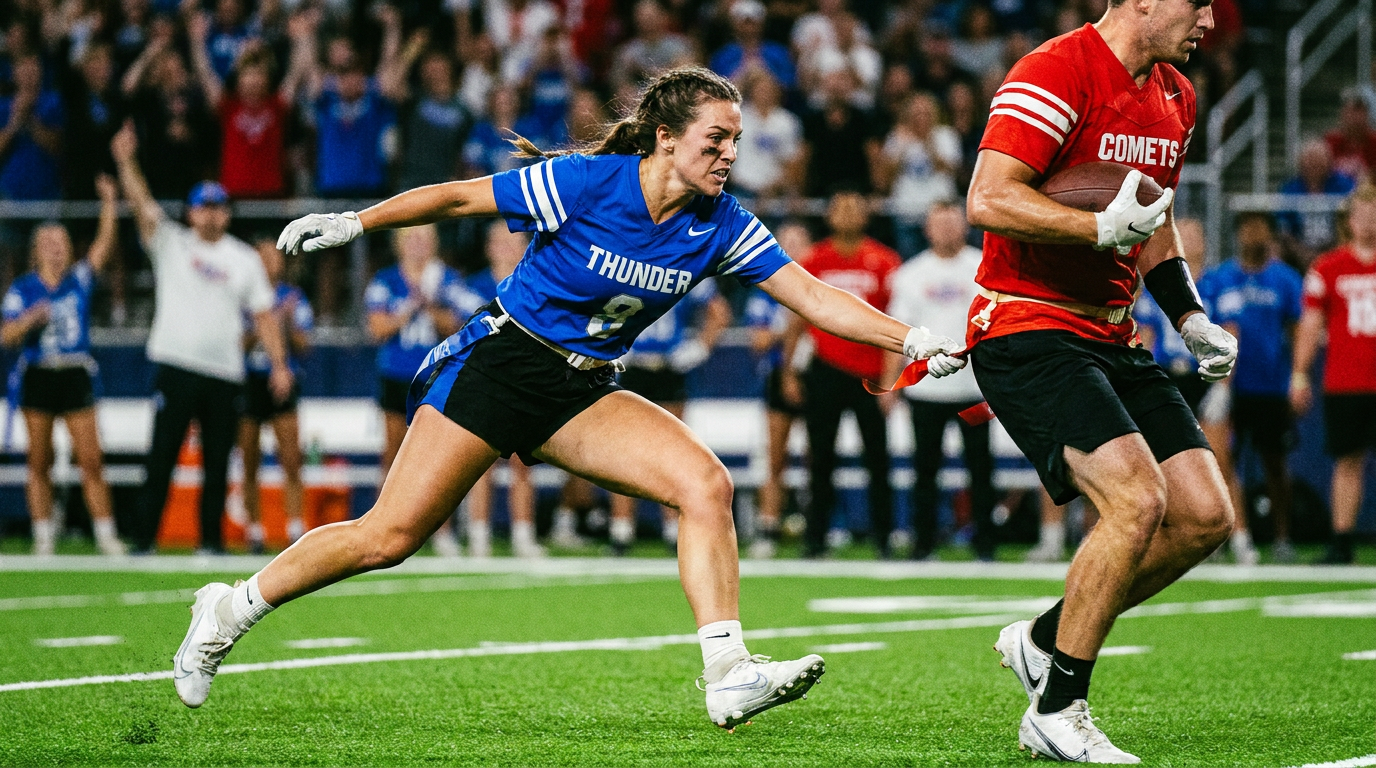
- NFL & Professional Athletes
- Professional gridiron stars view the Olympics as a unique legacy-building opportunity.
- International Grassroots Players
- Global advocates emphasize the sport's accessibility and gender parity.
- Global Governing Bodies
- Organizers are focused on standardizing the format and securing the sport's Olympic future.
What's not represented
- · Collegiate Tackle Football Programs
- · Traditional Olympic Host Cities
Why this matters
The inclusion of flag football in the Olympics transforms a recreational game into a globally funded sport, opening new avenues for collegiate scholarships and international athletic careers. For fans, it offers a rare chance to see elite American football stars compete on the world's biggest international stage.
Key points
- Flag football will debut as a medal event at the 2028 Los Angeles Olympics.
- The tournament will use a fast-paced 5-on-5 format on a condensed 50-by-25-yard field.
- In May 2025, the NFL voted to allow active roster players to compete in the Games.
- The sport currently boasts 20 million players across more than 100 countries.
- Women's flag football is driving massive international growth, highlighted by Mexico's 2022 World Games victory.
- Matches will be hosted at BMO Stadium in Los Angeles' Exposition Park.
For decades, flag football was viewed primarily as a backyard pastime or a recreational physical education activity. But in 2028, the sport will shed its casual reputation and step onto the world's most prestigious athletic stage. When the Summer Olympics arrive in Los Angeles, flag football will make its official debut as a medal event, introducing a fast-paced, highly strategic, and non-contact version of American football to billions of global viewers. The inclusion marks a historic milestone for the sport, transforming it from a grassroots hobby into a highly competitive international discipline. The decision to add flag football to the LA 2028 program reflects a broader Olympic push toward youth-oriented, accessible sports that require minimal specialized infrastructure.[1][4][6]
The sport's elevation to Olympic status is backed by staggering global participation numbers. According to the International Federation of American Football (IFAF), flag football is currently played by an estimated 20 million athletes across more than 100 countries. This explosive growth has been driven by the sport's low barrier to entry; unlike traditional tackle football, which requires expensive helmets, pads, and specialized field equipment, flag football requires little more than a ball and a set of flag belts. This accessibility has allowed the sport to flourish in regions where American football traditionally struggled to gain a foothold, establishing robust leagues across Europe, Asia, and Latin America.[2][5]
When the Olympic tournament kicks off, fans accustomed to the sprawling 11-on-11 spectacle of the NFL will encounter a vastly different, streamlined game. The LA 2028 Games will utilize a 5-on-5 format, emphasizing speed, agility, and quick decision-making over brute strength. Both the men's and women's tournaments will feature six national teams, with each country permitted a maximum roster size of just 10 players. This tight roster limit means athletes will likely need to specialize heavily on either offense or defense, though versatile two-way players could become highly valuable assets in the grueling tournament structure.[4]
The physical dimensions of the Olympic flag football field are significantly condensed compared to a traditional gridiron. Matches will be played on a field measuring 50 yards in length and 25 yards in width, flanked by two 10-yard endzones. Crucially, the 5-on-5 format eliminates the offensive and defensive lines entirely. There are no massive linemen battling in the trenches; instead, every player on the field is an eligible receiver. Plays begin with a "center" snapping the ball to the quarterback, but this center immediately becomes a route-runner, creating a dynamic, pass-heavy offensive environment where spacing and route precision are paramount.[4]

The mechanics of advancing the ball are also uniquely tailored to the smaller field. Offenses are granted four downs to cross midfield. If they successfully reach the midfield line, they are awarded a new set of four downs to reach the endzone and score. If a team fails to reach the line to gain, the ball is turned over on downs, and the opposing offense takes over from their own 5-yard line. To prevent overpowering goal-line running plays, offenses are strictly prohibited from running the ball when they are within five yards of the endzone, forcing teams to rely on sharp, quick passing concepts to secure touchdowns.[4]
Scoring in Olympic flag football mirrors the traditional game, with a few strategic twists. A touchdown is worth six points. However, the concept of a kicked extra point does not exist. Instead, teams must choose between attempting a one-point conversion from the 5-yard line or a two-point conversion from the 10-yard line. Offenses are permitted to run or pass the ball during these conversion attempts. Defensively, turnovers are generated through interceptions or by recovering fumbles, though the non-contact nature of the sport means fumbles are relatively rare and usually result from dropped lateral passes.[4]
The pace of play is designed to be relentless. Olympic matches will consist of two 20-minute halves featuring a running clock. The clock only stops during the final two minutes of each half—the traditional "two-minute warning"—during which it pauses for incomplete passes, plays that go out of bounds, and scoring events. If a medal match ends in a tie, the teams will enter a sudden-death overtime period where each team is guaranteed at least one offensive possession. The team that achieves the better result on their respective possession claims the victory, ensuring a dramatic conclusion to closely contested games.[4]
Olympic matches will consist of two 20-minute halves featuring a running clock.
While the grassroots growth of the sport is impressive, the Olympic tournament's profile skyrocketed following a landmark decision by the National Football League. In May 2025, NFL team owners officially voted to allow active roster players to compete in the LA 2028 Games. This unprecedented resolution bridged the gap between professional American football and the Olympic movement, effectively clearing the way for the world's most famous gridiron stars to chase Olympic gold. The NFL's backing provides the tournament with massive commercial appeal and guarantees that the United States will field a roster brimming with elite, household names.[3]

However, the NFL's participation comes with carefully negotiated guardrails designed to protect the league's competitive balance. Under the approved resolution, each of the 32 NFL franchises is permitted to send a maximum of one player to the Olympic tournament. Additionally, teams can allow their designated "International Player Pathway" athletes to represent their home countries. This restriction prevents any single NFL team from having its entire starting lineup depleted by Olympic commitments, while still ensuring that the Team USA roster will be a formidable all-star squad drawn from across the league.[3]
The agreement between the NFL, the NFL Players Association, and Olympic organizers also addressed the critical issue of injury liability. Professional players participating in the Games will receive specific injury protections and salary-cap credits, ensuring that an Olympic injury does not financially devastate a player or unfairly penalize their NFL franchise. Furthermore, Olympic venues must adhere to strict minimum standards for medical staffing and playing surfaces, mitigating the risk of non-contact injuries on artificial turf. These concessions were vital in securing the players' union's blessing for the mid-summer tournament.[3]
With the bureaucratic hurdles cleared, the anticipation surrounding player selection has become a major storyline. Philadelphia Eagles quarterback Jalen Hurts has already stepped into a prominent role as the global flag football ambassador, featuring heavily in the NFL's promotional handover campaigns. Other elite talents, including Minnesota Vikings wide receiver Justin Jefferson, have publicly expressed their desire to compete. Even retired legends have flirted with the idea of participation, though the grueling athletic demands of the 5-on-5 format will likely favor active, highly conditioned skill-position players who can handle the relentless two-way sprinting.[2][5]
While the potential inclusion of NFL stars dominates American headlines, the women's tournament is arguably the true engine of flag football's international expansion. Women and girls are driving the sport's fastest demographic growth, utilizing flag football as an accessible entry point into a sport that has historically lacked female representation. The Olympic platform will elevate female athletes who have spent years mastering the nuances of the flag format, providing them with a level of visibility and endorsement potential that was previously unimaginable in gridiron sports.[1][2]

The international parity in the women's game is already well-established, setting the stage for a fiercely competitive Olympic tournament. While the United States remains a powerhouse, they are far from invincible. Mexico's national team, led by superstar quarterback Diana Flores, famously defeated the US women's team to capture gold at the 2022 World Games. Flores has since become an international icon for the sport, starring in Super Bowl commercials and serving as a powerful advocate for Hispanic athletes. The US-Mexico rivalry is expected to be one of the marquee narratives of the LA 2028 Games.[1]
The competitive landscape extends well beyond North America. European nations have invested heavily in flag football infrastructure, yielding impressive results on the international stage. Great Britain's women's team, anchored by athletes like Phoebe Schecter, has emerged as a formidable contender, while Austria's men's program has consistently challenged traditional powerhouses in global competitions. The 2024 IFAF World Flag Football Championships in Finland, which featured 32 nations, demonstrated that the tactical sophistication of the sport has truly globalized, ensuring that the Olympic medal podium is not a foregone conclusion for the Americans.[1][5]
When the 2028 Games commence, the flag football tournaments will be hosted at The Stadium in Exposition Park, widely known as BMO Stadium. Located adjacent to the historic LA Memorial Coliseum, the open-air venue provides an intimate, high-energy environment perfectly suited for the fast-paced 5-on-5 format. By utilizing an existing, world-class Major League Soccer stadium, organizers are adhering to the LA 2028 commitment to sustainability and "no-build" infrastructure, proving that flag football can be seamlessly integrated into major multi-sport events without requiring massive capital investment.[4]

Ultimately, the debut of flag football at LA 2028 represents more than just a two-week spectacle; it is a catalyst for the sport's permanent institutionalization. Olympic recognition unlocks crucial government funding for national federations, paves the way for collegiate scholarship programs, and validates the sport in the eyes of global sports ministries. As IFAF officials look beyond Los Angeles, they are already laying the groundwork to keep flag football on the program for the 2032 Brisbane Games, hoping to cement its status not just as an American novelty, but as a permanent fixture of the Olympic movement.[2][5][6]
How we got here
2013
The International Federation of American Football (IFAF) is officially recognized by the IOC.
July 2022
Flag football makes its debut at The World Games in Birmingham, Alabama, with Mexico's women winning gold.
October 2023
The IOC officially approves flag football for inclusion in the LA 2028 sports program.
May 2025
NFL owners vote to allow active professional players to compete in the 2028 Olympics.
July 2028
Flag football will make its official Olympic debut at BMO Stadium in Los Angeles.
Viewpoints in depth
NFL & Professional Athletes
Professional gridiron stars view the Olympics as a unique legacy-building opportunity.
For active NFL players, the LA 2028 Games represent a once-in-a-lifetime chance to add an Olympic gold medal to their resumes. While professional tackle football offers immense domestic fame and financial reward, it lacks a true international pinnacle. Players and their representation see the Olympic platform as a way to elevate their personal brands globally. However, these athletes also acknowledge the distinct physical challenges of the 5-on-5 format, which requires relentless two-way sprinting and agility that differs significantly from the specialized, burst-heavy nature of the 11-on-11 game.
International Grassroots Players
Global advocates emphasize the sport's accessibility and gender parity.
Outside the United States, the flag football community views the Olympic inclusion as validation of a sport they have built from the ground up. For international players, particularly women, flag football is not merely a safer alternative to tackle football; it is a distinct discipline that rewards speed, creativity, and tactical precision. These grassroots advocates are fiercely protective of the sport's inclusive culture and hope the LA 2028 spotlight will drive further investment into youth leagues, collegiate scholarships, and national federations in countries where American football has traditionally been an afterthought.
Global Governing Bodies
Organizers are focused on standardizing the format and securing the sport's Olympic future.
For the International Federation of American Football (IFAF) and the IOC, the LA 2028 tournament is a high-stakes proof of concept. Governing bodies are meticulously standardizing the 5-on-5 ruleset to ensure matches are fast-paced, broadcast-friendly, and easy for international audiences to understand. Their ultimate goal extends beyond a successful showing in Los Angeles; they are actively lobbying to prove that flag football's minimal infrastructure requirements and massive youth appeal make it an ideal permanent addition to the Olympic program, starting with a push for inclusion at the Brisbane 2032 Games.
What we don't know
- Which specific NFL superstars will ultimately be selected for the 10-man Team USA roster.
- Whether the sport will generate enough global viewership to remain on the Olympic program for Brisbane 2032.
- How traditional tackle football players will adapt to the specialized stamina and agility required for the 5-on-5 flag format.
Key terms
- Down
- A single play or attempt by the offensive team to advance the ball.
- Endzone
- The 10-yard scoring area at each end of the field where touchdowns are scored.
- IFAF
- The International Federation of American Football, the global governing body for the sport.
- Two-point conversion
- An optional play after a touchdown where the offense attempts to score from the 10-yard line.
- Line to gain
- The midfield marker that an offense must cross within four downs to earn a fresh set of downs.
Frequently asked
Will NFL players be allowed to play in the 2028 Olympics?
Yes. In May 2025, the NFL approved a resolution allowing active players to compete, with a limit of one player per franchise per national team.
Is Olympic flag football a co-ed sport?
No. There will be separate men's and women's tournaments, each featuring six national teams.
How long is a flag football game?
Olympic matches will consist of two 20-minute halves with a running clock, stopping only near the end of the game or for timeouts.
Can you tackle in flag football?
No. It is a strictly non-contact sport. Defenders stop a play by removing one of the two flags attached to the ball-carrier's waist.
Sources
Source coverage
6 outlets
3 viewpoints surfaced





[1]Olympics.comInternational Grassroots Players
Inside the rise of flag football ahead of its Olympic debut
Read on Olympics.com →[2]NFL.comNFL & Professional Athletes
Flag Football is LA28 Bound!
Read on NFL.com →[3]Los Angeles TimesNFL & Professional Athletes
NFL owners could possibly vote on a resolution next week that will allow players to compete in flag football at the L.A. 2028 Olympics
Read on Los Angeles Times →[4]NBC OlympicsGlobal Governing Bodies
Men's & women's flag football debuts at LA 2028
Read on NBC Olympics →[5]Sky SportsInternational Grassroots Players
Flag football at the 2028 Olympics
Read on Sky Sports →[6]Factlen Editorial TeamGlobal Governing Bodies
Synthesis by Factlen editorial team
Read on Factlen Editorial Team →
Every angle. Every day.
Get sports stories with full source coverage and perspective breakdowns delivered to your inbox.