
How Fat Washing Transformed the Modern Cocktail
By borrowing an ancient perfume-making technique, mixologists have unlocked a scientific method for infusing spirits with savory flavors and silky textures.
By Factlen Editorial Team
- Molecular Mixologists
- Advocates for using scientific principles to unlock entirely new sensory experiences in drinks.
- Classic Bartenders
- Traditionalists who believe fat washing should be used sparingly to support, not mask, the spirit.
- Home Enthusiasts
- DIY cocktail makers who value the technique for its low barrier to entry and high impact.
What's not represented
- · Health professionals analyzing the caloric impact of fat-washed spirits
- · Master distillers reacting to the alteration of their aged products
Why this matters
Fat washing demystifies the high-end craft cocktail experience, proving that complex culinary science can be replicated in a home kitchen with nothing more than a mason jar and a freezer.
Key points
- Fat washing infuses spirits with savory flavors like bacon, butter, or olive oil without leaving a greasy texture.
- The technique relies on alcohol acting as a solvent to extract essential oils from the fat.
- Freezing the mixture separates the liquid alcohol from the solid fat, allowing it to be easily strained.
- Popularized in 2007 by Don Lee at PDT, the technique was inspired by the perfume-making process of enfleurage.
- Fat washing requires no specialized equipment, making it highly accessible for home bartenders.
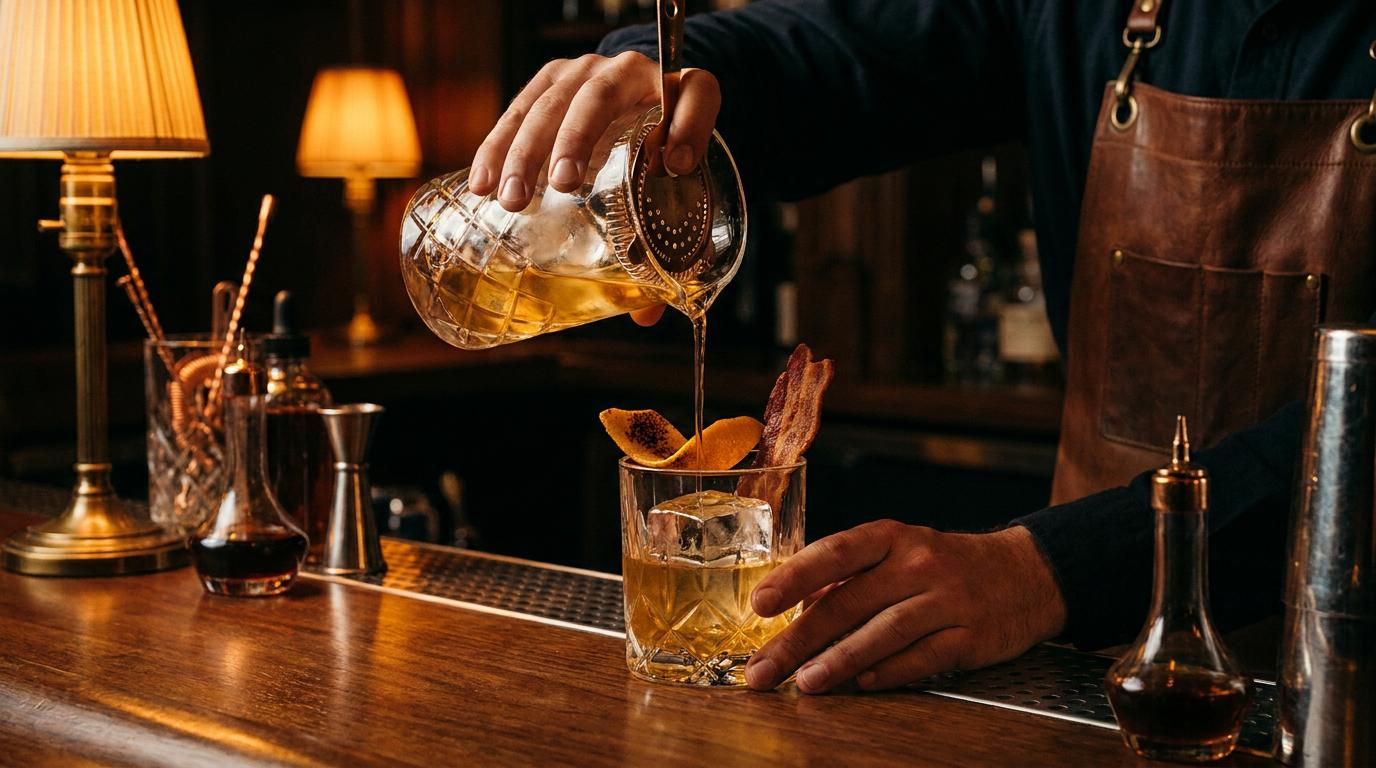
You order a cocktail at a dimly lit bar, expecting the familiar, sharp bite of bourbon. Instead, as the glass nears your face, you are greeted with the rich, smoky aroma of cured bacon. When you take a sip, the liquid coats your palate with a velvety, luxurious texture that feels more like a culinary reduction than a traditional spirit. This is not a magic trick, nor is it the result of artificial flavor syrups. It is the result of fat washing, a technique that has quietly revolutionized modern mixology.[4]
Over the last decade, fat washing has transitioned from a niche experiment in avant-garde cocktail lounges to a beloved, foundational technique used by bartenders worldwide. It allows creators to infuse high-proof spirits with savory, rich flavors—ranging from brown butter and toasted sesame oil to peanut butter and duck fat. The process bridges the gap between the culinary arts and the bar, bringing the savory depth of the kitchen directly into the cocktail glass.[3][5]
But beyond the sheer novelty of a bacon-flavored whiskey or an olive oil-infused gin, fat washing fundamentally alters the physical architecture of a drink. It provides a mechanism to extract complex flavor compounds without leaving a greasy, unappetizing slick on the surface of the cocktail. To understand how this works, one must look back to the origins of the technique and the underlying chemistry of alcohol.[4][6]
The modern origins of fat washing trace back to the mid-2000s, a golden era for the craft cocktail revival in New York City. The story centers on a legendary speakeasy called PDT (Please Don't Tell) and an innovative bartender named Don Lee. At the time, the molecular gastronomy movement was in full swing, and chefs were pushing the boundaries of flavor extraction using laboratory equipment.[1]

Lee was inspired by conversations with culinary pioneers and borrowed a concept from another bartender, Eben Freeman. The technique was actually rooted in an ancient perfume-making process known as enfleurage. In traditional enfleurage, perfumers press delicate, heat-sensitive flowers into odorless animal fat to extract their essential oils. Later, they use alcohol as a solvent to pull the captured fragrance out of the fat.[1][5]
Lee realized this exact scientific principle could be applied in reverse to flavor spirits with savory fats. He took smoky bacon fat from Benton's Smoky Mountain Country Hams—borrowed from the neighboring Momofuku restaurant—and infused it into Four Roses bourbon. The result was the Benton's Old Fashioned, a drink balanced with maple syrup and Angostura bitters that became an instant sensation and permanently altered the cocktail landscape.[1][6]
The science behind fat washing relies entirely on the unique chemical properties of alcohol. Ethanol is an exceptional solvent, capable of dissolving both water-soluble and fat-soluble flavor compounds. When a liquid fat—such as melted butter, warm coconut oil, or rendered bacon fat—is mixed with a high-proof spirit, the alcohol acts like a chemical magnet.[4]
The science behind fat washing relies entirely on the unique chemical properties of alcohol.
During the infusion period, which typically lasts a few hours at room temperature, the ethanol strips the aromatic molecules and essential oils out of the fat, absorbing them directly into the liquid. The two substances mingle, transferring the essence of the culinary ingredient into the spirit.[3][4]
The true magic, however, happens in the freezer. Because lipids (fats) and ethanol have drastically different freezing points, chilling the mixture forces a physical separation. The fat solidifies into a hard, opaque puck at the top of the container, while the high-proof alcohol remains entirely liquid beneath it.[3]

Once the fat has fully solidified overnight, it can be easily cracked and skimmed off the top. The remaining spirit is then passed through a fine filter, such as a coffee filter or a cheesecloth, to remove any microscopic particulates that might cloud the drink.[2][3]
What remains is a crystal-clear spirit that has captured the pure essence of the fat. Crucially, while the solid fat is discarded, the spirit retains a slightly altered viscosity. This gives the final cocktail a luxurious, silky mouthfeel that simply cannot be achieved through traditional syrups, juices, or standard infusions.[2][4]
Today, the technique has expanded far beyond bacon. Mixologists frequently pair extra virgin olive oil with botanical gins to create savory, herbaceous Martinis that carry a buttery weight. Coconut oil is commonly washed into white rums to add tropical richness to Daiquiris without the cloying, artificial sweetness of commercial coconut syrups.[2][3]
The beauty of fat washing lies in its profound accessibility. Unlike other molecular mixology techniques that require expensive centrifuges, liquid nitrogen, or specialized chemicals, fat washing requires only a glass jar, a standard kitchen freezer, and a coffee filter. This low barrier to entry has made it highly popular among home enthusiasts looking to elevate their DIY cocktail making.[3][5]

However, there are scientific variables that must be managed to achieve balance. The ratio of fat to spirit is critical; highly pungent fats like sesame oil or smoked bacon require only an ounce or two per bottle, while milder fats like clarified butter might require a heavier hand to make an impact.[3][6]
Furthermore, because the spirit now contains trace organic compounds, its shelf life is fundamentally altered. While pure spirits can sit on a bar cart indefinitely, experts recommend storing fat-washed spirits in the refrigerator to prevent oxidation and spoilage, ensuring the savory flavors remain fresh and vibrant for weeks to come.[3][6]
How we got here
Ancient times
Perfumers develop enfleurage, using fat to extract essential oils from flowers.
Mid-2000s
Molecular gastronomy chefs begin experimenting with new flavor extraction techniques.
2007
Bartender Don Lee creates the Benton's Old Fashioned at PDT in New York City, popularizing the fat-washing technique.
2010s
The technique spreads globally, with craft bars washing spirits in everything from olive oil to duck fat.
2020s
Fat washing becomes a mainstream trend among home bartenders and DIY mixology enthusiasts.
Viewpoints in depth
Molecular Mixologists
Advocates for using scientific principles to unlock entirely new sensory experiences in drinks.
For culinary-minded bartenders, fat washing is just one tool in a broader molecular arsenal. By understanding alcohol's role as a solvent, they can extract flavors that were previously impossible to incorporate into a liquid format. This camp is constantly experimenting with unconventional fats—from foie gras to wagyu beef drippings—pushing the boundaries of what a cocktail can taste like and prioritizing the element of surprise and textural innovation.
Classic Bartenders
Traditionalists who believe fat washing should be used sparingly to support, not mask, the spirit.
While acknowledging the brilliance of the technique, classic mixologists warn against the gimmickry of over-flavoring. They argue that a high-quality bourbon or gin already possesses a complex flavor profile crafted by master distillers. In their view, fat washing is best deployed with a light touch—such as a subtle brown butter wash in a rum—to add a silky mouthfeel and a complementary background note, ensuring the base spirit remains the star of the show.
Home Enthusiasts
DIY cocktail makers who value the technique for its low barrier to entry and high impact.
For the home bartender, fat washing represents the democratization of craft cocktails. Unlike clarification or spherification, which often require specialized chemicals or expensive centrifuges, fat washing requires nothing more than a mason jar and a standard kitchen freezer. This accessibility has sparked a massive online community of enthusiasts sharing recipes for peanut butter whiskey or olive oil gin, proving that high-end mixology can be replicated on a budget.
What we don't know
- The exact caloric transfer from the fat into the final strained spirit.
- How long specific fat-washed spirits can safely remain at room temperature before oxidizing.
Key terms
- Fat Washing
- A culinary technique used in mixology to infuse spirits with the flavor and texture of a fatty substance by mixing, freezing, and straining the liquid.
- Enfleurage
- An ancient perfume-making process that uses odorless fats to extract fragrant essential oils from botanical ingredients.
- Molecular Mixology
- The application of scientific principles and equipment to cocktail making to manipulate flavor, texture, and presentation.
- Mouthfeel
- The physical sensation of a food or drink in the mouth, such as the silky or velvety texture imparted by fat washing.
- Solvent
- A substance, such as ethanol in spirits, capable of dissolving other substances to extract their flavor compounds.
Frequently asked
Does fat washing make a cocktail greasy?
No. Because the mixture is frozen, the fat solidifies and is entirely strained out. The resulting spirit retains the flavor and a silky texture, but none of the actual grease.
What kind of alcohol is best for fat washing?
High-proof spirits (40% ABV or higher) like bourbon, rum, tequila, and gin work best, as the higher alcohol content more effectively extracts the flavor compounds.
How long does a fat-washed spirit last?
Because organic compounds are introduced, fat-washed spirits have a shorter shelf life than pure alcohol. They should be stored in the refrigerator and consumed within a few weeks to prevent spoilage.
Sources
Source coverage
6 outlets
3 viewpoints surfaced






[1]Difford's GuideClassic Bartenders
Fat-washing: History and Technique
Read on Difford's Guide →[2]Tasting TableClassic Bartenders
How To Fat Wash Spirits With Olive Oil For Savory Cocktails
Read on Tasting Table →[3]Dan Murphy'sHome Enthusiasts
How to fat wash spirits at home
Read on Dan Murphy's →[4]The BarHome Enthusiasts
How To Fat Wash Spirits At Home
Read on The Bar →[5]Alcohol ProfessorMolecular Mixologists
Modernist Techniques in Mixology
Read on Alcohol Professor →[6]Factlen Editorial Team
Synthesis by Factlen editorial team
Read on Factlen Editorial Team →
Every angle. Every day.
Get food drink stories with full source coverage and perspective breakdowns delivered to your inbox.