
How Enhanced Geothermal Systems Are Unlocking Clean Energy Anywhere
Next-generation geothermal technology uses advanced drilling to access the Earth's heat anywhere, providing 24/7 carbon-free electricity. With major cost reductions and backing from tech giants, enhanced geothermal systems (EGS) are poised to transform the global energy grid.
By Factlen Editorial Team
- Geothermal Developers
- EGS is now a commercially viable, scalable product ready for mass deployment.
- Energy Policymakers
- Next-generation geothermal is a critical pillar for national energy security and grid decarbonization.
- Geosciences Researchers
- The technology works, but requires rigorous monitoring of subsurface mechanics and seismic risks.
- Tech Industry Offtakers
- Geothermal is the ideal solution to power the explosive energy demands of artificial intelligence.
What's not represented
- · Local Water Authorities
- · Fossil Fuel Incumbents
Why this matters
As AI and electrification drive up electricity demand, wind and solar alone cannot provide the continuous baseload power required. EGS offers a reliable, carbon-free alternative that could rapidly replace fossil fuels without relying on the weather.
Key points
- Enhanced Geothermal Systems (EGS) create artificial underground reservoirs, allowing geothermal energy to be harvested anywhere.
- Recent breakthroughs have slashed deep-drilling costs by 70%, making the technology commercially viable.
- The U.S. Department of Energy projects next-generation geothermal could provide 90 gigawatts of power by 2050.
- Tech giants are signing massive contracts for EGS to secure 24/7 carbon-free power for AI data centers.
For decades, the transition to clean energy has wrestled with a fundamental limitation: the sun sets, and the wind stops blowing. As artificial intelligence data centers and widespread electrification drive up global electricity demand, the need for "baseload" power—energy that flows 24 hours a day, seven days a week—has become the grid's most urgent bottleneck.[1][6]
Historically, that continuous power has been supplied by coal, natural gas, or nuclear plants. Traditional geothermal energy, which taps into naturally occurring underground hot springs, offers a carbon-free alternative, but it is geographically constrained to rare tectonic hotspots like Iceland or Northern California.[4]
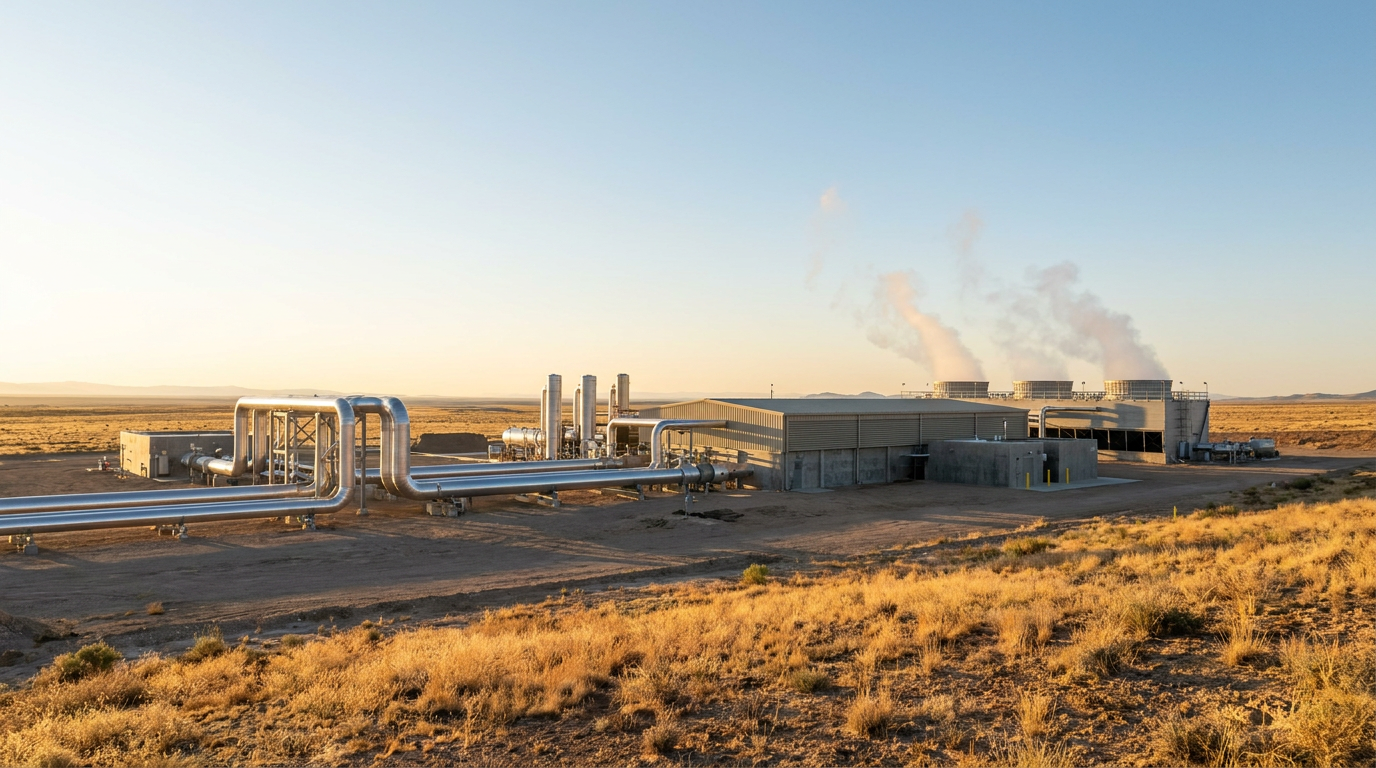
Now, a breakthrough technology known as Enhanced Geothermal Systems (EGS) is rewriting the rules of renewable energy. By applying advanced drilling techniques pioneered in the oil and gas industry, EGS allows engineers to create artificial geothermal reservoirs almost anywhere on Earth, unlocking a virtually limitless supply of continuous, clean electricity.[4][5]
The momentum behind EGS has accelerated dramatically in 2026. Fervo Energy, a leading U.S. geothermal developer, recently filed for a $1.33 billion initial public offering, targeting a valuation of up to $6.5 billion. The company has 3.65 gigawatts of power plant capacity in its development pipeline—enough to nearly double the current installed geothermal capacity of the entire United States.[1][6]

To understand why EGS is suddenly viable, it is necessary to look at the mechanism beneath the surface. Traditional geothermal relies on three naturally occurring elements: heat, fluid, and permeable rock. If any of those three are missing, a conventional geothermal well fails.[4]
EGS bypasses the need for natural fluid and permeability. Engineers drill deep into the Earth's crust—often 7,000 to 10,000 feet down—to reach hot, dry rock. They then drill horizontally, sometimes stretching for miles underground, to maximize contact with the heated formation.[4][5]
Once the wells are drilled, high-pressure fluid is injected to create a network of millimeter-thick fractures in the rock, a process similar to hydraulic fracturing ("fracking") but without the hydrocarbons. Water is then circulated down an injection well, heated by the surrounding rock to temperatures exceeding 300 degrees Fahrenheit, and brought back to the surface through a production well.[4]
At the surface, the superheated water transfers its thermal energy to a secondary fluid with a lower boiling point. This secondary fluid flashes into vapor, spinning a turbine to generate electricity. The cooled water is then pumped back underground in a continuous, closed-loop cycle, producing zero greenhouse gas emissions.[4]

The economic viability of this process has historically been the primary hurdle. Drilling deep into hard, igneous rock is notoriously expensive, often accounting for more than 50 percent of a geothermal project's capital costs.[5]
The economic viability of this process has historically been the primary hurdle.
However, recent field data demonstrates a staggering improvement in efficiency. By treating geothermal facilities as repeatable manufacturing processes rather than bespoke mega-projects, developers have slashed costs. Between its early pilot projects and its commercial-scale Cape Station facility in Utah, Fervo Energy reported a 70 percent reduction in drilling times and a nearly 50 percent drop in overall development costs.[1][5]
These cost reductions have caught the attention of the U.S. Department of Energy (DOE). In its recent "Pathways to Commercial Liftoff" report, the DOE projected that next-generation geothermal could expand twentyfold, contributing 90 gigawatts of clean, firm power to the U.S. grid by 2050.[2]
The DOE estimates that achieving this scale will require $20 billion to $25 billion in near-term investment, but the long-term payoff is immense. The agency forecasts that the levelized cost of energy (LCOE) for EGS could drop to $60 to $70 per megawatt-hour, making it fully cost-competitive with natural gas and other non-emitting sources of firm power.[2]

The commercialization of EGS is being heavily underwritten by the technology sector. Hyperscale data center operators, desperate for reliable, carbon-free power to fuel the AI boom, are signing massive Power Purchase Agreements (PPAs) to de-risk geothermal projects.[6]
Google, which partnered with Fervo on an initial pilot project in Nevada, recently expanded its commitment with a 115-megawatt PPA. Meta and other tech giants have followed suit, signaling a broader market trend where corporate procurement is driving the deployment of baseload clean energy. Utilities like Southern California Edison are also signing record-breaking geothermal contracts to ensure grid reliability.[1][6]
Despite the rapid progress, EGS still faces technical and environmental uncertainties. The most prominent concern is induced seismicity. Because EGS involves fracturing underground rock, it generates micro-earthquakes. While these are typically of very low magnitude and rarely felt at the surface, careful monitoring is essential to prevent larger seismic events.[3]
To mitigate this risk, scientists at the Lawrence Berkeley National Laboratory have developed custom, high-temperature seismometers. Deployed nearly 7,000 feet underground at the Cape Station site, these sensors provide continuous, real-time data on rock fractures, ensuring that the reservoir stimulation remains safe and controlled.[3]

Another open question is water consumption. While EGS operates as a closed loop, some water is inevitably lost to the surrounding rock formations over time. In arid regions like the American West, securing the water rights necessary to prime and maintain these massive underground reservoirs could present a logistical challenge.[7]
Finally, the industry is looking toward the next frontier: superhot rock geothermal. By drilling even deeper to reach temperatures above 750 degrees Fahrenheit (400 degrees Celsius), water enters a "supercritical" state, behaving as both a liquid and a gas. Supercritical wells could potentially produce five to ten times the energy of a standard EGS well, though the extreme heat currently melts standard drilling equipment.[4]
If these material science challenges can be overcome, the implications are profound. Enhanced geothermal systems offer a rare convergence of economic opportunity and climate necessity, utilizing the existing workforce and supply chains of the oil and gas industry to build a carbon-free future.[2]
For the first time, the heat beneath our feet is accessible at a commercial scale. As EGS moves from pilot projects to gigawatt-scale deployments, it promises to be the missing puzzle piece in the global transition to a fully decarbonized, highly reliable energy grid.[7]
How we got here
2021
Fervo Energy and Google partner on an initial 5-megawatt EGS pilot project in Nevada.
2023
Construction begins on Cape Station in Utah, designed to be the world's largest next-generation geothermal facility.
March 2024
The U.S. Department of Energy releases its Liftoff report, projecting a 20-fold increase in geothermal capacity by 2050.
Late 2025
Fervo achieves a 70% reduction in drilling times, proving the commercial scalability of EGS technology.
May 2026
Fervo Energy files for a $1.33 billion IPO, signaling major Wall Street backing for next-generation geothermal.
Viewpoints in depth
Geothermal Developers' View
EGS is now a commercially viable, scalable product ready for mass deployment.
Companies like Fervo Energy argue that the geothermal industry must move away from treating plants as bespoke, one-off construction projects. By standardizing the technology and applying horizontal drilling techniques from the oil and gas sector, developers believe they can achieve rapid learning curves. They point to the 70 percent reduction in drilling costs as proof that EGS is ready to compete directly with natural gas on price, while offering the premium value of zero-carbon baseload power.
Energy Policymakers' View
Next-generation geothermal is a critical pillar for national energy security and grid decarbonization.
The U.S. Department of Energy views EGS as a massive macroeconomic opportunity. Beyond the sheer volume of projected power—up to 90 gigawatts by 2050—policymakers highlight the strategic advantage of transitioning the existing fossil fuel workforce. Because EGS relies on the exact same drilling rigs, geophysicists, and supply chains used in oil and gas extraction, it offers a seamless economic pivot for traditional energy workers into the clean energy economy.
Geosciences Researchers' View
The technology works, but requires rigorous monitoring of subsurface mechanics and seismic risks.
Scientists at national laboratories emphasize that while the thermodynamic principles of EGS are sound, the subsurface environment is highly complex. Creating artificial fracture networks at 300 degrees Fahrenheit requires precise, real-time monitoring to prevent induced seismicity that could be felt at the surface. Researchers are focused on developing high-temperature sensors and advancing the material science needed to eventually tap into 'supercritical' fluids, which could multiply energy yields tenfold.
Tech Industry Offtakers' View
Geothermal is the ideal solution to power the explosive energy demands of artificial intelligence.
Hyperscale data center operators like Google and Meta are driving the commercialization of EGS through massive Power Purchase Agreements. From their perspective, wind and solar are insufficient because AI workloads run 24/7 and cannot tolerate intermittent power drops. Tech companies view EGS as a necessary investment to meet their aggressive net-zero climate pledges without compromising the reliability of their rapidly expanding computing infrastructure.
What we don't know
- How the water consumption required to prime and maintain EGS reservoirs will be managed in drought-prone regions like the American West.
- Whether the material science challenges of drilling into 750-degree 'supercritical' rock can be solved to unlock even higher energy yields.
- How quickly local utility commissions and regulatory bodies will approve the permitting for gigawatt-scale underground fracture networks.
Key terms
- Enhanced Geothermal Systems (EGS)
- A technology that extracts heat by creating artificial fracture networks in deep, hot rock formations that lack natural permeability.
- Baseload Power
- The minimum amount of electric power needed to be supplied to the electrical grid at any given time, requiring energy sources that can run continuously.
- Induced Seismicity
- Minor earthquakes and tremors that are caused by human activity, such as the fluid injection used to fracture rock in EGS.
- Levelized Cost of Energy (LCOE)
- A metric used to compare the lifetime costs of generating electricity across different technologies, expressed in dollars per megawatt-hour.
- Supercritical Fluid
- A state of matter achieved at extreme temperatures and pressures where water exhibits properties of both a liquid and a gas, capable of carrying massive amounts of thermal energy.
Frequently asked
What is the difference between traditional geothermal and EGS?
Traditional geothermal requires naturally occurring hot water and permeable rock. EGS creates artificial reservoirs by drilling into hot, dry rock and injecting water to create fractures.
Does enhanced geothermal cause earthquakes?
EGS creates micro-fractures in rock, which generate microseismic events. These are typically too small to be felt at the surface, but projects use deep sensors to monitor and control the process safely.
Why are tech companies investing in geothermal?
Tech giants like Google and Meta need massive amounts of 24/7 electricity for AI data centers. Geothermal provides continuous, carbon-free power, unlike wind and solar which fluctuate with the weather.
Is EGS economically competitive?
Recent breakthroughs have slashed drilling costs by 70%. The Department of Energy projects that EGS will soon reach a levelized cost of $60 to $70 per megawatt-hour, making it competitive with natural gas.
Sources
Source coverage
7 outlets
4 viewpoints surfaced






[1]Canary MediaGeothermal Developers
Fervo Energy IPO filing reveals massive geothermal pipeline
Read on Canary Media →[2]U.S. Department of EnergyEnergy Policymakers
Pathways to Commercial Liftoff: Next-Generation Geothermal Power
Read on U.S. Department of Energy →[3]Lawrence Berkeley National LaboratoryGeosciences Researchers
Custom sensor monitors seismicity for months straight more than a mile below ground
Read on Lawrence Berkeley National Laboratory →[4]ThinkGeoEnergyGeosciences Researchers
Concept and Mechanism of Enhanced Geothermal Systems
Read on ThinkGeoEnergy →[5]Information Technology and Innovation FoundationTech Industry Offtakers
EGS in Action: Fervo Case Study
Read on Information Technology and Innovation Foundation →[6]Carbon CreditsGeothermal Developers
Wall Street Bets Big on a $1.3 Billion Climate-Tech IPO
Read on Carbon Credits →[7]Factlen Editorial Team
Synthesis by Factlen editorial team
Read on Factlen Editorial Team →

Every angle. Every day.
Get guides stories with full source coverage and perspective breakdowns delivered to your inbox.