
How Direct Air Capture Works: The Technology Pulling Carbon from the Sky
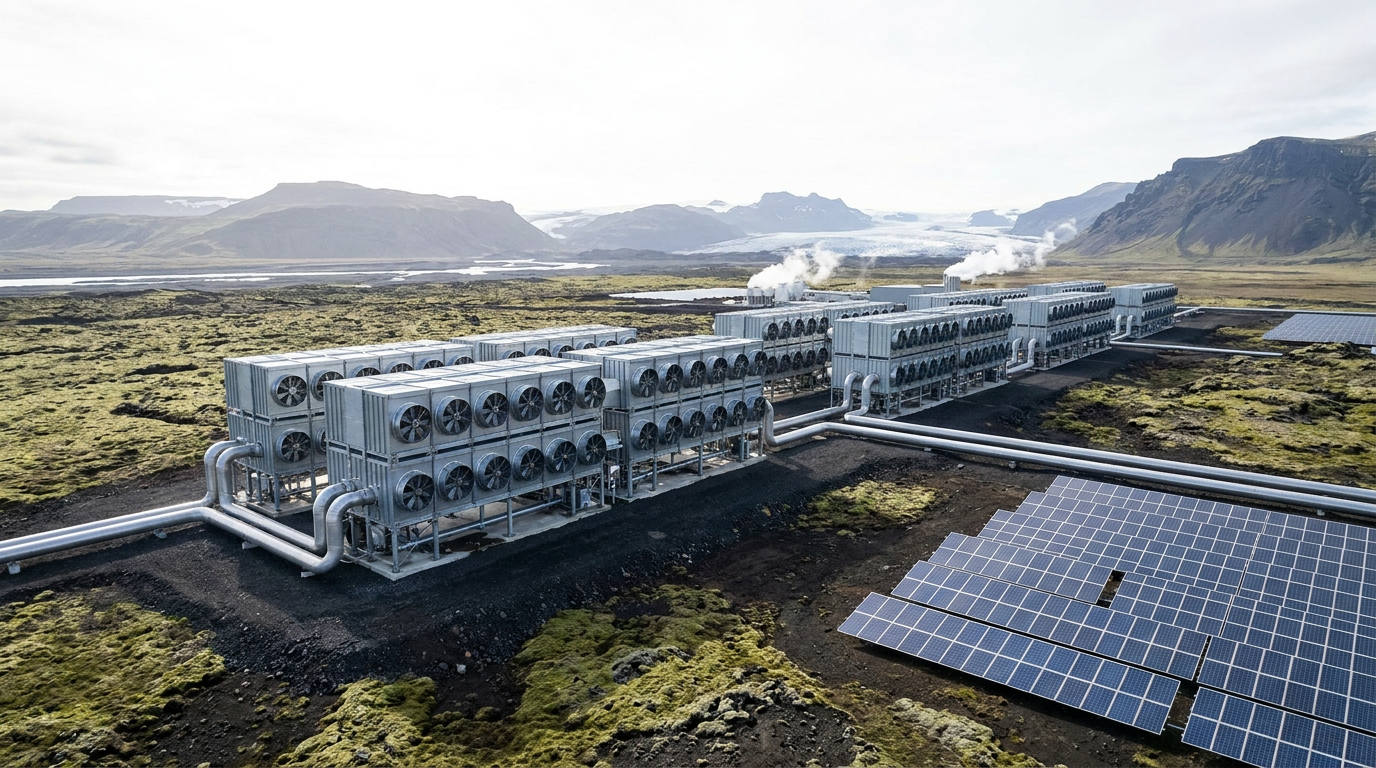
To meet global climate targets, engineers are building massive facilities that act like mechanical forests, filtering historical carbon dioxide directly out of the ambient air.
By Factlen Editorial Team
- Climate Technologists & Engineers
- Argue that DAC is an essential, scalable tool to address legacy emissions and hard-to-abate sectors.
- Policy & Energy Planners
- Focus on the massive infrastructure and energy requirements needed to scale the technology.
- Market Analysts & Corporate Buyers
- View DAC as the highest-quality, most durable carbon removal asset available on the market.
What's not represented
- · Environmental justice advocates concerned about local impacts of storage infrastructure
- · Fossil fuel executives viewing DAC as a way to prolong the use of hydrocarbons
Why this matters
To prevent the worst effects of climate change, humanity can no longer just reduce emissions—we must actively remove billions of tonnes of historical carbon from the sky. Direct Air Capture is currently the most permanent, scalable technology to achieve this, and its success will dictate whether global net-zero targets are mathematically possible.
Key points
- Direct Air Capture (DAC) acts like a mechanical forest, pulling carbon dioxide directly from the ambient atmosphere.
- The technology uses massive fans and chemical filters—either solid sorbents or liquid solvents—to trap CO2 molecules.
- Captured carbon is typically injected deep underground, where it mineralizes into solid rock for permanent storage.
- The industry faces a steep cost curve, currently charging $400 to $1,000 per tonne of CO2 removed.
- Tech giants like Microsoft and Amazon are pouring billions into DAC credits to neutralize their historical emissions.
The math of climate change has fundamentally shifted. For decades, the global focus was solely on reducing emissions—switching to renewable energy, driving electric vehicles, and increasing industrial efficiency. But climate models now universally agree that simply stopping new emissions is no longer enough to meet the 1.5°C target set by the Paris Agreement.[1][8]
We must also clean up the "legacy emissions" already warming the atmosphere. Enter Direct Air Capture (DAC), a rapidly maturing technology that acts like a mechanical forest, pulling carbon dioxide directly from the ambient air so it can be permanently locked away.[2][4]
Unlike traditional carbon capture, which scrubs concentrated exhaust directly from factory smokestacks, DAC operates in the open environment. Because the Earth's atmosphere mixes globally every few weeks, a DAC plant built in Iceland can effectively remove emissions generated by a steel plant in Australia or a highway in California.[4][7]
However, pulling CO2 from the sky is an immense engineering challenge. Carbon dioxide makes up just 0.04% of the ambient air. Finding and trapping those specific molecules is often compared to finding a needle in a haystack, requiring massive volumes of air to be processed to yield a meaningful amount of carbon.[2][5]

How does the mechanism actually work? While specific engineering designs vary by company, almost all Direct Air Capture systems follow a three-step process: contacting, capturing, and separating.[7]
First, massive industrial fans draw ambient air into a chamber known as a contactor. Inside this chamber, the air passes over a specialized chemical media designed to act as a highly selective sponge for CO2, allowing the rest of the air—mostly nitrogen and oxygen—to flow back out into the environment.[3][4]
The industry is currently divided into two primary approaches for this capture phase: solid sorbents (S-DAC) and liquid solvents (L-DAC). Each method has distinct advantages and energy requirements.[5][8]
Solid DAC systems, pioneered by companies like Switzerland's Climeworks, use porous, filter-like materials coated with chemicals that bind to CO2. Once the filter is saturated, the chamber is sealed and heated to around 100°C (often using waste heat or geothermal energy). This moderate heat breaks the chemical bond, releasing a stream of pure CO2.[3][7]
Solid DAC systems, pioneered by companies like Switzerland's Climeworks, use porous, filter-like materials coated with chemicals that bind to CO2.
Liquid DAC systems, such as those developed by Carbon Engineering, pass the air through an aqueous alkaline solution, like potassium hydroxide. The CO2 dissolves into the liquid, which must then be heated to much higher temperatures—often between 300°C and 900°C—to release the gas and regenerate the liquid for the next cycle.[1][5]

Once the pure CO2 is separated, it must be dealt with safely and permanently. The most durable solution is geological sequestration. In places like Iceland, DAC companies partner with specialized firms like Carbfix to dissolve the captured CO2 in water and pump it deep underground into basalt rock formations.[3][6]
Within roughly two years, the carbon dioxide reacts with the basalt and mineralizes, literally turning into solid stone. This ensures the carbon is locked away for millions of years, providing the highest level of permanence available in the carbon removal market.[3][6]
The scale of these operations is rapidly expanding from pilot projects to industrial facilities. In 2024, Climeworks launched its Mammoth plant in Iceland, which was designed to capture up to 36,000 tonnes of CO2 annually using geothermal power.[6]
Meanwhile, in Texas, 1PointFive is constructing Stratos, a massive liquid DAC facility. Once fully operational, Stratos is expected to capture up to 500,000 tonnes of CO2 per year, representing a massive leap in the technology's commercial footprint.[6]
Despite these engineering milestones, the industry faces a steep cost curve. Currently, capturing a single tonne of CO2 via DAC costs between $400 and $1,000. This premium price is driven largely by the massive energy requirements of the heating and vacuum processes needed to separate the carbon.[6][7]

To make DAC a globally viable climate tool, costs must plummet. The U.S. Department of Energy has launched the "Carbon Negative Shot," an ambitious innovation initiative aiming to drive the cost of carbon dioxide removal down to $100 per net metric ton by the end of the decade.[2]
To spur this innovation, governments and corporations are stepping in as early buyers. Tech giants like Microsoft, Amazon, and Stripe have committed hundreds of millions of dollars to purchase DAC carbon removal credits in advance, providing the guaranteed revenue these startups need to build larger, more efficient plants.[6]
Microsoft alone has secured roughly 18 million tonnes of durable carbon removal over the past two years. For these corporations, DAC represents the gold standard of carbon offsets—highly measurable and immune to the risks of wildfires that plague traditional forestry offsets.[6]

How we got here
1999
The concept of direct air capture is first proposed by scientists as a theoretical climate solution.
2018
The IPCC concludes that emission reductions alone are no longer sufficient to meet the 1.5°C target.
2021
Climeworks opens Orca in Iceland, the world's first commercial-scale DAC plant.
2024
The Mammoth plant comes online, scaling global direct air capture capacity significantly.
2025
1PointFive prepares to launch Stratos in Texas, designed to capture 500,000 tonnes annually.
Viewpoints in depth
Climate Technologists & Engineers
Argue that DAC is an essential, scalable tool to address legacy emissions and hard-to-abate sectors.
This camp emphasizes that the math of the Paris Agreement is impossible without massive carbon removal. Because DAC operates independently of emission sources, it can be deployed anywhere with abundant clean energy. They view the technology not as a replacement for decarbonization, but as the only viable mechanism to clean up the billions of tonnes of historical emissions already warming the planet.
Policy & Energy Planners
Focus on the massive infrastructure and energy requirements needed to scale the technology.
Government agencies and international energy bodies stress that DAC is currently too expensive and energy-intensive to be a silver bullet. They argue that scaling DAC to the gigatonne level will require unprecedented build-outs of renewable energy generation and geological storage networks. Their primary focus is on funding research to drive the cost per tonne down to $100, ensuring the technology becomes economically viable.
Market Analysts & Corporate Buyers
View DAC as the highest-quality, most durable carbon removal asset available on the market.
For tech giants and financial institutions with strict net-zero commitments, DAC represents the gold standard of carbon offsets. Unlike forestry projects, which can burn down or suffer from measurement inaccuracies, DAC provides highly measurable, permanent geological storage. These buyers are willing to pay a massive premium today—often over $500 per tonne—to help the industry scale and secure future capacity.
What we don't know
- Whether the industry can successfully drive the cost of removal down to the $100-per-tonne target by 2030.
- How the massive energy requirements of gigatonne-scale DAC will be met without straining renewable energy grids.
- Whether the promise of future carbon removal might reduce the political urgency to cut fossil fuel emissions today.
Key terms
- Direct Air Capture (DAC)
- A technology that uses chemical or physical processes to extract carbon dioxide directly from the ambient atmosphere.
- Sorbent
- A solid filter material used in DAC systems that chemically binds to carbon dioxide molecules.
- Solvent
- A liquid chemical solution used to dissolve and trap carbon dioxide from the air.
- Mineralization
- The process of injecting captured CO2 deep underground, where it reacts with rock formations to turn into solid stone.
- Carbon Dioxide Removal (CDR)
- The broad category of methods, both natural and engineered, designed to remove historical CO2 from the atmosphere.
Frequently asked
Is direct air capture the same as carbon capture at power plants?
No. Traditional carbon capture scrubs CO2 directly from the concentrated exhaust stacks of factories. DAC pulls CO2 from the open atmosphere, meaning it can be located anywhere.
Why is direct air capture so expensive?
Because CO2 makes up only about 0.04% of the atmosphere, DAC systems must process massive volumes of air. The energy required to move that air and heat the filters drives up operational costs.
What happens to the carbon once it is captured?
It is typically compressed and injected deep underground into geological formations where it permanently mineralizes into rock. It can also be utilized to make synthetic fuels or building materials.
Sources
Source coverage
8 outlets
3 viewpoints surfaced








[1]IEAPolicy & Energy Planners
Tracking Direct Air Capture
Read on IEA →[2]US Department of EnergyPolicy & Energy Planners
Direct Air Capture
Read on US Department of Energy →[3]ClimeworksClimate Technologists & Engineers
Climeworks Solutions and Direct Air Capture
Read on Climeworks →[4]Carbon DirectClimate Technologists & Engineers
What is direct air capture?
Read on Carbon Direct →[5]Mission Zero TechnologiesClimate Technologists & Engineers
Direct Air Capture: Climate Tech for a Post-Fossil World
Read on Mission Zero Technologies →[6]SenkenMarket Analysts & Corporate Buyers
The World's Largest Direct Air Capture Facility
Read on Senken →[7]WikipediaPolicy & Energy Planners
Direct air capture
Read on Wikipedia →[8]Factlen Editorial TeamMarket Analysts & Corporate Buyers
Synthesis by Factlen editorial team
Read on Factlen Editorial Team →

Every angle. Every day.
Get guides stories with full source coverage and perspective breakdowns delivered to your inbox.