
How Creatine is Evolving from a Muscle Builder to a Brain Health Essential
New research reveals that the popular sports supplement creatine monohydrate acts as a critical energy buffer for the brain, improving memory and processing speed during sleep deprivation and aging.
By Factlen Editorial Team
- Cognitive Aging Researchers
- Focus on creatine's ability to rescue energy-starved neurons and delay age-related cognitive decline.
- Performance Nutritionists
- Emphasize the transition of creatine from a muscle-building tool to a holistic performance and recovery aid.
- Psychiatric Researchers
- Investigate the link between brain energy metabolism and mood disorders like depression.
What's not represented
- · Pediatric Neurologists
- · Long-term safety regulators for high-dose protocols
Why this matters
As the global population ages and the demands of the modern knowledge economy increase, finding safe, evidence-based ways to protect brain energy is critical. Creatine's transition from a bodybuilding staple to a neuroprotective tool offers a cheap, accessible intervention for sleep deprivation, cognitive decline, and mental fatigue.
Key points
- Creatine recycles ATP in the brain, acting as a rapid-response energy buffer during periods of high mental demand.
- Supplementation significantly improves memory and processing speed in individuals experiencing sleep deprivation or mental fatigue.
- Vegetarians and older adults see the most pronounced cognitive benefits due to lower baseline brain creatine levels.
- Neurological benefits often require higher daily doses (15-20 grams) than those traditionally used for muscle growth.
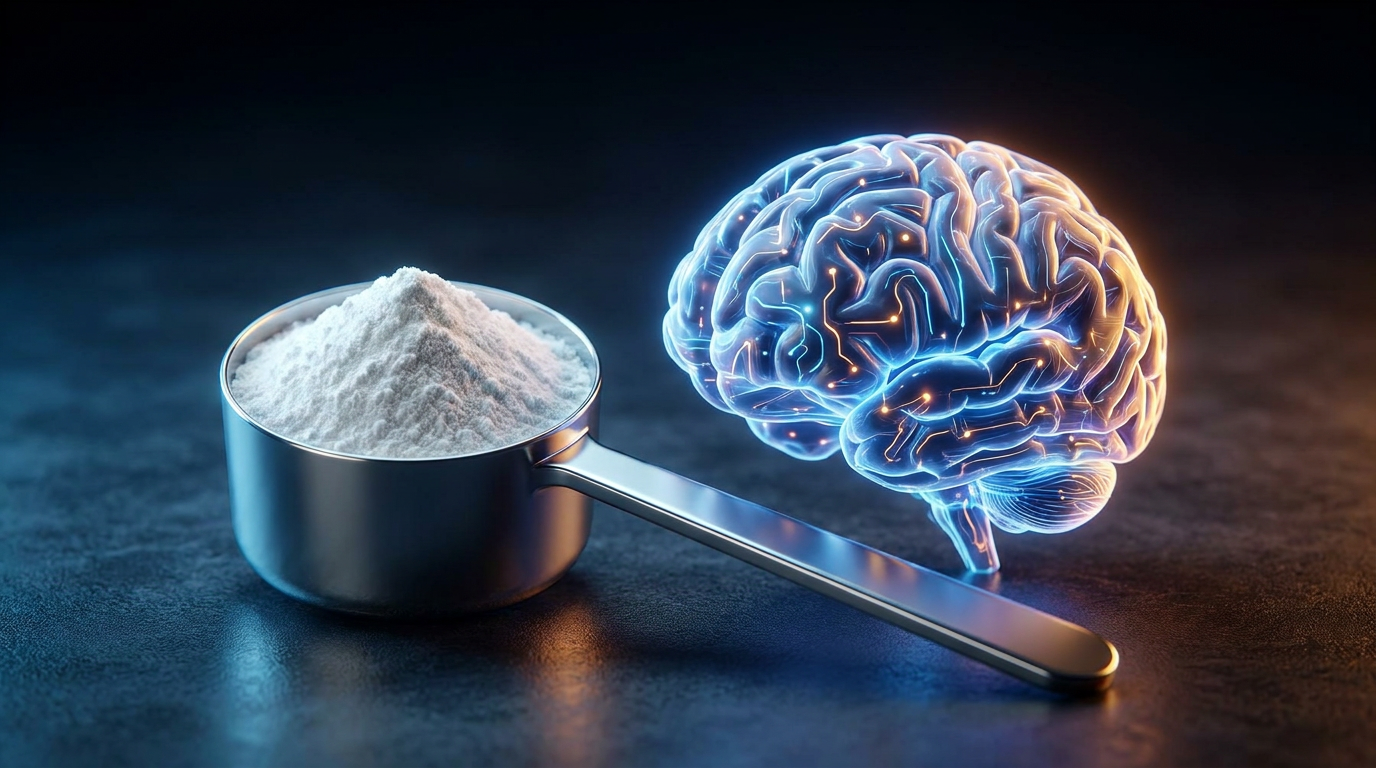
For decades, creatine monohydrate has been the undisputed king of the weight room. Associated primarily with bodybuilders and sprinters, it is the most widely researched sports supplement in history, proven to increase muscle power and accelerate physical recovery. But in recent years, a quiet paradigm shift has occurred in laboratories around the world. Researchers are no longer just looking at what creatine does below the neck. They are looking at the brain.[4][7]
The brain is a notoriously demanding organ. While it accounts for only about two percent of human body weight, it consumes roughly 20 percent of the body's resting energy. Every thought, memory retrieval, and moment of intense focus requires a massive, uninterrupted supply of cellular fuel. When that fuel supply falters—due to aging, sleep deprivation, or metabolic stress—cognitive performance rapidly degrades.[4][5]
To understand how a muscle supplement rescues a tired brain, one must look at the biological currency of energy: Adenosine Triphosphate, or ATP. Whenever a brain cell fires, it burns ATP, stripping away a phosphate molecule and leaving behind a depleted byproduct called ADP. Under normal conditions, the cell must metabolize glucose to rebuild that ATP, a process that takes time and resources.[5][7]
This is where creatine intervenes. Inside the body, creatine binds with phosphate to form phosphocreatine. It acts as a rapid-response energy reserve, standing by with spare phosphate molecules. When ATP is depleted, phosphocreatine instantly donates its phosphate to the useless ADP, recycling it back into usable ATP in a fraction of a second. This mechanism, long understood in skeletal muscle, is now recognized as a critical buffer for neural energy.[4][5]

The evidence for creatine as a cognitive enhancer has crystallized over the past two years. A comprehensive 2024 systematic review and meta-analysis published in Frontiers in Nutrition examined 16 randomized controlled trials involving nearly 500 participants. The researchers found that creatine supplementation yielded statistically significant improvements in memory, attention time, and information processing speed.[1]
However, the data reveals a fascinating nuance: creatine is not a universal smart pill. Its cognitive benefits are highly conditional. If you are a well-rested, healthy 22-year-old eating a standard diet, supplementing with creatine is unlikely to alter your performance on a math test. Young, healthy brains generally synthesize and maintain sufficient creatine levels on their own, leaving little room for a supplement to make a measurable difference.[1][7]
Instead, creatine shines under conditions of metabolic stress—when the brain's energy demands suddenly outstrip its supply. The most common form of this stress is sleep deprivation. In a landmark 2024 study published in Scientific Reports, researchers kept healthy adults awake for 21 hours and administered a single high dose of creatine. The supplemented group demonstrated a 16 to 29 percent improvement in processing speed and a 10 percent boost in memory compared to the placebo group, alongside a reduction in subjective fatigue.[3]

Instead, creatine shines under conditions of metabolic stress—when the brain's energy demands suddenly outstrip its supply.
Dietary habits also dictate who benefits most. Because natural creatine is found almost exclusively in meat and fish, vegetarians and vegans consistently exhibit lower baseline levels of brain and muscle creatine. Consequently, systematic reviews repeatedly show that plant-based eaters experience significantly more pronounced cognitive improvements from supplementation than omnivores, particularly in short-term memory and reasoning tasks.[1][7]
Beyond acute stressors like sleep loss, researchers are increasingly focused on the chronic metabolic stress of aging. As humans age, mitochondrial function declines, making the brain less efficient at producing and utilizing energy. This energy starvation is a hallmark of cognitive decline and neurodegenerative diseases, prompting scientists to investigate whether energy buffers can slow the process.[2][4]
A 2026 systematic review published in Nutrition Reviews evaluated the impact of creatine on older adults. Analyzing data from over 1,500 participants, the researchers found a positive relationship between creatine supplementation and cognitive preservation, particularly in the domains of memory and attention. By acting as an energy buffer, creatine appears to help aging neurons survive periods of metabolic shortfall.[2]

This neuroprotective effect is now being tested in clinical populations. Pilot studies have explored high-dose creatine supplementation in patients with Alzheimer's disease. Early results have been highly encouraging, showing an 11 percent increase in total brain creatine and measurable improvements in global and fluid cognitive composite scores after eight weeks, without adverse side effects.[5][7]
The psychiatric applications of creatine are also expanding rapidly. Because brain bioenergetics play a crucial role in mood regulation, researchers are investigating creatine as an adjunct treatment for depression. Recent trials have demonstrated that adding creatine to cognitive behavioral therapy or standard SSRI antidepressants significantly improves treatment outcomes, particularly in women with major depressive disorder.[6][7]
Despite the promising data, a major hurdle remains: dosing. The blood-brain barrier is highly selective, and the brain's creatine transporter system is less efficient than that of skeletal muscle. While a standard dose of 3 to 5 grams per day is sufficient to saturate muscle tissue, neurological studies suggest that the brain requires much higher doses—often 15 to 20 grams per day—to achieve meaningful increases in cerebral phosphocreatine levels.[3][5]

This high-dose requirement has prompted researchers to explore alternative delivery methods, such as intranasal administration or creatine analogs like cyclocreatine, which might cross the blood-brain barrier more easily. Until those are developed and proven safe, experts studying cognitive decline and sleep deprivation generally utilize the higher 20-gram oral protocols.[5][7]
As the science evolves, creatine's reputation is undergoing a profound transformation. It remains one of the safest, most extensively tested dietary supplements on the market, with decades of data confirming its benign safety profile. But its future lies far beyond the gym. From exhausted parents and jet-lagged executives to aging populations looking to protect their neural circuitry, creatine is emerging as a foundational tool for cognitive longevity.[4][7]
How we got here
1990s
Creatine monohydrate gains global popularity as a sports supplement for increasing skeletal muscle power and mass.
2006
Early studies demonstrate that creatine supplementation can improve cognitive performance in young adults subjected to sleep deprivation.
2018
Systematic reviews begin confirming that vegetarians and vegans experience significant memory improvements from creatine due to lower baseline levels.
2024
A landmark meta-analysis in Frontiers in Nutrition confirms creatine's efficacy in improving memory and processing speed across diverse adult populations.
2026
New systematic reviews highlight creatine's potential as a neuroprotective agent for aging brains, spurring clinical trials for Alzheimer's and depression.
Viewpoints in depth
Cognitive Aging Researchers
Focus on creatine's ability to rescue energy-starved neurons and delay age-related cognitive decline.
For researchers studying neurodegeneration, the brain is fundamentally an energy-hungry engine that loses its efficiency over time. As mitochondria degrade with age, neurons struggle to produce enough ATP to maintain their synapses, leading to cognitive slowing and increased vulnerability to diseases like Alzheimer's. This camp views creatine not as a stimulant, but as a structural energy buffer. By artificially increasing the brain's phosphocreatine reserves, they argue we can provide aging neurons with an emergency fuel source, potentially slowing the metabolic starvation that precedes cognitive decline.
Performance Nutritionists
Emphasize the transition of creatine from a muscle-building tool to a holistic performance and recovery aid.
Sports scientists have studied creatine for decades, primarily focusing on how it recycles ATP during a heavy deadlift or a 100-meter sprint. Today, this camp is leading the charge in applying those same bioenergetic principles to the central nervous system. They highlight that the brain dictates physical fatigue just as much as the muscles do. For performance nutritionists, high-dose creatine is becoming a standard recommendation for athletes dealing with jet lag, concussion recovery, and the intense mental fatigue that accompanies elite competition.
Psychiatric Researchers
Investigate the link between brain energy metabolism and mood disorders like depression.
A growing faction within psychiatry is moving away from purely neurotransmitter-based models of depression (like the serotonin hypothesis) and looking at brain bioenergetics. They note that patients with major depressive disorder often exhibit impaired cellular energy metabolism in the prefrontal cortex. By supplementing with creatine, this camp aims to correct those underlying energy deficits. Their clinical trials suggest that when the brain has more readily available ATP, patients respond better to traditional therapies like SSRIs and cognitive behavioral therapy.
What we don't know
- The exact dosage required to optimally saturate the brain across different age groups and body weights remains unconfirmed.
- Whether long-term, high-dose creatine supplementation (20g+ daily) carries any unforeseen risks over decades of use.
- The precise mechanisms by which creatine interacts with standard antidepressant medications to improve mood disorders.
Key terms
- Adenosine Triphosphate (ATP)
- The primary molecule that stores and transfers energy within cells; the basic fuel source for all brain and muscle activity.
- Phosphocreatine
- A molecule that stores high-energy phosphate groups and rapidly donates them to depleted ATP, instantly recharging the cell's energy supply.
- Blood-Brain Barrier
- A highly selective semipermeable border of cells that prevents most substances in the blood from crossing into the fluid of the central nervous system.
- Bioenergetics
- The study of how cells transform energy, specifically how the brain produces and consumes fuel to maintain cognitive function.
- Metabolic Stress
- Conditions—such as sleep deprivation, intense mental fatigue, or aging—where a cell's demand for energy exceeds its available supply.
Frequently asked
Do I need a higher dose of creatine for my brain than for my muscles?
Yes. While 3 to 5 grams daily is enough to saturate skeletal muscle, the blood-brain barrier makes it harder for creatine to enter the brain. Neurological studies often use 15 to 20 grams per day to achieve measurable cognitive effects.
Will taking creatine keep me awake at night?
No. Unlike caffeine, creatine is not a central nervous system stimulant. It provides cellular energy (ATP) rather than stimulating neurotransmitters, so it does not cause jitteriness or interfere with sleep architecture.
Why do vegetarians see a bigger cognitive boost from creatine?
Creatine is naturally found in meat and fish. Because vegetarians consume almost zero dietary creatine, their baseline tissue levels are lower. Supplementing fills a larger deficit, leading to more pronounced improvements in memory and reasoning.
Does creatine help young, healthy people study better?
Generally, no. Studies show that well-rested, healthy young adults already have optimal brain creatine levels. Supplementation only provides a noticeable cognitive boost when the brain is under metabolic stress, such as during sleep deprivation.
Sources
Source coverage
7 outlets
3 viewpoints surfaced







[1]Frontiers in NutritionPsychiatric Researchers
Efficacy of creatine supplementation on cognitive function in adults
Read on Frontiers in Nutrition →[2]Nutrition ReviewsCognitive Aging Researchers
Creatine and Cognition in Aging: A Systematic Review of Evidence in Older Adults
Read on Nutrition Reviews →[3]Scientific ReportsPerformance Nutritionists
Single dose creatine improves cognitive performance and induces changes in cerebral high energy phosphates during sleep deprivation
Read on Scientific Reports →[4]TIMEPerformance Nutritionists
Can Creatine Supplements Boost Your Brain Power?
Read on TIME →[5]Health AdvancesCognitive Aging Researchers
Creatine for Brain Bioenergetics, Health and Function
Read on Health Advances →[6]Psychiatry PodcastPsychiatric Researchers
Creatine as an Adjunct Psychiatric Treatment
Read on Psychiatry Podcast →[7]Factlen Editorial TeamPsychiatric Researchers
Synthesis by Factlen editorial team
Read on Factlen Editorial Team →
More in health
See all 9 stories →Dementia Research
The Shingles Vaccine Is Emerging as a Powerful Shield Against Dementia
7 sources

Exercise Mimetics
The Science of 'Exercise in a Pill': How New Longevity Drugs Mimic Physical Activity
7 sources
Brain Health
How Deep Sleep Washes the Brain: The Science of the Glymphatic System
7 sources
Longevity Science
The Postbiotic Promise: How Urolithin A Recycles Aging Cells
6 sources
Every angle. Every day.
Get health stories with full source coverage and perspective breakdowns delivered to your inbox.