
How Content Credentials Work: The Invisible Tech Fighting Fake Photos
As AI-generated imagery becomes indistinguishable from reality, the photography industry is adopting C2PA cryptographic signatures to prove a photo's origin. Here is how the 'nutrition label for media' actually works, and why it isn't a silver bullet.
By Factlen Editorial Team
- Photojournalists & Publishers
- Advocating for verifiable truth as a defense against accusations of fake news.
- Hardware Manufacturers
- Balancing cryptographic security with camera performance and usability.
- Security Researchers
- Probing the standard for vulnerabilities to harden the ecosystem.
- Digital Consumers
- Seeking simple, transparent ways to verify media without understanding complex cryptography.
What's not represented
- · Social media platforms that strip metadata
- · AI generation companies
Why this matters
As AI-generated images become indistinguishable from reality, cryptographic provenance is the only mathematical way to prove a photo is genuine. Understanding this technology is essential for anyone who relies on visual evidence for news, legal matters, or historical record.
Key points
- C2PA is an open standard that acts as a tamper-evident 'nutrition label' for digital media.
- Supported cameras use hardware security chips to cryptographically sign images at the moment of capture.
- Editing software like Photoshop logs adjustments and chains a new signature to the original file.
- The standard proves the history of a file, but cannot verify the physical truth of the scene depicted.
- Recent vulnerabilities, like a multiple-exposure exploit on Nikon cameras, highlight the ongoing challenge of securing firmware.
In 2026, asking whether a photograph is "real" is no longer a philosophical exercise; it is a daily operational hurdle for newsrooms, insurance adjusters, and ordinary internet users. Generative AI models can now conjure photorealistic scenes in seconds, rendering traditional visual intuition obsolete. The industry's answer to this crisis is not to build better AI detectors—which have proven notoriously unreliable and prone to false positives—but to invert the paradigm entirely. Instead of trying to prove that a fake image is fake, the photography and technology industries have united to prove that a real image is real.[8]
This effort is anchored by the Coalition for Content Provenance and Authenticity (C2PA), an open technical standard that acts as a tamper-evident "nutrition label" for digital media. By early 2026, the standard has reached a critical mass, supported by a coalition of over 6,000 members and affiliates, including tech giants like Adobe and Google, alongside legacy camera manufacturers like Sony, Nikon, and Leica. The goal is to create a secure, verifiable chain of custody that tracks a digital asset from the moment of capture through every stage of editing and publication.[1][5]
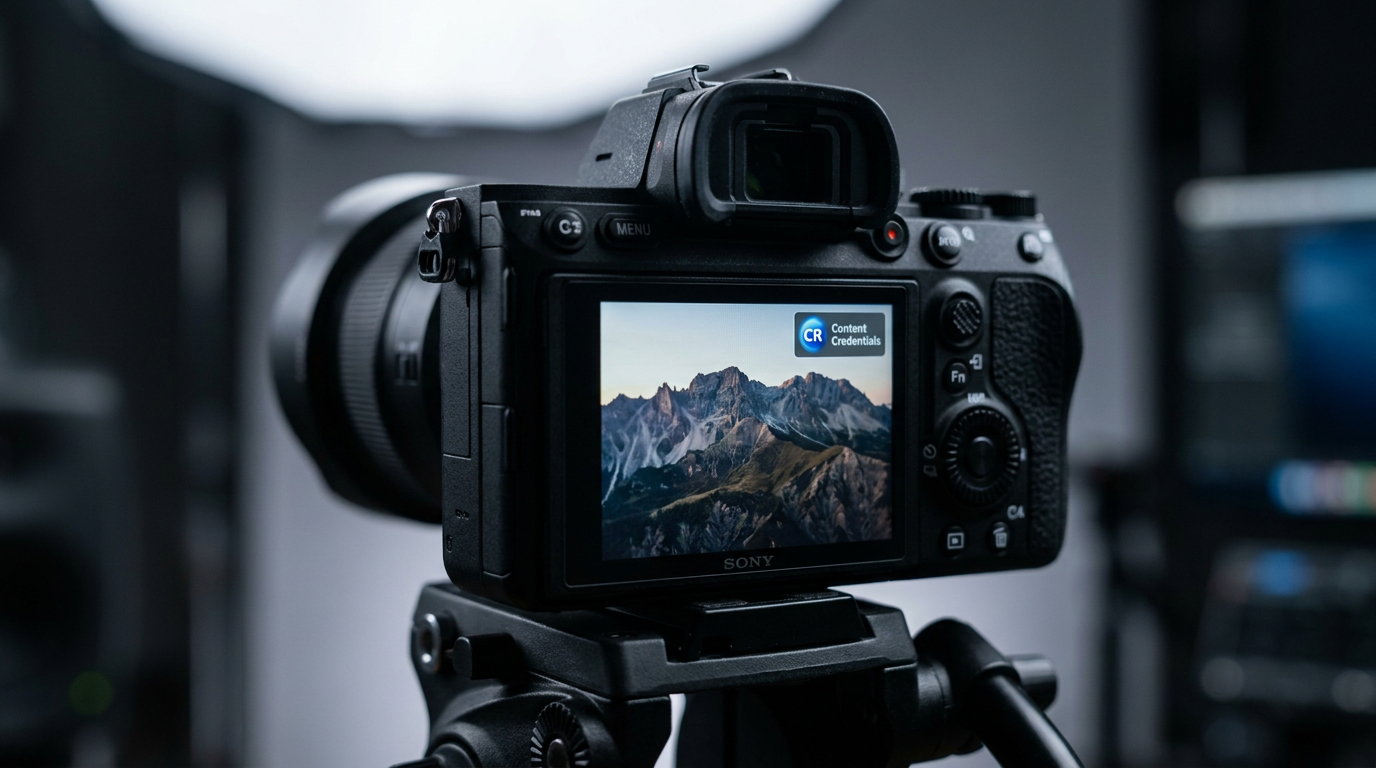
But how does a camera actually prove it took a photograph? The mechanism relies on cryptographic hardware built directly into the camera body. When a photographer presses the shutter on a C2PA-enabled device, the camera's internal security chip generates a "manifest." This manifest contains specific assertions about the image: the exact camera model, the hardware serial number, the time of capture, the location, and the exposure settings. Crucially, the camera then seals this manifest and the raw image data together using an X.509 digital certificate—the exact same public key infrastructure (PKI) that secures HTTPS web traffic and online banking.[2][3][5][6]
Once that cryptographic signature is applied, the image and its metadata are mathematically bound. If a bad actor intercepts the file and alters even a single pixel to change the context of the scene—perhaps adding a weapon to a subject's hand or changing a protest sign—the cryptographic hash of the image will no longer match the signature. The signature will immediately break, and any compliant viewing platform will flag the image as tampered. This provides a robust defense against retroactive manipulation.[3][5]

The chain of trust extends far beyond the initial moment of capture. When a photojournalist opens a signed image in C2PA-compliant editing software, such as Adobe Photoshop or Capture One, the software reads and verifies the original camera manifest. As the editor makes standard journalistic adjustments—cropping for composition, adjusting exposure, or color grading—the software meticulously logs these specific actions. It does not prevent editing, nor does it judge the artistic merit of the changes; it simply demands cryptographic transparency about what was altered and what tools were used.[1][5]
Upon export, the editing software generates a brand new manifest that includes the complete editing history. It signs this new manifest and cryptographically chains it to the original camera signature. When a viewer eventually encounters the image online, they can click a "Content Credentials" pin to inspect the file's entire lineage. They can see exactly who took it, what camera was used, and every software adjustment made along the way, allowing them to make an informed decision about the image's trustworthiness.[1][5]
Upon export, the editing software generates a brand new manifest that includes the complete editing history.
Hardware adoption of this standard has accelerated rapidly across the industry. Leica pioneered the technology in late 2023 with the M11-P, the world's first production camera to feature a dedicated hardware encryption chip specifically for Content Credentials. By 2026, the ecosystem has expanded dramatically. It now encompasses flagship professional mirrorless bodies from Sony and Nikon, and has even reached the broader consumer market via smartphones like the Google Pixel 10, which utilizes its custom Tensor security chips to sign images natively without requiring a dedicated camera body.[2][3]
However, the system is not a flawless silver bullet, and its architects are quick to point out its inherent limitations. C2PA is fundamentally designed to certify the history of a file, not its semantic truth. This distinction creates structural vulnerabilities, most notably the "analog hole." If a user generates a photorealistic deepfake on their high-resolution computer monitor, and then uses a C2PA-enabled camera to take a photograph of that screen, the camera will dutifully sign the file as an authentic capture.[3][5]
The resulting image will possess a perfectly valid cryptographic signature proving it was taken by a real camera at a specific time and place. The provenance is mathematically accurate—the camera really did capture that specific arrangement of light—even though the subject matter depicted is entirely fabricated. C2PA cannot verify the physical reality of the scene in front of the lens, only the digital reality of the file created by the sensor, meaning human judgment remains a necessary component of media literacy.[3][5]

The standard also faces active, necessary probing from security researchers looking to harden the ecosystem. In late 2025, a photographer and researcher named Adam Horshack discovered a severe vulnerability in Nikon's implementation on the Z6 III mirrorless camera. By embedding a fully AI-generated image—specifically, a picture of a pug flying an airplane—into a Nikon RAW file and utilizing the camera's in-body multiple-exposure function, he tricked the camera's hardware into cryptographically signing the AI image as a genuine, unaltered photograph.[4][7]
The exploit forced Nikon to temporarily suspend its C2PA service and actively revoke the digital certificates issued to affected cameras. The incident highlighted a structural challenge for the initiative: while the underlying cryptography is mathematically sound, the complex firmware bridging the camera's sensor and its security chip can still harbor exploitable loopholes. Furthermore, the revocation exposed a weakness in the verification ecosystem, as many open-source validation tools were not configured by default to check whether a camera's certificate had been actively revoked by the manufacturer.[4]
Despite these inevitable growing pains, the standard continues to mature and expand its technical scope. In February 2026, the coalition launched C2PA version 2.3, a major specification update that expanded the framework beyond still images and pre-recorded video to include live video provenance. This breakthrough allows broadcasters to cryptographically sign live streams in real-time as they are captured, providing a critical, tamper-evident defense against real-time deepfake injection during breaking news events, sports broadcasts, and live political debates.[1]
Ultimately, Content Credentials represent a fundamental shift in digital literacy and modern media consumption. They do not prevent the creation of fake media, nor do they automatically scrub manipulated images from the internet—bad actors will always find platforms willing to host unsigned content. Instead, they provide a verifiable anchor of truth for those who actively choose to look for it, ensuring that authentic human documentation can still be distinguished, verified, and protected in an increasingly synthetic and AI-saturated world.[8]

How we got here
Feb 2021
The C2PA coalition is founded by major tech and media companies to address digital trust.
Oct 2023
Leica releases the M11-P, the world's first camera with native C2PA hardware signing.
Aug 2025
Nikon introduces C2PA support to the Z6 III mirrorless camera via a major firmware update.
Sep 2025
A security researcher exploits the Z6 III's firmware, forcing Nikon to temporarily suspend the service.
Feb 2026
C2PA version 2.3 is released, expanding the standard to include real-time live video provenance.
Viewpoints in depth
Photojournalists & Publishers
Advocating for verifiable truth as a defense against accusations of fake news.
For newsrooms, the primary value of C2PA is defensive. In an era where political actors routinely dismiss unfavorable photography as 'AI-generated' or 'manipulated,' cryptographic provenance provides an objective mathematical defense. Publishers view hardware-level signing as the gold standard, ensuring that the chain of custody begins the millisecond light hits the camera's sensor, long before the file reaches an editor's desk.
Hardware Manufacturers
Balancing cryptographic security with camera performance and usability.
Camera makers face the immense technical challenge of integrating secure signing enclaves into devices that must shoot dozens of frames per second. Generating an X.509 signature requires processing power; doing it instantly without bottlenecking the camera's buffer is a major engineering feat. Manufacturers are also grappling with the responsibility of securing their firmware against injection attacks, as a compromised camera certificate undermines the entire trust ecosystem.
Security Researchers
Probing the standard for vulnerabilities to harden the ecosystem.
Cybersecurity experts argue that no standard is truly secure until it has been aggressively tested in the wild. Researchers focus on edge cases like the 'analog hole' (recapture attacks) and firmware exploits. They emphasize that while the underlying cryptography of C2PA is robust, the implementation by individual manufacturers will always be the weak link, requiring constant vigilance, bug bounties, and rapid revocation protocols.
What we don't know
- Whether major social media platforms will stop stripping C2PA metadata by default.
- How quickly consumer smartphones beyond the Google Pixel will adopt hardware-level signing.
- If the 'analog hole' (photographing a screen) can ever be fully solved by software.
Key terms
- C2PA
- The Coalition for Content Provenance and Authenticity, the open technical standard for digital media provenance.
- Content Credentials
- The consumer-facing name for the tamper-evident metadata and cryptographic signatures attached to a file.
- Manifest
- The structured set of data embedded within a media file that contains assertions about its origin and edit history.
- X.509 Certificate
- A standard digital certificate used to verify identity and secure communications, utilized by C2PA to sign images.
- Analog Hole
- A vulnerability where digital security is bypassed by converting media to an analog format and re-digitizing it, such as photographing a screen.
Frequently asked
Does C2PA detect if an image is AI-generated?
Not automatically. C2PA records the history of a file; it only flags AI if the generating software voluntarily embeds a manifest declaring it as AI-generated.
Can C2PA metadata be stripped from a photo?
Yes. Social media platforms often strip metadata to save space. However, stripping the data removes the proof of authenticity, which alerts viewers that the file's history is unknown.
Do I need a new camera to use Content Credentials?
While new cameras sign images at the hardware level, you can also attach Content Credentials later using compliant software like Adobe Photoshop.
What happens if someone takes a picture of a fake image on a screen?
This is known as the 'analog hole.' The camera will cryptographically sign the photo, proving the camera took a picture of a screen, but it cannot verify if the subject on the screen is real.
Sources
Source coverage
8 outlets
4 viewpoints surfaced







[1]C2PA.aiPhotojournalists & Publishers
C2PA Turns Five, Launches Content Credentials 2.3
Read on C2PA.ai →[2]Leica CameraHardware Manufacturers
Leica Content Credentials in the M11-P
Read on Leica Camera →[3]LumethicHardware Manufacturers
Every Camera That Supports C2PA Content Credentials in 2026
Read on Lumethic →[4]PetaPixelSecurity Researchers
Nikon Can't Fully Solve the Z6 III's C2PA Problems Alone
Read on PetaPixel →[5]TrueScreenPhotojournalists & Publishers
C2PA Standard in 2026: How It Works, Limitations & What's Missing
Read on TrueScreen →[6]NikonHardware Manufacturers
Nikon develops firmware that adds a function compliant with C2PA standards to the Nikon Z6III
Read on Nikon →[7]Camera DecisionSecurity Researchers
Nikon to Introduce C2PA Content Credentials to the Z6 III by 2025
Read on Camera Decision →[8]Factlen Editorial TeamDigital Consumers
Synthesis by Factlen editorial team
Read on Factlen Editorial Team →
Every angle. Every day.
Get culture stories with full source coverage and perspective breakdowns delivered to your inbox.