
How Content Credentials Are Saving Photography in the AI Era
As generative AI makes it harder to trust digital media, a cross-industry standard called C2PA is embedding cryptographically secure 'nutrition labels' directly into photographs.
By Factlen Editorial Team
- Authenticity Standards Bodies
- Argue that open, cryptographically secure standards are the only scalable way to restore trust in digital media without relying on flawed AI detectors.
- Camera Manufacturers
- View hardware-level provenance as a critical new feature to protect their professional users' livelihoods and intellectual property.
- Working Photographers
- Embrace the technology as a way to prove their work is genuine and unaltered, distinguishing human photojournalism from synthetic media.
What's not represented
- · Privacy advocates concerned about the surveillance implications of tracking every digital edit
- · Independent software developers struggling to implement complex cryptographic standards
Why this matters
With AI-generated deepfakes flooding the internet, the ability to cryptographically prove a photograph is real protects both the livelihoods of working photographers and the media literacy of the general public.
Key points
- Content Credentials act as a 'nutrition label' for digital media, showing who created an image and how.
- The C2PA standard uses cryptographic hashes to bind capture data and edit history directly to the file.
- Camera manufacturers like Leica and Nikon are now building C2PA signing directly into their hardware.
- The system is tamper-evident; if metadata is stripped or the image is screenshotted, the chain of trust breaks.
- Major AI generators also use the standard to transparently label synthetic media.
In an era where artificial intelligence can conjure a photorealistic image of a non-existent event in seconds, a fundamental question has emerged: how do you prove a photograph is actually real? For over a century, the photographic medium relied on an implicit social contract that a camera captured light reflecting off a genuine scene. Today, that contract is broken. The democratization of powerful generative AI tools has flooded the internet with synthetic media, leaving audiences, newsrooms, and historians struggling to separate fact from fiction.[6]
The solution to this crisis of trust is not a better AI detector—which often falls prey to false positives—but a fundamental shift in how digital files are created and tracked. Enter Content Credentials, an open technical standard designed to act as a "nutrition label" for digital media. Developed by the Coalition for Content Provenance and Authenticity (C2PA), this framework provides a tamper-evident, cryptographically secure history of an image from the moment the shutter clicks to the moment it appears on a screen.[1][3]
The C2PA consortium represents an unprecedented alignment of tech and media giants, including Adobe, Microsoft, Google, Sony, Nikon, Canon, and the BBC. Rather than attempting to police what is "true," the coalition's goal is to establish verifiable provenance. Provenance simply means the factual history of a digital asset: who created it, what device was used, when and where it was captured, and what alterations were made along the way.[1][4]
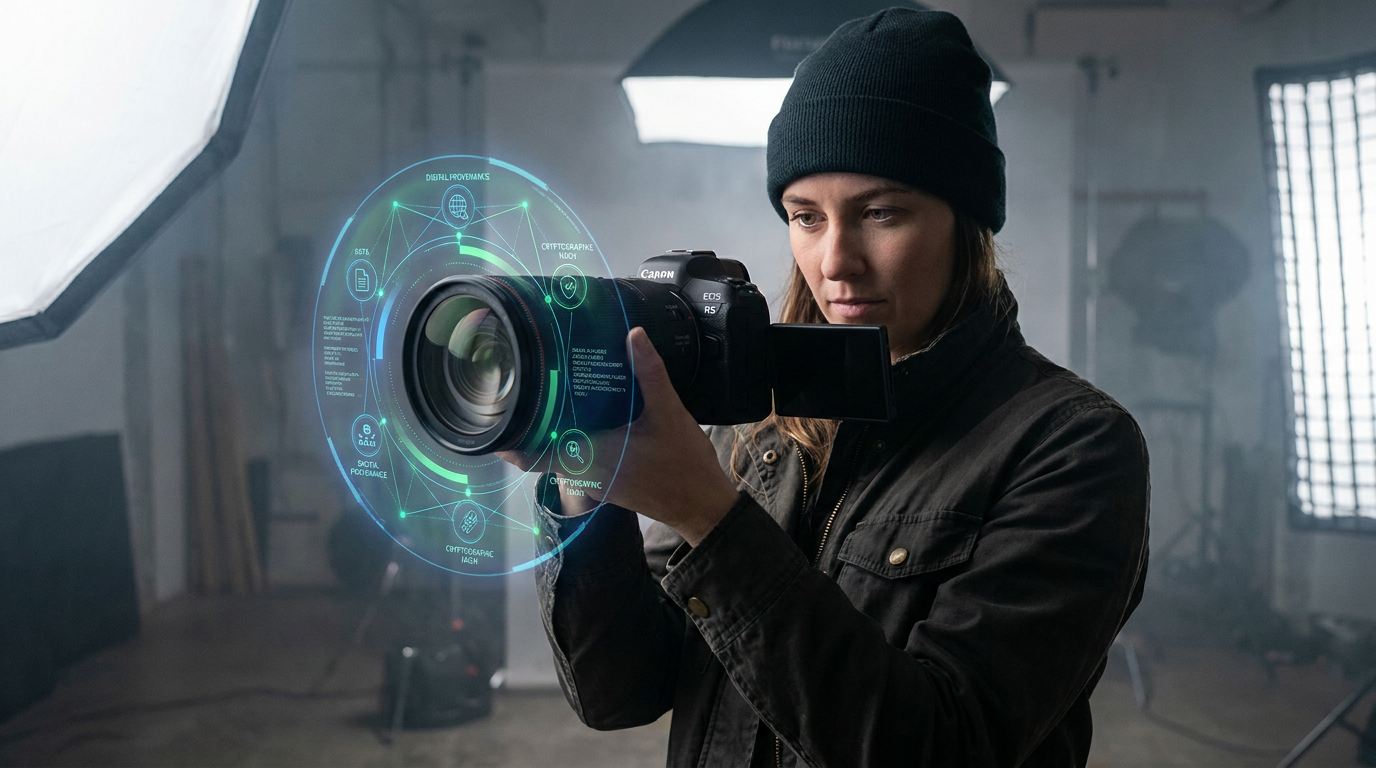
At a technical level, Content Credentials rely on cryptographic hashes and digital signatures—the same underlying security architecture that protects online banking and secure communications. When a photographer takes a picture with a C2PA-compliant camera, the device generates a digital manifest. This manifest records the camera's unique hardware certificate, the capture settings, and the timestamp, binding this data to the image pixels using a cryptographic seal before the file ever leaves the memory card.[1][4]

This hardware-level integration is the holy grail of digital provenance, and it is rapidly moving from specification documents to consumer electronics. In late 2023, Leica became the first manufacturer to bring this technology to market with the M11-P, a camera featuring a dedicated secure chipset to sign images natively. Leica's implementation proved that hardware-level signing could be seamless, requiring no extra steps from the photographer once enabled in the menu.[5]
Following Leica's lead, the broader camera industry is now rolling out support. Nikon recently announced firmware updates for its mid-tier Z6III mirrorless camera, bringing C2PA compliance to a wider audience of working professionals and enthusiasts. Sony and Canon are similarly integrating the standard into their flagship bodies, signaling a future where cryptographic signing is as standard as autofocus.[2][5]
But capturing the image is only the first step in a photograph's lifecycle. The true power of Content Credentials lies in their additive nature throughout the editing process. When a C2PA-signed RAW file is imported into compliant software like Adobe Lightroom or Photoshop, the software reads the original manifest and begins recording a new layer of data.[1][3]
But capturing the image is only the first step in a photograph's lifecycle.
Every significant adjustment—whether it is a simple exposure correction, a crop, or the use of an AI-powered tool like Generative Fill—is logged in the manifest. When the photographer exports the final JPEG, the software cryptographically seals this new layer on top of the original capture data. The result is a transparent chain of custody. The viewer can see exactly what was altered, ensuring that standard color correction isn't conflated with deceptive manipulation.[3][4]

Crucially, this system is designed to be tamper-evident rather than tamper-proof. If a bad actor opens a C2PA-signed image in non-compliant software, strips the metadata, or simply takes a screenshot of the image to bypass the credentials, the cryptographic chain is broken. When that screenshot is uploaded online, it will lack the Content Credentials badge, immediately signaling to viewers and publishers that the image's history cannot be verified.[1][6]
For consumers, verifying an image is designed to be frictionless. Platforms integrating the standard display a small "CR" (Content Credentials) pin on the image. Clicking this pin reveals the nutrition label, showing the creator's verified identity, the original capture device, and the timeline of edits. Alternatively, anyone can upload an image to the open-source verification portal at contentcredentials.org to inspect its cryptographic history.[1][3]
While the technology is robust, its architects are quick to emphasize its limitations. Content Credentials provide transparency, not absolute truth. A C2PA manifest can prove that a specific camera captured a specific arrangement of light at a specific time, but it cannot prove that the scene itself wasn't staged. A photojournalist could still ask subjects to pose, or photograph a miniature model designed to look like a real building.[4][6]
Furthermore, the system does not inherently penalize AI-generated art. In fact, major AI generators like OpenAI's DALL-E 3 and Adobe Firefly now automatically attach Content Credentials to their outputs. The manifest simply states that the image was created by an AI model rather than a camera. This neutrality is vital; the goal is not to ban synthetic media, but to ensure that audiences are never deceived about what they are looking at.[4][6]

The adoption of Content Credentials is fundamentally reshaping the workflow of modern newsrooms. Organizations like the BBC and the Associated Press are building C2PA verification into their content management systems. In the near future, photo editors will be able to automatically reject freelance submissions that lack an intact cryptographic chain from a verified camera, drastically reducing the risk of publishing a deepfake during a breaking news event.[1][2]
For independent creators, the standard offers a powerful new way to protect their intellectual property. By embedding their verified social media profiles and copyright information directly into the cryptographic manifest, photographers can ensure their attribution travels with the image, no matter how many times it is downloaded, shared, or re-uploaded across the web.[3][5]
As we move deeper into the generative AI era, digital provenance is transitioning from a niche technical feature to a critical pillar of media literacy. The widespread adoption of Content Credentials by camera manufacturers, software developers, and publishers represents a rare, proactive triumph of industry collaboration, empowering creators to prove their authenticity and giving audiences the tools they need to trust their own eyes again.[4][6]
How we got here
2019
The Content Authenticity Initiative (CAI) is founded to combat digital misinformation.
2021
The C2PA is formed to develop open, cross-industry technical standards for digital provenance.
Oct 2023
Leica launches the M11-P, the world's first camera with built-in C2PA hardware signing.
2024
Major AI platforms, including OpenAI and Adobe Firefly, begin automatically attaching Content Credentials to synthetic outputs.
Mid 2025
Nikon begins rolling out C2PA-compliant firmware updates to its mid-tier mirrorless cameras.
Viewpoints in depth
Authenticity Standards Bodies
Argue that open, cryptographically secure standards are the only scalable way to restore trust in digital media without relying on flawed AI detectors.
Organizations like the C2PA and the Linux Foundation emphasize that the internet cannot rely on AI detection tools, which are engaged in a perpetual arms race with generative models and frequently produce false positives. Instead, they advocate for a 'zero-trust' baseline where media is assumed unverified unless it carries an intact cryptographic manifest. By making provenance an open, opt-in standard, they aim to create a web ecosystem where transparency is rewarded by algorithms and publishers, eventually making uncredentialed media a red flag for consumers.
Camera Manufacturers
View hardware-level provenance as a critical new feature to protect their professional users' livelihoods and intellectual property.
For legacy imaging companies like Nikon, Leica, and Sony, the rise of AI represents an existential threat to the perceived value of traditional photography. By integrating secure C2PA chips directly into their camera bodies, these manufacturers are offering a premium feature that AI cannot replicate: the cryptographic proof of physical reality. This hardware-level integration allows them to market their cameras not just as image-capturing devices, but as essential tools for truth-gathering in an increasingly synthetic world.
Working Photographers
Embrace the technology as a way to prove their work is genuine and unaltered, distinguishing human photojournalism from synthetic media.
Photojournalists and commercial photographers face a landscape where their genuine work is routinely accused of being AI-generated by skeptical audiences. Content Credentials provide a definitive defense against these accusations. By maintaining an unbroken chain of custody from the camera sensor to the published page, photographers can prove their images are real, protect their copyright, and ensure that standard editorial adjustments (like cropping or color grading) are not misrepresented as deceptive manipulation.
What we don't know
- Whether social media platforms will algorithmically penalize or hide images that lack Content Credentials.
- How quickly older, non-compliant camera models will be phased out of professional newsroom workflows.
- If bad actors will find novel ways to spoof hardware certificates to generate fake C2PA manifests for AI images.
Key terms
- C2PA
- The Coalition for Content Provenance and Authenticity, an open-standards body developing the technical framework for digital provenance.
- Content Credentials
- The consumer-facing term for a C2PA manifest; essentially a 'nutrition label' detailing a digital file's history.
- Cryptographic Hash
- A complex mathematical algorithm that acts as a secure digital fingerprint, binding metadata to the actual pixels of an image.
- Manifest
- The secure data structure embedded in a file that stores the history of its creation, edits, and authorship.
- Provenance
- The factual, verifiable history of where a digital asset came from and what has been done to it.
Frequently asked
Does C2PA prevent AI from generating images?
No. Content Credentials do not block AI generation; instead, they label AI-generated images transparently so viewers know exactly how the image was created.
What happens if someone screenshots my C2PA photo?
Taking a screenshot breaks the cryptographic chain. The resulting image will lack the Content Credentials badge, signaling to viewers that its history cannot be verified.
Do I need a new camera to use Content Credentials?
Not necessarily. While new cameras can sign images at the hardware level, you can also attach Content Credentials to any image during the editing process using compliant software like Adobe Photoshop.
Sources
Source coverage
6 outlets
3 viewpoints surfaced






[1]Coalition for Content Provenance and AuthenticityAuthenticity Standards Bodies
C2PA Specifications for Content Credentials
Read on Coalition for Content Provenance and Authenticity →[2]Nikon AsiaCamera Manufacturers
Nikon develops firmware with Content Credentials for Z6III
Read on Nikon Asia →[3]Digital Camera WorldWorking Photographers
What is Content Credentials?
Read on Digital Camera World →[4]Linux FoundationAuthenticity Standards Bodies
How C2PA works to establish digital provenance
Read on Linux Foundation →[5]C2PA.aiCamera Manufacturers
How to Enable Content Credentials on Leica M11-P, SL3 & Q3
Read on C2PA.ai →[6]Factlen Editorial Team
Synthesis by Factlen editorial team
Read on Factlen Editorial Team →


Every angle. Every day.
Get culture stories with full source coverage and perspective breakdowns delivered to your inbox.