
How Climate Change and Processing Innovations Are Elevating Robusta Coffee
Historically dismissed as a bitter, cheap alternative to Arabica, Robusta coffee is undergoing a specialty renaissance as climate change threatens traditional growing regions.
By Factlen Editorial Team
- Agronomists & Climate Scientists
- Focused on the biological thermal limits, genetic resilience, and yield stability of coffee species in a warming world.
- Specialty Roasters & Q Graders
- Focused on cup quality, sensory evaluation, and expanding the definition of premium coffee beyond Arabica's traditional acidity.
- Coffee Producers & Economists
- Focused on farm-level profitability, supply chain stability, and the financial risks of transitioning crops.
What's not represented
- · Smallholder farmers unable to afford the transition costs
- · Traditional Italian espresso roasters
Why this matters
As global temperatures rise, the delicate Arabica beans that dominate specialty coffee are facing an existential threat. The elevation of Robusta ensures the long-term survival of the morning cup while providing a vital economic lifeline to farmers in warming climates.
Key points
- Climate change is rapidly shrinking the high-altitude land required to grow delicate Arabica coffee.
- Robusta coffee is naturally hardier, tolerating higher temperatures and resisting devastating fungal diseases.
- Historically viewed as cheap and bitter, Robusta is being elevated through meticulous harvesting and advanced fermentation.
- The Coffee Quality Institute now grades 'Fine Robusta' on a strict 100-point scale, requiring an 80+ score.
- While more resilient, scientists warn Robusta still has thermal limits and is vulnerable to extreme heatwaves.
For decades, the specialty coffee world has operated on a strict, unspoken caste system. At the top sits Coffea arabica, celebrated for its delicate acidity, complex floral notes, and absolute dominance in high-end cafes. At the bottom lies Coffea canephora—better known as Robusta. Historically relegated to instant coffee and cheap espresso blends, Robusta earned a reputation for tasting harsh, rubbery, and aggressively bitter. But a quiet revolution is brewing in the global coffee supply chain. Driven by the urgent pressures of climate change and a wave of processing innovations, the industry's ugly duckling is being elevated to a new, premium category: Fine Robusta.[1]
The catalyst for this shift is fundamentally biological. Arabica is a fragile species, requiring cool, high-altitude environments with stable temperatures typically between 18 and 22 degrees Celsius. As global temperatures rise and weather patterns become increasingly erratic, the land suitable for cultivating high-quality Arabica is shrinking rapidly. Agronomists project that by 2050, the global area capable of supporting Arabica could be slashed by up to 50 percent. For an industry worth over $100 billion, this represents an existential threat that cannot be solved by simply moving farms higher up the mountainside.[1][5]
Enter Robusta. True to its name, the species is naturally hardier. It thrives at lower altitudes, tolerates warmer mean temperatures up to 24 to 26 degrees Celsius, and boasts a natural resistance to coffee leaf rust—a devastating fungal disease that has plagued Arabica farmers for over a century. Because it requires less pesticide and can withstand more varied rainfall, Robusta offers a vital economic lifeline for farmers facing crop failures in traditional Arabica zones.[1][2]

The agricultural potential of Robusta is already triggering massive institutional investment. In early 2026, food giant Nestlé unveiled the results of multi-year agronomic trials in Côte d'Ivoire, testing 18 different Robusta varieties under severe climate stress. By cultivating a specific blend of six top-performing varieties, researchers achieved yield increases of up to 86 percent, all while noting a significant reduction in the woody, bitter notes typically associated with the species. Brazil, already an agricultural powerhouse, is aggressively expanding its Robusta footprint, utilizing degraded pasturelands to scale up production without triggering new deforestation.[2][3]
But agricultural resilience only solves half the equation. For Fine Robusta to succeed, it actually has to taste good. The historical bitterness of commodity Robusta wasn't just a genetic inevitability; it was the result of mass-production processing. Because it was destined for cheap instant coffee, commodity Robusta was often strip-picked—meaning ripe, unripe, and overripe cherries were harvested together—and dried haphazardly, leading to the harsh, rubbery flavors consumers learned to avoid.[1]
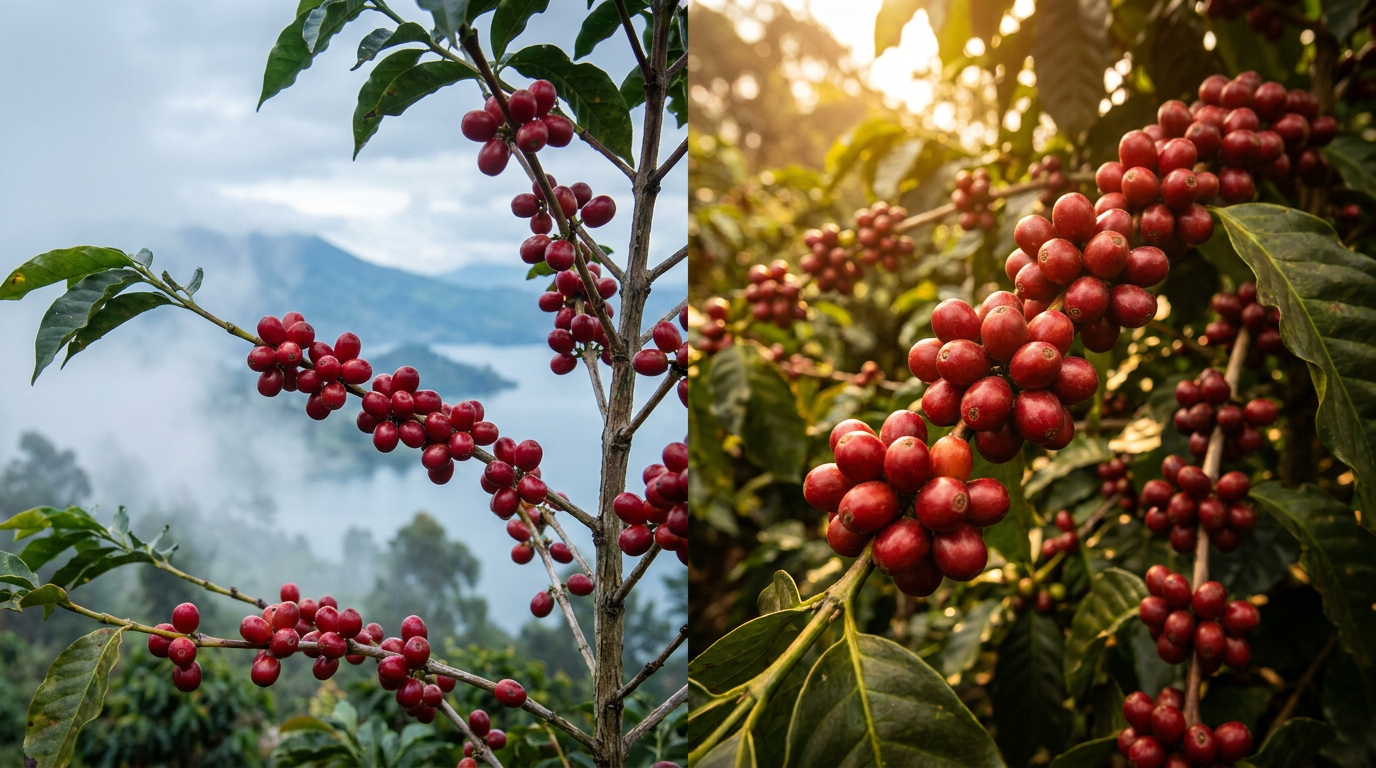
To elevate the bean to specialty status, producers are applying the meticulous, labor-intensive techniques once reserved exclusively for Arabica. This begins at the farm level with selective hand-picking. Instead of stripping a branch bare, workers pass through the farm multiple times over a season, ensuring only perfectly ripe, crimson cherries are harvested. This single change drastically reduces the astringency caused by underripe green beans.[7]
To elevate the bean to specialty status, producers are applying the meticulous, labor-intensive techniques once reserved exclusively for Arabica.
From there, the processing becomes highly scientific. Because Robusta cherries have a thicker, more viscous layer of mucilage (the sticky fruit surrounding the bean), they require longer, more carefully managed fermentation times than Arabica. If left unmonitored, this thick fruit layer can rot, imparting the swampy, fermented defects that ruin the cup.[7]

To combat this, producers are experimenting with advanced techniques like anaerobic fermentation—sealing the cherries in oxygen-free tanks to encourage the development of complex, fruity esters—and enzyme-assisted pectin breakdown to cleanly remove the fruit without introducing off-flavors. When dried slowly on raised beds, these carefully processed beans shed their harshness. The resulting cup profile is entirely distinct from Arabica: it lacks the bright, tea-like acidity, offering instead a massive, syrupy body, deep chocolate and nutty notes, and a surprisingly smooth finish.[7]
To formalize this new tier of quality, the industry needed a standardized language. In 2010, the Coffee Quality Institute (CQI)—the same body that governs Arabica grading—established the Q Robusta program. This created a rigorous, globally recognized framework for evaluating the species. Just as with Arabica, a coffee must score 80 points or higher on a 100-point scale to earn the title of "Fine Robusta."[4]
Grading Robusta, however, requires a completely different sensory approach. Certified Q Graders (professional coffee tasters who must pass 22 rigorous sensory exams) use a specialized cupping form tailored to the species. While Arabica is heavily penalized for lacking acidity, the Fine Robusta scale focuses heavily on the bitter-to-sweet ratio and the tactile quality of the body. A score above 80 indicates a coffee that is not just "good for a Robusta," but objectively excellent in its own right.[4]

Despite the optimism, climate scientists warn that Robusta is not a magic bullet. While it is more resilient than Arabica, it is not invincible to extreme heat. A comprehensive study by the University of Southern Queensland analyzed a decade of yield data across nearly 800 farms in Southeast Asia, challenging long-held assumptions about the plant's thermal limits. The researchers found that Robusta's optimal growing temperature is actually below 20.5 degrees Celsius—significantly lower than the 22-to-30-degree range cited in historical botanical texts.[5]
This vulnerability has been starkly demonstrated in recent years. Prolonged droughts and unprecedented heatwaves in Vietnam—the world's largest producer of Robusta—have severely impacted yields, driving global prices to all-time highs. Agronomists caution that while Robusta buys the industry valuable time, it cannot infinitely override the physics of a rapidly warming planet. Adaptation has hard thermal limits, and even the hardiest crops will struggle if global temperatures continue to climb unchecked.[2][6]
Furthermore, transitioning a farm from Arabica to Robusta is not a simple swap. The implementation costs for new Robusta plantations are high, requiring significant upfront capital for irrigation systems and new processing infrastructure. For smallholder farmers, this transition carries substantial financial risk, necessitating support from larger buyers, cooperatives, and international agricultural funds.[2][6]
Ultimately, the rise of Fine Robusta is not about replacing Arabica, but about expanding the coffee lexicon. For roasters, it offers a new tool for creating rich, full-bodied espresso blends that punch through milk, while single-origin Fine Robustas are beginning to appear on the menus of avant-garde cafes. By embracing the unique characteristics of Coffea canephora and treating it with the respect it deserves, the coffee industry is building a more diverse, resilient, and flavorful future.[1][7]
How we got here
2010
The Coffee Quality Institute establishes the Q Robusta program to create a standardized language for high-quality Robusta.
2019
Wild Arabica is placed on the IUCN Red List as an Endangered species due to climate change projections.
2023
University of Southern Queensland researchers publish data showing Robusta's optimal thermal limits are lower than historically assumed.
Early 2026
Nestlé unveils new high-yield Robusta varieties capable of boosting production by 86% under climate stress.
Viewpoints in depth
Agronomists & Climate Scientists
Focused on the biological limits and genetic potential of coffee species in a warming world.
This camp emphasizes that while Robusta is hardier than Arabica, it is not immune to climate change. Researchers point to recent data showing Robusta's optimal growing temperatures are lower than historical estimates, warning that extreme heatwaves in Vietnam and Brazil still devastate yields. However, they remain optimistic about targeted genetic trials—like Nestlé's recent high-yield varieties—that aim to push the biological boundaries of the species.
Specialty Roasters & Q Graders
Focused on cup quality, sensory evaluation, and expanding the definition of premium coffee.
For decades, this group viewed Robusta as an inferior product that ruined specialty blends. Now, they are actively rewriting the sensory rulebook. By championing the Coffee Quality Institute's Fine Robusta standards, they argue that heavy body and low acidity shouldn't be penalized, but celebrated as a different, equally valid expression of coffee. Their goal is to educate consumers to appreciate Robusta's rich, chocolatey profile on its own merits.
Coffee Producers & Economists
Focused on farm-level profitability, supply chain stability, and the financial risks of crop transition.
Producers view Robusta as a vital risk-mitigation tool against erratic rainfall and coffee leaf rust. Economists note that while Robusta generally requires fewer pesticides, transitioning a traditional Arabica farm to Robusta involves massive upfront capital for new infrastructure and irrigation. This camp advocates for stronger financial support and premium pricing models to ensure farmers aren't bearing the entire financial burden of climate adaptation.
What we don't know
- Whether consumers accustomed to Arabica's acidity will fully embrace Fine Robusta's heavier, low-acid profile at scale.
- How quickly smallholder farmers can secure the capital needed to transition their crops and processing infrastructure.
Key terms
- Fine Robusta
- Robusta coffee that scores 80 points or higher on the Coffee Quality Institute's standardized cupping scale.
- Coffea canephora
- The scientific name for the Robusta coffee plant species, known for its hardiness and high caffeine content.
- Q Grader
- A licensed professional trained to objectively evaluate and score coffee quality using standardized global protocols.
- Cupping
- The standardized sensory evaluation method used by professionals to assess the aroma, flavor, and body of brewed coffee.
- Coffee Leaf Rust
- A devastating fungal disease that severely affects Arabica plants but to which Robusta is naturally resistant.
- Anaerobic Fermentation
- A processing method where coffee cherries are sealed in oxygen-free tanks to develop complex, fruity flavor compounds.
Frequently asked
What is the difference between Arabica and Robusta?
Arabica is known for delicate flavors and acidity but is highly sensitive to climate change. Robusta is hardier, higher in caffeine, and traditionally bolder and more bitter, though processing innovations are changing its flavor profile.
What makes a Robusta 'Fine'?
It must score 80 points or higher on the Coffee Quality Institute's standardized 100-point cupping scale, a benchmark achieved through meticulous selective harvesting and advanced fermentation.
Does Fine Robusta taste like Arabica?
No. Instead of bright acidity, Fine Robusta offers a thick, syrupy body, very low acidity, and deep notes of chocolate, nuts, and subtle sweetness.
Will Robusta replace Arabica entirely?
Unlikely. Experts view it as a necessary addition to diversify the supply chain and create resilient blends, rather than a total replacement for Arabica's unique flavor.
Sources
Source coverage
7 outlets
3 viewpoints surfaced







[1]The Washington PostAgronomists & Climate Scientists
To survive climate change, coffee must embrace resilient beans
Read on The Washington Post →[2]RabobankCoffee Producers & Economists
Robusta rising: Climate resilience meets market expansion in Brazil
Read on Rabobank →[3]FoodIngredientsFirstAgronomists & Climate Scientists
Rethinking Coffee: Nestlé targets yield and resilience with robusta varieties
Read on FoodIngredientsFirst →[4]Coffee Quality InstituteSpecialty Roasters & Q Graders
Q Coffee System and Fine Robusta Standards
Read on Coffee Quality Institute →[5]Perfect Daily GrindAgronomists & Climate Scientists
Robusta is here to stay – but it cannot save the future of coffee
Read on Perfect Daily Grind →[6]Cumpa GmbHCoffee Producers & Economists
Robusta at All-Time High
Read on Cumpa GmbH →[7]Factlen Editorial TeamSpecialty Roasters & Q Graders
Synthesis by Factlen editorial team
Read on Factlen Editorial Team →

Every angle. Every day.
Get lifestyle stories with full source coverage and perspective breakdowns delivered to your inbox.