
How Biophilic Design is Rewiring Architecture for Human Health
By structurally integrating nature into the built environment, biophilic design is moving beyond aesthetics to measurably reduce stress and boost cognitive performance.
By Factlen Editorial Team
- Architects & Urban Planners
- Focus on integrating natural systems into the built environment to create sustainable, resilient, and aesthetically cohesive spaces.
- Environmental Psychologists
- Emphasize the cognitive and physiological benefits of nature exposure, studying how environments affect stress and attention.
- Corporate Employers
- View biophilic design as a strategic investment to boost employee productivity, reduce absenteeism, and improve workplace satisfaction.
What's not represented
- · Building Maintenance & Facilities Managers
- · Low-Income Urban Communities
Why this matters
Americans spend an estimated 90 percent of their lives indoors. Understanding how the physical spaces we inhabit affect our nervous systems allows individuals and companies to design environments that actively improve mental health, focus, and overall well-being.
Key points
- Biophilic design structurally integrates nature into buildings to improve human health.
- The methodology relies on 15 distinct patterns, including natural light, organic materials, and spatial refuge.
- Exposure to biophilic environments lowers cortisol levels and reduces sympathetic nerve activity.
- Workplaces utilizing these principles report up to a 15% increase in employee productivity.
- Urban planners are adopting 'biophilic urbanism' to build climate-resilient, healthier cities.
Modern humans are overwhelmingly an indoor species. We spend an estimated 90 percent of our lives inside buildings, sealed off from the natural world by drywall, synthetic carpets, and artificial lighting. This chronic disconnection from nature takes a measurable toll on human health, contributing to elevated stress, mental fatigue, and diminished cognitive performance. In response, a growing movement in architecture is attempting to reverse this isolation.[6]
The solution is known as biophilic design, an architectural approach that structurally reconnects people to nature within the built environment. The concept is rooted in "biophilia"—a hypothesis popularized in 1984 by biologist E.O. Wilson, which posits that humans possess an innate, evolutionary affinity for the natural world. Because our nervous systems evolved in natural landscapes over millions of years, our bodies react poorly to sterile, synthetic environments.[1][3]
In practice, biophilic design is far more sophisticated than simply placing a potted fern on a desk. It is a scientifically validated methodology that weaves natural light, organic materials, and living systems into the very framework of a building. When executed correctly, these spaces do not just look better; they actively manipulate human physiology to reduce stress and enhance cognitive function.[1][2][4]
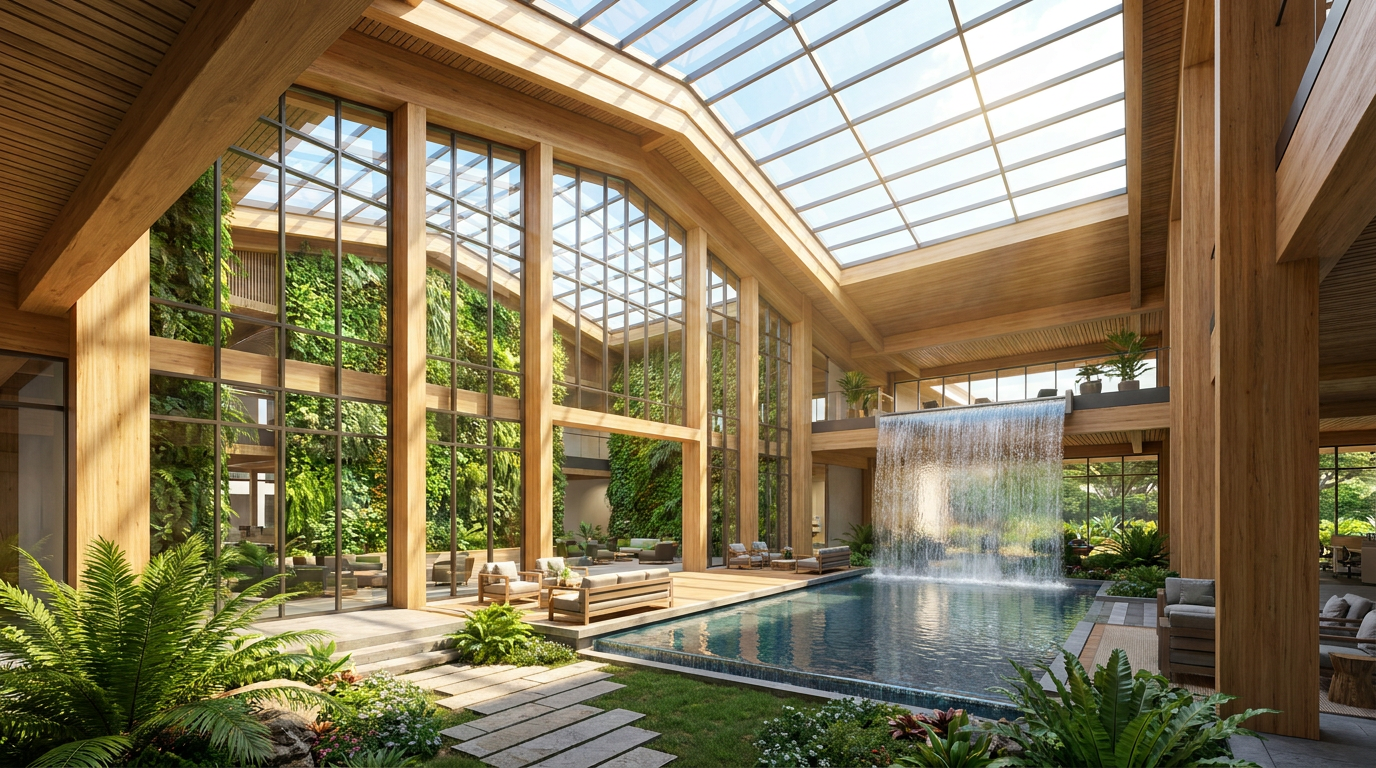
To standardize this approach, environmental consultants at Terrapin Bright Green codified the "14 Patterns of Biophilic Design," which serve as a blueprint for architects. These patterns are divided into three broad categories. The first, "Nature in the Space," involves the direct, physical presence of nature. This includes living green walls, indoor water features, and dynamic natural light that changes intensity throughout the day to support human circadian rhythms.[1][2]

The second category, "Natural Analogues," utilizes organic materials and forms that reference nature without being alive. Architects use timber, stone, bamboo, and clay to provide tactile and visual connections to the outdoors that synthetic materials cannot replicate. This also includes biomorphic shapes—curved lines and fractal patterns that mimic the complexity found in leaves, shells, and tree branches.[1][4]
The third category, "Nature of the Space," focuses on spatial configurations that evoke the psychological safety of natural landscapes. A key concept here is "prospect and refuge"—the design of spaces that offer unimpeded views of the surrounding environment (prospect) while providing a sheltered, secure area at the user's back (refuge). This mirrors how early humans scanned the savannah for predators while safely hidden.[1]
Recently, researchers have expanded this framework. In late 2022, "Awe" was formally recognized as a 15th pattern of biophilic design. This pattern moves beyond creating merely comfortable spaces and aims to engineer profound, transcendent emotional experiences—such as the feeling of standing beneath a massive indoor waterfall or a towering architectural canopy. Experiencing awe has been shown to make people feel more humble, charitable, and connected to the broader world.[2]
In late 2022, "Awe" was formally recognized as a 15th pattern of biophilic design.
The physiological evidence supporting these interventions is robust. Environmental psychologists have found that exposure to biophilic environments triggers a drop in sympathetic nerve activity, which governs the body's "fight or flight" response. Studies show that interacting with natural components—even indoors—can lower cortisol levels, reduce blood pressure, and decrease heart rates. In healthcare settings, biophilic design has been linked to reduced pain levels and faster recovery times for patients.[4]
The cognitive benefits are equally striking. According to Attention Restoration Theory (ART), modern work requires intense "directed attention," which quickly depletes our mental reserves. Natural stimuli, however, engage our "soft fascination," allowing the brain to rest and recover from cognitive fatigue. Research published in Scientific Reports indicates that biophilic interventions significantly reduce stress during cognitively demanding tasks.[1][4]
For corporate employers, this cognitive restoration translates directly to the bottom line. A comprehensive study by the employee wellbeing consultancy Human Spaces found that workers in environments enriched with natural light and greenery are 15 percent more productive and 15 percent more creative than their peers in standard offices. Furthermore, these nature-inspired environments are associated with a 30 percent reduction in self-reported stress levels, leading to lower absenteeism and higher employee retention.[3][6]

Major corporations and institutions are already deploying these principles at scale. Apple's ring-shaped headquarters in Cupertino, California, is a famous example, designed to pull natural light from all angles while surrounding employees with thousands of trees. In Milan, the Bosco Verticale (Vertical Forest) features two residential towers draped in thousands of shrubs and trees, utilizing a specialized rainwater capture system for irrigation.[3]
The next frontier of biophilic design involves integrating living systems with advanced technology. Stanford University's upcoming Living Building, slated for 2026, will feature adaptive botanical systems, including smart green walls equipped with sensors to monitor air quality, humidity, and plant health in real-time. This creates a dynamic interior ecosystem that responds to seasonal changes and building occupancy.[1]

Beyond individual buildings, urban planners are scaling these concepts to the municipal level through "Biophilic Urbanism." This approach treats nature as critical civic infrastructure, integrating green corridors, urban forests, and constructed wetlands into city grids. Cities like Amsterdam are pioneering this with their "Green Infrastructure Vision 2050," which prioritizes equitable access to urban nature to improve public health, bolster biodiversity, and adapt to climate change.[5]
Despite its proven benefits, researchers caution that biophilic design is not a panacea. The effectiveness of these interventions is highly context-dependent, and superficial applications—often dismissed as "greenwashing"—fail to deliver meaningful physiological benefits. Furthermore, while indoor plants can improve perceived air quality and comfort, building scientists note they are not a substitute for robust mechanical ventilation and air filtration systems at a commercial scale.[4][5]
Ultimately, biophilic design represents a fundamental shift in how we conceive of the built environment. By acknowledging our biological imperative to connect with the natural world, architects are moving beyond the sterile boxes of the 20th century. As the evidence mounts, integrating nature into our buildings is no longer viewed as a luxury aesthetic, but as a foundational requirement for human health and flourishing.[6]
How we got here
1984
Biologist E.O. Wilson popularizes the "biophilia" hypothesis, arguing humans have an innate affinity for the natural world.
2014
Terrapin Bright Green publishes the "14 Patterns of Biophilic Design," establishing a standardized framework for architects.
2022
"Awe" is formally recognized by researchers as a 15th pattern of biophilic design, focusing on transcendent emotional experiences.
2026
Stanford University prepares to open its Living Building, integrating smart sensors with adaptive botanical systems.
Viewpoints in depth
Architects & Urban Planners
Focus on the structural integration of nature to solve design problems and improve sustainability.
For architects and urban planners, biophilic design is a functional toolset rather than a mere aesthetic choice. By utilizing the 15 patterns of biophilic design, they can create buildings that naturally regulate temperature, maximize daylight, and improve acoustics. At the municipal level, 'biophilic urbanism' allows planners to use green infrastructure—like urban forests and constructed wetlands—to manage stormwater, reduce the urban heat island effect, and build climate resilience while simultaneously improving public health.
Environmental Psychologists
Focus on the physiological and cognitive mechanisms of how nature restores the human brain.
Environmental psychologists view biophilic design through the lens of human evolutionary biology. They argue that because the human nervous system evolved in natural landscapes, synthetic environments inherently trigger low-level, chronic stress. By studying metrics like cortisol levels, heart rate variability, and sympathetic nerve activity, psychologists have proven that introducing natural elements into a space actively down-regulates the body's stress response and allows the brain to recover from the cognitive fatigue of modern, screen-heavy work.
Corporate Employers
Focus on the return on investment (ROI) of biophilic design through improved employee performance.
For corporate real estate managers and employers, biophilic design is increasingly viewed as a strategic financial investment. While installing living walls or maximizing natural light may increase upfront construction costs, the long-term ROI is realized through human capital. Because staff costs typically account for 90 percent of a business's operating expenses, even a modest 15 percent boost in productivity—coupled with reduced absenteeism and lower healthcare costs—rapidly offsets the initial architectural investment.
What we don't know
- How the physiological benefits of biophilic design scale across different cultural contexts and baseline health conditions.
- The exact threshold at which a space transitions from merely 'decorated with nature' to providing measurable cognitive restoration.
- How to standardize the financial valuation of biophilic interventions in commercial real estate markets.
Key terms
- Biophilia
- The inherent human evolutionary inclination to affiliate with nature and other forms of life.
- Attention Restoration Theory (ART)
- A psychological theory suggesting that exposure to natural environments helps the brain recover from cognitive fatigue.
- Prospect and Refuge
- An architectural concept describing spaces that offer unimpeded views (prospect) while providing a sense of safety and shelter (refuge).
- Biomimicry
- Design that imitates nature's functional strategies to solve human problems, distinct from biophilic design which brings actual nature into spaces.
Frequently asked
Is biophilic design just about adding more houseplants?
No. While plants are a component, true biophilic design structurally integrates natural light, airflow, organic materials, and spatial patterns that mimic natural environments.
Does biophilic design actually improve productivity?
Yes. Studies show that environments enriched with natural light and greenery can boost employee productivity and creativity by up to 15 percent.
How does biophilic design affect mental health?
Exposure to natural elements in the built environment lowers cortisol levels and sympathetic nerve activity, leading to measurable reductions in stress and anxiety.
Can biophilic design be applied to urban planning?
Yes. "Biophilic urbanism" scales these principles to entire cities, using green infrastructure to improve air quality, biodiversity, and public health.
Sources
Source coverage
6 outlets
3 viewpoints surfaced






[1]Learn BiomimicryArchitects & Urban Planners
What is Biophilic Design? A Complete Guide with Principles & Examples
Read on Learn Biomimicry →[2]Plant SolutionsEnvironmental Psychologists
Discover how the new breakthrough of 'awe' enhances biophilic design principles
Read on Plant Solutions →[3]University of MinnesotaCorporate Employers
Biophilic design: Connecting people with nature
Read on University of Minnesota →[4]Biophilic InnovationsEnvironmental Psychologists
Health benefits of biophilic design (what the evidence supports)
Read on Biophilic Innovations →[5]MDPIArchitects & Urban Planners
Biophilic Urbanism: Enhancing Livability in the Built Environment
Read on MDPI →[6]Factlen Editorial TeamCorporate Employers
Synthesis by Factlen editorial team
Read on Factlen Editorial Team →



Every angle. Every day.
Get culture stories with full source coverage and perspective breakdowns delivered to your inbox.