
How Biophilic Architecture is Turning Buildings Into Engines of Public Health
Architects are increasingly integrating living systems, natural light, and organic materials directly into urban buildings. Evidence shows this biophilic approach significantly lowers stress, accelerates medical recovery, and boosts cognitive performance.
By Chen Wang

In short
- Biophilic design integrates natural elements directly into building structures to improve human health.
- Exposure to these environments lowers cortisol levels and triggers parasympathetic relaxation.
- Biophilic hospitals show faster patient recovery times and reduced staff burnout.
For decades, the defining aesthetic of urban progress was concrete, steel, and glass. Cities were engineered to insulate humanity from the natural world, prioritizing density, mechanical efficiency, and rapid construction over biological needs. Today, a quiet but profound revolution is reversing that paradigm.
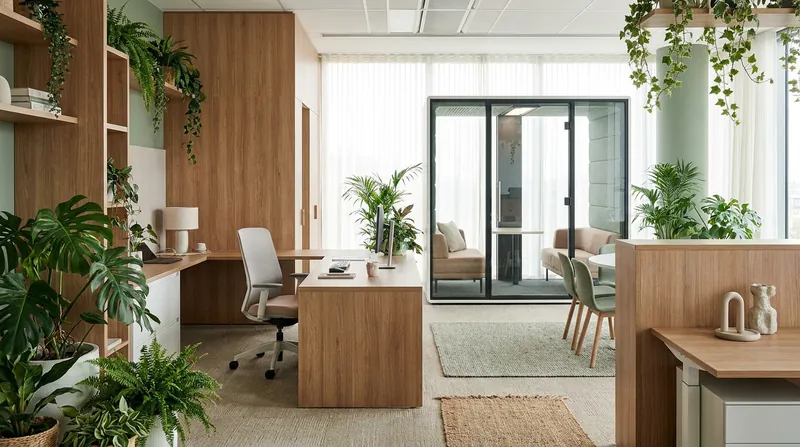
Across global metropolises, architects and urban planners are abandoning the sterile "concrete jungle" model in favor of biophilic design—a structural philosophy that weaves living systems, natural light, and organic materials directly into the built environment. This is not merely an aesthetic trend; it is a fundamental rethinking of how human habitats should function. By acknowledging that humans are biological creatures who thrive in natural settings, designers are creating spaces that actively support physical and mental health.[3]
Biophilic design is frequently misunderstood as simply the act of placing potted plants in a corporate lobby or painting walls green. In reality, it is a rigorous, evidence-based approach to architecture that recognizes humanity's innate biological connection to nature.
By integrating natural analogues, mimicking organic spatial patterns, and prioritizing direct exposure to the elements, designers are transforming buildings from passive shelters into active engines of public health. True biophilic architecture operates on multiple scales, from the tactile feel of a wooden handrail to the macro-level engineering of a building's airflow and natural light penetration.[3]
The urgency behind this architectural shift is driven by modern demographic realities. With over half the global population currently residing in urban centers, the average city dweller now spends roughly 90 percent of their life indoors.
This profound and historically unprecedented disconnection from nature has been linked to rising rates of chronic stress, cognitive fatigue, and urban isolation. In response, biophilic architecture treats the building itself as a therapeutic intervention, attempting to bridge the gap between the artificial environments we have constructed and the natural environments our bodies evolved to inhabit.
The neurological mechanics of biophilic design are rooted in two foundational psychological frameworks: Stress Reduction Theory (SRT) and Attention Restoration Theory (ART). SRT posits that human nervous systems are evolutionarily hardwired to relax in natural environments, which historically signaled safety, shelter, and resource abundance. Conversely, ART suggests that the "soft fascination" of nature—such as watching leaves flutter in the wind or water ripple in a fountain—allows the brain's directed-attention mechanisms to rest and recover from the intense focus required by modern screen-based work.
Empirical evidence supporting these theories has moved steadily from niche environmental psychology into mainstream medical science. A cornerstone of this field is environmental psychologist Roger Ulrich's landmark 1984 study, which demonstrated that hospital patients with window views of trees recovered faster and required fewer painkillers than those staring at brick walls. Today, institutions like the Academy of Neuroscience for Architecture are taking this research further, using advanced neural cartography to map exactly how biophilic spaces influence brain plasticity, emotional regulation, and cognitive longevity.
The physiological impacts of these design choices are measurable and immediate. Studies compiled by the Global Wellness Institute indicate that exposure to biophilic environments actively lowers cortisol levels, reduces blood pressure, and stabilizes heart rate variability. When a building incorporates dynamic natural light, flowing water, and organic textures, it triggers a parasympathetic nervous system response. This biological reaction nudges occupants out of the chronic "fight or flight" state frequently induced by harsh fluorescent lighting, poor ventilation, and acoustic urban chaos.[1]
These health benefits translate directly into performance and recovery metrics, particularly in high-stress environments. In healthcare settings, a 2024 systematic review of biophilic hospital design found that natural integrations significantly reduced hospitalization times, lowered patient mortality rates, and alleviated burnout among medical staff. Facilities are increasingly treating natural light, garden access, and organic materials as critical medical infrastructure rather than mere aesthetic amenities, recognizing that the building itself plays a role in the healing process.[1]
In the commercial sector, the data is equally compelling and is driving a massive shift in corporate real estate. Biophilic workspaces have been shown to boost employee productivity by up to 15 percent, while simultaneously reducing absenteeism and mental fatigue. The presence of natural elements stimulates the cognitive centers of the brain, fostering a conducive environment for problem-solving and creative thinking. For employers, the financial return on a healthier, more focused workforce far outweighs the costs of traditional, sterile office fit-outs.[4]
Real-world applications of these principles are becoming increasingly ambitious, moving far beyond interior decoration. In Singapore, the Khoo Teck Puat Hospital stands as a masterclass in biophilic integration. Conceived from the ground up as a "healing environment," the facility features walls specifically engineered to channel prevailing winds, enhancing natural airflow by 20 to 30 percent. Its central courtyard, terraced gardens, and water features blur the line between the clinical interior and the tropical exterior, creating a space that feels more like a botanical garden than a medical center.
Similarly, the Sagehaus Office Garden in Indonesia inverts the traditional corporate layout. Rather than designing an office that contains a garden as an afterthought, the architects designed a lush garden structured to support modern work. By utilizing natural timber, stone surfaces, and open sightlines, the space provides both "prospect" (open views of the surroundings) and "refuge" (sheltered, secure alcoves). This satisfies deep-seated evolutionary preferences for spatial awareness and safety, resulting in a workspace that actively reduces anxiety.
Despite the clear and documented benefits, the transition to biophilic architecture is not without friction. The most immediate hurdle for developers is economic. Implementing direct nature integrations—such as living walls, advanced natural ventilation systems, and indoor water features—carries an estimated 8 to 12 percent premium on initial construction costs. These features also demand specialized engineering to manage moisture, structural loads, and complex maintenance schedules that traditional buildings simply do not require.[4]
Skeptics and urban economists often point to the long-term operational challenges of maintaining living buildings. Natural elements require consistent upkeep; without it, they can rapidly deteriorate, attract pests, or trigger occupant allergies. Furthermore, indoor gardens and extensive water features can significantly increase a building's water consumption, raising valid concerns about resource sustainability and operational costs, particularly in regions facing drought or strict water conservation mandates.
However, biophilic design practitioners argue that the long-term return on investment heavily outweighs the initial capital expenditure. A three-tier implementation strategy allows developers to scale their approach based on budget. While "Tier 1" direct nature integration is costly, "Tier 2" natural analogues (biomimetic forms, organic color palettes) and "Tier 3" spatial qualities (optimizing natural light and sightlines) offer highly cost-effective ways to achieve biophilic benefits without the ongoing maintenance overhead of living plants.[4]
The financial calculus is rapidly shifting as the commercial real estate market responds to tenant demands. Commercial spaces with biophilic applications consistently command rental premiums, achieve faster lease-up rates, and experience higher tenant retention. In a post-pandemic era where organizations are desperate to lure employees back to physical offices, environments that actively improve well-being are no longer viewed as luxury expenses, but as baseline business necessities required to attract top talent.[4]
Perhaps the most pressing challenge facing the biophilic movement today is the issue of equity. Currently, the most spectacular examples of nature-integrated architecture are concentrated in luxury residential developments, high-end corporate headquarters, and elite private hospitals. There is a growing consensus among urban planners and public health officials that biophilic design must be democratized to prevent it from becoming an exclusive health amenity available only to the wealthy.
Housing equity advocates stress that low-income urban populations—who often suffer the most from the "urban heat island" effect, poor air quality, and a lack of access to public parks—stand to gain the most from biophilic interventions. Integrating natural light, communal green spaces, and organic materials into social housing projects has been shown to foster community engagement, reduce vandalism, and significantly lower rates of depression and social isolation among residents.
As climate change accelerates, biophilic architecture is also proving to be a vital tool for broad urban resilience. Green facades and living roofs provide crucial thermal insulation, reducing a building's energy consumption while mitigating the ambient temperature of the surrounding neighborhood. By absorbing rainwater, filtering air pollutants, and supporting local biodiversity, these structures perform essential ecological services that traditional concrete buildings actively disrupt.[2]
The future of urban design lies in this synthesis of biology and structural engineering. As the evidence base grows, sustainable materials become more accessible, and construction techniques evolve, the rigid distinction between the built environment and the natural world will continue to dissolve. Biophilic design offers a hopeful, evidence-backed blueprint for the 21st century: creating cities that do not just house humanity, but actively heal it.[3]
Key terms
- Biophilia
- The innate human instinct to connect with nature and other living systems.
- Stress Reduction Theory (SRT)
- A psychological framework suggesting that humans are evolutionarily hardwired to relax in natural environments.
- Attention Restoration Theory (ART)
- The concept that exposure to nature allows the brain's directed-attention mechanisms to rest and recover from mental fatigue.
- Biomimicry
- The design and production of materials, structures, and systems that are modeled on biological entities and processes.
- Parasympathetic Nervous System
- The network of nerves that relaxes the body after periods of stress or danger, often stimulated by natural environments.
Frequently asked
What is biophilic design?
An architectural approach that integrates natural elements, light, and organic forms into the built environment to improve human well-being.
Is biophilic design just adding plants to a room?
No. While plants are a component, true biophilic design involves structural changes like natural ventilation, organic materials, and maximizing daylight.
Does biophilic design cost more to build?
Yes, direct nature integrations typically carry an 8 to 12 percent construction premium, though this is often offset by long-term productivity and rental gains.
Can biophilic architecture improve mental health?
Yes. Studies show that exposure to biophilic environments lowers cortisol levels, reduces stress, and accelerates recovery times in hospitals.
Viewpoints in depth
Architectural Innovators
Focus on pushing boundaries and integrating nature structurally rather than decoratively.
For this camp, biophilic design is a fundamental rethinking of how a building operates. They argue that simply adding potted plants is insufficient; true biophilic architecture requires manipulating the 'Nature of the Space' itself. This involves engineering natural ventilation channels, utilizing mass timber, and designing floor plans that mimic the organic prospect and refuge patterns found in nature. They view the building as a living organism that must interact seamlessly with its local ecology.
Public Health Researchers
Focus on empirical evidence, cortisol reduction, and the cognitive benefits of nature exposure.
Medical and psychological researchers view biophilic design primarily as a non-pharmacological public health intervention. Drawing on decades of data, they emphasize that exposure to natural light, organic textures, and greenery actively down-regulates the sympathetic nervous system. Their primary goal is to quantify these benefits—measuring heart rate variability, hospital recovery times, and cognitive longevity—to prove that nature-integrated buildings are a medical necessity, not an architectural luxury.
Urban Economists
Focus on the financial realities, ROI, maintenance costs, and property value premiums.
Developers and economists approach biophilic design through a pragmatic lens of cost versus yield. They acknowledge the 8 to 12 percent premium on initial construction and the ongoing maintenance liabilities of living systems. However, they increasingly champion the approach because the market demands it. By calculating the financial value of a 15 percent boost in worker productivity, faster lease-up rates, and reduced tenant turnover, they argue that biophilic buildings are ultimately more profitable assets.
Housing Equity Advocates
Focus on democratizing access to biophilic spaces and preventing it from being a luxury-only amenity.
This perspective highlights the stark divide between high-end biophilic corporate headquarters and the concrete reality of low-income urban housing. Equity advocates argue that the populations most vulnerable to urban heat islands and chronic stress are precisely those excluded from nature-integrated architecture. They push for policy changes and procurement reforms that mandate biophilic elements—such as natural light optimization and communal green spaces—in publicly funded social housing projects.
- Architectural Innovators
- Focus on pushing boundaries and integrating nature structurally rather than decoratively.
- Public Health Researchers
- Focus on empirical evidence, cortisol reduction, and the cognitive benefits of nature exposure.
- Urban Economists
- Focus on the financial realities, ROI, maintenance costs, and property value premiums.
- Housing Equity Advocates
- Focus on democratizing access to biophilic spaces and preventing it from being a luxury-only amenity.
Perspectives this story doesn't cover
- Traditional HVAC Engineers
- Municipal Water Authorities
Sources
Source coverage
4 outlets
4 viewpoints surfaced




- [1]Global Wellness InstitutePublic Health Researchers
Biophilic Design Positively Impacts Physical and Mental Wellbeing
Read on Global Wellness Institute → - [2]MDPIPublic Health Researchers
Exterior Biophilic Architectural Attributes and Urban Mental Well-Being
Read on MDPI → - [3]Factlen Editorial TeamArchitectural Innovators
Synthesis by Factlen editorial team
Read on Factlen Editorial Team → - [4]MediumUrban Economists
The Influence of Nature in Design: A Practitioner's Guide to Biophilic Architecture
Read on Medium →
More in Culture
See all →Calm Technology
The Rise of Calm Technology: How Design is Curing Digital Fatigue
5 sources
Sensory Architecture
Beyond the Ramp: How Architects Are Redesigning Buildings for Neurodiversity
5 sources
Urban Heritage
Sagrada Familia Reaches Full Height After 144 Years, Shifting Focus to a Bitter Urban Dispute
6 sources
Neuroinclusive Design
The Rise of Neuroinclusive Design: How Architecture and UX Are Adapting to the Human Brain
5 sources
Comments
Every angle. Every day.
Get Culture stories with full source coverage and perspective breakdowns, free every day.