
How Bidirectional Charging is Turning EVs Into Massive Home Batteries
Vehicle-to-home and vehicle-to-grid technologies are reaching commercial scale in 2026, allowing electric vehicles to power households during outages and stabilize the electrical grid.
By Factlen Editorial Team
- Consumer & Energy Advocates
- Focused on home resilience, backup power, and lowering daily electricity costs.
- Grid & Utility Sector
- Views EVs as a critical, decentralized tool for balancing the intermittent nature of renewable energy.
- Automotive Industry
- Embracing bidirectional charging as a premium feature that adds immense value to their vehicles.
What's not represented
- · Stationary battery manufacturers whose market share may be threatened by V2H.
- · Renters and multi-family housing residents who cannot install bidirectional home chargers.
Why this matters
An electric vehicle battery holds roughly ten times the energy of a standard home backup battery. Unlocking this capacity allows drivers to survive multi-day power outages, slash their utility bills, and earn passive income by stabilizing the local power grid.
Key points
- Bidirectional charging allows EVs to send stored battery power back to homes, appliances, or the electrical grid.
- A standard EV battery holds enough energy to power an average household for three to ten days during an outage.
- Vehicle-to-Grid (V2G) technology could reduce the need for utility-scale stationary batteries by up to 92%.
- Automakers are increasingly making bidirectional hardware standard, though compatible home chargers remain expensive.
- Regulatory changes are dismantling fees that previously penalized consumers for selling power back to the grid.
The average passenger vehicle sits parked for roughly 95% of its life. For a combustion-engine car, that idle time represents dead capital. But for an electric vehicle, that downtime is rapidly becoming its most valuable asset. As battery capacities grow, an EV is no longer just a mode of transportation; it is a massive, mobile energy storage system.[1]
In 2026, the automotive and energy sectors are crossing a critical threshold with the mainstream rollout of bidirectional charging. After years of being trapped in limited pilot programs, the technology that allows electric vehicles to send power back out of their batteries is reaching commercial scale.[5]
Traditional EV charging operates on a one-way street: alternating current (AC) flows from the grid into the vehicle, where it is converted to direct current (DC) and stored in the battery. Bidirectional charging flips this script. Using specialized inverters—either built into the vehicle or housed within the wall charger—the system can convert that stored DC power back into AC electricity, dispatching it wherever it is needed.[1][7]
The industry categorizes this two-way flow under the umbrella term "V2X," or Vehicle-to-Everything. The simplest and most common application is Vehicle-to-Load (V2L). Vehicles equipped with V2L feature standard 120-volt or 240-volt outlets, allowing owners to plug in power tools at a job site, run camping equipment, or keep a refrigerator running during a brief power outage.[2][8]
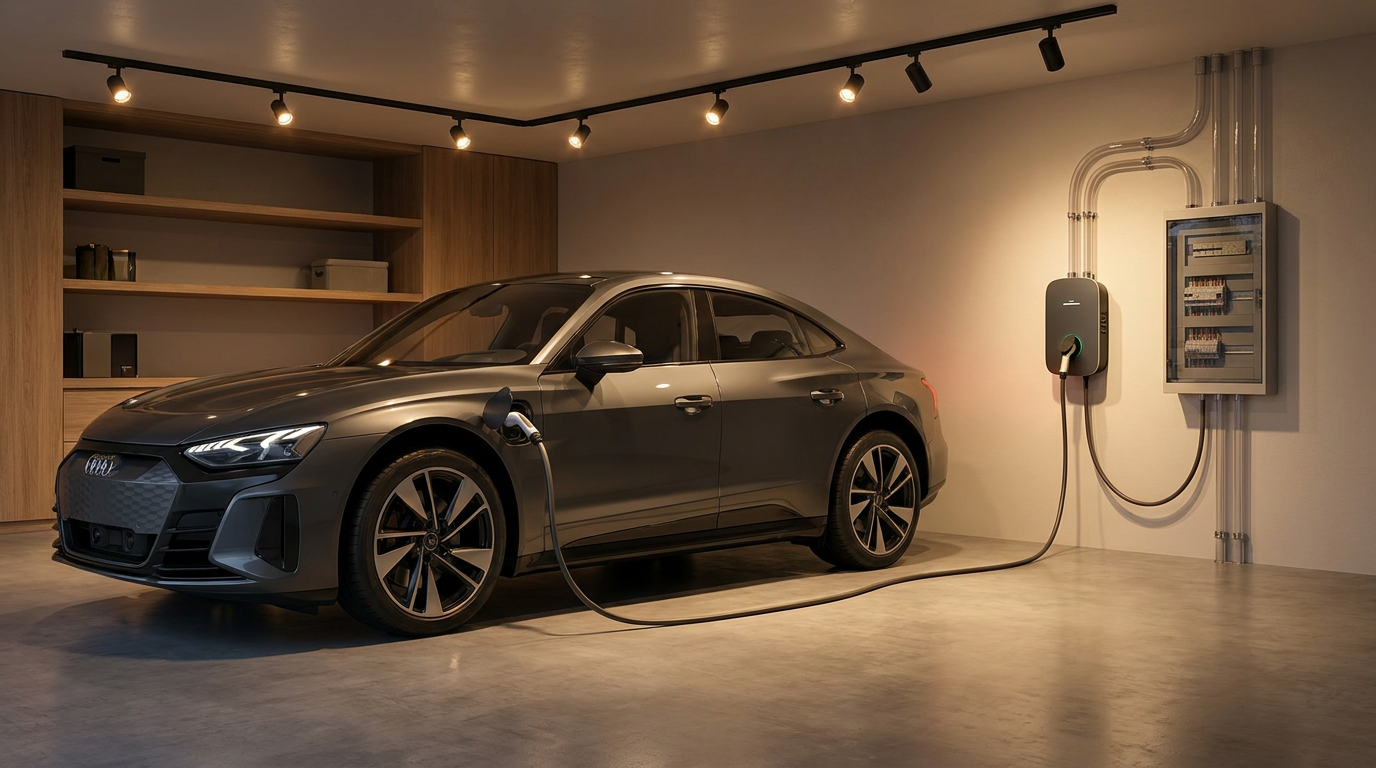
The true paradigm shift, however, arrives with Vehicle-to-Home (V2H) technology. V2H integrates the vehicle directly into a home's electrical panel, effectively turning the car into a whole-house backup generator. The sheer scale of EV batteries makes dedicated home storage systems look diminutive by comparison. A standard Tesla Powerwall holds 13.5 kilowatt-hours (kWh) of energy; a Ford F-150 Lightning pickup truck carries a 131 kWh battery pack—nearly ten times the capacity.[8]

In practical terms, this massive energy reserve provides unprecedented resilience. During a grid blackout, a fully charged high-capacity EV can power an average household for three to ten days without requiring significant lifestyle compromises.[2][8]
Beyond emergency backup, V2H unlocks daily financial benefits through "time-of-use" arbitrage and solar integration. A homeowner with rooftop solar panels can charge their EV during the day when sunlight is abundant and electricity is virtually free. When the sun sets and utility rates spike during peak evening hours, the home automatically switches to drawing power from the car rather than the grid.[6]
Beyond emergency backup, V2H unlocks daily financial benefits through "time-of-use" arbitrage and solar integration.
The most ambitious application of bidirectional charging is Vehicle-to-Grid (V2G). Instead of keeping the energy behind the meter, V2G allows the vehicle to export surplus power back into the broader electrical grid. Utilities can tap into thousands of plugged-in EVs simultaneously to balance supply and demand, effectively using consumer vehicles as a decentralized power plant.[7]
The macroeconomic implications of V2G are staggering. A comprehensive study by the Fraunhofer Institute estimates that fully integrating V2G technology could reduce the European Union's annual energy system costs by 8.6% by 2040, generating €22.2 billion in yearly savings.[3]
Furthermore, because EVs provide such a vast distributed storage network, the same study projects that V2G could reduce the need for utility-scale stationary battery storage by up to 92%. This drastically lowers the infrastructure costs required to transition to intermittent renewable energy sources like wind and solar.[3]

Recognizing this potential, major automakers are pivoting hard. General Motors has announced that bidirectional capability will become a "foundational standard" across its entire EV portfolio. The company is already partnering with utilities like Pacific Gas and Electric (PG&E) to enroll tens of thousands of vehicles into grid-balancing programs by the end of the decade.[4]
Despite the immense promise, several hurdles remain before bidirectional charging becomes ubiquitous. The primary barrier is hardware cost. A bidirectional home charger currently costs between $3,000 and $8,000 more than a standard Level 2 charger, and installation requires complex electrical work, including an automatic transfer switch to safely isolate the home from the grid during an outage.[2][8]
Regulatory frameworks are also playing catch-up. For years, V2G adoption was stifled by policies that charged "double grid fees"—taxing the electricity when it entered the car and again when it was fed back into the grid. Countries like Germany have recently dismantled these penalties, legally reclassifying EVs as mobile storage units rather than end consumers, which turns V2G from a financial penalty into a revenue opportunity.[5]
Interoperability presents another technical challenge. For a vehicle to seamlessly sell power back to the grid, the car, the charger, and the utility must speak the same digital language. The industry is rapidly coalescing around the ISO 15118-20 standard, a communication protocol that acts as a digital handshake for bidirectional energy transfer, which is now becoming mandatory for new public chargers in Europe.[5]

On the consumer side, the biggest hesitation is battery degradation. EV owners are understandably wary that "micro-cycling"—constantly charging and discharging the battery for grid services—will prematurely wear out their vehicle's most expensive component and void warranties. Automakers are countering this by developing intelligent battery management software that limits V2G discharges to shallow cycles that have negligible impact on long-term battery health.[2][5]
For those willing to adopt the technology early, the financial incentives are compelling. Beyond the savings generated by V2H solar arbitrage, active V2G pilot programs in California and Europe are currently paying EV owners between $400 and $780 annually just for allowing the utility to access a small portion of their battery capacity during peak demand.[2]

As hardware costs inevitably fall and software integration becomes seamless, the relationship between drivers and the energy grid will fundamentally change. Electric vehicles are transforming consumers into "prosumers"—active participants who not only draw power from the grid but actively stabilize it, turning their driveways into the foundation of a resilient, renewable energy future.[1][5]
How we got here
2021
Early V2G pilot programs launch in Europe and California, testing grid integration.
2022
Ford releases the F-150 Lightning with Intelligent Backup Power, bringing V2H to the mainstream US market.
2024
Major studies confirm V2G could save billions in grid infrastructure costs by replacing stationary storage.
2025
Germany and other European nations remove 'double grid fees' that penalized V2G participation.
2026
ISO 15118-20 communication standards become mandatory for new public chargers, enabling seamless bidirectional data flow.
Viewpoints in depth
Grid Operators
View EVs as a critical tool for balancing the intermittent nature of renewable energy.
Utility companies and grid operators see the millions of EVs hitting the road not as a liability, but as a massive, decentralized battery network. By tapping into these vehicles during peak demand, they can avoid firing up expensive, highly polluting 'peaker' plants. They argue that incentivizing V2G participation is far cheaper than building dedicated grid-scale storage facilities.
Automakers
Embracing bidirectional charging as a premium feature that adds immense value to their vehicles.
Manufacturers like GM, Ford, and Hyundai are leveraging V2H and V2G as major selling points. They recognize that offering customers the ability to power their homes or earn money from their cars justifies higher vehicle price tags. However, they are proceeding cautiously with intelligent battery management software to ensure that grid services do not accelerate battery degradation and trigger costly warranty claims.
Energy Consumers
Focused on home resilience and lowering daily electricity costs.
For the average homeowner, the primary appeal of bidirectional charging is energy independence. Consumers are highly motivated by the ability to keep their lights on and refrigerators running during severe weather outages without buying a separate, expensive home battery. While the passive income of V2G is attractive, early adopters are primarily utilizing V2H to maximize their rooftop solar investments and avoid peak utility rates.
What we don't know
- How quickly hardware costs for bidirectional home chargers will fall to match standard Level 2 chargers.
- The long-term real-world impact of daily V2G micro-cycling on EV battery lifespan and warranty claims.
- Whether utility companies will standardize compensation rates for consumers providing grid services.
Key terms
- Bidirectional Charging
- Technology that allows an electric vehicle to both receive energy from the grid and discharge stored energy back out.
- V2H (Vehicle-to-Home)
- A system where an electric vehicle powers a household directly, acting as a backup generator during outages or peak pricing.
- V2G (Vehicle-to-Grid)
- A system that allows electric vehicles to sell stored battery energy back to the local utility grid to balance supply and demand.
- V2L (Vehicle-to-Load)
- A feature that provides standard electrical outlets on an EV to power tools, appliances, or camping gear directly.
- Time-of-Use Arbitrage
- The practice of charging a battery when electricity rates are low and using that stored power when rates are high to save money.
- ISO 15118-20
- An international communication standard that allows EVs and charging stations to securely exchange data for bidirectional charging.
Frequently asked
Will bidirectional charging ruin my EV battery?
Automakers use intelligent battery management software to limit V2G discharges to shallow cycles. This prevents deep depletion and minimizes any impact on the battery's long-term health or warranty.
Do I need a special charger for V2H or V2G?
Yes. You need a bidirectional charger equipped with a specialized inverter, which currently costs significantly more than a standard home EV charger, plus a home integration system.
Can any electric vehicle power a home?
No. Both the vehicle and the charger must support bidirectional power flow. While it is becoming a standard feature on new models from brands like GM, Ford, and Hyundai, older EVs generally lack the necessary hardware.
How long can an EV power a house during a blackout?
Depending on the vehicle's battery size and the home's energy usage, a fully charged EV can typically power an average household for three to ten days.
Sources
Source coverage
8 outlets
3 viewpoints surfaced








[1]Factlen Editorial TeamConsumer & Energy Advocates
Synthesis by Factlen editorial team
Read on Factlen Editorial Team →[2]Energy Solutions IntelligenceAutomotive Industry
Bidirectional EV Charging 2026: Which Cars Can Power Your Home and the Grid?
Read on Energy Solutions Intelligence →[3]The Mobility HouseGrid & Utility Sector
V2G Studies 2025/26: The Future of EV Integration
Read on The Mobility House →[4]EV Infrastructure NewsAutomotive Industry
General Motors launches V2G push, enters energy storage market
Read on EV Infrastructure News →[5]EnBWGrid & Utility Sector
Vehicle-to-Grid 2026: Key Barriers to Mass Adoption and Startup Solutions
Read on EnBW →[6]American Solar Energy SocietyConsumer & Energy Advocates
V2H: Vehicle-to-Home Bi-Directional Charging
Read on American Solar Energy Society →[7]Octopus EnergyGrid & Utility Sector
Vehicle-to-grid, V2H & bidirectional charging: the complete UK guide
Read on Octopus Energy →[8]NuWattConsumer & Energy Advocates
Bidirectional EV Charging & V2H in 2026: Can Your EV Replace a Home Battery?
Read on NuWatt →
Every angle. Every day.
Get automotive stories with full source coverage and perspective breakdowns delivered to your inbox.