
How Bidirectional Charging is Turning Electric Vehicles Into Home Power Plants
Bidirectional charging allows modern electric vehicles to power homes during blackouts and sell energy back to the grid. Here is how the technology works, what hardware it requires, and why it is transforming home energy resilience in 2026.
By Factlen Editorial Team
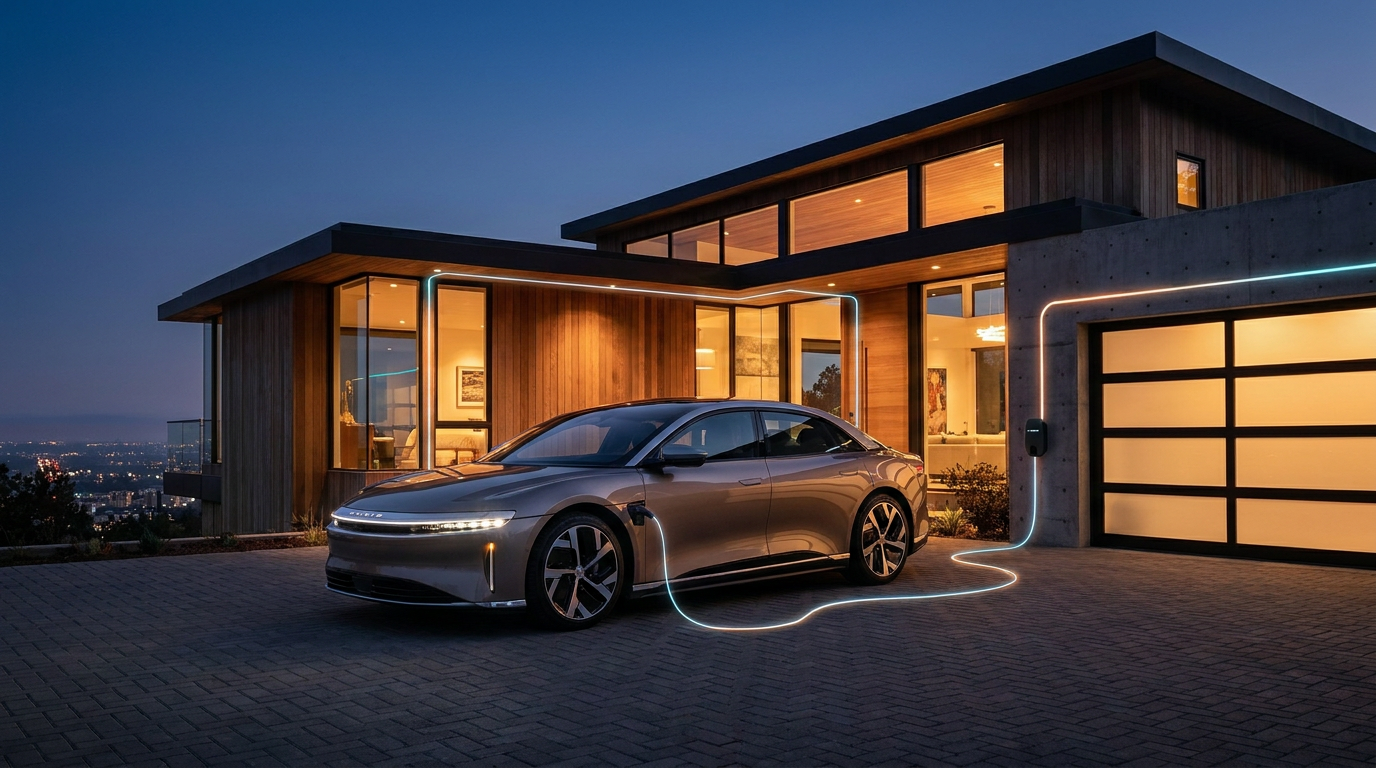
- Energy Independence Advocates
- Focuses on V2H technology as a tool for household resilience, backup power, and self-reliance during grid outages.
- Grid Operators & Utilities
- Views EVs as decentralized energy storage that can balance renewable energy loads and prevent blackouts via V2G.
- Automotive Pragmatists
- Highlights the practical hurdles of bidirectional charging, including hardware costs, standardization issues, and battery degradation.
What's not represented
- · Electricians and Installers
- · Renters without dedicated driveways
Why this matters
An EV battery holds enough energy to power an average home for up to five days. Understanding bidirectional charging allows car shoppers to buy a vehicle that doubles as a whole-home backup generator, saving thousands of dollars on dedicated wall batteries.
Key points
- Bidirectional charging allows an EV to discharge its battery to power external devices, a home, or the municipal grid.
- A typical EV battery holds enough energy to power an average household for three to five days during a blackout.
- Vehicle-to-Home (V2H) setups require a specialized bidirectional charger and an automatic transfer switch to safely isolate the house from the grid.
- Vehicle-to-Grid (V2G) programs allow EV owners to earn money by selling surplus energy back to utility companies during peak demand.
- Hardware costs, standardization issues, and battery degradation concerns remain the primary hurdles to widespread adoption in 2026.
For decades, an automobile was the most expensive depreciating asset most people owned—a machine that sat idle in a driveway or parking lot for roughly 95 percent of its life. But in 2026, the electric vehicle is undergoing a fundamental identity shift. It is no longer just a mode of transportation; it is a rolling, high-capacity power plant. This transformation is driven by bidirectional charging, a technology that allows electricity to flow not just from the grid into the car, but from the car back out to the world. While early electric vehicles were strictly energy consumers, the latest generation of vehicles can discharge their massive battery packs to run heavy power tools, keep a house illuminated during a multi-day blackout, or even sell electricity back to the utility company.[1][2]
To understand the sheer scale of this shift, one must consider the basic math of modern energy storage. A standard, dedicated home backup battery—such as a Tesla Powerwall 3 or an LG Chem RESU—holds roughly 13.5 kilowatt-hours of electricity. In stark contrast, a typical modern electric vehicle battery holds between 60 and 110 kilowatt-hours of energy. That means a single electric truck like the Ford F-150 Lightning, or a crossover like the Hyundai Ioniq 5, contains the equivalent of five to eight wall-mounted home batteries on wheels.[1][3]
The practical implications of that math are staggering for home resilience. During a severe grid outage caused by a winter storm or a summer heatwave, a fully charged electric vehicle can comfortably power an average household for three to five days. That includes running high-draw appliances like the refrigerator, keeping the lights and Wi-Fi on, and operating the HVAC system, all without requiring the homeowner to make significant lifestyle compromises or listen to the deafening roar of a gas-powered generator.[4]

However, unlocking this rolling fortress of power requires specific hardware and communication protocols. Standard electric vehicle charging is a one-way street: alternating current flows from the municipal grid and is converted to direct current to be stored safely in the car's battery cells. Bidirectional charging requires a two-way highway. When a homeowner wants to extract power, that stored direct current energy must be inverted back into alternating current power that the home's electrical panel and standard appliances can actually use.[1][5]
This inversion process happens in one of two ways: either via an onboard inverter built directly into the vehicle itself, or through a specialized, wall-mounted bidirectional charger installed in the garage. The automotive and energy industries currently divide this two-way capability into three distinct tiers, often referred to collectively as the "V2X" ecosystem. The most basic, affordable, and widely available of these tiers is known as Vehicle-to-Load, or V2L.[2][5]
Vehicle-to-Load essentially turns the car into a giant, silent, portable generator. Vehicles equipped with V2L feature standard 120-volt or 240-volt alternating current outlets built directly into the cabin, the trunk, or the truck bed. Owners can plug in camping gear, laptops, tailgating equipment, or heavy power tools directly into the vehicle. Because it requires no special home installation or grid interconnection, V2L is highly accessible, though it is limited in output and cannot power an entire house through a breaker panel.[2][3]
The second tier is Vehicle-to-Home, commonly abbreviated as V2H, which is exactly what most consumers are actively shopping for in 2026. V2H connects the electric vehicle directly to the home's main electrical panel via a bidirectional charger and an automatic transfer switch. When the municipal grid goes down, the transfer switch instantly isolates the house from the neighborhood power lines. This isolation is a critical safety feature, preventing the car from backfeeding electricity onto the grid, which could fatally injure utility line workers attempting to repair the outage.[1][4]

The second tier is Vehicle-to-Home, commonly abbreviated as V2H, which is exactly what most consumers are actively shopping for in 2026.
Once the house is safely isolated, the system seamlessly draws power from the car's battery to keep the home running. As of 2026, roughly 60 percent of new electric vehicle models support V2H hardware. Leading the charge are the GM Ultium lineup, the Kia EV9, the Hyundai Ioniq series, and the pioneering Nissan Leaf. By effectively bundling a high-capacity home battery into the purchase price of a vehicle, the automotive industry is inadvertently democratizing backup power for millions of suburban households.[4][6]
The final and most technologically complex tier is Vehicle-to-Grid, or V2G. Instead of merely powering a single isolated home during a blackout, V2G allows an electric vehicle to actively export its surplus energy back to the municipal power grid during times of peak demand. For utility companies, V2G represents a holy grail of grid management. Instead of firing up expensive, highly polluting "peaker plants" on hot summer afternoons when everyone turns on their air conditioning, the grid operator can simply borrow a few kilowatts from thousands of plugged-in cars.[3][5]
In exchange for allowing the utility to tap into their batteries, electric vehicle owners are financially compensated. Utility companies operating pilot programs across California, the United Kingdom, and the Netherlands are currently offering participating EV owners annual incentives ranging from $500 to $1,200. The car essentially becomes an income-generating asset while it sits parked in the garage, automatically buying electricity when rates are cheap overnight and selling it back when rates spike in the late afternoon.[4][5]
Despite the obvious consumer and environmental benefits, the widespread rollout of full V2H and V2G capabilities has faced significant friction. The primary hurdle for homeowners is the upfront installation cost. While a standard Level 2 home charger costs around $500 to $800, a bidirectional charging station—complete with the necessary heavy-duty inverter and automatic transfer switch—can run between $4,000 and $7,000 fully installed by a certified electrician.[4]

Hardware compatibility is another major bottleneck frustrating early adopters. The dream of "any car powering any home" remains elusive in 2026. A bidirectional charger designed specifically for a Nissan Leaf's older CHAdeMO standard will not work with a Ford's CCS port. Furthermore, while Tesla has finally introduced bidirectional capabilities on its flagship Cybertruck, millions of older Model 3 and Model Y vehicles remain locked out of the V2H ecosystem via software, forcing owners to buy separate Tesla Powerwalls if they want home backup.[1][4]
Automakers and consumers alike are also grappling with the long-term implications for battery longevity. Electric vehicle warranties are typically based on mileage and time, but V2G micro-cycling—the process of constantly discharging and recharging the battery by a few percentage points to support the grid—adds chemical wear and tear that never shows up on the vehicle's odometer. Some consumers remain hesitant to degrade their primary mode of transportation just to shave a few dollars off their monthly utility bill.[4][6]
To address these valid warranty concerns, manufacturers are writing highly complex software algorithms that strictly limit how deeply the battery can be discharged for grid services. These energy management systems ensure that the owner always wakes up with enough range for their morning commute, and that the battery's chemical lifespan is protected from excessive heat and deep cycling. Many modern EV warranties now explicitly cover V2H usage, provided it is managed by approved hardware.[5][6]
Regulatory red tape also continues to slow adoption. In many jurisdictions, connecting any power-exporting device to the grid requires lengthy interconnection approvals from local utility monopolies. This bureaucratic process can delay a V2H installation by several months, as utilities are forced to update their aging safety protocols to account for mobile batteries that can plug and unplug at will. Until national standards for grid interconnection are fully streamlined, homeowners must navigate a patchwork of local regulations just to use the battery they already own.[1][5]

Yet, despite the costs and the red tape, the momentum behind bidirectional charging is undeniable. As extreme weather events increase the frequency and duration of grid outages globally, the appeal of total energy independence is driving massive consumer demand. Car shoppers are increasingly viewing bidirectional capability not as a luxury add-on, but as a critical home-resilience feature. The driveway is no longer just a place to park; it is rapidly becoming the cornerstone of a decentralized, resilient energy grid.[1][6]
How we got here
2013
Nissan introduces early V2H capabilities in Japan with the Leaf, utilizing the CHAdeMO charging standard.
2022
Ford launches the F-150 Lightning with Intelligent Backup Power, bringing whole-home EV backup into the mainstream US market.
2024
Major automakers, including GM and Hyundai, commit to making bidirectional hardware standard on their next-generation EV platforms.
2025
Tesla enables bidirectional charging on the Cybertruck, marking a significant shift in the company's historical resistance to V2H technology.
2026
V2H and V2G capabilities become standard on roughly 60% of all new electric vehicle models globally.
Viewpoints in depth
Energy Independence Advocates
Focuses on the ability of EVs to provide household resilience and backup power during grid outages.
For homeowners and solar advocates, the primary draw of bidirectional charging is Vehicle-to-Home (V2H) capability. They view the electric vehicle not just as transportation, but as a massive, mobile Powerwall that can sever a home's reliance on a fragile municipal grid. By pairing rooftop solar panels with a V2H-capable EV, households can capture free solar energy during the day and use the car to power the home through the night, effectively achieving total energy independence while insulating themselves from rising utility rates and weather-related blackouts.
Grid Operators & Utilities
Views electric vehicles as a massive, decentralized battery network that can stabilize the power grid.
Utility companies see millions of plugged-in EVs as the ultimate solution to the intermittency of renewable energy. Because solar and wind power fluctuate, grids often struggle to balance supply and demand. Through Vehicle-to-Grid (V2G) programs, utilities can tap into the collective storage of thousands of cars, drawing power during peak evening hours and returning it overnight when wind energy is abundant. This 'virtual power plant' model prevents the need to build expensive, carbon-heavy peaker plants, which is why utilities are increasingly willing to pay EV owners for access to their batteries.
Automotive Pragmatists
Highlights the practical hurdles of hardware costs, standardization, and battery degradation.
While the technology is proven, pragmatists point out that the economics and hardware standards are still messy in 2026. A bidirectional charger can cost upwards of $5,000 to install, eating into the potential savings of grid-export programs. Furthermore, battery engineers caution that V2G micro-cycling adds chemical wear to the vehicle's most expensive component. Until automakers standardize charging protocols—bridging the gap between CCS, NACS, and CHAdeMO—and offer bulletproof warranties that cover V2G degradation, pragmatists argue that bidirectional charging will remain a premium feature rather than a ubiquitous utility.
What we don't know
- How aggressively utility companies will scale V2G financial incentives once bidirectional charging becomes ubiquitous.
- Whether Tesla will eventually use software updates to unlock bidirectional capabilities on older Model 3 and Model Y vehicles.
- The exact long-term impact of daily V2G micro-cycling on the chemical lifespan of solid-state EV batteries.
Key terms
- Bidirectional Charging
- Technology that allows electricity to flow both into an electric vehicle's battery and back out to power external devices, homes, or the municipal grid.
- V2L (Vehicle-to-Load)
- A feature that allows an EV to power standard 120V or 240V appliances and tools directly from outlets built into the car.
- V2H (Vehicle-to-Home)
- A system that connects an EV to a home's electrical panel, allowing the car's battery to power the entire house during a blackout.
- V2G (Vehicle-to-Grid)
- A technology that allows an EV to export surplus stored energy back to the municipal power grid, often in exchange for financial compensation from the utility.
- Inverter
- A device that converts the direct current (DC) electricity stored in a battery into the alternating current (AC) electricity used by household appliances.
- Automatic Transfer Switch
- A safety device that automatically disconnects a home from the municipal grid during a blackout, allowing the EV to safely power the house without backfeeding electricity onto public power lines.
Frequently asked
Can any electric vehicle power my home?
No. Your vehicle must specifically support bidirectional charging, and you must have a compatible bidirectional home charger. As of 2026, about 60% of new EV models support this, including the Ford F-150 Lightning, Kia EV9, and Hyundai Ioniq 5.
Will using my EV to power my house void the battery warranty?
Generally, no, as long as you use manufacturer-approved V2H hardware. Most automakers have updated their warranties to allow for home backup usage, though some place specific limits on aggressive V2G grid-exporting to prevent excessive battery degradation.
How much does a bidirectional charger cost?
While a standard EV charger costs around $500 to $800, a bidirectional setup—which requires a heavy-duty inverter and an automatic transfer switch—typically costs between $4,000 and $7,000 fully installed by a certified electrician.
What happens if I need to drive during a blackout?
You can simply unplug your vehicle and drive away. However, the moment you disconnect the car, your home will lose power unless you have a secondary backup system like a dedicated wall battery or a gas generator.
Sources
Source coverage
6 outlets
3 viewpoints surfaced






[1]EnergySageEnergy Independence Advocates
Bidirectional EV chargers: Your EV could be the ultimate home backup battery
Read on EnergySage →[2]Recurrent AutoEnergy Independence Advocates
Bidirectional Charging 101: Can Your Car Power Your Home?
Read on Recurrent Auto →[3]ElectroverseAutomotive Pragmatists
What is bidirectional charging, and how does it work?
Read on Electroverse →[4]Energy Solutions IntelligenceGrid Operators & Utilities
The 2026 Guide to Bidirectional Charging: V2H and V2G
Read on Energy Solutions Intelligence →[5]Solar ChoiceGrid Operators & Utilities
Bidirectional EV Chargers: A Homeowner's Guide
Read on Solar Choice →[6]Factlen Editorial TeamAutomotive Pragmatists
Synthesis by Factlen editorial team
Read on Factlen Editorial Team →

More in shopping
See all 5 stories →


Every angle. Every day.
Get shopping stories with full source coverage and perspective breakdowns delivered to your inbox.