
How AI is Unlocking the Lost Library of Herculaneum
Two millennia after Mount Vesuvius turned a Roman library into carbonized lumps, machine learning is allowing researchers to read the scrolls without opening them.
By Factlen Editorial Team
- Digital Archaeologists
- Focus on the technical pipeline of CT scanning, 3D segmentation, and training machine learning models to detect carbon ink.
- Classicists & Historians
- Focus on the humanistic impact of translating the recovered texts and the potential to find lost works of major historical figures.
- Open-Source Community
- Emphasize the collaborative, crowdsourced nature of the breakthrough, where independent researchers drive innovation.
What's not represented
- · The Italian government and local archaeological authorities managing the physical Herculaneum site.
- · Traditional papyrologists who specialize in physical manuscript preservation.
Why this matters
The Herculaneum papyri represent the only intact library surviving from the classical world. Successfully decoding them could double the amount of ancient literature available to humanity, recovering lost works of history, science, and philosophy that have been unread for 2,000 years.
Key points
- Over 600 carbonized scrolls from the eruption of Mount Vesuvius remain unopened and unreadable.
- Researchers are using high-resolution CT scans from particle accelerators to create 3D models of the scrolls.
- Machine learning models have been trained to detect microscopic textural changes left by carbon-based ink.
- The crowdsourced Vesuvius Challenge has successfully decoded passages of ancient Greek philosophy.
- A new €11.5 million grant aims to fully automate the digital unwrapping pipeline by 2026.
In 79 CE, the eruption of Mount Vesuvius buried the Roman towns of Pompeii and Herculaneum under millions of tons of superheated ash. While the catastrophe froze Pompeii in time, the intense pyroclastic flows that hit Herculaneum did something unique: they instantly carbonized organic material. Inside a grand estate believed to have belonged to Julius Caesar’s father-in-law, a vast library of papyrus scrolls was flash-baked into solid lumps of charcoal. Discovered by farmworkers in the 18th century, the "Villa of the Papyri" yielded over 1,800 scrolls. They represent the only intact library to survive from the classical world, holding the tantalizing promise of lost philosophical treatises, histories, and poetry.[1][5]
For more than two and a half centuries, those scrolls remained an agonizing mystery. Early attempts to physically unroll them were disastrous. Monks and early archaeologists used knives, rose water, and mechanical contraptions to pry the layers apart, but the brittle, carbonized papyrus often shattered into dust. Hundreds of scrolls were destroyed or severely damaged, yielding only fragmented texts. The remaining unopened scrolls—roughly 600 of them—were deemed unreadable, locked away in museum vaults in Naples, Paris, and Oxford as silent relics of a lost intellectual world.[1]
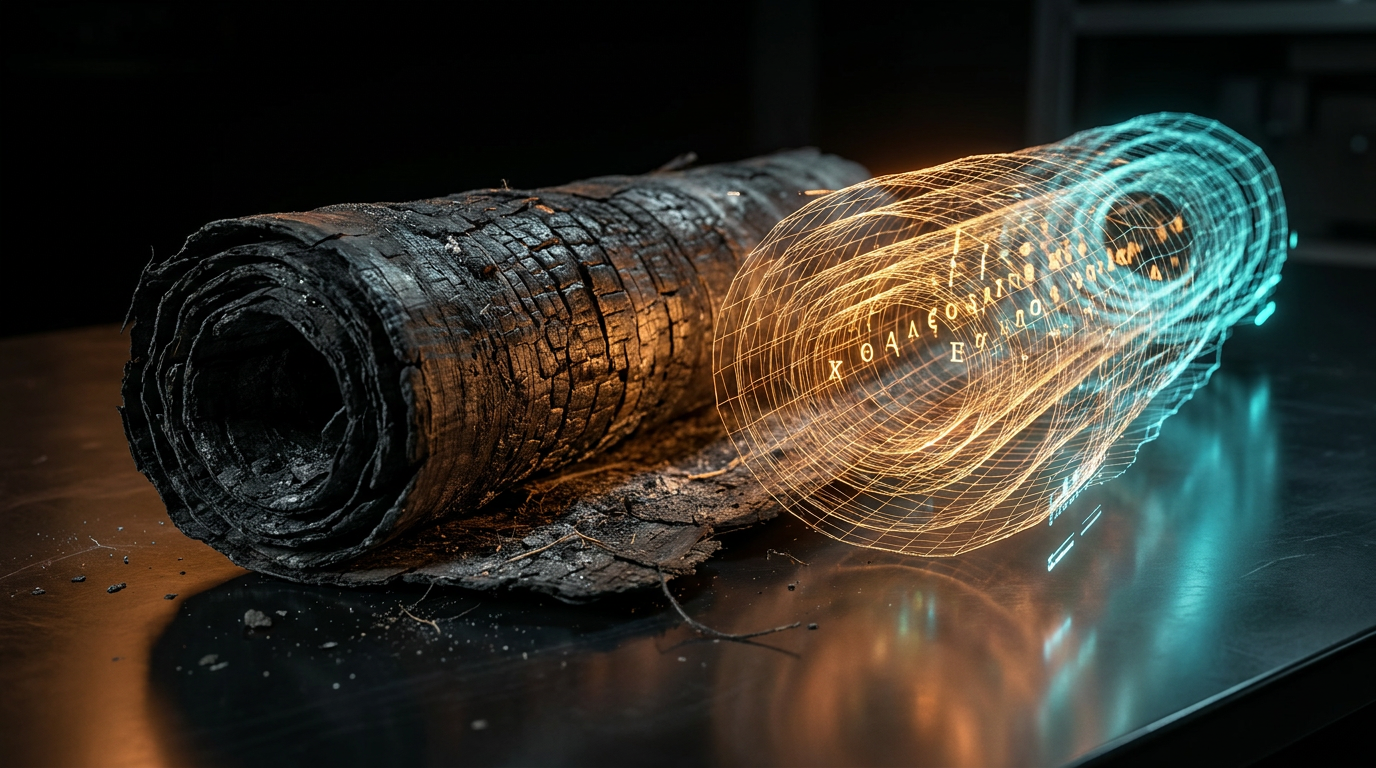
Today, that silence is finally being broken, not by archaeologists with scalpels, but by computer scientists armed with artificial intelligence. A revolutionary technique known as "virtual unwrapping" is allowing researchers to peer inside the carbonized lumps and read the ancient Greek and Latin texts without ever opening the physical scrolls. Pioneered by computer science professor Brent Seales at the University of Kentucky, the process relies on high-resolution X-ray computed tomography (CT) scans, similar to medical imaging but vastly more powerful.[2][5]
The virtual unwrapping pipeline begins in a particle accelerator. Researchers transport the fragile scrolls to facilities like the Diamond Light Source in the United Kingdom, where a synchrotron generates a powerful X-ray beam. This beam penetrates the charcoal lump, creating a three-dimensional digital replica of the scroll's internal structure at a resolution of just a few micrometers—roughly one-fiftieth the width of a human hair. Within this digital volume, researchers can map the spiraling, crushed layers of papyrus, a painstaking process known as segmentation.[3][4]

However, mapping the papyrus was only half the battle. The Herculaneum scrolls presented a unique chemical hurdle: Roman scribes wrote using an ink made from soot and water. Because both the papyrus and the ink are carbon-based, they possess nearly identical densities. When X-rayed, the ink did not show up as a distinct bright spot the way iron-based medieval inks do. For years, researchers could trace the physical shape of the rolled papyrus but were left staring at blank digital pages, unable to distinguish the carbon ink from the carbonized paper.[5]
The breakthrough came when researchers realized that the ink, though chemically identical to the papyrus, physically altered the surface of the scroll. The water in the ink caused the papyrus fibers to swell slightly, leaving microscopic textural changes—often referred to as "crackle patterns"—on the surface. To detect these imperceptible variations, Seales and his team turned to machine learning. They hypothesized that a neural network could be trained to recognize the subtle topographical signatures of the ink, even if the human eye could not see them.[1][6]
To accelerate this monumental task, Seales partnered with Silicon Valley entrepreneurs in 2023 to launch the Vesuvius Challenge, a global crowdsourced competition offering a $1 million prize pool. The organizers released thousands of 3D X-ray scans and open-source software tools to the public, inviting coders, students, and data scientists worldwide to train AI models on the data. The initiative transformed a niche academic pursuit into a massive, decentralized engineering effort, proving that open-source collaboration could solve centuries-old archaeological puzzles.[1][2]
The results were swift and historic. By late 2023, two students working independently—Luke Farritor, a SpaceX intern, and Youssef Nader, a graduate student in Berlin—developed machine learning models that detected the first complete word hidden deep within an unopened scroll. The word was "πορφύραc" (porphyras), ancient Greek for "purple." This milestone validated the entire virtual unwrapping pipeline, proving definitively that the ink was there and that artificial intelligence could find it.[2][5]

The momentum accelerated rapidly. In early 2024, a team of three students claimed the Vesuvius Challenge Grand Prize by deciphering more than 5 percent of a scroll. The recovered text revealed a previously unknown philosophical treatise by the Epicurean philosopher Philodemus. In the newly translated passages, Philodemus discusses the nature of pleasure, debating whether the scarcity of food or music affects the enjoyment of it. It was the first time in two millennia that these specific thoughts had been read by human eyes, recovered entirely through digital inference.[1][5]
In early 2024, a team of three students claimed the Vesuvius Challenge Grand Prize by deciphering more than 5 percent of a scroll.
The technology has continued to yield unprecedented discoveries. In early 2025, the Vesuvius Challenge and the Bodleian Libraries at the University of Oxford announced a major breakthrough with a scroll known as PHerc. 172. Scanned at the Diamond Light Source, the resulting AI-enhanced images revealed the clearest columns of text yet recovered. Among the first words translated by Oxford scholars was "διατροπή" (diatrope), meaning "disgust." The clarity of PHerc. 172 stunned researchers, suggesting that some scrolls may be far easier to read than initially feared.[3][4]
Interestingly, the legibility of the Oxford scroll may be due to an ancient anomaly. Researchers noted that the ink in PHerc. 172 appears to contain a denser contaminant, potentially lead. While standard Roman soot ink is invisible to X-rays, the presence of heavier elements makes the ink stand out more clearly in the CT scans. This discovery has prompted researchers to investigate whether different scribes in the Villa of the Papyri used varying ink recipes, which could drastically accelerate the decoding of certain volumes.[4]
Despite these triumphs, immense challenges remain. The primary bottleneck is no longer detecting the ink, but segmenting the 3D scans. Tracing the crushed, fused layers of papyrus through a digital volume is a painstakingly slow, manual process. When layers are tightly compressed, the AI models can struggle to determine which layer of papyrus a specific stroke of ink belongs to, creating a jumbled, unreadable mess. Automating this 3D segmentation is the current frontier of the project.[1][2]
To overcome this hurdle, the European Research Council awarded a €11.5 million ($13.5 million) Synergy Grant in July 2025 to a global consortium led by Seales. The project, dubbed "UnLost," aims to build an open-access digital library of the Herculaneum texts. A major focus of the funding is developing new AI models capable of automatically detecting and digitally repositioning misplaced layers, scaling the unwrapping process from small patches of text to entire, intact scrolls.[2]

As the technology scales into 2026, the Vesuvius Challenge has issued new prizes aimed at fully automating the extraction pipeline. The goal is no longer just to prove that the scrolls can be read, but to process the remaining 600 unopened scrolls at an industrial pace. If successful, this effort could effectively double the amount of ancient literature available to humanity, fundamentally altering our understanding of the classical world.[1][6]
The implications extend far beyond the scrolls currently sitting in museum vaults. Archaeologists believe that the 1,800 scrolls recovered in the 18th century represent only a fraction of the Villa of the Papyri's collection. The main library of the estate, which could house thousands of additional Latin and Greek texts, may still lie buried under the hardened volcanic rock of Herculaneum. If researchers can prove that these scrolls can be read reliably and non-destructively, it could spark a renewed push to excavate the rest of the villa.[5][6]
We are standing on the precipice of a digital Renaissance. By combining particle physics, machine learning, and classical philology, a global community of researchers is reaching back across two millennia to rescue human knowledge from the ashes. The Herculaneum scrolls are no longer just artifacts of a volcanic tragedy; they are active voices from antiquity, finally ready to speak again.[6]
How we got here
79 CE
Mount Vesuvius erupts, burying the Villa of the Papyri and carbonizing its library of scrolls.
1752
Farmworkers discover the buried villa and recover approximately 1,800 carbonized scrolls.
2015
Dr. Brent Seales pioneers virtual unwrapping by successfully reading the charred En-Gedi scroll from Israel.
March 2023
The Vesuvius Challenge launches, offering a $1 million prize pool and releasing 3D scans of the scrolls to the public.
Late 2023
Students independently discover the first complete word, 'purple' (πορφύραc), hidden inside an unopened scroll.
Early 2024
A team of three students wins the Grand Prize by deciphering 5% of a scroll, revealing a philosophical text.
July 2025
A global consortium secures a €11.5 million grant to automate the AI pipeline and scale the unwrapping process.
Viewpoints in depth
Digital Archaeologists
Solving a 2,000-year-old data extraction problem.
For computer scientists and imaging specialists, the Herculaneum scrolls represent the ultimate data recovery challenge. The focus is entirely on the physical and digital pipeline: using particle accelerators to generate terabytes of 3D volumetric data, and then training neural networks to detect microscopic topographical anomalies (the ink) on a crushed, carbonized surface. Their primary goal is automating the 3D segmentation process so that entire scrolls can be unwrapped by algorithms in hours rather than months.
Classicists & Historians
A potential doubling of surviving ancient literature.
Papyrologists and historians view this breakthrough as the most significant classical discovery since the Renaissance. Because the Villa of the Papyri is the only intact library surviving from antiquity, it offers an unfiltered look at Roman and Greek intellectual life. Classicists are eager to move beyond the Epicurean philosophy found so far, hoping the unread scrolls—and those potentially still buried—contain lost plays by Sophocles, missing books of Livy's history of Rome, or early scientific treatises.
The Open-Source Community
Democratizing archaeological discovery through crowdsourcing.
The success of the Vesuvius Challenge has proven that complex archaeological problems don't have to be solved exclusively in closed academic labs. By releasing the 3D scans and base code to the public, the initiative tapped into a global network of students, tech workers, and hobbyists. This perspective champions decentralized science, arguing that open data and financial bounties can accelerate breakthroughs far faster than traditional academic grants.
What we don't know
- Whether the AI models can successfully segment the most tightly fused and damaged layers of the scrolls.
- If the remaining unexcavated portions of the Villa of the Papyri contain the thousands of additional scrolls archaeologists suspect are there.
- What specific lost works of classical literature or history might be hidden within the remaining 600 unopened scrolls.
Key terms
- Virtual Unwrapping
- A non-invasive digital technique that uses 3D X-ray scans and computer algorithms to flatten and read the internal layers of a rolled or folded document.
- Computed Tomography (CT)
- An imaging method that uses X-rays to create detailed, cross-sectional 3D models of the inside of an object.
- Segmentation
- The painstaking digital process of tracing and mapping the individual, crushed layers of papyrus within a 3D scan of a scroll.
- Epicureanism
- An ancient Greek system of philosophy founded by Epicurus, which teaches that the pursuit of modest, sustainable pleasure and freedom from fear is the greatest good.
- Synchrotron
- A type of particle accelerator that produces extremely bright, powerful X-rays, used to scan the dense carbonized scrolls at microscopic resolutions.
Frequently asked
Why couldn't they just unroll the scrolls?
The heat from Mount Vesuvius turned the papyrus into brittle charcoal. Physical attempts to unroll them cause the scrolls to shatter into dust, destroying the text.
How does AI read the text if the ink is invisible?
Roman ink was carbon-based, just like the burned papyrus. However, the ink caused the papyrus fibers to swell slightly. AI models are trained to detect these microscopic 3D textural changes, known as 'crackle patterns'.
What have they found in the scrolls so far?
Researchers have uncovered philosophical texts by the Epicurean philosopher Philodemus discussing music and food, as well as isolated words like 'purple' and 'disgust'.
Are there more scrolls still buried?
Yes. Archaeologists believe the 1,800 scrolls found in the 18th century are only a fraction of the library, and thousands more may still be buried in the unexcavated sections of the villa.
Sources
Source coverage
6 outlets
3 viewpoints surfaced






[1]Vesuvius ChallengeDigital Archaeologists
Resurrect an ancient library from the ashes of a volcano
Read on Vesuvius Challenge →[2]University of KentuckyDigital Archaeologists
UK's Brent Seales, global team secure Europe's top research grant to digitally decode Herculaneum scrolls
Read on University of Kentucky →[3]Oxford UniversityClassicists & Historians
Inside of Herculaneum scroll seen for the first time in almost 2,000 years
Read on Oxford University →[4]ForbesOpen-Source Community
AI Peers Inside Burned 2,000-Year-Old Vesuvius Scroll, Finds 'Disgust'
Read on Forbes →[5]Smithsonian MagazineClassicists & Historians
How Artificial Intelligence Is Making 2,000-Year-Old Scrolls Readable Again
Read on Smithsonian Magazine →[6]Factlen Editorial TeamOpen-Source Community
Synthesis by Factlen editorial team
Read on Factlen Editorial Team →

More in culture
See all 33 stories →Eco-Theology
How the World's Major Religions Are Uniting to Drive Global Climate Action
8 sources
Art Conservation
Unveiling the Invisible: How AI and Macro-X-Ray Tech Are Rewriting Art History
6 sources
Circular Economy
How the 'Library of Things' and Repair Cafes Are Transforming Neighborhood Economies
8 sources
Digital Gardening
The Rise of the 'Slow Web': How Digital Gardening is Saving Internet Culture
8 sources

Every angle. Every day.
Get culture stories with full source coverage and perspective breakdowns delivered to your inbox.