
How AI is Rewriting the Timeline of Materials Science
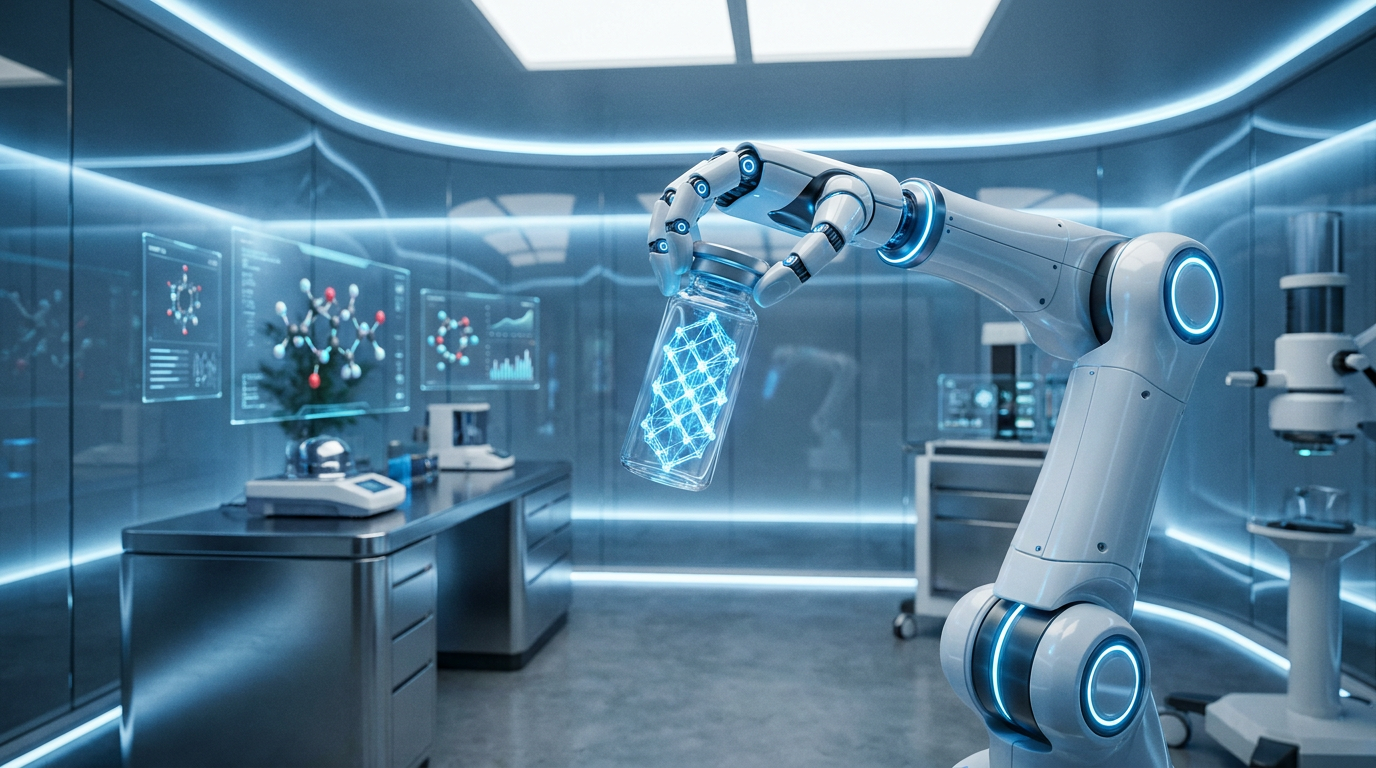
Artificial intelligence is discovering millions of new chemical compounds and guiding autonomous robotic labs to synthesize them, drastically accelerating the development of next-generation batteries and clean energy technologies.
By Factlen Editorial Team
- Computational Optimists
- Believe that AI and quantum computing will completely automate the discovery of every necessary material for the clean energy transition.
- Experimental Realists
- Emphasize that digital predictions are meaningless until physically synthesized, pointing out AI's tendency to hallucinate impossible chemical structures.
- Sustainability Advocates
- Focus on AI's ability to replace geopolitically fraught and environmentally destructive elements like lithium and rare-earth metals with abundant alternatives.
What's not represented
- · Mining industry representatives facing disrupted demand for lithium and rare-earth metals.
- · Developing nations whose economies rely heavily on traditional mineral extraction.
Why this matters
The transition to clean energy is currently bottlenecked by the scarcity of materials like lithium and rare-earth metals. By using AI to discover and synthesize alternative materials in months rather than decades, scientists are unlocking cheaper, safer, and more abundant technologies for electric vehicles and the power grid.
Key points
- Artificial intelligence has shifted materials science from physical trial-and-error to rapid computational prediction.
- Google DeepMind's GNoME model predicted 2.2 million new crystal structures, identifying 380,000 as stable candidates.
- Microsoft and PNNL used AI to discover and synthesize a new solid-state battery material using 70% less lithium in just nine months.
- Researchers are using AI to identify new high-temperature magnetic materials, reducing reliance on rare-earth elements.
- Agentic AI systems are now capable of autonomously guiding robotic laboratories to synthesize new superconductors.
- Critics caution that many AI-predicted structures may be computational hallucinations that cannot be physically manufactured.
For centuries, materials science has been bound by the slow, painstaking process of physical trial and error. From Thomas Edison testing thousands of filaments for the incandescent lightbulb to modern chemists spending years tweaking battery cathodes, discovering a new functional material has historically required decades of incremental laboratory work.
That era is definitively ending. Over the past 36 months, artificial intelligence has fundamentally rewritten the timeline of physical chemistry, transforming materials discovery from a laboratory guessing game into a computational certainty. The integration of large language models with atomic foundation models has shifted the paradigm from accidental discovery to intentional design.[6]
The stakes for this acceleration are existential. The global transition to clean energy—encompassing electric vehicles, grid-scale storage, and high-efficiency solar panels—is currently bottlenecked by the scarcity and geopolitical concentration of specific elements like lithium, cobalt, and rare-earth metals. Finding viable alternatives is no longer just an academic pursuit; it is a critical industrial mandate.[2][4]
The primary claim driving this revolution is that AI can predict stable chemical structures at a scale that dwarfs human history. The watershed moment arrived when Google DeepMind unveiled Graph Networks for Materials Exploration (GNoME). By training deep learning models on decades of data from the Materials Project, GNoME successfully predicted the structures of 2.2 million new crystals.[1][3]

To put that number in perspective, it represents roughly 800 years' worth of human knowledge generated in a matter of months. Of those predictions, DeepMind identified 380,000 as highly stable—meaning they sit on the thermodynamic convex hull, are unlikely to spontaneously decompose, and serve as prime candidates for experimental synthesis.[1]
A second major piece of evidence is AI's proven ability to drastically compress the timeline from digital simulation to physical prototype. Prediction is only half the battle; a material must actually be synthesized to be useful. In a landmark collaboration, Microsoft’s Azure Quantum Elements partnered with the Pacific Northwest National Laboratory (PNNL) to find a better, more abundant battery material.[2]
The joint team tasked their AI with screening 32.6 million potential inorganic materials for energy storage viability. The algorithm narrowed the massive field down to 18 highly promising candidates in just 80 hours—a computational feat that researchers estimate would have taken two decades using traditional laboratory screening methods.[2]
The joint team tasked their AI with screening 32.6 million potential inorganic materials for energy storage viability.
Crucially, PNNL scientists took the AI's top recommendation—a novel solid-state electrolyte—and successfully synthesized it in the physical lab. The entire process, from the initial digital prompt to a working physical battery prototype, took less than nine months. The resulting material uses up to 70% less lithium than traditional lithium-ion batteries, offering a blueprint for cheaper, safer, and more sustainable energy storage.[2]

The evidence also shows AI actively decoupling clean energy technologies from rare-earth supply chains. Beyond batteries, the push for sustainable infrastructure requires advanced permanent magnets for electric vehicle motors and wind turbines. In February 2026, researchers at the University of New Hampshire deployed AI to build a comprehensive database of 67,573 magnetic compounds.[4]
The system successfully identified 25 previously unrecognized materials that retain their magnetic properties at high temperatures—a critical requirement for heavy industrial applications. By accelerating the discovery of these specific compounds, AI provides a direct pathway to manufacturing high-performance motors without relying on environmentally destructive rare-earth mining.[4]
The most recent breakthrough involves the emergence of fully "closed-loop" autonomous discovery. The frontier of AI materials science in 2026 has moved beyond human-in-the-loop synthesis. At Stanford University's AI+Science conference, researchers detailed how agentic AI systems are now acting as autonomous collaborators rather than mere computational tools.[5]
In recent demonstrations, AI agents have fused large language models with atomic foundation models to not only predict candidate materials but to directly guide robotic laboratories in synthesizing them. In April 2026, one such system successfully synthesized four new superconducting materials—including a complex zirconium-scandium-rhenium compound—without human iteration at each step.[5][6]

Despite the staggering top-line numbers, the evidence for AI's infallibility remains contested, and researchers are transparent about the uncertainty. Independent chemists have scrutinized massive AI-generated databases and found significant flaws in the models' chemical intuition, suggesting that the raw numbers may be artificially inflated.[7]
Critics point out that some AI-predicted structures exhibit improper chemical nomenclature, unlikely oxidation states, and structural symmetries that simply do not exist in the physical world. When models generate compounds based on extremely rare or radioactive elements, the "discoveries" offer no practical utility, leading skeptics to label them as computational hallucinations.[7]
Furthermore, thermodynamic stability in a simulation does not guarantee that a material can actually be manufactured. The physical synthesis of metastable phases—materials that only form under highly specific temperature and pressure conditions—remains a profound challenge that classical AI models struggle to solve without the eventual integration of quantum computing.[1][6]
Ultimately, the integration of AI into materials science is not a flawless oracle, but it is an undeniable paradigm shift. While the raw number of discovered materials may be inflated by computational artifacts, the verified physical successes—from low-lithium batteries to rare-earth-free magnets—prove that AI has permanently accelerated the physical sciences.[6]
How we got here
Nov 2023
Google DeepMind publishes the GNoME paper in Nature, announcing 2.2 million new crystal predictions.
Jan 2024
Microsoft and PNNL announce the synthesis of a new low-lithium battery material discovered via AI in just 9 months.
Feb 2026
University of New Hampshire researchers use AI to identify 25 new high-temperature magnetic materials to replace rare-earth elements.
April 2026
Researchers demonstrate agentic AI systems capable of autonomously guiding robotic labs to synthesize new superconductors.
Viewpoints in depth
The Computational Optimists
Believe that AI and quantum computing will completely automate the discovery of every necessary material for the clean energy transition.
This camp, largely driven by tech giants and computational physicists, views materials science as a data problem that has now been solved by scale. They argue that by feeding decades of experimental data into graph neural networks, AI can accurately predict the thermodynamic stability of millions of compounds that humans would never have thought to test. For these optimists, the bottleneck is no longer discovery, but simply building enough robotic laboratories to synthesize the blueprints the AI has already provided.
The Experimental Realists
Emphasize that digital predictions are meaningless until physically synthesized, pointing out AI's tendency to hallucinate impossible chemical structures.
Traditional chemists and laboratory researchers caution against taking AI's massive numbers at face value. They point out that deep learning models lack true chemical intuition and frequently suggest compounds with impossible oxidation states or structural symmetries that violate the laws of physics. This camp argues that while AI is a powerful screening tool, the true bottleneck remains the physical synthesis of metastable phases, which still requires immense human expertise and trial-and-error in the lab.
The Sustainability Advocates
Focus on AI's ability to replace geopolitically fraught and environmentally destructive elements like lithium and rare-earth metals with abundant alternatives.
For environmental scientists and energy policy experts, the value of AI in materials science is purely practical: it offers an escape route from the current clean energy supply chain. They highlight successes like PNNL's low-lithium battery and the University of New Hampshire's rare-earth-free magnets as proof that AI can help the world build solar panels, wind turbines, and electric vehicles using cheap, abundant, and ethically sourced elements.
What we don't know
- It remains unclear what percentage of the 380,000 'stable' materials predicted by AI can actually be synthesized in a physical laboratory.
- The long-term degradation and real-world durability of the new AI-discovered solid-state battery materials have not yet been proven at commercial scale.
- We do not yet know how the massive energy costs required to run these AI models will balance against the energy efficiency of the materials they discover.
Key terms
- Density Functional Theory (DFT)
- A quantum mechanical modeling method used in physics and chemistry to investigate the electronic structure of atoms and molecules.
- Convex Hull
- In materials science, a thermodynamic concept used to determine if a new material is stable; materials 'on the hull' will not spontaneously decompose into other phases.
- Solid-State Battery
- A battery technology that uses solid electrodes and a solid electrolyte, instead of the liquid or polymer gel electrolytes found in traditional lithium-ion batteries.
- Metastable Phase
- A state of a material that is stable under certain conditions but can transition to a more stable state if given enough energy.
Frequently asked
What is a solid-state electrolyte?
A solid material that conducts ions between a battery's anode and cathode, replacing the flammable liquid electrolytes used in traditional lithium-ion batteries.
How does AI discover new materials?
AI models are trained on databases of known chemical structures and use graph neural networks to predict how new combinations of atoms will bond and whether they will be stable.
Can AI actually make the materials it invents?
Not on its own, but AI is increasingly being paired with automated robotic laboratories to physically synthesize the materials it predicts with minimal human intervention.
Why do we need to replace lithium?
Lithium is relatively scarce, expensive to mine, geopolitically concentrated, and traditional lithium-ion batteries pose safety and fire risks.
Sources
Source coverage
7 outlets
3 viewpoints surfaced







[1]Google DeepMindComputational Optimists
Millions of new materials discovered with deep learning
Read on Google DeepMind →[2]Pacific Northwest National LaboratorySustainability Advocates
PNNL Kicks-Off Multi-Year Energy Storage, Scientific Discovery Collaboration with Microsoft
Read on Pacific Northwest National Laboratory →[3]NatureComputational Optimists
Scaling deep learning for materials discovery
Read on Nature →[4]ScienceDailySustainability Advocates
AI breakthrough could replace rare earth magnets in electric vehicles
Read on ScienceDaily →[5]Stanford University HAIComputational Optimists
AI+Science: Accelerating Discovery
Read on Stanford University HAI →[6]Factlen Editorial Team
Synthesis by Factlen editorial team
Read on Factlen Editorial Team →[7]Chemistry WorldExperimental Realists
Doubts raised over AI materials discovery claims
Read on Chemistry World →
More in ai
See all 5 stories →On-Device AI
How Local AI Replaced the Cloud: Running Frontier Models on Your Laptop
0 sources

Enterprise AI
The Rise of Small Language Models: How Enterprises Are Running AI Locally in 2026
0 sources
Drug Discovery
New AI Model Accelerates Molecular Simulations 10,000-Fold, Slashing Drug Discovery Timelines
0 sources
Every angle. Every day.
Get ai stories with full source coverage and perspective breakdowns delivered to your inbox.