
How AI is Reading the 2,000-Year-Old Carbonized Scrolls of Herculaneum
Using particle accelerators and machine learning, researchers are finally decoding the only intact library surviving from the classical world—without ever unrolling the fragile papyrus.
By Factlen Editorial Team
- Classical Scholars
- Eager to expand the surviving corpus of ancient literature and philosophy, viewing the scrolls as an unprecedented window into antiquity.
- Machine Learning Researchers
- Focused on the technical computer vision challenges and the success of open-source, crowdsourced problem solving.
- Heritage Conservators
- Relieved that non-invasive digital techniques have permanently replaced the destructive physical unrolling of fragile artifacts.
What's not represented
- · Italian Government & Antiquities Authorities
- · Traditional Archaeologists
Why this matters
The Villa of the Papyri contains the only intact library to survive from antiquity. Successfully decoding these scrolls could double the amount of classical literature, philosophy, and history available to modern scholars, fundamentally altering our understanding of the ancient world.
Key points
- The 79 AD eruption of Mount Vesuvius carbonized and preserved an entire library of ancient Roman scrolls.
- Physical attempts to open the scrolls destroyed them, leaving hundreds unreadable for centuries.
- Researchers used particle accelerators to create ultra-high-resolution 3D scans of the closed scrolls.
- The Vesuvius Challenge crowdsourced AI models to detect invisible 'crackle patterns' left by carbon ink.
- The successful decoding of the scrolls could double the amount of surviving classical literature.
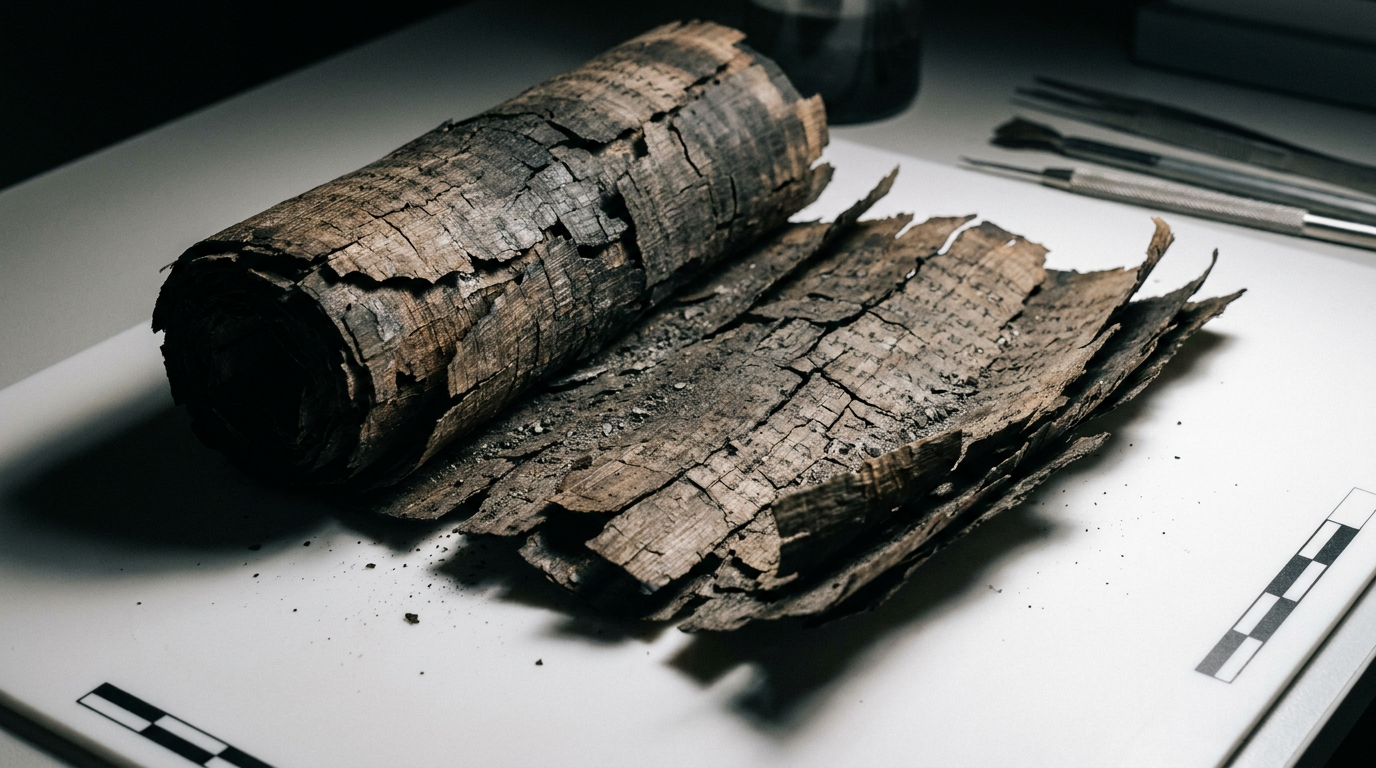
In 79 AD, the eruption of Mount Vesuvius unleashed a torrent of superheated gas and ash that obliterated the Roman cities of Pompeii and Herculaneum. Amid the destruction, a massive luxury estate—believed to belong to Julius Caesar's father-in-law—was buried under twenty meters of volcanic mud. Inside this estate, known today as the Villa of the Papyri, lay a vast library of ancient texts. The intense heat of the pyroclastic flow flash-fried the library, instantly carbonizing the papyrus scrolls. For nearly two millennia, the texts sat in the dark, perfectly preserved but transformed into brittle lumps of charcoal.[1][4][5]
When excavators finally unearthed the villa in the 1750s, they discovered roughly 1,800 of these blackened cylinders. It was the only intact library to survive from the classical world. However, the discovery quickly turned into a tragedy of preservation. The carbonized papyrus was so fragile that early attempts to physically unroll the scrolls caused them to shatter into dust. While a few were painstakingly peeled apart over decades, destroying much of the text in the process, more than 600 scrolls were deemed completely unopenable and locked away as indecipherable curiosities.[1][4][5]
For centuries, the Herculaneum papyri represented one of archaeology's most tantalizing locked doors. Scholars knew the scrolls contained lost works of Greek and Roman philosophy, but accessing them seemed physically impossible. The paradigm only began to shift in the early 21st century, driven by advancements in medical and industrial imaging. Dr. Brent Seales, a computer scientist at the University of Kentucky, pioneered a technique called "virtual unwrapping," which uses X-ray microtomography (micro-CT) to create 3D volumetric scans of closed documents.[2][4][5][7]
In 2015, Seales and his team achieved a landmark victory by virtually unwrapping the En-Gedi scroll, a charred Hebrew parchment from Israel, revealing text from the Book of Leviticus without ever opening the physical artifact. But when the team applied the same X-ray techniques to the Herculaneum scrolls, they hit a wall. The En-Gedi ink contained metal, which glowed brightly on an X-ray. The Roman writers at Herculaneum, however, used a carbon-based ink made of soot and water. On an X-ray, the carbon ink was completely indistinguishable from the carbonized papyrus it was written on.[1][2][5]

To solve the ink problem, researchers realized they needed unprecedented imaging resolution. They took the fragile scrolls to particle accelerators, such as the Diamond Light Source in the United Kingdom, which can generate X-ray beams billions of times brighter than the sun. At these microscopic resolutions, a new detail emerged: the carbon ink didn't change the chemical density on the scan, but it did slightly alter the physical geometry of the papyrus. The ink coated the ancient fibers, creating a faint 3D texture—a "crackle pattern"—that was invisible to the human eye but theoretically detectable by software.[1][3][5][6]
Recognizing that the bottleneck had shifted from archaeology to computer science, Seales teamed up with Silicon Valley entrepreneurs Nat Friedman and Daniel Gross. In March 2023, they launched the Vesuvius Challenge, releasing terabytes of high-resolution 3D scroll scans and open-sourcing the initial machine-learning algorithms. They offered a $1 million prize pool to anyone in the world who could improve the AI models and extract readable text. The crowdsourced approach transformed a niche academic pursuit into a global technology race.[1][2][4][5][7]

Recognizing that the bottleneck had shifted from archaeology to computer science, Seales teamed up with Silicon Valley entrepreneurs Nat Friedman and Daniel Gross.
The breakthrough came astonishingly fast. In late 2023, Luke Farritor, a 21-year-old college student and SpaceX intern, trained a machine-learning model specifically on the faint crackle patterns discussed in the project's online forums. His software successfully detected ink traces deep inside a closed scroll, revealing the Greek word "porphyras," meaning purple. It was the first time in 2,000 years that a word had been read from an unopened Herculaneum scroll.[1][4]
The momentum accelerated into 2024. Farritor teamed up with Youssef Nader, an Egyptian graduate student in Germany, and Julian Schilliger, a Swiss robotics engineer. Together, they won the $700,000 Grand Prize by developing a sophisticated pipeline that virtually unrolled the 3D scans and used AI to identify over 2,000 Greek characters across 15 columns of text. The decoded passages were revealed to be a previously unknown work by Philodemus, an Epicurean philosopher, discussing the nature of pleasure, music, and food.[1][3][4]
The success of the Vesuvius Challenge proved that the entire Herculaneum library was theoretically readable. In 2025, the project expanded its scope, scanning additional scrolls housed at the Bodleian Libraries in Oxford. Using the refined AI pipeline, researchers quickly generated images of the inside of scroll PHerc. 172, identifying words like "diatrope," meaning disgust. Interestingly, the Bodleian scroll exhibited a slightly different ink chemistry, suggesting that different scribes or time periods might require specialized AI models.[3][5][6]

The current frontier of the project is automation. While the 2024 Grand Prize proved the concept, the process of digitally segmenting the tangled, crushed layers of papyrus remains highly manual and labor-intensive. Computer scientists are now competing to develop algorithms that can automatically trace the continuous surface of a scroll through the chaotic 3D data, a process known as "auto-segmentation." Solving this will allow researchers to move from reading isolated patches of text to deciphering entire scrolls in a matter of days.[1][7]
The implications for classical history are staggering. Currently, the surviving corpus of ancient Greek and Roman literature represents only a tiny fraction of what was written; the rest was lost to decay, war, and religious suppression. The Villa of the Papyri is the only place on Earth where a comprehensive ancient library remains intact. If the automated AI pipeline can decode the remaining 600 scrolls, it could fundamentally alter our understanding of the ancient world.[1][4][7]
Furthermore, archaeologists believe that the 1,800 scrolls recovered in the 18th century represent only a portion of the villa's collection. The main library of the estate may still lie buried under the unexcavated sections of Herculaneum. With the knowledge that any recovered scroll can now be read safely, there is renewed momentum to resume excavations at the site, potentially uncovering thousands of additional texts.[5][7]

The Vesuvius Challenge stands as a landmark example of interdisciplinary collaboration. It required the expertise of classicists to translate the Greek, physicists to operate the particle accelerators, and a global community of computer scientists to build the machine-learning models. By treating a 2,000-year-old archaeological mystery as an open-source software problem, the project bypassed decades of traditional academic siloing.[2][6][7]
As the AI models continue to improve, scholars are eagerly awaiting the next batch of translations. While the texts decoded so far have been Epicurean philosophy, the library could hold lost plays by Sophocles, missing histories of the Roman Republic, or early scientific treatises. The ashes of Mount Vesuvius, which brought death and destruction to the Bay of Naples, inadvertently created a perfect time capsule. Now, artificial intelligence is finally providing the key to open it.[1][4][7]
How we got here
79 AD
Mount Vesuvius erupts, burying the Villa of the Papyri and carbonizing its library.
1752
Workers excavating the ancient town of Herculaneum discover the blackened scrolls.
2015
Dr. Brent Seales successfully uses virtual unwrapping to read the En-Gedi scroll.
March 2023
The Vesuvius Challenge is launched to crowdsource the AI decoding of the scrolls.
October 2023
The first word, 'porphyras' (purple), is successfully decoded from a closed scroll.
February 2024
The Grand Prize is awarded for decoding over 2,000 characters of Epicurean philosophy.
February 2025
Researchers successfully image and translate text from a Bodleian Library scroll.
Viewpoints in depth
Classical Scholars
The prospect of doubling the known corpus of ancient Greek and Roman texts.
For historians and classicists, the Herculaneum scrolls represent the holy grail of archaeology. Because the vast majority of ancient literature was lost to decay or deliberate destruction over the centuries, our modern understanding of antiquity is based on a highly filtered, fragmented record. The Villa of the Papyri offers an unfiltered time capsule. Scholars are thrilled by the recovery of lost Epicurean philosophy, but they are even more excited by the possibility that the unread scrolls might contain lost plays, early Roman histories, or foundational scientific texts that could rewrite the history books.
Computer Scientists & Open-Source Advocates
The success of the prize-based, crowdsourced model in accelerating scientific discovery.
The technology community views the Vesuvius Challenge as a triumph of open-source collaboration. For years, the effort to read the scrolls was bottlenecked within a few specialized academic labs. By releasing the raw 3D scans and offering a financial bounty, the organizers incentivized thousands of independent developers, students, and engineers to tackle the problem simultaneously. This distributed approach led to a breakthrough in months that might otherwise have taken decades, proving that complex heritage science problems can be solved rapidly when treated as open software challenges.
Papyrologists & Conservators
The relief of ending the era of physical destruction for fragile artifacts.
For centuries, the field of papyrology was haunted by a destructive paradox: to read a scroll was to destroy it. Early attempts to peel the Herculaneum papyri apart resulted in the permanent loss of priceless texts as the carbonized flakes crumbled to dust. Conservators celebrate virtual unwrapping because it completely decouples the extraction of information from the physical manipulation of the artifact. The scrolls can now remain safely preserved in climate-controlled vaults while their digital twins are endlessly analyzed and decoded.
What we don't know
- What specific texts are contained in the remaining 600 unopened scrolls.
- Whether the unexcavated portions of the Villa of the Papyri hold thousands of additional, undiscovered scrolls.
- The exact chemical recipe of the ink used in the Bodleian scrolls, which differs slightly from the others.
Key terms
- Virtual Unwrapping
- A non-invasive digital technique that uses 3D X-ray scans and software to computationally flatten and read closed documents.
- Micro-CT
- Microtomography, a high-resolution X-ray imaging technique used to create detailed 3D models of the internal structure of the scrolls.
- Papyrus
- A thick, paper-like material used in antiquity for writing, made from the pith of the papyrus plant.
- Epicureanism
- An ancient Greek system of philosophy founded by Epicurus, emphasizing that the goal of a happy life is the pursuit of modest, sustainable pleasure and the absence of pain.
- Synchrotron
- A type of particle accelerator that produces extremely bright X-ray beams, used to scan the scrolls at microscopic resolutions.
Frequently asked
Why couldn't researchers just unroll the scrolls?
The intense heat of the volcanic eruption turned the papyrus into brittle carbon. Physical attempts to unroll them caused the scrolls to shatter and crumble into dust.
How does the AI see the ink if it's invisible to X-rays?
The machine learning models are trained to detect microscopic 3D textures—a faint "crackle pattern"—where the carbon-based ink slightly thickened the papyrus fibers.
What kind of texts are in the scrolls?
Most decoded so far are Greek philosophical texts, particularly from the Epicurean school, discussing topics like pleasure, music, and food.
How many scrolls are left to read?
There are over 600 intact, unopened scrolls recovered from Herculaneum, though archaeologists believe thousands more may still be buried in the unexcavated portions of the villa.
Sources
Source coverage
7 outlets
3 viewpoints surfaced







[1]Vesuvius ChallengeMachine Learning Researchers
Resurrect an ancient library from the ashes of a volcano
Read on Vesuvius Challenge →[2]University of KentuckyHeritage Conservators
Herculaneum scrolls: A 20-year journey to read the unreadable
Read on University of Kentucky →[3]The GuardianClassical Scholars
Writing on PHerc. 172 papyrus revealed after 3D X-rays and software competition
Read on The Guardian →[4]Smithsonian MagazineClassical Scholars
Using A.I., Researchers Peer Inside a 2,000-Year-Old Scroll Charred by Mount Vesuvius
Read on Smithsonian Magazine →[5]National GeographicHeritage Conservators
AI just deciphered part of an 'unreadable' ancient scroll
Read on National Geographic →[6]University of OxfordClassical Scholars
Inside of Herculaneum scroll seen for the first time in almost 2,000 years
Read on University of Oxford →[7]Factlen Editorial TeamMachine Learning Researchers
Synthesis by Factlen editorial team
Read on Factlen Editorial Team →
Every angle. Every day.
Get culture stories with full source coverage and perspective breakdowns delivered to your inbox.