
How AI is Quietly Solving the Restaurant Industry's $230 Billion Food Waste Problem
New artificial intelligence systems are helping restaurants predict exact daily demand and track plate waste, reducing discarded food by up to 50% while boosting profit margins.
By Factlen Editorial Team
- Restaurant Operators
- Focused on protecting thin profit margins and improving labor efficiency.
- Climate Advocates
- Focused on the massive environmental impact of organic waste in landfills.
- Food Tech Innovators
- Focused on modernizing the food supply chain through data and automation.
What's not represented
- · Front-of-house staff adapting to new tech
- · Small independent farmers supplying the restaurants
Why this matters
Food waste is a massive driver of greenhouse gas emissions and a major financial drain on the hospitality sector. By using technology to stop overproduction before it happens, the industry is simultaneously protecting the climate and keeping local restaurants financially viable.
Key points
- Nearly 30% of all food produced in the U.S. goes uneaten, costing the industry $230 billion annually.
- AI predictive tools analyze weather, events, and past sales to tell kitchens exactly how much food to prep.
- Computer vision cameras scan discarded plates to help chefs adjust portion sizes and recipes.
- Early adopters have reduced bread and prep waste by over 50%.
- Automating inventory frees up kitchen staff to focus on food quality rather than counting stock.
For decades, the rhythm of a commercial kitchen has relied on a chef's intuition. Predicting how many covers a restaurant will serve on a rainy Tuesday, or exactly how much prime rib a banquet will consume, has always been an educated guessing game. But when intuition misses the mark, the result ends up in the dumpster. In an industry where profit margins are notoriously razor-thin, the financial and environmental toll of this daily overproduction has reached a breaking point.[6]
The sheer scale of the problem is staggering. According to 2026 data from ReFED, a nonprofit dedicated to tracking food surplus, approximately 60 million tons of food—or 29% of all food produced in the United States—goes uneaten each year. Across all sectors of the food industry, this surplus represents a $230 billion inefficiency. For a typical high-volume hotel or convention center, experience-based guessing can result in hundreds of thousands of dollars in purchased ingredients being thrown away annually.[1][5][6]
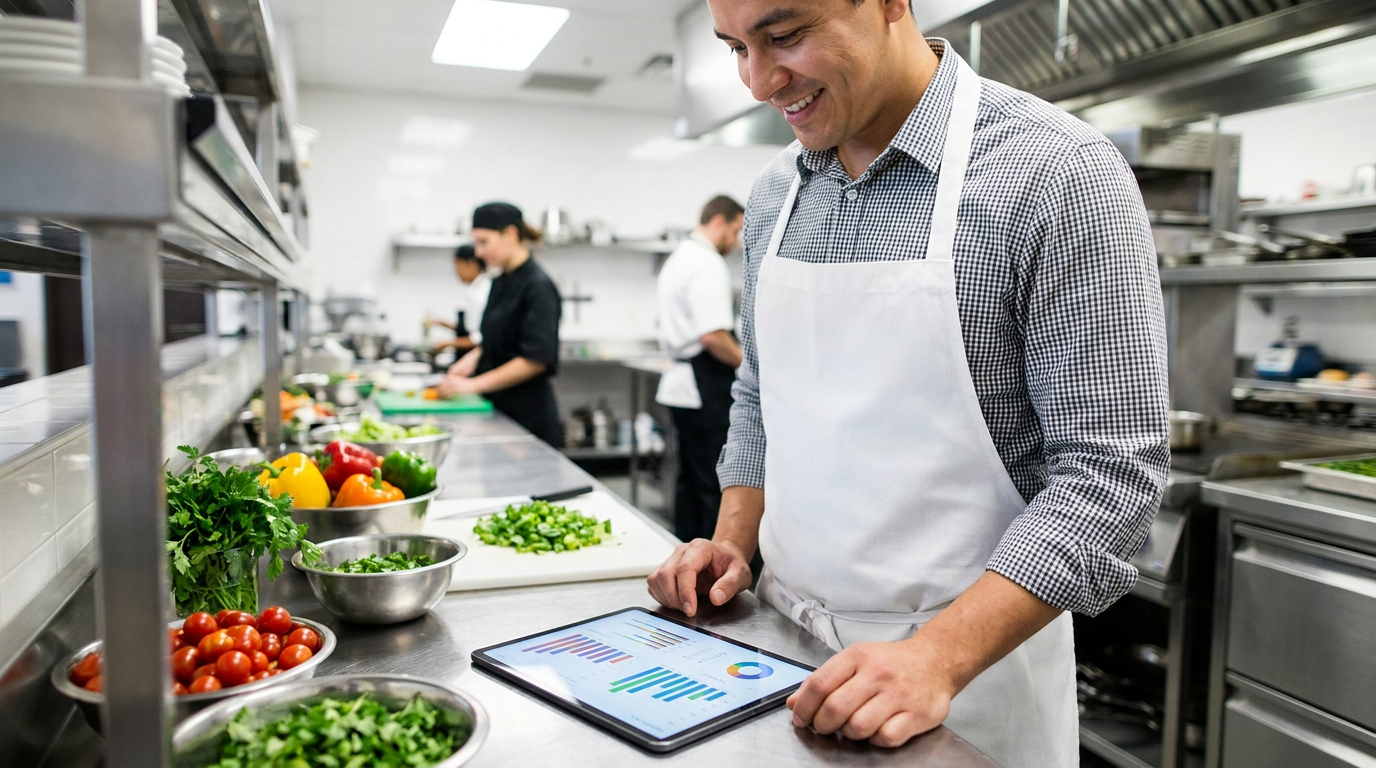
Now, a wave of artificial intelligence tools is quietly transforming how kitchens operate, shifting the industry from reactive guesswork to data-driven precision. Rather than relying on a manager's memory of last year's sales, modern predictive analytics platforms ingest a complex web of variables. These algorithms analyze historical point-of-sale data, local weather forecasts, upcoming neighborhood events, and day-of-the-week trends to generate highly accurate prep sheets.[2][5]

The impact on daily operations is immediate. By telling prep cooks exactly how many pounds of vegetables to chop or how many portions of protein to thaw, AI eliminates the "just in case" buffer that traditionally leads to massive spoilage. In one recent case study, a multi-unit quick-service franchisee deployed predictive software from tech provider ClearCOGS to manage its baking schedule. By generating precise, hour-by-hour prep sheets, the operator reduced its daily bread waste by 53%.[2][5][6]
Beyond predictive ordering, artificial intelligence is also tackling the post-consumer side of the equation: the food that guests leave on their plates. At the 2026 ChangeNOW summit, a global gathering for planetary solutions, computer vision emerged as a breakthrough technology for commercial kitchens. Startups like the French tech firm KIKLEO are installing smart cameras directly above restaurant disposal areas to monitor exactly what gets scraped into the trash.[3]
Beyond predictive ordering, artificial intelligence is also tackling the post-consumer side of the equation: the food that guests leave on their plates.
As plates pass beneath the lens, the computer vision system scans and identifies the discarded ingredients in real time. The software then aggregates this data into a dashboard, showing chefs precisely which menu items are consistently unfinished. If a restaurant discovers that 40% of its side salads are returning untouched, the kitchen can adjust portion sizes, tweak the recipe, or change the default side dish entirely. Early adopters of these visual scanning systems have reported reducing their overall food waste by up to 30%.[3][6]

This technological shift is also reshaping menu design. According to 2026 predictive analytics from Tastewise, the concept of a "zero-waste" kitchen is evolving from a niche sustainability trend into a core operational strategy. Chefs are increasingly using data to design "root-to-stem" menus, where the byproducts of one dish become the foundational ingredients of another. Vegetable trim is upcycled into high-value broths, and fruit peels are fermented into signature cocktail syrups, ensuring that every purchased ounce generates revenue.[4][6]
The benefits extend well beyond the balance sheet. Food waste is a massive contributor to global greenhouse gas emissions; when organic matter decomposes in landfills, it releases methane, a potent climate pollutant. By preventing overproduction at the source, AI-driven inventory systems offer one of the most immediate and scalable ways for the hospitality sector to shrink its environmental footprint.[1][5]
Furthermore, automating the math of inventory and prep frees up valuable labor. In an era of persistent staffing challenges, kitchen managers no longer need to spend hours in the walk-in freezer with a clipboard, calculating pars and yields. Instead, that time can be redirected toward training staff, refining recipes, and elevating the actual dining experience.[5][6]

As these AI tools become more affordable and integrate seamlessly into standard restaurant software, they are rapidly moving from luxury upgrades to essential infrastructure. For an industry built on hospitality and nourishment, the ability to serve guests perfectly—without leaving a mountain of waste behind—represents a profound, quiet revolution in how the world eats.[6]
Despite the clear advantages, the transition to AI-managed kitchens is not without friction. The algorithms are only as good as the data they ingest, meaning restaurants must maintain rigorous digital hygiene. If staff fail to log waste accurately or bypass the point-of-sale system during a rush, the predictive models can skew, leading to the very stockouts or over-ordering the technology was designed to prevent. Training culinary teams to trust a tablet's recommendation over their own seasoned instincts requires a significant cultural shift within the kitchen hierarchy.[5][6]
Yet, the momentum is undeniable. As consumer awareness around planetary health grows, diners are increasingly favoring establishments that demonstrate genuine environmental stewardship. The restaurants of the future will likely treat food waste not as an inevitable cost of doing business, but as a solvable data problem. By merging culinary artistry with machine learning, the hospitality industry is proving that sustainability and profitability can finally share the same plate.[4][6]
How we got here
2020–2022
Supply chain disruptions force the restaurant industry to reevaluate inventory efficiency and waste.
2024
ReFED reports that 29% of all U.S. food produced goes uneaten, highlighting a massive economic inefficiency.
2025
Predictive AI tools begin integrating directly into mainstream restaurant point-of-sale systems.
Spring 2026
Computer vision plate-scanning technology takes center stage at global sustainability events like the ChangeNOW summit.
Viewpoints in depth
Restaurant Operators
Focused on protecting thin profit margins and improving labor efficiency.
For restaurant owners, food waste is fundamentally a financial issue. In an industry where profit margins often hover in the single digits, throwing away purchased ingredients directly erodes the bottom line. Operators view AI as a crucial operational tool that removes the guesswork from daily prep, prevents costly over-ordering, and frees up kitchen staff from tedious inventory counting.
Climate Advocates
Focused on the massive environmental impact of organic waste in landfills.
Environmental groups emphasize that food waste is a major driver of climate change. When discarded food decomposes in landfills, it releases methane—a greenhouse gas significantly more potent than carbon dioxide. From this perspective, deploying AI in commercial kitchens is a vital, scalable climate intervention that stops emissions at the source by preventing the surplus from being grown, transported, and discarded in the first place.
Food Tech Innovators
Focused on modernizing the food supply chain through data and automation.
Technologists see the hospitality sector as historically lagging in digital transformation. They argue that the integration of machine learning, computer vision, and predictive analytics is the necessary infrastructure for a modern, circular economy. By turning physical food waste into measurable data points, innovators believe the entire supply chain can become hyper-efficient and responsive to real-time consumer habits.
What we don't know
- Whether smaller, independent restaurants will be able to afford these AI systems as quickly as major chains.
- How diners will react to the knowledge that their discarded food is being scanned and analyzed by cameras.
Key terms
- Predictive Analytics
- The use of historical data and machine learning algorithms to forecast future outcomes, such as daily customer demand.
- Computer Vision
- A field of artificial intelligence that enables computers to identify and process objects in digital images, used to track discarded ingredients.
- Root-to-Stem Cooking
- A sustainable culinary philosophy that utilizes every edible part of an ingredient to minimize kitchen waste.
- Point of Sale (POS) System
- The digital software and hardware restaurants use to process orders, track sales, and manage daily transactions.
Frequently asked
How does AI predict restaurant food demand?
AI algorithms analyze historical sales data, local weather forecasts, upcoming events, and day-of-the-week trends to calculate exactly how many portions a kitchen should prepare.
What is computer vision in a kitchen?
It involves smart cameras mounted over disposal areas that scan plates to identify exactly which ingredients customers are leaving behind, helping chefs adjust portion sizes.
Does this technology replace kitchen staff?
No, it actually frees up staff. By automating inventory math and prep sheets, culinary teams can spend more time cooking and less time counting stock in the freezer.
Sources
Source coverage
6 outlets
3 viewpoints surfaced






[1]ReFEDClimate Advocates
Food Waste in the U.S. Retail and Foodservice Sectors
Read on ReFED →[2]ClearCOGSRestaurant Operators
AI Predictive Prep Sheets in QSR Operations
Read on ClearCOGS →[3]ChangeNOW SummitFood Tech Innovators
KIKLEO AI Food Waste Tracking at ChangeNOW 2026
Read on ChangeNOW Summit →[4]TastewiseFood Tech Innovators
Zero-Waste Food Trends and Predictive Analytics 2026
Read on Tastewise →[5]Convenience Store NewsRestaurant Operators
How AI Helps Cut Food Waste
Read on Convenience Store News →[6]Factlen Editorial Team
Synthesis by Factlen editorial team
Read on Factlen Editorial Team →

Every angle. Every day.
Get food drink stories with full source coverage and perspective breakdowns delivered to your inbox.