
How AI is Democratizing Feature-Length Animation for Solo Creators
New AI video and in-betweening tools are allowing independent animators to produce studio-quality films and cinematics in a fraction of the time, reshaping the economics of the animation industry.
By Factlen Editorial Team
- Solo Creators & Indie Studios
- View AI as an empowering force that removes financial barriers and allows small teams to compete with massive studios.
- Traditional Animation Studios
- Focus on integrating AI into existing pipelines for pre-visualization and efficiency while maintaining human artistry.
- Animation Educators
- Emphasize a shift in curriculum from mechanical drawing skills to storytelling, acting, and AI-assisted workflows.
What's not represented
- · Voice actors affected by AI dubbing
- · Junior animators whose entry-level tweening jobs are being automated
Why this matters
By collapsing the cost and time required to produce high-quality animation, AI is breaking the studio monopoly on animated storytelling. This allows independent artists, educators, and small businesses to create visually stunning content that previously required millions of dollars.
Key points
- AI tools have drastically reduced the cost and time required to produce high-quality animation.
- Automated 'in-betweening' allows AI to generate smooth transitional frames from just two key poses.
- Markerless motion capture lets creators use smartphones instead of expensive sensor suits.
- Animation schools are shifting focus from mechanical drawing skills to storytelling and acting.
For a century, animation has been governed by a brutal mathematical reality: 24 frames per second. Producing a feature-length animated film or a high-end video game cinematic required armies of specialized artists, massive render farms, and budgets stretching into the tens of millions. The sheer mechanical labor of drawing, rigging, and rendering kept the medium locked behind massive studio gates.[6]
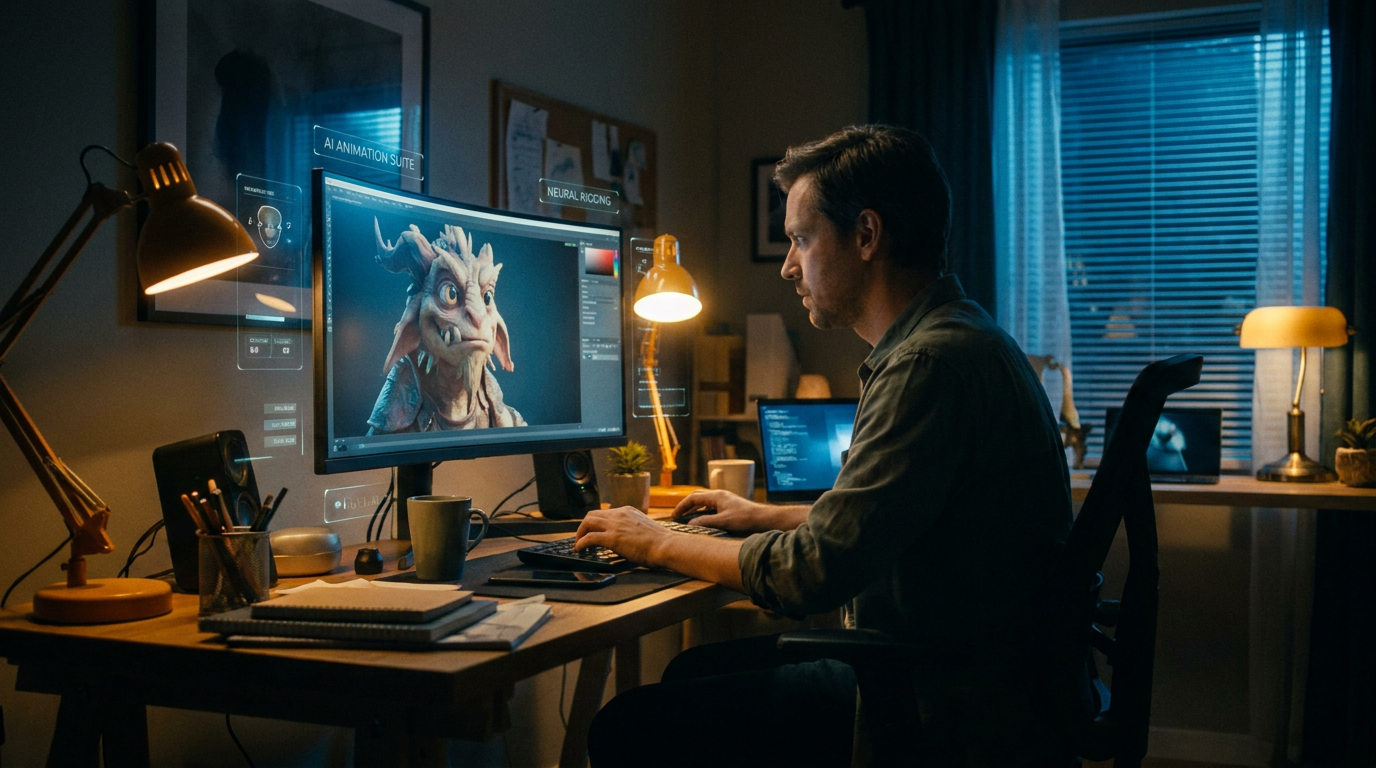
In 2026, those gates have been blown off their hinges. A new generation of artificial intelligence tools has fundamentally altered the economics and logistics of animation, empowering solo creators to produce studio-quality work from their bedrooms. What was once a highly fragmented, labor-intensive pipeline has been compressed into intuitive, AI-assisted workflows.[2][6]
The financial shift is staggering. Just a few years ago, a standard 30-second animated commercial cost between $15,000 and $75,000, requiring a team of eight to fifteen specialists working for up to eight weeks. Today, independent creators are using AI animation platforms to produce comparable results in a matter of hours, often for less than $300 in software subscription costs.[4][6]

This democratization is not being driven by a single magic button that generates a movie from a text prompt. Instead, it is the result of specialized AI models taking over the most tedious, mechanical aspects of the animation pipeline, allowing human artists to focus entirely on creative direction and storytelling.[6]
The most significant breakthrough has been the automation of in-betweening. Traditionally, a lead animator draws the critical keyframes—the start and end points of an action—while junior artists, known as in-betweeners, painstakingly draw the dozens of transitional frames required to create the illusion of smooth motion.[5]
Modern AI tools have effectively eliminated this bottleneck. Animators can now submit two key poses, and physics-aware AI models instantly generate the transitional frames. This AI-assisted interpolation has reduced production timelines by 40 to 70 percent, allowing a single artist to output the volume of a small studio.[5]

Motion capture has undergone a similar revolution. Previously, capturing realistic human movement required renting a specialized studio and outfitting actors in $50,000 sensor suits. In 2026, markerless tracking has become the industry standard for independent developers.[3]
Previously, capturing realistic human movement required renting a specialized studio and outfitting actors in $50,000 sensor suits.
Using nothing more than a standard smartphone camera, creators can record themselves performing an action—a dance, a combat maneuver, or a subtle facial expression. AI algorithms clean the video data in milliseconds and apply the precise physics and weight distribution directly to a 3D character rig. Indie game studios report that this technology has slashed their animation costs by up to 80 percent.[3]
Meanwhile, generative video models have solved their biggest historical flaw: temporal consistency. Early AI video generators were notorious for morphing, where characters would randomly change clothing, facial features, or physical proportions as the camera moved.[6]
The 2026 iterations of models like Runway Gen-4, OpenAI's Sora 2, and Kling 2.5 act more like physics engines than simple image generators. They understand how objects exist in three-dimensional space, allowing creators to maintain strict character consistency across hundreds of different shots and complex camera angles.[2]

Software giants have rapidly integrated these capabilities into standard editing environments. Tools like Adobe Firefly now allow solo editors to generate cinematic AI animation, blend it with real-world footage, and adjust lighting—all within a single timeline, without needing to export to specialized visual effects software.[6]
Despite these massive leaps in automation, industry veterans emphasize that AI is not replacing the core artistry of animation. The technology excels at the mechanics of motion, but it cannot replicate the soul of a performance.[5]
Animation relies heavily on intent and interpretation, notes the curriculum at leading animation schools, which have rapidly adapted to the new landscape. AI can calculate the physics of a jump, but a human animator must decide if that jump should feel triumphant, exhausted, or comedic.[5]
As a result, animation education in 2026 has shifted its focus. Students spend less time mastering the repetitive mechanics of tweening and more time studying acting, comedic timing, cinematography, and emotional nuance—the uniquely human elements that AI cannot synthesize.[5]

The ultimate impact of this technological shift is a massive expansion of who gets to tell animated stories. By lowering the technical and financial barriers to entry, AI has decoupled animation from massive studio budgets.[2][6]
The industry is now bracing for an influx of independent intellectual property. Just as affordable digital cameras democratized live-action indie filmmaking in the 2000s, the AI tools of 2026 are unleashing a new wave of solo animators, ready to bring their own feature-length visions to life.[6]
How we got here
2023
Early AI video generators produce blurry, morphing clips limited to 3-5 seconds.
Late 2024
OpenAI announces Sora, demonstrating the potential for physically coherent video generation.
2025
Markerless motion capture and AI in-betweening tools begin integrating into professional 3D software.
Mid-2026
Solo creators begin releasing feature-length animated films produced entirely on consumer hardware.
Viewpoints in depth
Solo Creators & Indie Studios
View AI as an empowering force that removes financial barriers and allows small teams to compete with massive studios.
For independent creators, AI is the ultimate equalizer. Historically, the sheer cost of rendering and manual keyframing meant that independent animated films were either incredibly short or took decades to produce. By adopting tools like Runway and DeepMotion, solo artists can now execute complex camera movements, realistic lighting, and fluid character motion that previously required a multimillion-dollar budget. This camp argues that AI doesn't replace art; it simply removes the financial gatekeepers from the medium.
Traditional Animation Studios
Focus on integrating AI into existing pipelines for pre-visualization and efficiency while maintaining human artistry.
Major studios are adopting AI, but primarily as an efficiency multiplier rather than a replacement for their core workforce. They use generative video for rapid storyboarding and pre-visualization, allowing directors to test camera angles before committing to a final render. While they acknowledge the massive cost savings of AI in-betweening, studio veterans maintain that the highest tier of animation will always require human animators to refine the final output, ensuring the emotional resonance and stylized acting that audiences expect from blockbuster films.
Animation Educators
Emphasize a shift in curriculum from mechanical drawing skills to storytelling, acting, and AI-assisted workflows.
Educators recognize that the entry-level 'in-betweener' job—traditionally the stepping stone for young animators—is rapidly disappearing. In response, animation schools are overhauling their programs. Rather than spending semesters teaching students how to manually draw 24 frames of a bouncing ball, curriculums now focus on the 'why' of animation: cinematic language, comedic timing, and character psychology. Educators argue that the animator of the future is essentially a director, using AI as a highly capable assistant to execute their creative vision.
What we don't know
- How copyright law will ultimately treat AI-generated character designs that closely mimic existing studio styles.
- Whether audiences will embrace fully AI-generated feature films in theaters, or relegate them to streaming and social media.
- How the disappearance of entry-level 'in-betweener' jobs will affect the long-term talent pipeline for master animators.
Key terms
- In-betweening (Tweening)
- The process of generating intermediate frames between two key images to create the illusion of smooth motion.
- Temporal Consistency
- An AI model's ability to keep characters, lighting, and environments stable across multiple frames without random morphing.
- Markerless Motion Capture
- Capturing human movement using standard cameras or smartphones, without requiring the subject to wear a specialized sensor suit.
- Keyframe
- A drawing or pose that defines the starting or ending point of any smooth transition in animation.
Frequently asked
Will AI completely replace human animators?
No. While AI automates the mechanical labor of drawing in-between frames, human animators are still required for acting choices, comedic timing, and emotional nuance.
What tools are solo creators using in 2026?
Creators rely on a mix of generative video models like Runway Gen-4 and Kling 2.5, alongside specialized rigging tools like Cascadeur and DeepMotion.
How has motion capture changed?
Expensive mocap suits are no longer required; new AI tools can extract precise full-body motion data from standard smartphone video.
Can AI animation maintain character consistency?
Yes. Breakthroughs in 2026 models have largely solved 'temporal consistency,' allowing characters to look identical across different scenes and camera angles.
Sources
Source coverage
6 outlets
3 viewpoints surfaced






[1]Grand View ResearchTraditional Animation Studios
AI Video Generation Market Size & Trends
Read on Grand View Research →[2]Animation World NetworkTraditional Animation Studios
How AI is Reshaping the Animation Pipeline in 2026
Read on Animation World Network →[3]DeepMotionSolo Creators & Indie Studios
Indie Game Developers Cut Animation Costs by 80% with Markerless Tracking
Read on DeepMotion →[4]WyzowlSolo Creators & Indie Studios
The State of Video Marketing 2026
Read on Wyzowl →[5]Educational VoiceAnimation Educators
Transforming Traditional Animation Methods with AI
Read on Educational Voice →[6]Factlen Editorial TeamAnimation Educators
Synthesis by Factlen editorial team
Read on Factlen Editorial Team →
More in ai
See all 5 stories →

Every angle. Every day.
Get ai stories with full source coverage and perspective breakdowns delivered to your inbox.