
How AI and Computer Vision Are Revolutionizing Football Scouting
Artificial intelligence is transforming how football clubs identify talent, using computer vision to turn raw video into predictive data and uncovering hidden gems across the globe.
By Factlen Editorial Team
- Data-Driven Analysts
- Advocates for relying heavily on machine learning and predictive models to uncover undervalued talent.
- Traditional Scouts
- Professionals who emphasize the irreplaceable value of human intuition and psychological profiling.
- Grassroots Developers
- Coaches and players focused on how AI democratizes visibility for lower-league and amateur talent.
What's not represented
- · Players' unions concerned about data privacy and the commodification of biometric data.
- · Fans who worry that data-driven recruitment makes playing styles too homogenous.
Why this matters
The integration of AI into football scouting is democratizing the sport, ensuring that talented players in obscure leagues or underfunded academies can be discovered based on objective data rather than geographic luck. For clubs, it means smarter investments, fewer expensive transfer flops, and a more equitable global talent market.
Key points
- AI and computer vision can now extract professional-grade tracking data from standard broadcast or smartphone video.
- Machine learning algorithms analyze thousands of data points to predict a player's future development and injury risk.
- The technology allows clubs to filter the global market for 'statistical unicorns' who match specific tactical profiles.
- Grassroots academies are using AI to make their players visible to global scouting networks.
- Experts agree AI will not replace human scouts, but rather augment them by filtering noise and validating hypotheses.
- Human intuition remains essential for evaluating a player's psychological resilience and dressing-room character.
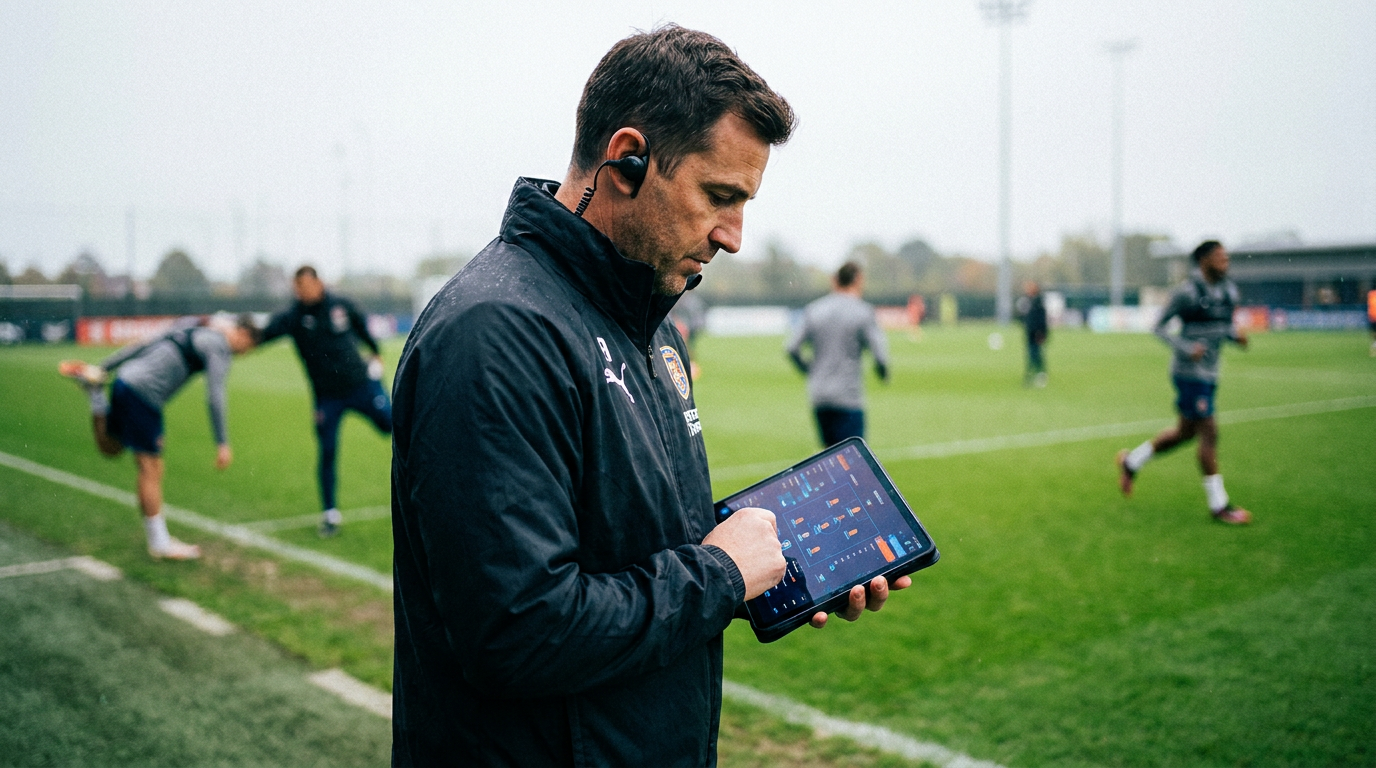
For over a century, professional football scouting relied on a familiar, romanticized image: a solitary figure in a heavy coat, standing on the touchline of a rain-swept pitch, scribbling notes into a dog-eared pad. The "eye test" was everything. Scouts trusted their gut to spot the intangible qualities of a future star, relying on vast personal networks and thousands of hours of travel. But this traditional model had a fundamental flaw: it could only cover a fraction of the global talent pool, and it was inherently vulnerable to human bias. Today, the world's biggest clubs—and increasingly, grassroots academies—are abandoning the notepad for the algorithm.[9]
The catalyst for this transformation is the rapid advancement of artificial intelligence, specifically computer vision and machine learning. Historically, capturing detailed match data required expensive, stadium-installed optical tracking systems, creating a "data black hole" for leagues below the top professional tiers. Millions of matches happened every week with zero data captured. Now, AI-powered platforms can ingest raw broadcast footage—or even a video shot on a smartphone from the sidelines—and automatically generate comprehensive scouting reports.[4][9]
The mechanism behind this shift is computer vision, a field of AI that trains computers to interpret and understand the visual world. Modern systems can track all 22 players and the ball simultaneously, measuring positions with centimeter-level precision up to 25 times per second. This technology extracts kinematic data without the need for wearable GPS vests. It records top speeds, acceleration profiles, sprint frequencies, and spatial relationships, generating a digital twin of the match that reveals tactical patterns invisible to the naked eye.[1][5]

Once the raw video is translated into structured data, machine learning models take over. These algorithms process the technical, physical, and tactical information, turning every action into a measurable metric. Passes completed, duels won, and areas of influence are quantified. The AI then compares these data points against historical records from thousands of professional footballers to detect hidden patterns. This allows clubs to evaluate a player's true potential objectively, stripping away the subjective biases that might cause a traditional scout to overlook a prospect due to their unorthodox running style or the obscurity of their league.[2][7]
This data-driven approach is fundamentally changing how clubs search for talent. Instead of sending scouts to watch specific matches on a hunch, recruitment departments now use AI to filter the global market. Analysts can create "proxies" or ideal player profiles based on specific metrics. For example, a club might instruct an algorithm to find a 21-year-old box-to-box midfielder in the Polish Ekstraklasa who matches the movement patterns and Expected Goals (xG) output of an elite Premier League star. The system instantly flags "statistical unicorns"—players who are physically and technically dominating their competition in ways the data cannot ignore.[5][8]
This data-driven approach is fundamentally changing how clubs search for talent.
The implications for global talent mapping are profound. By analyzing vast datasets, AI uncovers undervalued talent markets and helps clubs allocate their scouting resources more efficiently. This predictive analytics approach forecasts a player's future performance and development trajectory, allowing teams to identify players who are likely to outperform their current level. For clubs operating on tighter budgets, this means finding hidden gems and securing them for lower transfer fees before their market value skyrockets, effectively leveling the playing field against wealthier rivals.[2][3]

But the revolution extends far beyond the top-tier clubs. The democratization of data is perhaps the most uplifting aspect of this technological leap. Platforms are emerging that allow amateur players and grassroots academies to upload their own match footage. The AI tracks the players, evaluates performance, and generates highlight reels and written scouting blurbs automatically. This means a talented teenager playing in a regional league with zero existing data infrastructure can now generate a professional-grade statistical profile, making them visible to scouts worldwide.[4]
Beyond talent identification, AI is increasingly being deployed as a risk management tool, particularly in the realm of injury prediction. Before committing millions to a new signing, clubs conduct rigorous due diligence. AI models analyze a player's accumulated workload, medical history, and recovery patterns to estimate the risk of specific muscular or joint injuries. Advanced systems even use skeleton tracking and gesture analysis to monitor posture, head position, and gait changes during the final minutes of a match, identifying the subtle signs of fatigue that precede catastrophic injuries.[2][5][6]
Despite the immense power of these algorithms, the consensus among industry experts is that AI will not replace human scouts. Instead, it serves to remove inefficiency and filter out the noise. When an algorithm highlights a statistical outlier in a lower division, it validates a hypothesis, prompting the club to deploy a human scout for a targeted assessment. The human element remains crucial for evaluating the psychological and emotional aspects of the game that data cannot yet quantify.[5][7]

This "red flag" audit is where the traditional scout's eye is irreplaceable. An algorithm can confirm that a winger has elite acceleration and flawless passing metrics, but it struggles to interpret body language when a team concedes a goal. How does the player react to a bad refereeing decision? Do they track back when they lose possession? How do they interact with their teammates in the dressing room? These intangible qualities dictate whether a player has the mental resilience to succeed at the highest level, and they require human intuition to assess.[5]
Educational institutions are already adapting to this new reality. Graduate programs and professional scouting associations are offering courses in machine learning, large language models, and automated scouting workflows. The next generation of football analysts is being trained not just to watch matches, but to build multimodal data pipelines and apply reinforcement learning concepts to tactical analysis. The modern scout is evolving into a hybrid professional, blending a deep understanding of the game with the technical skills to interpret complex data visualizations.[5][6]
Ultimately, the integration of artificial intelligence into football scouting represents a shift toward a more equitable and efficient ecosystem. By combining human expertise with objective, data-driven insights, clubs can make smarter, more sustainable decisions. The romantic image of the scout in the rain isn't disappearing; it is simply being augmented by a tablet streaming real-time kinematic data. As the technology continues to evolve, the beautiful game is entering an era of unprecedented precision, ensuring that true talent, no matter where it is located, has a pathway to the pitch.[1][2][9]
How we got here
Pre-2010s
Scouting relies almost entirely on subjective human observation, handwritten reports, and vast personal networks.
2010s
Basic data analytics and event data, such as passes completed and shots taken, become mainstream in top-tier professional leagues.
Early 2020s
Optical tracking systems are installed in major stadiums, providing rich physical data but leaving lower leagues in a 'data black hole.'
2024-2025
Machine learning models begin predicting player development trajectories and identifying undervalued 'statistical unicorns.'
2026
AI computer vision platforms democratize scouting, allowing grassroots clubs to generate professional-grade data from simple smartphone footage.
Viewpoints in depth
Data-Driven Analysts
Advocates for relying heavily on machine learning and predictive models to uncover undervalued talent.
This camp argues that human observation is inherently flawed by cognitive biases and physical limitations. They point out that a scout can only watch one match at a time, whereas an algorithm can process thousands of hours of footage simultaneously. By prioritizing metrics like Expected Goals (xG) and kinematic data, these analysts believe clubs can find 'statistical unicorns' in obscure leagues, saving millions in transfer fees and building more efficient, objective recruitment pipelines.
Traditional Scouts
Professionals who emphasize the irreplaceable value of human intuition and psychological profiling.
While acknowledging the utility of data as a filtering mechanism, traditional scouts warn against over-reliance on algorithms. They argue that football is played by humans, not spreadsheets. An AI cannot accurately assess a player's dressing-room character, their reaction to a hostile away crowd, or their body language after making a critical error. This camp insists that the final decision must always rest on a 'red flag' audit conducted in person by an experienced scout who understands the emotional nuances of the game.
Grassroots Developers
Coaches and players focused on how AI democratizes visibility for lower-league and amateur talent.
For this group, the most exciting aspect of the AI revolution is not how it helps wealthy clubs save money, but how it illuminates the 'data black hole' of lower-tier football. They celebrate platforms that allow anyone with a smartphone to generate professional-grade scouting reports. By lowering the barrier to entry for data collection, they argue that AI is creating a more equitable global ecosystem where a talented teenager in a regional league has the same statistical visibility as an academy prospect at a top-tier club.
What we don't know
- How strictly governing bodies like FIFA will regulate the collection and ownership of players' biometric and kinematic data.
- Whether the widespread adoption of AI scouting will lead to a homogenization of playing styles, as algorithms optimize for similar tactical profiles.
Key terms
- Computer Vision
- A field of artificial intelligence that trains computers to interpret and understand visual information from the world, such as tracking player movements from video footage.
- Expected Goals (xG)
- A statistical metric that assesses the quality of a scoring opportunity, calculating the likelihood that a shot will result in a goal based on historical data.
- Kinematic Data
- Information relating to the motion of players, including top speeds, acceleration profiles, and sprint frequencies, extracted without the need for wearable sensors.
- Predictive Analytics
- The use of data, statistical algorithms, and machine learning techniques to identify the likelihood of future outcomes, such as a player's development trajectory.
- Skeleton Tracking
- An AI technique that maps the joints and limbs of a player's body to analyze posture, gait, and biomechanics, often used for injury prediction.
Frequently asked
Will AI replace human football scouts?
No. Industry experts agree that AI acts as a powerful filter to process vast amounts of data and validate hypotheses, but human scouts remain essential for evaluating a player's psychological resilience and character.
Do clubs need expensive cameras to use AI scouting?
Not anymore. While top leagues use stadium-installed optical systems, new AI platforms can extract professional-grade tracking data from standard broadcast footage or even smartphone video.
How does AI predict player injuries?
Algorithms analyze a player's accumulated workload, medical history, and recovery patterns. Advanced systems also use skeleton tracking to monitor subtle changes in posture and gait that indicate fatigue.
Can AI measure a player's mentality?
Currently, AI struggles to quantify intangibles like leadership, dressing-room influence, or reaction to adversity. These psychological 'red flags' still require in-person observation by experienced scouts.
Sources
Source coverage
9 outlets
3 viewpoints surfaced









[1]FC BarcelonaGrassroots Developers
Recruitment and Scouting Revolution
Read on FC Barcelona →[2]Sports Data CampusGrassroots Developers
Artificial Intelligence in scouting
Read on Sports Data Campus →[3]Call PlaybookData-Driven Analysts
Global Talent Mapping and Predictive Analytics
Read on Call Playbook →[4]Reddit Sports AnalyticsGrassroots Developers
Built an AI that generates scouting reports from raw match footage
Read on Reddit Sports Analytics →[5]The PFSATraditional Scouts
How AI Is Actually Used in Football Recruitment (Not the Hype)
Read on The PFSA →[6]CourseraGrassroots Developers
AI in Scouting and Performance
Read on Coursera →[7]LUISS UniversityData-Driven Analysts
Football Data Analytics: The Science of Talent
Read on LUISS University →[8]LatentView AnalyticsData-Driven Analysts
How Predictive Analytics Is Reshaping Football Scouting
Read on LatentView Analytics →[9]Factlen Editorial TeamTraditional Scouts
Synthesis by Factlen editorial team
Read on Factlen Editorial Team →

Every angle. Every day.
Get sports stories with full source coverage and perspective breakdowns delivered to your inbox.