
How Agrivoltaics Will Transform Global Farming and Energy by 2030
As the demand for renewable energy collides with agricultural land constraints, the simultaneous harvesting of solar power and crops is projected to become a $12.5 billion global industry by 2030.
By Factlen Editorial Team
- Renewable Energy Developers
- Focus on maximizing land use, grid capacity, and scaling solar deployment rapidly.
- Agricultural Economists
- Prioritize crop yields, farm profitability, and the financial trade-offs of solar leases.
- Climate Resilience Advocates
- Emphasize water conservation, microclimate benefits, and sustainable food systems.
What's not represented
- · Traditional farmers opposed to industrializing rural landscapes
- · Local zoning boards managing land-use permits
Why this matters
The transition to clean energy requires millions of acres of land, threatening to displace vital food production. Agrivoltaics solves this zero-sum conflict, offering a blueprint for how communities can secure both their power grids and their food supply chains simultaneously.
Key points
- The global agrivoltaics market is projected to reach $12.5 billion by 2030 as land constraints force dual-use innovations.
- Solar panels create microclimates that reduce heat stress and can cut agricultural water needs by up to 50 percent.
- Crop yield impacts vary by climate; humid regions see yield drops, while arid regions can see increases for crops like soybeans.
- Technological advancements like bifacial panels and dynamic tracking are maximizing both electricity generation and crop health.
As the global transition to renewable energy accelerates, a quiet battle over land is unfolding in rural communities. By 2030, the United States alone will require between two and four million acres of land to host utility-scale solar projects [1]. Traditionally, this has presented a zero-sum conflict: a hectare of land can either harvest the sun for electricity or harvest the soil for food, but not both. This tension has sparked local opposition to solar developments on prime agricultural land, threatening to bottleneck the grid's decarbonization.[1]
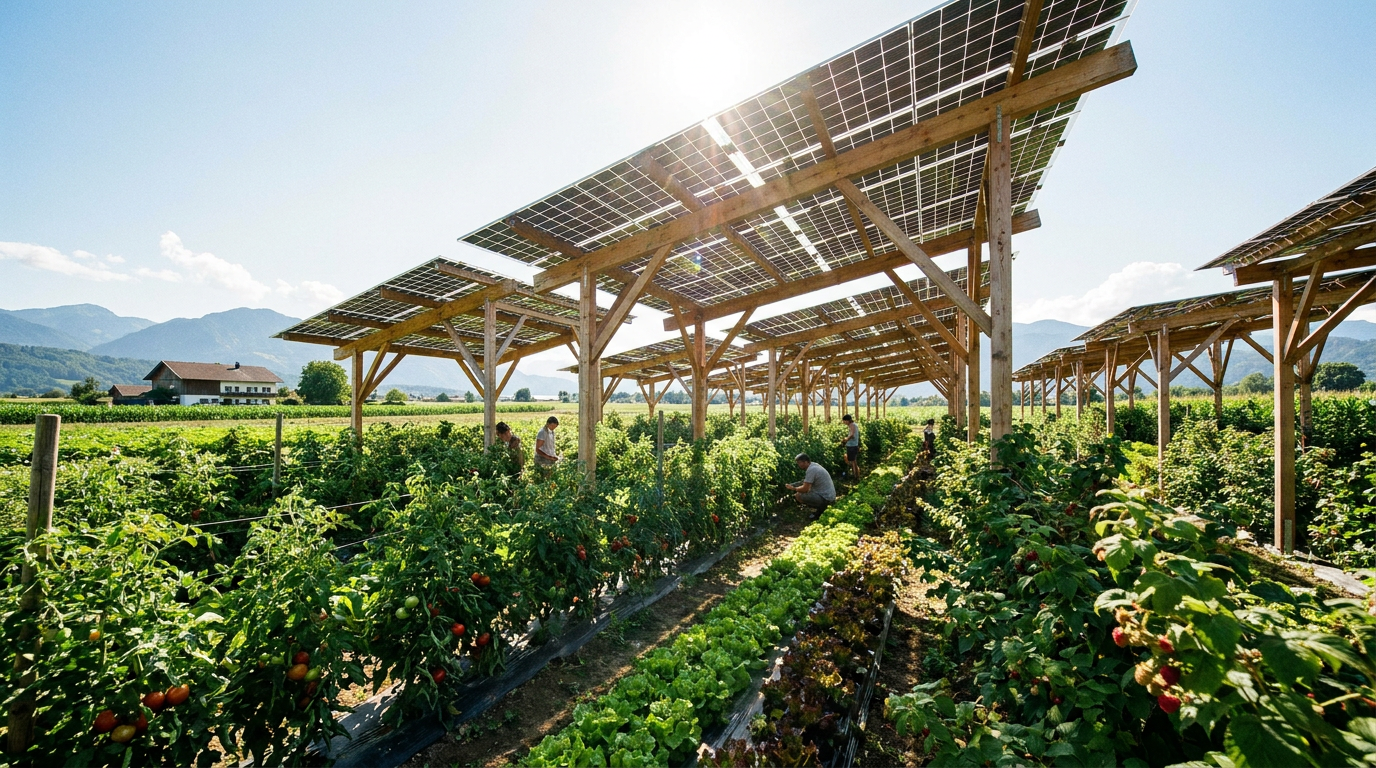
Enter agrivoltaics, a rapidly scaling discipline that replaces the "either-or" paradigm with a symbiotic "both-and." Rather than clearing fields to mount low-lying solar arrays, agrivoltaics elevates photovoltaic panels high enough to allow tractors, livestock, and crops to operate underneath [7]. The concept is transforming from a niche academic experiment into an industrial cornerstone, with the global agrivoltaics market projected to surge from $5.1 billion in 2024 to $12.5 billion by 2030 [3].[3][7]
The mechanism driving this growth is not just land efficiency, but the creation of artificial microclimates. Solar panels cast partial shade, which fundamentally alters the thermodynamics of the field below [4]. During peak summer heat, this shading reduces ground surface temperatures by up to 5 degrees Celsius, shielding plants from extreme heat stress [4]. For shade-tolerant or heat-sensitive crops, this canopy acts as a protective shield, extending the optimal window for photosynthesis during the hottest parts of the day.[4]

The most immediate and measurable benefit of this microclimate is water conservation. By blocking direct sunlight and lowering ambient temperatures, solar panels drastically reduce the rate of soil evaporation and plant transpiration. Research from the National Renewable Energy Laboratory (NREL) has demonstrated staggering efficiency gains in arid environments: peppers grown under solar panels required 50 percent less water, while tomato crops saw a 30 percent reduction in water needs [1]. In regions facing chronic drought, this moisture retention can mean the difference between a viable harvest and a total crop failure.[1]
However, agrivoltaics is not a universal silver bullet, and its efficacy is highly dependent on local climates and crop types. A landmark 2026 study published in the Proceedings of the National Academy of Sciences (PNAS) analyzed 14 years of crop data across the American Midwest, revealing stark regional divergences [2]. The researchers found that the benefits of agrivoltaics vary dramatically depending on ambient humidity and the specific photosynthetic demands of the crop being cultivated [6].[2][6]
In the humid, eastern stretches of the Midwest, the shading from solar panels proved detrimental to commodity crops. The PNAS models showed that the reduced sunlight curbed photosynthesis enough to drive maize yields down by 24 percent and soybean yields down by 16 percent, compared to conventional open-field farming [2]. In these moisture-rich environments, the water-saving benefits of the panels were entirely outweighed by the loss of solar radiation necessary for robust plant growth [6].[2][6]

In the humid, eastern stretches of the Midwest, the shading from solar panels proved detrimental to commodity crops.
Yet, when the same models were applied to the semiarid, western regions of the Midwest, the math shifted entirely. While maize—a notoriously shade-intolerant crop—still saw a 12 percent yield reduction, soybeans actually experienced a 6 percent yield increase under the solar panels [2]. In these drier climates, the moisture retained in the soil more than compensated for the reduced sunlight, creating a "triple-win" scenario of higher soybean yields, new solar lease revenue, and clean electricity generation [6].[2][6]
To mitigate the yield losses associated with shading, the solar industry is rapidly iterating on panel technology. The integration of bifacial solar modules has become a standard in modern agrivoltaic design [4]. Unlike traditional monofacial panels, bifacial modules capture direct sunlight from above and reflected light from the ground below. This not only boosts electricity generation by 15 to 25 percent but also allows more diffused light to reach the crops, improving the photosynthetic environment for plants that struggle under heavy shade [4].[4]
Dynamic tracking systems are also pushing the boundaries of what is possible. Rather than remaining static, these advanced arrays use software and sensors to tilt the panels throughout the day [3]. During peak sunlight hours, the panels can angle themselves to maximize electricity production; if the crops below require more light, or if severe weather threatens the field, the panels can rotate vertically to let the sun pass through or to shed heavy wind and rain [3].[3]

Despite these technological leaps, the economics of agrivoltaics remain complex for the average farmer. The U.S. Department of Agriculture notes that while specialty crops like leafy greens, berries, and tomatoes thrive under panels, the integration with massive commodity crops like corn and soy requires careful financial calculus [5]. In many cases, the reliable, long-term lease payments from solar developers can offset minor crop yield losses, providing farmers with a diversified, weather-proof income stream [2].[2][5]
Beyond direct crop cultivation, the agrivoltaics umbrella is expanding to include "ecovoltaics"—the practice of planting native pollinator habitats beneath solar arrays [1]. By seeding the ground with native wildflowers and grasses, developers can drastically reduce mowing and maintenance costs while creating massive sanctuaries for bees and butterflies. This, in turn, boosts the pollination rates and yields of adjacent agricultural fields, creating a halo effect of productivity [7].[1][7]
Globally, Europe currently dominates the agrivoltaics sector, holding over 30 percent of the market share [3]. Countries like France and Germany, which face strict emissions targets coupled with severe land constraints, have pioneered the regulatory frameworks necessary to scale dual-use farming [4]. Meanwhile, the Asia-Pacific region is projected to be the fastest-growing market through 2030, driven by immense population density and the urgent need to secure both food and energy supply chains simultaneously [3].[3][4]
As the 2030 decarbonization deadlines loom, agrivoltaics represents a rare paradigm shift in infrastructure development. It acknowledges that the earth's surface is a finite resource, and that the transition to clean energy cannot come at the expense of global food security [7]. By engineering systems where agriculture and energy generation actively support one another, agrivoltaics is proving that the farms of the future can harvest the sun twice.[7]
How we got here
2010s
Early pilot projects in Japan and Europe begin testing the viability of co-locating solar panels and agriculture.
2022
The U.S. Department of Energy and NREL publish extensive data on the water-saving benefits of agrivoltaic microclimates.
2024
The global agrivoltaics market surpasses $5 billion, driven by rapid adoption in Europe and the Asia-Pacific.
March 2026
A landmark PNAS study reveals the stark regional divergences in crop yields under solar panels, highlighting the 'triple-win' for soybeans in arid climates.
Viewpoints in depth
Renewable Energy Developers
Viewing agrivoltaics as the key to unlocking the millions of acres needed for grid decarbonization.
For energy developers, the primary bottleneck to renewable deployment is no longer panel cost, but land acquisition and community pushback. By 2030, the U.S. will need up to four million acres for solar arrays. Developers argue that agrivoltaics neutralizes the 'food versus fuel' debate, allowing them to lease prime, flat agricultural land without destroying its agrarian value. They point to dynamic tracking and bifacial panels as proof that energy generation can be optimized without ruining the harvest.
Agricultural Economists
Weighing the guaranteed revenue of solar leases against the complex realities of shaded crop yields.
Agricultural economists approach agrivoltaics with cautious optimism, heavily caveated by regional data. While the solar lease payments offer farmers a highly attractive, weather-proof revenue stream, the impact on commodity crops like corn and soy can be detrimental in humid climates. This camp emphasizes that agrivoltaics is not a one-size-fits-all solution; it requires rigorous financial modeling to ensure that the loss in crop yield does not outpace the energy dividends, particularly for shade-intolerant crops.
Climate Resilience Advocates
Championing agrivoltaics for its ability to conserve water and protect crops from extreme heat.
For climate and sustainability advocates, the electricity generated by agrivoltaics is almost secondary to its adaptive agricultural benefits. As global temperatures rise and droughts become more frequent, the microclimates created by solar panels offer a lifeline to heat-stressed crops. This camp highlights data showing massive reductions in water usage for vegetables grown under panels, arguing that agrivoltaics will become a mandatory adaptation strategy for farming in arid and semi-arid regions.
What we don't know
- How the long-term soil health and microbiome will be affected by decades of partial shading.
- Whether the cost of elevated steel mounting structures will decrease enough to make agrivoltaics viable in developing nations without heavy subsidies.
- How the insurance industry will model crop failure risks for dual-use farms facing severe weather events.
Key terms
- Agrivoltaics
- The simultaneous use of areas of land for both solar photovoltaic power generation and agriculture.
- Microclimate
- The specific, localized climate conditions created directly underneath and around the solar panels, typically characterized by lower temperatures and higher humidity.
- Bifacial Solar Panels
- Solar modules designed to capture sunlight from both the front and the back, utilizing light reflected off the ground.
- Dynamic Tracking
- A system where solar panels automatically tilt and rotate throughout the day to follow the sun or adjust the amount of light reaching the crops below.
Frequently asked
Can you grow any crop under solar panels?
No. Shade-tolerant crops like leafy greens, tomatoes, and certain berries thrive, while shade-intolerant commodity crops like corn often see reduced yields depending on the climate.
Do solar panels take water away from the crops?
The opposite is true. The shade from the panels reduces soil evaporation and plant transpiration, meaning crops grown under panels typically require significantly less irrigation.
Is agrivoltaics profitable for farmers?
Generally, yes. The reliable revenue from leasing land to solar developers often outweighs the potential losses in crop yield, though the exact economics depend heavily on the region and crop type.
How much land is needed for solar energy by 2030?
The National Renewable Energy Laboratory estimates that the United States will need between two and four million acres of land for solar projects by 2030.
Sources
Source coverage
7 outlets
3 viewpoints surfaced





[1]National Renewable Energy LaboratoryRenewable Energy Developers
Agrivoltaics: Co-locating Agricultural and Solar Energy Production
Read on National Renewable Energy Laboratory →[2]PNASAgricultural Economists
Climate-driven divergence in biophysical and economic impacts of agrivoltaics
Read on PNAS →[3]MarkNtel AdvisorsRenewable Energy Developers
Global Agrivoltaics Market Analysis, 2025-2030
Read on MarkNtel Advisors →[4]Fraunhofer ISEClimate Resilience Advocates
Agrivoltaics: Opportunities for Agriculture and the Energy Transition
Read on Fraunhofer ISE →[5]U.S. Department of AgricultureAgricultural Economists
Impacts of Solar Shading on Commodity Crop Yields
Read on U.S. Department of Agriculture →[6]Anthropocene MagazineAgricultural Economists
It depends on where you farm: New study shows agrivoltaics trade-offs
Read on Anthropocene Magazine →[7]Factlen Editorial TeamClimate Resilience Advocates
Synthesis by Factlen editorial team
Read on Factlen Editorial Team →
Every angle. Every day.
Get opinion stories with full source coverage and perspective breakdowns delivered to your inbox.