
How Agrivoltaics is Turning a Land-Use Battle into a Win-Win for Farming and Energy
By elevating solar panels above active farmland, engineers and agronomists have discovered a synergistic system that boosts crop yields, saves water, and increases electrical efficiency.
By Factlen Editorial Team
- Agricultural Producers
- Farmers and agronomists focused on maintaining crop yields, reducing water usage, and securing stable secondary revenue streams.
- Clean Energy Developers
- Solar industry stakeholders seeking to expand utility-scale capacity while minimizing land-use conflicts and community opposition.
- Climate & Land-Use Planners
- Researchers and policymakers prioritizing the efficient dual-use of finite land to meet both decarbonization and food security goals.
What's not represented
- · Traditional commodity crop farmers whose sun-intensive operations are not compatible with current agrivoltaic designs.
- · Rural zoning boards tasked with updating decades-old land use codes to accommodate dual-use infrastructure.
Why this matters
The transition to renewable energy requires millions of acres of land, threatening to displace vital agricultural production. Agrivoltaics proves that we can stack these critical infrastructure systems on the same plot of earth, securing the food supply while accelerating decarbonization.
Key points
- Agrivoltaics combines solar power generation and farming on the same land, resolving conflicts over rural land use.
- The solar panels create a microclimate that reduces soil evaporation by 15 to 30 percent, saving significant irrigation water.
- Shade-tolerant crops like tomatoes and leafy greens can see yield increases of 8 to 18 percent under the panels.
- Plants release moisture that cools the underside of the solar panels, boosting electrical efficiency by roughly 2 percent.
- While initial construction costs are 10 to 20 percent higher, the dual revenue streams provide farmers with long-term financial stability.
As the global transition to renewable energy accelerates, a quiet battle over real estate has emerged in rural communities. To meet ambitious climate targets, utility-scale solar developers are scouring the countryside for flat, sun-drenched acreage. However, the exact topographical features that make a parcel of land perfect for a sprawling photovoltaic array also make it ideal for farming. For years, this dynamic has forced a zero-sum choice upon landowners and local governments: harvest the sun for clean electricity, or harvest the soil to feed a growing population. The National Renewable Energy Laboratory projects that by 2050, solar installations could require up to 10 million acres of land in the United States alone, representing a noticeable fraction of the nation's total arable footprint.[2]
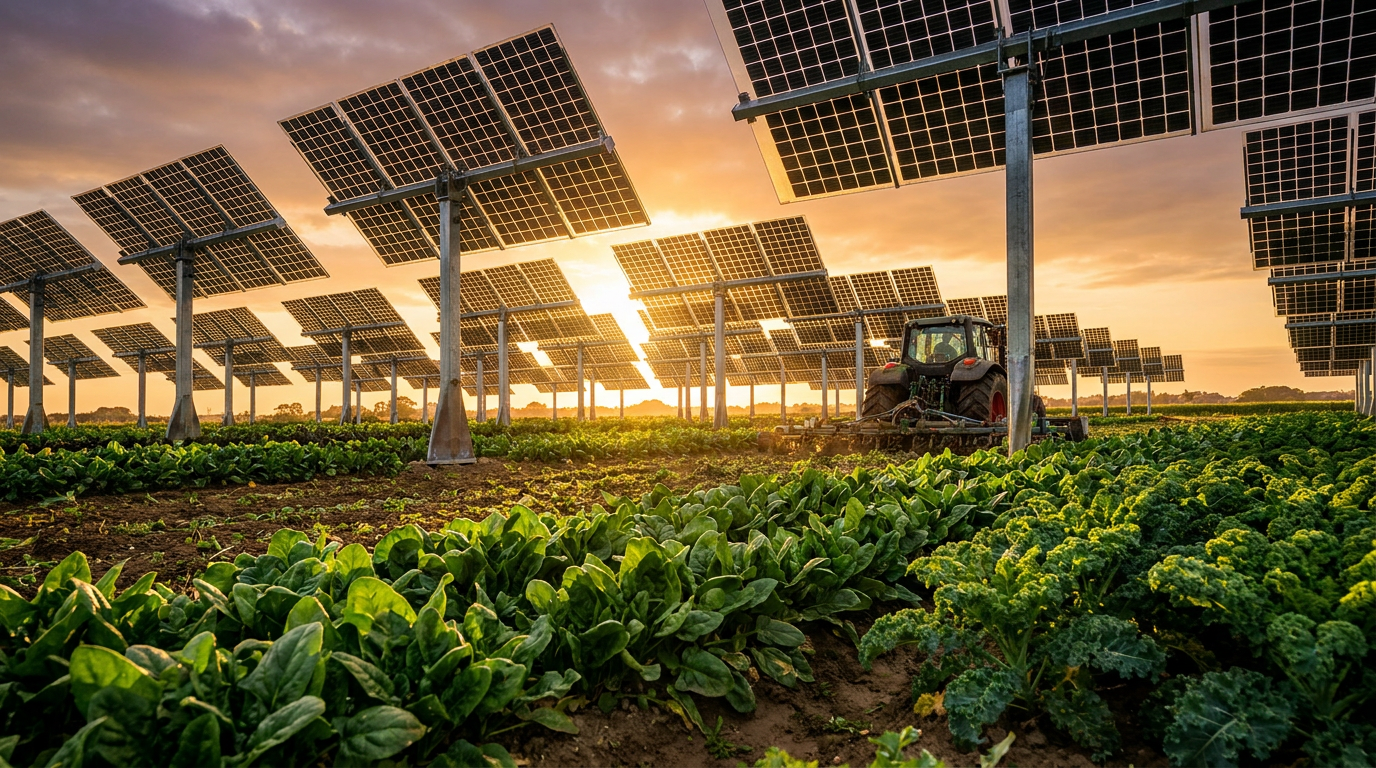
This land-use tension has historically sparked fierce local opposition, with rural communities resisting the conversion of multi-generational farms into fenced-off seas of glass and steel. But a rapidly maturing approach known as agrivoltaics is proving that food and energy production do not have to be mutually exclusive. Agrivoltaics—the deliberate co-location of agricultural production and solar power generation on the same plot of land—reimagines the geometry of a solar farm. Instead of mounting panels just inches above the dirt to minimize steel costs, developers elevate the arrays on taller racks and space the rows wider, allowing tractors, livestock, and farm workers to operate freely underneath.[7][8]
The concept is shifting from a niche academic experiment to a commercially viable sector, driven by a growing body of agronomic evidence showing that the two systems actually benefit each other. The core mechanism driving these benefits is the creation of a highly regulated microclimate beneath the solar canopy. According to landmark research published in Nature Sustainability, the strategic shading provided by the overhead panels fundamentally alters the environmental stressors acting on the crops below. By blocking the most punishing midday rays, the panels buffer the plants against extreme temperature spikes and intense solar radiation.[3]
This shading effect dramatically reduces evapotranspiration—the combined process of water evaporating directly from the soil and transpiring from the leaves of the plants. In arid and semi-arid agricultural regions, this moisture retention is transformative. Studies show that the microclimate beneath an agrivoltaic array can reduce soil evaporation by 15 to 30 percent, allowing farmers to maintain or even increase crop yields while using significantly less irrigation water. For water-stressed regions facing prolonged droughts and depleted aquifers, the ability to stretch a limited water supply further is a massive operational advantage.[3][4]

The impact on crop yields depends heavily on the specific plant variety being cultivated. While it might seem counterintuitive that blocking sunlight could help plants grow, many high-value crops actually suffer from light saturation and heat stress during the peak of summer. Shade-tolerant crops, including leafy greens like lettuce and spinach, as well as tomatoes, peppers, and strawberries, thrive in this dappled light environment. Field trials have demonstrated yield increases of 8 to 18 percent for these specific crops when grown under solar panels, as the moderated temperatures extend their optimal window for photosynthesis and prevent leaf scorch.[1][3]
The symbiotic relationship extends upward as well, solving a persistent engineering challenge for the solar industry. Photovoltaic panels are inherently sensitive to heat; as their surface temperature rises during a blistering summer afternoon, their electrical conversion efficiency drops. However, the crops growing beneath the panels act as a natural cooling system. As the plants release water vapor through transpiration, the rising moisture cools the underside of the silicon panels. Researchers have documented that this localized evaporative cooling effect can lower the temperature of the solar array enough to boost annual electricity generation by roughly 2 percent.[3]
Beyond the biophysical synergies, the economic architecture of agrivoltaics is proving highly attractive to rural stakeholders. A recent analysis by the Institute for Energy Economics and Financial Analysis highlights how dual-use solar provides farmers with a vital economic hedge. Agriculture is notoriously volatile, subject to the whims of extreme weather, commodity price swings, and shifting global trade policies. By leasing the airspace above their fields to a solar developer, farmers secure a predictable, long-term revenue stream that acts as a financial anchor, ensuring the farm remains solvent even during catastrophic harvest years.[4]
Beyond the biophysical synergies, the economic architecture of agrivoltaics is proving highly attractive to rural stakeholders.
This compelling economic logic has triggered a quiet boom in deployment. In the United States, agrivoltaic capacity has expanded rapidly, growing from just 4.5 gigawatts in 2020 to more than 10 gigawatts by the end of 2024. These dual-use installations now cover an estimated 62,000 acres of American farmland, generating enough clean electricity to power roughly 1.5 million homes while keeping the underlying soil in active agricultural production. The model is proving particularly popular for community-scale solar projects, which typically sit closer to population centers where land-use conflicts are most acute.[4]

The potential for expansion is vast, particularly in densely populated nations where land is at a premium. In Germany, a comprehensive spatial analysis conducted by the Fraunhofer Institute for Solar Energy Systems evaluated the nation's permanent grassland, arable land, and orchards. The researchers concluded that Germany possesses the technical potential to install up to 500 gigawatts of agrivoltaic capacity on highly suitable agricultural land. This figure dramatically exceeds the country's entire 2040 solar expansion target of 400 gigawatts, suggesting that dual-use systems alone could theoretically meet the nation's clean energy goals without sacrificing a single hectare of food production.[1][5]
To maximize these dual yields, the industry is rapidly moving away from static, fixed-tilt solar racks. The modern agrivoltaic market is increasingly dominated by dynamic tracking systems, which are projected to account for nearly 88 percent of new installations by 2026. These motorized arrays slowly tilt throughout the day to follow the sun's trajectory. Crucially, the tracking algorithms can be programmed to prioritize the needs of the crops during critical growth phases, rotating the panels to let more direct light through when the plants need it, or flattening out to provide maximum shade during a dangerous heatwave.[6]
Hardware innovations are also improving the quality of light that reaches the soil. Developers are increasingly deploying bifacial solar modules, which feature active photovoltaic cells on both the top and bottom surfaces. These panels capture direct sunlight from the sky while simultaneously harvesting light that reflects off the ground. Because they are often manufactured with semi-transparent backsheets, bifacial panels allow a higher percentage of diffused light to pass through to the crops below, creating a softer, more uniform lighting environment that prevents the harsh, high-contrast shadows cast by traditional opaque panels.[1]

Despite the overwhelming momentum, agrivoltaics is not a universal silver bullet for the agricultural sector. The most significant limitation is crop compatibility. While leafy greens and root vegetables flourish under partial shade, sun-intensive commodity crops like corn, wheat, and soybeans require maximum solar radiation to reach maturity. Agronomic trials have consistently shown that cultivating these staple crops beneath solar arrays results in severe yield reductions ranging from 25 to 40 percent. Consequently, agrivoltaics is currently best suited for specialty crops, horticulture, and livestock grazing, rather than the massive monoculture grain operations that dominate the American Midwest.[8]
The financial barriers to entry also remain a hurdle for widespread adoption. Designing a solar array that allows a heavy combine harvester to pass underneath requires significantly more structural steel than a standard ground-mounted system. The elevated racking must be engineered to withstand higher wind loads, and the specialized tracking hardware adds complexity. These factors typically drive up the initial capital expenditure of an agrivoltaic facility by 10 to 20 percent compared to a traditional solar farm. While the dual revenue streams generally offset this premium over the 25-year lifespan of the project, the upfront costs can deter risk-averse developers.[4][8]
To bridge this gap, policymakers and researchers are working to standardize best practices and de-risk the investments. The U.S. Department of Energy's Foundational Agrivoltaic Research for Megawatt Scale (FARMS) program is actively funding projects that optimize system designs and lower the barriers to entry. By building open-source databases of crop performance and microclimate data, these initiatives aim to provide farmers and developers with the precise, localized blueprints they need to secure financing and execute successful dual-use projects.[7]

Ultimately, the rise of agrivoltaics represents a profound shift in how society manages its natural resources. By moving past the binary choice between energy security and food security, engineers and agronomists have engineered a system where the two actively support one another. As the climate warms and the demand for both clean power and resilient agriculture intensifies, the ability to stack these critical infrastructure systems on the same plot of earth offers a rare, pragmatic win-win for the energy transition.[8]
How we got here
1982
The concept of co-locating solar panels and agriculture is first proposed by researchers Adolf Goetzberger and Armin Zastrow.
2019
A landmark study in Nature Sustainability quantifies the synergistic benefits of agrivoltaics, including panel cooling and crop drought resilience.
2022
The U.S. Department of Energy launches the FARMS program to fund megawatt-scale agrivoltaic research and lower barriers to entry.
2024
U.S. agrivoltaic capacity reaches 10 gigawatts across 62,000 acres, proving the commercial viability of dual-use systems.
Viewpoints in depth
The Agronomic View
Focusing on microclimates, crop resilience, and water conservation.
For agricultural scientists and farmers, the primary value of agrivoltaics lies in climate adaptation. As extreme heat and prolonged droughts become more common, the protective canopy of a solar array acts as a buffer, reducing evapotranspiration and preventing heat scorch in vulnerable crops. While they acknowledge that sun-hungry commodity crops like corn are ill-suited for this setup, they view the technology as a lifeline for specialty crops and grazing operations that are increasingly threatened by shifting weather patterns.
The Developer's View
Prioritizing grid expansion, land acquisition, and community relations.
Solar developers view agrivoltaics as a strategic tool to unlock new land and smooth the permitting process. Traditional utility-scale solar projects frequently face intense pushback from rural communities concerned about the loss of agricultural heritage. By keeping the land in active farming production, developers can reframe their projects as farm-saving investments rather than industrial intrusions. They are willing to absorb the 10 to 20 percent premium in structural costs if it means avoiding years of costly zoning battles.
The Policy Perspective
Balancing national decarbonization targets with long-term food security.
Government agencies and land-use planners look at the macro math: hitting net-zero emissions requires millions of acres of solar panels. They see agrivoltaics as the only pragmatic way to achieve these energy targets without triggering a crisis in food production. Their focus is on funding research, standardizing zoning laws, and potentially offering tax incentives to offset the higher capital costs of elevating panels, ensuring that the transition to clean energy does not cannibalize the agricultural sector.
What we don't know
- How the long-term changes in soil microbiology under permanent partial shade will affect nutrient cycling over a 25-year solar lease.
- Whether the higher upfront capital costs will prevent smaller, independent farms from adopting the technology without heavy government subsidies.
- How effectively dynamic tracking algorithms can be optimized to balance the real-time wholesale price of electricity against the specific daily light requirements of different crop varieties.
Key terms
- Agrivoltaics
- The simultaneous use of a single piece of land for both solar power generation and agricultural production.
- Evapotranspiration
- The combined process of water evaporating from the soil surface and transpiring from the leaves of plants.
- Bifacial Solar Modules
- Solar panels equipped with active cells on both sides, allowing them to capture direct sunlight from above and reflected light from below.
- Dynamic Tracking Systems
- Motorized solar panel mounts that slowly tilt throughout the day to follow the sun's trajectory, optimizing light capture.
Frequently asked
Does growing crops under solar panels reduce the harvest?
It depends on the crop. Shade-tolerant plants like lettuce, tomatoes, and strawberries can see yield increases of 8 to 18 percent. However, sun-intensive crops like corn and wheat suffer significant yield drops.
How do tractors fit under the solar panels?
Agrivoltaic systems are specifically designed with elevated steel racking and wider row spacing, allowing standard agricultural machinery to pass underneath without hitting the infrastructure.
Do the plants help the solar panels generate more electricity?
Yes. As plants release moisture through transpiration, they create a localized cooling effect. Because solar panels lose efficiency when they overheat, this cooling can boost electricity generation by roughly 2 percent.
Why aren't all solar farms built this way?
Elevating the panels and reinforcing the steel structures to withstand wind loads at height increases the initial construction costs by 10 to 20 percent, which can deter some developers.
Sources
Source coverage
8 outlets
3 viewpoints surfaced








[1]Fraunhofer Institute for Solar Energy Systems (ISE)Climate & Land-Use Planners
Agrivoltaics: Opportunities for Agriculture and the Energy Transition
Read on Fraunhofer Institute for Solar Energy Systems (ISE) →[2]National Renewable Energy Laboratory (NREL)Clean Energy Developers
Solar Market Research and Analysis: Agrivoltaics
Read on National Renewable Energy Laboratory (NREL) →[3]Nature SustainabilityAgricultural Producers
Agrivoltaics provide mutual benefits across the food–energy–water nexus in drylands
Read on Nature Sustainability →[4]Institute for Energy Economics and Financial Analysis (IEEFA)Agricultural Producers
Agrivoltaics: An economic option for farmers and rural development
Read on Institute for Energy Economics and Financial Analysis (IEEFA) →[5]PV MagazineClimate & Land-Use Planners
Fraunhofer ISE pegs Germany's agrivoltaic potential at 500 GW
Read on PV Magazine →[6]Coherent Market InsightsClean Energy Developers
Agrivoltaics Market Analysis & Forecast - 2026 to 2033
Read on Coherent Market Insights →[7]U.S. Department of EnergyClean Energy Developers
Agrivoltaics: Solar and Agriculture Co-Location
Read on U.S. Department of Energy →[8]Factlen Editorial TeamClimate & Land-Use Planners
Synthesis by Factlen editorial team
Read on Factlen Editorial Team →
Every angle. Every day.
Get environment stories with full source coverage and perspective breakdowns delivered to your inbox.