
How Agentic AI and 'Self-Driving Labs' Are Accelerating Scientific Discovery
Autonomous laboratories powered by agentic AI are moving beyond digital simulations to physically execute and optimize experiments, compressing years of research into weeks.
By Factlen Editorial Team
- Scientific Automation Pioneers
- Advocates focused on scaling throughput and removing the human bottleneck in the laboratory.
- National Research Strategists
- Policymakers viewing autonomous labs as critical infrastructure for global competitiveness.
- Mechanistic Researchers
- Scientists emphasizing that AI must explain the underlying chemistry, not just find solutions.
- Factlen Synthesis
- The overarching view connecting the hardware, software, and policy implications of autonomous science.
What's not represented
- · Laboratory Technicians
- · Bioethics Watchdogs
Why this matters
By removing the human bottleneck from routine experimentation, self-driving labs are drastically shortening the time it takes to discover life-saving drugs, clean-energy batteries, and advanced materials from decades to mere months.
Key points
- Agentic AI is moving beyond digital simulations to physically execute experiments in self-driving laboratories.
- These systems operate on a continuous Design-Make-Test-Analyze-Learn loop, autonomously adjusting parameters when experiments fail.
- Academic and industrial labs are already using the technology to accelerate the discovery of quantum dots, batteries, and pharmaceuticals.
- Researchers are developing 'gray-box' AI to ensure these systems explain the chemical mechanisms behind their discoveries.
- Hardware fragmentation and regulatory compliance remain the primary hurdles to achieving full 'Level 5' laboratory autonomy.
For centuries, the pace of scientific discovery has been fundamentally constrained by a single bottleneck: human hands. Whether developing a novel catalyst for clean energy or synthesizing the next breakthrough pharmaceutical, the scientific method has relied on researchers manually designing experiments, mixing compounds at the bench, and painstakingly analyzing the results. This sequential trial-and-error process is inherently slow, limiting humanity's ability to explore the vast, unmapped universe of possible chemical and biological combinations. But a structural evolution is underway. The convergence of advanced robotics and a new generation of artificial intelligence is moving AI out of the purely digital realm of simulation and into the physical execution of science.
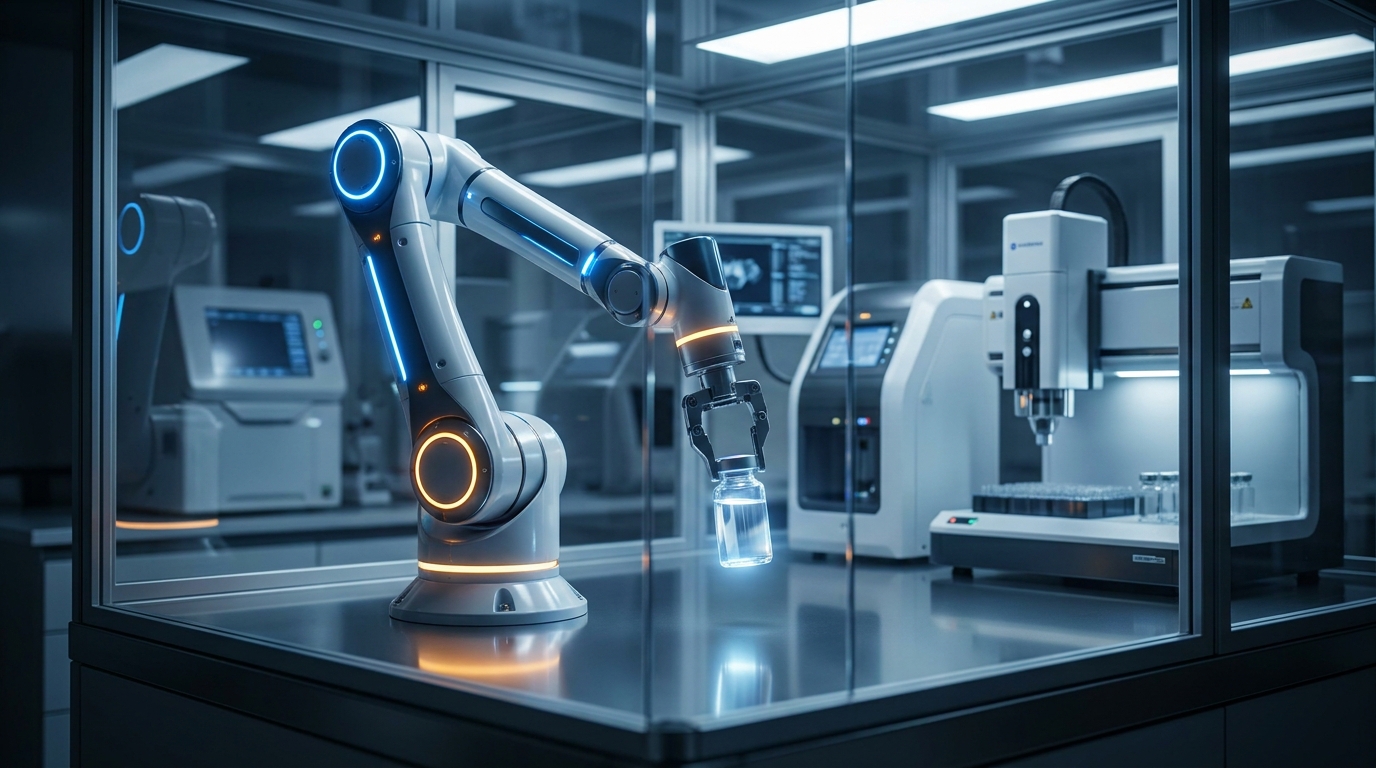
This shift is giving rise to the "Self-Driving Laboratory" (SDL), a fully integrated research facility where AI systems autonomously design experiments, robotic platforms execute them, and the AI analyzes the results to decide what to run next. Unlike traditional laboratory automation, which simply follows pre-programmed instructions to move liquids or load plates, these new systems are powered by "agentic AI." Agentic AI possesses the ability to reason, make sequential decisions, and adapt its strategy on the fly without waiting for a human prompt. It transforms the laboratory from a static workspace into an intelligent, self-correcting engine of discovery.
At the core of the self-driving lab is the closed-loop DMTA-L cycle: Design, Make, Test, Analyze, and Learn. In this continuous loop, the AI agent begins by formulating a hypothesis or identifying a target molecule. It then translates that goal into physical instructions, directing robotic arms and automated synthesizers to create the material. Once synthesized, integrated characterization tools—such as mass spectrometers or nuclear magnetic resonance machines—test the sample. The AI instantly ingests this analytical data, learns from the outcome, and immediately designs the next iteration, compounding its knowledge with every cycle.[1]

Because the AI agent can process complex, multi-dimensional data in real time, it can navigate experimental dead ends and optimize chemical recipes far faster than a human team. If a particular reaction yields unexpected toxicity or poor stability, the agentic AI autonomously adjusts the parameters—tweaking the temperature, swapping a solvent, or altering the timing—and initiates a new experiment within minutes. This capability allows researchers to compress discovery timelines that have historically spanned years into a matter of weeks or even days.[5]
The sheer scale of this acceleration is already being demonstrated in academic and industrial settings. At North Carolina State University, researchers have built one of the largest systems of automated labs in the country. Their flagship self-driving lab, nicknamed "Rainbow," is dedicated to optimizing the synthesis of next-generation quantum dots—nanoscale semiconductor materials used in advanced displays, solar cells, and medical imaging. Finding the perfect synthetic route for these materials is traditionally a laborious process requiring massive design spaces.[4]
Powered by machine learning algorithms that intelligently plan follow-up experiments, Rainbow can conduct and analyze up to 1,000 experiments per day entirely without human intervention. Within a single day of operation, the autonomous system successfully identified quantum dots that are considered best-in-class. By running round-the-clock, high-throughput campaigns, these self-driving platforms can accelerate the discovery of new molecules and materials up to 100 times faster than conventional manual experimentation.[4]
The strategic implications of this technology are so profound that it is reshaping national research priorities. The U.S. Department of Energy recently launched the "Genesis Mission," a national strategy aimed at building an AI-driven discovery platform that links the country's most powerful supercomputers with autonomous experimentation. Recognizing that traditional human-driven processes cannot keep pace with the urgent need for clean energy solutions, the initiative positions self-driving labs as critical infrastructure for maintaining scientific leadership and economic competitiveness.[2]
The strategic implications of this technology are so profound that it is reshaping national research priorities.
At facilities like Oak Ridge National Laboratory, researchers are already prototyping these "Labs of the Future." By integrating leadership-class computing with cutting-edge instrumentation, they are creating an ecosystem where AI models propose experimental conditions for novel batteries, fusion materials, and advanced alloys. The automated instruments synthesize the materials, and the resulting data feeds directly back into the supercomputers, creating a continuous loop that rapidly maps complex scientific spaces that would take human teams decades to explore.[3]

In the pharmaceutical sector, the stakes are equally high. Early-stage drug discovery is a race against time, complexity, and staggering costs, characterized by high attrition rates as promising compounds fail in late-stage testing. Agentic AI is emerging as a transformative response to these bottlenecks. By automating the most data-heavy and decision-intensive steps of the pipeline, multi-agent systems can autonomously screen millions of molecules, predict efficacy and toxicity, and design novel drug compounds with unprecedented speed.[5]
Companies at the forefront of this intersection are rapidly scaling their physical footprints. Atinary recently launched a new AI-powered laboratory in Boston specifically designed to support pharmaceutical research from early discovery through process development. Similarly, synthetic biology leaders like Ginkgo Bioworks are leveraging autonomous platforms to systematically map the design spaces of biologics and cell therapies. These facilities prove that AI is no longer just an in silico predictive tool; it is a physical engine executing real-world chemistry.[7][8]
Yet, speed and throughput are only part of the equation. A persistent criticism of AI in the physical sciences has been its "black box" nature. Historically, machine learning models might identify a highly efficient catalyst or a potent drug candidate, but they could not explain the underlying chemical mechanisms that made the molecule work. For scientists, this lack of transparency limits trust and hinders the broader understanding necessary to generalize findings to other applications.
To address this, researchers are pioneering a "gray-box" approach to agentic AI. A recent breakthrough published in the journal ACS Catalysis demonstrated an AI-driven strategy that combines rapid optimization with deep mechanistic interpretability. Instead of simply hunting for the best-performing material, the AI was explicitly designed to explore the chemical space in a way that simultaneously uncovered the physical rules governing the reactions.[6]

The research team validated this gray-box strategy on the conversion of propane into propylene—a crucial industrial building block for plastics. The self-driving lab required fewer than 50 experiments to navigate a staggering design space of more than ten trillion possible combinations. Not only did the AI identify a catalyst that outperformed current benchmarks, but it also translated its complex outputs into chemically meaningful insights, explaining exactly why the new catalyst worked.[6]
Despite these monumental strides, the transition to fully autonomous science faces significant hurdles. Most self-driving labs today operate at intermediate levels of autonomy, handling closed-loop optimization on narrowly defined tasks while humans still set the overarching goals and manage complex exceptions. Achieving true "Level 5" autonomy—where an AI agent can analyze literature, formulate a novel hypothesis, and execute the entire experimental campaign across hundreds of instruments without any human intervention—remains a distant frontier.
Hardware fragmentation presents another massive engineering challenge. The laboratory equipment market is highly bespoke, with instruments from different vendors operating on proprietary software and closed data formats. Building a self-driving lab requires creating complex middleware to translate instructions between the AI agent, the robotic liquid handlers, and the analytical spectrometers. Until modular, plug-and-play standards are widely adopted, constructing these autonomous ecosystems will require massive upfront investments in custom engineering.
Regulatory compliance also dictates the pace of adoption, particularly in clinical diagnostics and pharmaceutical manufacturing. In GxP-regulated environments, the FDA and EMA require strict data integrity and traceability. AI outputs in these settings must currently be treated as recommendations that require human approval for quality-critical decisions. While new guidelines are evolving to accommodate AI, the burden of proving that an autonomous system is reliable, reproducible, and safe remains high.

Ultimately, the rise of the self-driving laboratory does not signal the obsolescence of the human scientist. Instead, it represents a fundamental elevation of their role. By delegating the repetitive, high-volume execution of experiments to agentic AI, researchers are freed to focus on the highest-impact aspects of their work: interpreting complex mechanistic insights, generating creative new hypotheses, and directing the strategic future of scientific inquiry. The lab of the future is not human-free; it is a profound human-AI collaboration.
How we got here
2024
Comprehensive reviews identify drug discovery and genomics as high-impact domains for early self-driving lab deployment.
Late 2025
Researchers publish breakthroughs in 'gray-box' AI, allowing autonomous labs to explain chemical mechanisms rather than just finding solutions.
Early 2026
Atinary launches a dedicated AI-powered laboratory in Boston to scale autonomous pharmaceutical R&D.
Mid 2026
The U.S. Department of Energy accelerates the Genesis Mission, linking national supercomputers with autonomous experimentation.
Viewpoints in depth
Scientific Automation Pioneers
Advocates focused on scaling throughput and removing the human bottleneck in the laboratory.
This camp, which includes academic leaders and synthetic biology companies, views the physical execution of science as the primary bottleneck to innovation. They argue that human hands are too slow and error-prone to navigate the massive chemical design spaces required for modern breakthroughs. By entirely removing humans from the routine DMTA-L loop, they believe we can achieve a 100-fold acceleration in discovering new materials, quantum dots, and life-saving therapeutics.
National Research Strategists
Policymakers viewing autonomous labs as critical infrastructure for global competitiveness.
For government agencies and national laboratories, self-driving labs are a matter of national security and economic dominance. Initiatives like the DOE's Genesis Mission frame autonomous experimentation as the only viable way to rapidly develop next-generation energy grids, advanced batteries, and fusion materials. This perspective emphasizes integrating these physical labs with national supercomputing clusters to maintain a strategic edge in the 21st-century technological arms race.
Mechanistic Researchers
Scientists emphasizing that AI must explain the underlying chemistry, not just find solutions.
While acknowledging the speed of autonomous labs, this camp warns against relying on 'black-box' AI that outputs optimal recipes without explaining why they work. They argue that true scientific progress requires understanding the physical and chemical mechanisms behind a discovery. Consequently, they advocate for 'gray-box' approaches where the AI is explicitly constrained and designed to yield interpretable, mechanistic insights alongside its high-throughput optimizations.
What we don't know
- How quickly regulatory bodies like the FDA will adapt their frameworks to fully accept autonomously generated clinical data.
- When the industry will coalesce around unified software standards to easily connect bespoke laboratory hardware.
- Whether 'Level 5' autonomy—where an AI designs an entire research program from scratch without any human direction—is practically achievable in the near term.
Key terms
- Self-Driving Laboratory (SDL)
- A research facility where AI autonomously designs experiments, robots execute them, and the system learns from the results.
- Agentic AI
- Artificial intelligence capable of independent reasoning, sequential decision-making, and adapting to new information without human prompting.
- DMTA-L Cycle
- The core closed-loop process of autonomous science: Design, Make, Test, Analyze, and Learn.
- Gray-Box AI
- An AI model that provides interpretable insights into how and why it reached a specific conclusion, rather than just outputting a final result.
- High-Throughput Screening
- An automated method that allows researchers to quickly conduct thousands or millions of chemical or biological tests.
Frequently asked
Will self-driving labs replace human scientists?
No. They are designed to automate repetitive, high-volume experimentation, freeing human researchers to focus on high-level hypothesis generation, strategic direction, and interpreting complex results.
How is agentic AI different from standard lab automation?
Standard automation blindly executes pre-programmed physical tasks. Agentic AI can reason, analyze incoming data in real-time, and autonomously change the experimental plan if a reaction fails.
Can autonomous labs be used for drug discovery?
Yes. Pharmaceutical companies are using them to rapidly screen millions of molecules, predict toxicity, and optimize chemical synthesis, compressing timelines from years to weeks.
What is a 'gray-box' AI approach?
Unlike 'black-box' AI that provides an answer without explanation, gray-box AI is designed to uncover and explain the underlying physical and chemical mechanisms behind its discoveries.
Sources
Source coverage
8 outlets
4 viewpoints surfaced








[1]Factlen Editorial TeamFactlen Synthesis
Synthesis by Factlen editorial team
Read on Factlen Editorial Team →[2]U.S. Department of EnergyNational Research Strategists
Achieving AI-Driven Autonomous Laboratories
Read on U.S. Department of Energy →[3]Oak Ridge National LaboratoryNational Research Strategists
Autonomous Laboratories at Oak Ridge National Laboratory
Read on Oak Ridge National Laboratory →[4]NC State UniversityScientific Automation Pioneers
Self-driving labs are accelerating the discovery of new molecules and materials
Read on NC State University →[5]Technology NetworksMechanistic Researchers
Agentic AI in pharma: outlook and research implications
Read on Technology Networks →[6]WileyMechanistic Researchers
AI-powered self-driving labs move beyond discovery to explain catalyst performance
Read on Wiley →[7]AtinaryScientific Automation Pioneers
Atinary Launches AI-Powered Laboratory in Boston
Read on Atinary →[8]Ginkgo BioworksScientific Automation Pioneers
Why autonomous labs matter for everyone
Read on Ginkgo Bioworks →

More in ai
See all 5 stories →On-Device AI
How Local AI Replaced the Cloud: Running Frontier Models on Your Laptop
0 sources

Enterprise AI
The Rise of Small Language Models: How Enterprises Are Running AI Locally in 2026
0 sources
Drug Discovery
New AI Model Accelerates Molecular Simulations 10,000-Fold, Slashing Drug Discovery Timelines
0 sources

Every angle. Every day.
Get ai stories with full source coverage and perspective breakdowns delivered to your inbox.