
How Adaptive Tech and Inclusive Leagues Are Leveling the Esports Playing Field
Advancements in modular hardware and AI-driven software are dismantling physical barriers in competitive gaming, allowing disabled athletes to compete on equal footing.
By Factlen Editorial Team
- Hardware Innovators
- Engineers and designers focused on modularity and physical accessibility.
- Inclusive League Organizers
- Advocates building dedicated competitive spaces for disabled athletes.
- Academic Researchers
- Technologists looking at software and systemic integration.
- Esports Advocates
- Voices pushing for universal design and mainstream integration.
What's not represented
- · Game Developers (focusing on built-in software accessibility)
Why this matters
With over 425 million players in the gaming and disability community, making esports accessible transforms a multi-billion-dollar industry into a truly equitable space where physical limitations no longer dictate competitive success.
Key points
- Over 425 million gamers identify as part of the disability community, yet 66% face physical or software barriers.
- Modular devices like the Xbox Adaptive Controller and PlayStation Access Controller allow players to build bespoke, accessible setups.
- AI-driven matchmaking and cross-platform integration are helping to normalize performance gaps between adaptive and standard controllers.
- Inclusive tournaments are proving that disabled athletes can compete at the highest levels without being relegated to separate leagues.
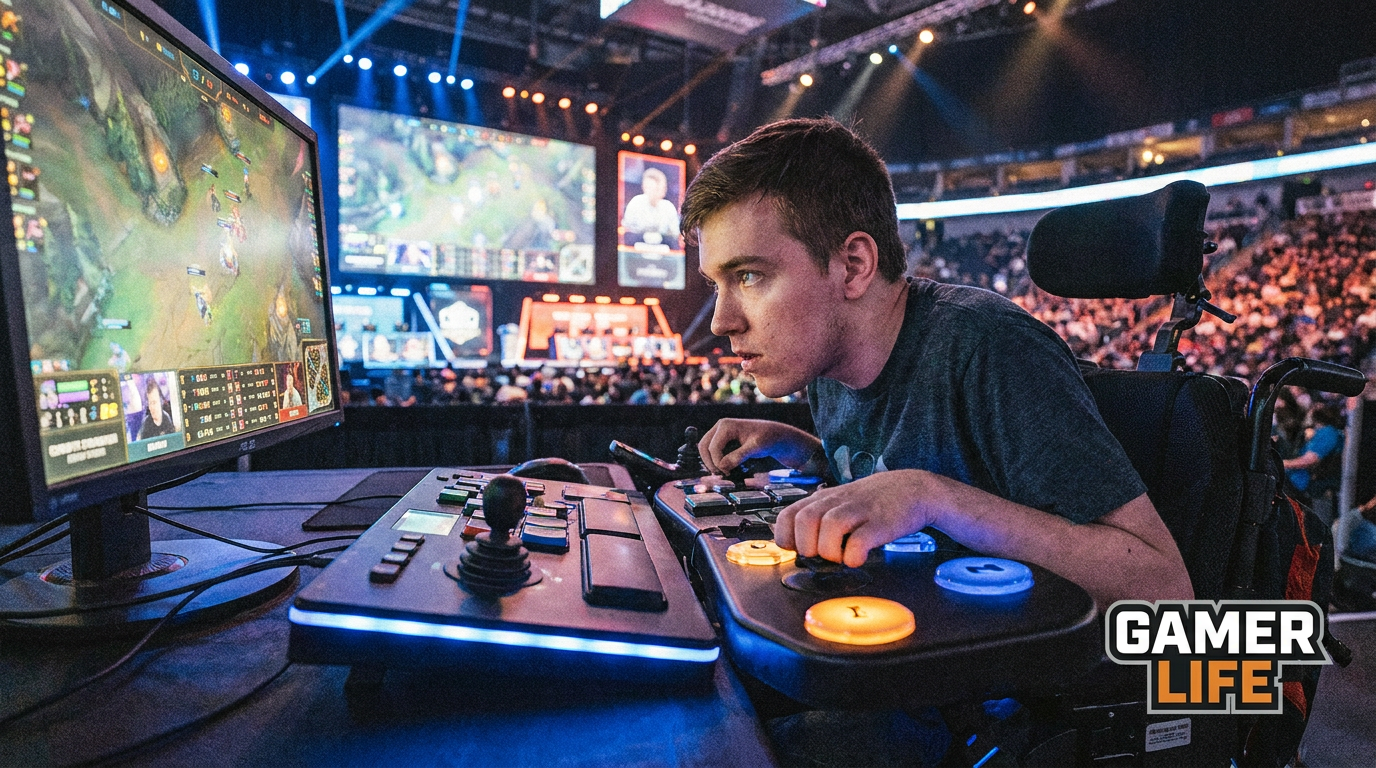
Esports has rapidly transformed from a niche internet subculture into a multi-billion-dollar global enterprise, complete with massive stadium events, lucrative sponsorships, and collegiate scholarships. Yet, for decades, the standard keyboard, mouse, and handheld controller setup acted as a rigid gatekeeper. If a player lacked the fine motor skills to rapidly press a cluster of small buttons or the dexterity to grip a standard gamepad for hours, they were effectively locked out of the competition. Today, that paradigm is shifting. A wave of hardware innovation and inclusive league structures is dismantling these physical barriers, proving that competitive gaming can be the most equitable sport in the world.[6]
The scale of the accessibility gap in gaming is staggering. Industry estimates suggest that there are over 425 million players globally who identify as part of the gaming and disability community. Despite this massive demographic, roughly 66 percent of gamers with disabilities report facing significant physical or software barriers that hinder their ability to play. For years, disabled gamers had to rely on expensive, custom-built rigs or simply watch from the sidelines. Now, major console manufacturers and tournament organizers are recognizing that accessibility is not just a charitable endeavor, but a fundamental expansion of the esports ecosystem.[2][3]
The core philosophy driving this shift is a complete reversal of traditional hardware design. Instead of forcing players to adapt their bodies to the rigid shape of a controller, engineers are building controllers that adapt to the player. This modular approach treats the gamepad not as a finished product, but as a customizable canvas. By breaking down the traditional controller into its component parts—joysticks, triggers, and face buttons—players can physically arrange their inputs in a way that matches their unique strength, range of motion, and physical needs.[8]

Microsoft pioneered this mainstream approach with the release of the Xbox Adaptive Controller, a wide, flat hub designed to sit comfortably on a lap or wheelchair tray. The device features a row of 3.5mm auxiliary ports along its back, allowing players to plug in an array of external switches, foot pedals, and specialized joysticks created by third-party accessibility companies. This plug-and-play ecosystem meant that a player who could only use their feet or head movements could suddenly map those motions to standard in-game actions, leveling the playing field instantly.[2]
Sony recently expanded the accessible hardware market with its own highly customizable kit, originally codenamed Project Leonardo and now known as the Access Controller for the PlayStation 5. Developed in collaboration with accessibility experts, the device features a circular, "split controller" design. It allows for near free-form thumbstick repositioning and includes a robust kit of swappable analog stick caps and buttons in various shapes and sizes. Like its Xbox counterpart, it includes four auxiliary ports to integrate specialty switches, ensuring that players with limited motor control can craft their own bespoke play experience.[1]
The mechanism of these devices relies heavily on deep software integration. Hardware is only useful if the console understands how to interpret it. Both PlayStation and Xbox allow players to remap any function to any physical input, effectively tricking the console into thinking a standard controller is being used. Players can store multiple control profiles directly on the console, allowing them to switch seamlessly between a setup optimized for a fast-paced shooter and one designed for a strategic role-playing game with the press of a single button.[1]

The mechanism of these devices relies heavily on deep software integration.
Affordability and form factor remain critical frontiers for hardware innovators. In response to community feedback requesting cheaper, one-handed options, Microsoft developed the Xbox Adaptive Joystick. Designed to be mounted on tabletops or used with non-hand body parts, the joystick can seamlessly incorporate into existing setups. To further personalize the experience, companies are now offering complimentary 3D-printable files, allowing players to print custom thumbstick toppers that perfectly match the contours of their hands or adaptive equipment, drastically lowering the cost of bespoke hardware.[2]
Beyond physical hardware, artificial intelligence and software engineering are quietly bridging the remaining gaps. Academic researchers note that AI-driven input adaptation can help normalize the performance differences between traditional controllers and adaptive setups. By optimizing matchmaking algorithms and analyzing player data, machine learning models can create skill-based matchmaking systems that ensure fair competition. This means a player using a sip-and-puff switch can be accurately matched against a keyboard-and-mouse user of the exact same skill level, preserving the competitive integrity of the match.[6]
Cross-platform integration and cloud gaming are also playing a vital role in democratizing esports. Historically, fragmented gaming ecosystems and hardware exclusivity created massive financial barriers. By moving processing power to the cloud and unifying account progression across PC, console, and mobile platforms, developers are ensuring that players do not need to purchase multiple expensive consoles to compete. This unified virtual ecosystem allows disabled gamers to invest in a single, high-quality adaptive setup and use it across virtually any competitive title.[6]

This robust technological foundation has birthed a new era of inclusive esports leagues and tournaments. Organizations are no longer just accommodating disabled players; they are building massive events around them. The Adaptive Esports Summit, for example, brings together disabled gamers, industry leaders, and tech innovators for high-stakes tournaments and showcases. Scheduled for late 2025 in Daejeon, South Korea, the summit features professional showmatches in titles like Tekken 8, proving that adaptive technology can support the lightning-fast reflexes required at the highest echelons of competitive play.[3]
Specialized leagues are also thriving at the scholastic level, providing crucial developmental pathways. The Tiger Gaming League, hosted by the Rochester Institute of Technology, offers a dedicated national competition exclusively for deaf and hard-of-hearing high school students. Competing in popular titles like Fortnite and Rocket League, these students form teams, communicate through specialized visual interfaces, and battle through virtual brackets for a chance to play on a national stage. It provides a space where they can hone their skills without the communication barriers present in standard online lobbies.[4]
For visually impaired gamers, the barriers to entry might seem insurmountable, but innovative tournaments are proving otherwise. In Japan, the Shingan Cup made headlines by hosting a competitive Street Fighter V tournament strictly for blind gamers. Because modern fighting games feature incredibly detailed spatial sound design, visually impaired players can compete at astonishingly high levels simply by listening to and reacting to distinct audio cues. These tournaments showcase the depth of possibilities in esports, highlighting how heightened auditory processing can replace visual tracking.[7]

Ultimately, the goal of the accessibility movement is mainstream integration. Events like the Special Olympics' "Gaming for Inclusion" hybrid tournament demonstrate what the future of the industry looks like. By partnering with major tech companies, these events allow disabled athletes to compete alongside neurotypical and able-bodied peers in a unified bracket. Because adaptive setups map perfectly to standard inputs, disabled gamers can train and compete without ever feeling "othered" or relegated to a separate, less competitive tier.[2][5]
As adaptive technology becomes standard rather than exceptional, esports is uniquely positioned to become the most equitable competitive arena in the world. Unlike traditional physical sports, where biological differences often dictate separate leagues, the digital nature of esports allows technology to act as the ultimate equalizer. By continuing to invest in modular hardware, AI-driven software, and inclusive tournament structures, the gaming industry is ensuring that skill, strategy, and dedication are the only metrics that matter on the digital battlefield.[5][8]
How we got here
2018
Microsoft releases the Xbox Adaptive Controller, establishing a new baseline for accessible gaming hardware.
Nov 2019
ePARA hosts its first esports tournament in Japan focused on promoting diversity and inclusion for disabled players.
Jan 2023
Sony unveils Project Leonardo at CES, a highly customizable accessibility controller kit for the PlayStation 5.
Oct 2024
The Special Olympics hosts the 'Gaming for Inclusion' showcase, integrating adaptive tech into a major hybrid tournament.
Early 2025
Microsoft launches the affordable Xbox Adaptive Joystick, designed to be mounted or used with non-hand body parts.
Viewpoints in depth
Hardware Innovators
Engineers and designers focused on modularity and physical accessibility.
This camp argues that the standard controller is an arbitrary barrier to entry. By designing modular hubs with 3.5mm AUX ports and 3D-printable components, they aim to create a 'canvas' where players can build a setup tailored to their exact range of motion. Their focus is on affordability, interoperability, and ensuring that hardware adapts to the human, not the other way around.
Inclusive League Organizers
Advocates building dedicated competitive spaces for disabled athletes.
Organizations running events like the Adaptive Esports Summit and the Tiger Gaming League emphasize the social and developmental benefits of competition. They argue that dedicated leagues provide a necessary stepping stone, offering disabled gamers a space to hone their skills, build community, and experience the high-stakes thrill of esports without the immediate pressure of mainstream, able-bodied tournaments.
Academic & AI Researchers
Technologists looking at software and systemic integration.
Researchers view accessibility through the lens of cross-platform integration and artificial intelligence. They argue that hardware is only half the battle; the future of equitable esports relies on AI-driven input adaptation that normalizes performance gaps and skill-based matchmaking that ensures fair competition regardless of the physical device a player uses.
Esports Advocates
Voices pushing for universal design and mainstream integration.
This perspective champions the idea that esports is uniquely positioned to be the ultimate equalizer. Because the competition happens in a digital space, they argue that disabled athletes should not be 'othered' into separate categories permanently. Their ultimate goal is universal design, where adaptive setups are so seamlessly integrated that disabled and able-bodied gamers compete side-by-side on the main stage.
What we don't know
- Whether major mainstream esports tournaments will universally adopt standardized rules for adaptive hardware in professional brackets.
- How quickly AI-driven input adaptation will be integrated into the core engines of the most popular competitive titles.
- The long-term impact of 3D printing on the affordability and widespread distribution of custom controller parts.
Key terms
- Adaptive Controller
- A customizable gaming gamepad designed specifically for players with limited mobility, allowing them to plug in external switches and remap buttons.
- Cross-Platform Integration
- The ability for players on different gaming systems (like PC, Xbox, and PlayStation) to play together in the same virtual ecosystem.
- Input Remapping
- A software feature that allows a player to change which physical button or joystick movement triggers a specific action in a game.
- Skill-Based Matchmaking
- An automated system that pairs players of similar ability levels against each other in competitive games.
Frequently asked
What is an adaptive controller?
It is a highly customizable gamepad that allows players to swap out buttons, adjust joysticks, and plug in external switches to fit their specific physical needs.
Are there esports tournaments specifically for disabled gamers?
Yes. Events like the Adaptive Esports Summit, the Special Olympics' Gaming for Inclusion, and the Tiger Gaming League offer dedicated competitive spaces for disabled athletes.
How do blind gamers play competitive esports?
Many visually impaired players rely on distinct audio cues and spatial sound design, allowing them to react to in-game events in titles like Street Fighter V.
Can adaptive controllers be used in mainstream tournaments?
Increasingly, yes. Because adaptive setups simply map to standard controller inputs, disabled gamers can compete alongside able-bodied peers without requiring separate game versions.
Sources
Source coverage
8 outlets
4 viewpoints surfaced








[1]PlayStationHardware Innovators
Project Leonardo for PlayStation 5
Read on PlayStation →[2]XboxHardware Innovators
Xbox Celebrates Accessibility in Gaming with New Adaptive Joystick
Read on Xbox →[3]Adaptive Esports SummitInclusive League Organizers
Creating a More Inclusive Gaming Community
Read on Adaptive Esports Summit →[4]Rochester Institute of TechnologyInclusive League Organizers
Tiger Gaming League Spring Season
Read on Rochester Institute of Technology →[5]British EsportsEsports Advocates
Inclusivity and Accessibility in Esports
Read on British Esports →[6]All Multidisciplinary JournalAcademic Researchers
Cross-Platform Integration Framework in eSports
Read on All Multidisciplinary Journal →[7]NextSharkInclusive League Organizers
Blind gamers compete in Japanese 'Street Fighter V' esports tournament
Read on NextShark →[8]Factlen Editorial TeamEsports Advocates
Synthesis by Factlen editorial team
Read on Factlen Editorial Team →
Every angle. Every day.
Get gaming esports stories with full source coverage and perspective breakdowns delivered to your inbox.