
How Adaptive Tech and Co-Pilot Modes Are Making Esports the First Universal Sport
A quiet revolution in modular controllers and audio accessibility is dismantling physical barriers in competitive gaming, allowing disabled players to compete at the highest levels.
By Factlen Editorial Team
- Inclusive Design Advocates
- Argue that hardware and software must be built from the ground up to remove physical barriers to entry.
- Tournament Organizers
- Focus on standardizing rules to ensure competitive integrity while fully accommodating adaptive technology.
- Adaptive Competitors
- Advocate for the right to compete on a level playing field alongside non-disabled peers rather than in segregated leagues.
What's not represented
- · Game developers balancing the cost of implementing extensive accessibility features against tight production budgets.
- · Non-disabled competitors adjusting to new tournament rulesets and hardware verification delays.
Why this matters
For decades, physical limitations excluded millions from the social and competitive benefits of gaming. The standardization of adaptive controllers and accessible software is turning esports into a truly universal arena, where physical interface is decoupled from digital skill.
Key points
- Sven Van de Wege's historic EVO 2023 victory proved that visually impaired players can compete at the highest levels using audio cues.
- First-party hardware like the Xbox Adaptive Controller and PS5 Access Controller have decoupled physical dexterity from digital input.
- Co-Pilot modes allow players to link multiple adaptive switches and standard gamepads into a single unified control profile.
- The 2025 Adaptive Esports Summit in South Korea marked a major step toward standardizing adaptive hardware rules for global tournaments.
- Grassroots leagues are increasingly using handicap systems and driving assists to let adaptive and non-disabled players compete side-by-side.
For decades, the stereotype of a professional esports athlete has been defined by raw physical metrics: twitch reflexes, flawless hand-eye coordination, and the ability to execute hundreds of actions per minute. This hyper-focus on traditional dexterity inadvertently built a wall around competitive gaming, seemingly excluding millions of players with physical or visual disabilities. But over the last few years, a quiet revolution in hardware and software design has begun to dismantle that wall.[1]
The turning point for public awareness arrived on the main stage of the Evolution Championship Series (EVO), the world's largest fighting game tournament. Sven "BlindWarriorSven" Van de Wege, a competitor who lost his eyesight to cancer at age six, sat down to play Street Fighter 6. Wearing a black blindfold, he didn't just participate—he dominated his opponent, executing a flawless level-three Critical Art to win the match to the roaring applause of nearly 10,000 fans.[2][3]
Van de Wege's victory shattered the ceiling of what was considered possible in top-tier esports, but it was not achieved through sheer willpower alone. It was the result of a deliberate shift in how game developers approach inclusive design. Street Fighter 6 features an extensive suite of audio accessibility options that translate visual data into a complex, readable soundscape.[2][3]
By utilizing distinct audio cues for character movement, distance tones, and left-right balance, the game allows visually impaired players to build a precise mental map of the digital arena. A specific chime indicates when an opponent's attack is high or low, while the pitch of a tone reveals exactly how much distance separates the two fighters. This mechanism allows a blind player to react to an opponent's strategy with the same speed as a sighted player.[1][3]

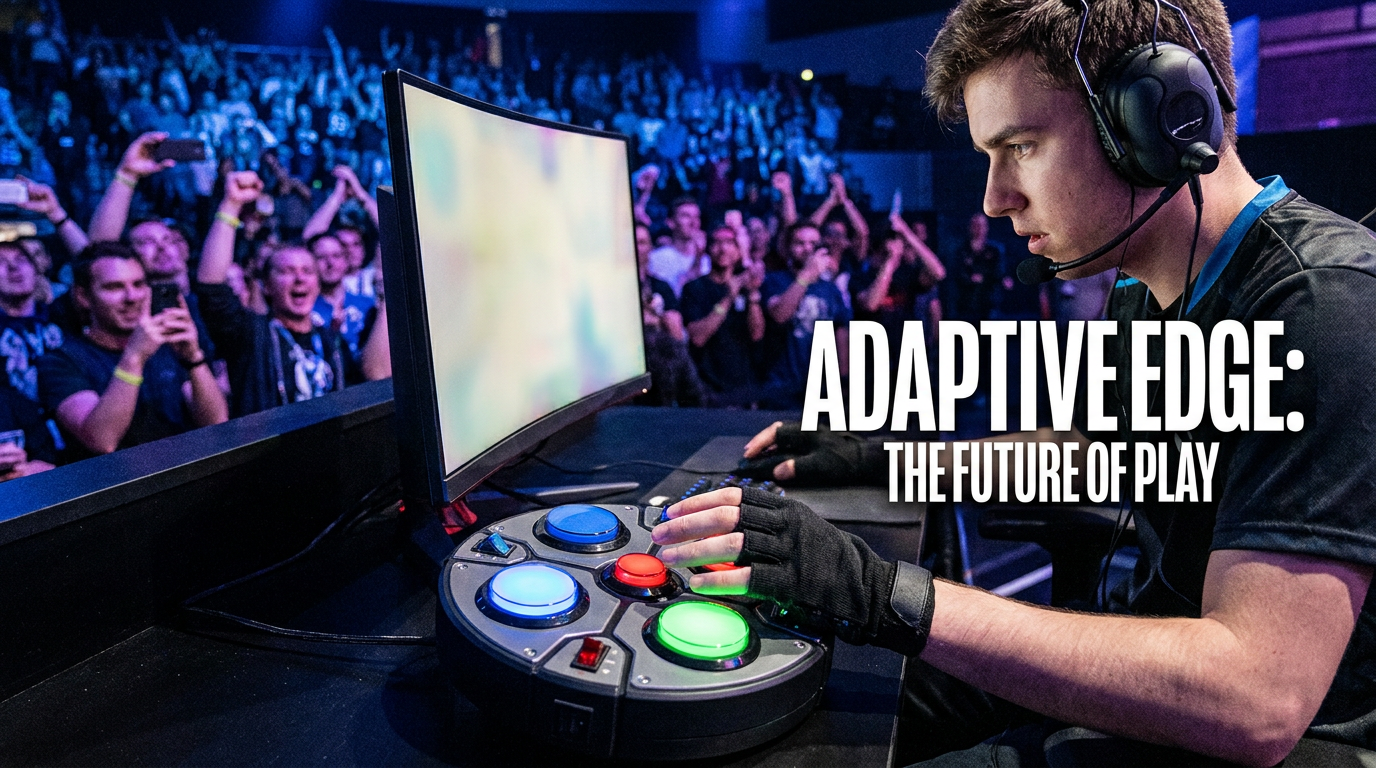
While software accessibility has made massive strides, the physical interface—the controller—remained the most significant barrier for players with motor disabilities. Standard gamepads require high manual dexterity, forcing players to adapt their bodies to the hardware. The modern adaptive tech movement flips this paradigm entirely, allowing the hardware to adapt to the player's body.[1][4]
Microsoft pioneered this space with the Xbox Adaptive Controller, a flat, rectangular hub featuring two large programmable buttons and a row of 3.5mm expansion ports. These universal ports allow players to plug in custom switches, foot pedals, and specialized joysticks, mapping them to any standard controller input. If a player can only move their head and one foot, the controller can be built around those specific movements.[1][5]
PlayStation recently followed suit with the Access Controller for the PS5, a highly customizable circular pod designed in collaboration with the accessibility community. It features swappable button caps, an adjustable joystick, and its own array of 3.5mm expansion ports. The device is designed to sit flat on a wheelchair tray or desk, requiring zero grip strength to operate.[4]

The true power of these first-party devices lies in their modularity and software integration. Both platforms now support "Co-Pilot" or linked-controller modes. On the PS5, a player can link up to two Access Controllers and one standard DualSense controller, merging all three physical devices into a single digital input profile.[1][4]
The true power of these first-party devices lies in their modularity and software integration.
This mechanism is transformative. It means a player could use their feet to operate two large external switches for the "X" and "O" buttons, use their left hand on an Access Controller joystick for movement, and have a teammate or their right hand manage the camera on a standard gamepad. The console simply reads the combined inputs as one player playing the game seamlessly.[1][4]
The ecosystem is further supported by third-party manufacturers like Logitech, which produces the Adaptive Gaming Kit—a collection of plug-and-play buttons and triggers that can be arranged on a rigid gaming mat with a hook-and-loop system. Grassroots organizations and 3D-printing communities have also stepped in to create custom, low-cost mounts and switches, addressing the fact that 30% of disabled gamers cite the affordability of assistive tech as their primary barrier to entry.[4][5]

With the hardware and software foundations firmly in place, the focus has now shifted to competitive integration. Historically, tournament organizers struggled with how to regulate custom controllers, fearing that specialized macros or modified hardware could provide an unfair advantage to the user.[1]
To address this friction, the industry is moving toward standardized rulesets for adaptive play. In December 2025, the city of Daejeon, South Korea, hosted the first Adaptive Esports Summit. The event brought together global accessibility experts, including Bryce Johnson, co-inventor of the Xbox Adaptive Controller, and legendary esports competitors to draft frameworks for inclusive tournament play.[5][6]
The summit's core mission was to prove that adaptive technology does not compromise competitive integrity; rather, it levels the playing field. By showcasing exhibition matches in games like Tekken 8 and League of Legends, organizers demonstrated how players using adaptive rigs could compete fairly against those using standard controllers, provided the hardware maps one physical press to one digital action.[5][6]
This push for inclusion is also taking root at the grassroots and collegiate levels. In the United States, the Easterseals ES Gaming initiative has partnered with universities to launch local esports teams that center accessibility. They provide adaptive hardware and accessible software, ensuring that students with disabilities have the exact same opportunities to compete, build community, and pursue STEM pathways as their peers.[8]

Similarly, the Australian Esports League recently integrated comprehensive adaptive support into its regional competitions. At the Gippsland Esports Competition, advanced players and adaptive players race side-by-side in titles like F1 2025. The tournament utilizes official disability grading systems, driving assists, and Xbox Adaptive Controllers to ensure a fully supported and fair environment.[7]
The business case for this integration is undeniable. According to industry data, 66% of gamers with disabilities face barriers to play, yet disabled gamers consistently spend more time gaming per session than non-disabled gamers. By removing these barriers, the esports industry is unlocking a massive, highly engaged demographic that has been historically sidelined.[5]
Looking ahead, the ultimate goal of the adaptive esports movement is not to create separate, segregated leagues for disabled players. Instead, the objective is universal design—tournaments where the physical interface is entirely decoupled from the digital competition, allowing anyone to plug in their preferred input method and compete for the same championship trophy.[1][5]
As hardware becomes more modular and software more accommodating, competitive gaming is uniquely positioned to become the world's first truly universal sport. In the digital arena, the only metrics that matter are strategy, timing, and skill—regardless of how the buttons are pressed.[1]
How we got here
2018
Microsoft releases the Xbox Adaptive Controller, establishing the first major first-party hardware hub for disabled gamers.
August 2023
BlindWarriorSven wins a Street Fighter 6 match on the main stage at EVO, utilizing the game's advanced audio accessibility features.
December 2023
PlayStation launches the Access Controller for the PS5, expanding the first-party adaptive hardware ecosystem.
December 2025
The first Adaptive Esports Summit is held in Daejeon, South Korea, bringing together industry leaders to standardize inclusive tournament play.
Viewpoints in depth
The Hardware Innovators
Focusing on modularity and universal standards to lower the physical barriers to gaming.
Companies like Microsoft and PlayStation, alongside third-party creators like Logitech, view the standard gamepad as a bottleneck. Their approach is to decouple the input method from the console itself. By creating centralized hubs with universal 3.5mm expansion ports, they allow players to build bespoke control schemes—using foot pedals, bite switches, or oversized arcade buttons—that map perfectly to their unique physical mobility.
Tournament Regulators
Balancing the need for accessibility with the strict requirements of competitive integrity.
For years, major esports tournaments banned custom controllers to prevent cheating via hardware macros or automated inputs. Now, organizations are working to create standardized verification processes for adaptive rigs. The goal is to ensure that an adaptive switch performs exactly one in-game action per physical press, allowing disabled competitors to participate in mainstream brackets without triggering unfair-advantage disputes.
The Competitors' Vision
Fighting for mainstream integration rather than segregated 'special' leagues.
Adaptive esports athletes consistently push back against the idea of separate tournaments for disabled players. Because video games take place in a digital space, the physical method of input shouldn't matter as long as the digital output is fair. Competitors argue that with the right adaptive tech and software audio cues, they can—and do—compete at the highest levels of mainstream events like EVO.
What we don't know
- How quickly smaller, regional tournament organizers will be able to afford and implement the standardized verification tools needed for custom adaptive rigs.
- Whether future virtual reality (VR) esports will be able to adapt to physical mobility limitations as effectively as traditional gamepad-based titles.
Key terms
- Co-Pilot Mode
- A system-level console feature that links two or more physical controllers together so the game registers them as a single player's input.
- 3.5mm Expansion Port
- A universal audio-style jack used on adaptive controllers to plug in custom external buttons, switches, and foot pedals.
- Critical Art
- A high-damage, cinematic special move in Street Fighter that requires a full energy meter to execute.
- Universal Design
- The concept of creating products and environments that are accessible to all people, regardless of age, disability, or other factors.
Frequently asked
What is an adaptive controller?
An adaptive controller is a highly customizable gaming hub that allows players to plug in external switches, joysticks, and pedals. This lets players with limited mobility create a personalized setup that works for their body.
How do blind players compete in fighting games?
Modern fighting games like Street Fighter 6 include advanced audio accessibility features. These provide specific sound cues for character movement, attack types, and distance, allowing visually impaired players to react entirely based on sound.
Can adaptive controllers be used in professional tournaments?
Yes, increasingly so. Major tournaments like EVO and regional leagues are adopting standardized rulesets that allow players to use verified adaptive controllers, ensuring they can compete fairly against standard gamepad users.
Sources
Source coverage
8 outlets
3 viewpoints surfaced








[1]Factlen Editorial TeamInclusive Design Advocates
Synthesis by Factlen editorial team
Read on Factlen Editorial Team →[2]KotakuAdaptive Competitors
Blind Street Fighter 6 Player Steals Fighting Game Tournament's Hearts
Read on Kotaku →[3]ONE EsportsAdaptive Competitors
Completely blind pro player wins Street Fighter match on Evo 2023 main stage
Read on ONE Esports →[4]PlayStationInclusive Design Advocates
Access controller for PS5 console
Read on PlayStation →[5]Adaptive Esports SummitTournament Organizers
Adaptive Esports Summit 2025 - Daejeon
Read on Adaptive Esports Summit →[6]Esports RadarTournament Organizers
First Adaptive Esports Summit to be held in South Korea
Read on Esports Radar →[7]Australian Esports LeagueTournament Organizers
Gippsland Esports Competition - All Abilities Adaptive Play
Read on Australian Esports League →[8]EastersealsInclusive Design Advocates
Launching Local Esports with ES Gaming
Read on Easterseals →
Every angle. Every day.
Get gaming esports stories with full source coverage and perspective breakdowns delivered to your inbox.