
Hidden Gas on Uranus Settles the Debate Over Its 'Ice Giant' Status
New observations using the ALMA observatory have detected carbon monoxide deep in the atmosphere of Uranus. The discovery confirms the planet is rich in water ice, resolving a long-standing mystery about its formation and interior.
By Factlen Editorial Team
- Ice Giant Proponents
- Argue that Uranus and Neptune share a similar formation history rich in volatile ices.
- Rock-Dominated Theorists
- Previously argued that the lack of carbon monoxide indicated a fundamentally different, rocky interior.
- Planetary Mission Advocates
- Emphasize that remote observations have limits and only a dedicated flagship mission can map the interior.
What's not represented
- · Exoplanet Researchers
Why this matters
Understanding the true composition of Uranus helps astronomers decode how our solar system formed. It also provides a crucial baseline for studying the thousands of similar 'ice giant' exoplanets discovered orbiting other stars.
Key points
- Astronomers used the ALMA observatory to detect carbon monoxide deep in Uranus's atmosphere for the first time.
- The presence of the gas acts as a chemical tracer, proving the planet's interior is rich in water ice.
- This discovery refutes the 'rock giant' hypothesis, confirming Uranus and Neptune share similar compositions.
- The findings simplify models of how the outer solar system formed from primordial cometary materials.
- Scientists still advocate for a dedicated Uranus Orbiter to fully map the planet's hidden interior.
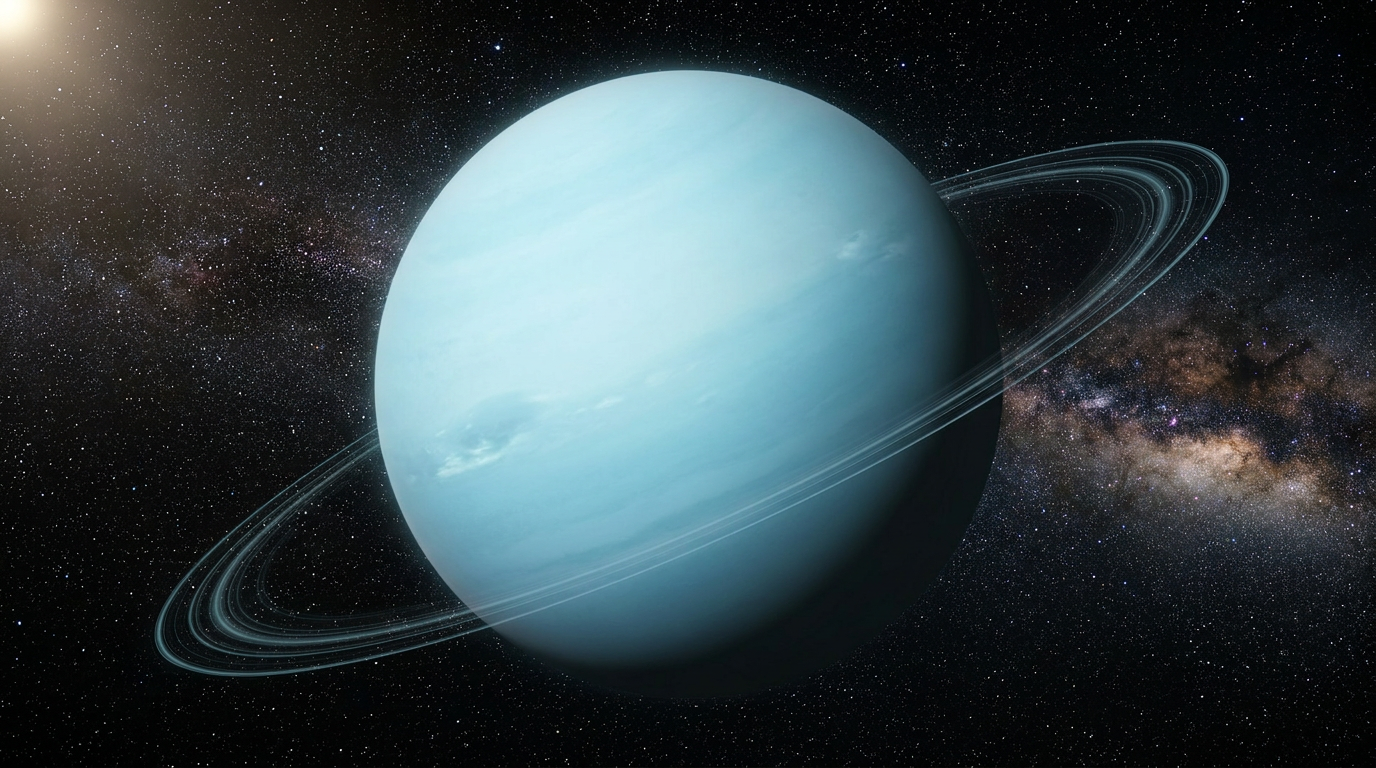
At the frigid outer edges of our solar system, Uranus and Neptune have long been classified as planetary twins. Both are roughly four times the diameter of Earth, both feature thick atmospheres of hydrogen and helium tinged blue by methane, and both have historically been categorized as "ice giants." This classification separates them from the gas giants, Jupiter and Saturn, which are composed almost entirely of hydrogen and helium. Instead, the ice giants are believed to harbor massive interior oceans of heavier elements. Yet, for decades, a glaring chemical discrepancy threatened to tear that family portrait apart.[1][4]
While the two planets look remarkably similar from afar, their atmospheric chemistries presented a baffling puzzle to astronomers. Neptune's deep atmosphere is demonstrably rich in carbon monoxide, a gas that wells up from the planet's interior. Uranus, however, appeared strangely devoid of the gas in its lower atmosphere. Previous observations had only detected trace amounts of carbon monoxide in Uranus's upper stratosphere, which scientists attributed to external sources like cometary impacts raining debris down onto the planet. The deep troposphere, where internal gases should mix and become visible, seemed completely empty.[1][5]
This absence was not merely a minor atmospheric quirk; it struck at the heart of how the planet formed. The lack of deep carbon monoxide led some planetary scientists to propose a radical idea: Uranus might not be an ice giant at all. Instead, it could be a "rock giant" masquerading in a gaseous envelope. If Uranus lacked the internal oxygen required to produce carbon monoxide, it might be composed primarily of heavy silicates and metals, fundamentally separating it from its neighbor Neptune.[1][5]
The "rock giant" hypothesis gained traction because carbon monoxide acts as a crucial chemical tracer for a planet's internal composition. In the extreme pressures and temperatures deep inside a giant planet, carbon monoxide is produced when oxygen reacts with carbon. Because the primary source of oxygen in the outer solar system is water ice, the presence of carbon monoxide is a direct proxy for the presence of water. Convection currents dredge this gas up into the lower atmosphere, where it can theoretically be detected by telescopes.[4][5]

Because astronomers could easily spot carbon monoxide welling up from Neptune's interior, they knew Neptune possessed a massive, water-rich mantle. The baffling inability to find the same gas deep within Uranus suggested its interior was fundamentally different, perhaps dominated by heavy rock rather than oxygen-rich ices. This presented a major headache for planetary formation models, which generally assume that planets forming in the same distant, freezing zone of the protoplanetary disk should accrete from the same available building blocks.[1][5]
Now, a breakthrough observation has rewritten our understanding of the seventh planet, restoring its status as a true ice giant. Using the Atacama Large Millimeter/submillimeter Array (ALMA)—a sprawling network of highly sensitive radio antennas situated high in the Chilean Andes—astronomers have finally peered deep enough into the Uranian atmosphere to solve the mystery. ALMA's ability to detect faint millimeter-wavelength emissions makes it uniquely suited to cut through planetary haze.[2][3]
Between 2022 and 2024, a research team led by Thibault Cavalié at the University of Bordeaux conducted a series of unprecedented observations. They tuned ALMA to the specific frequencies required to probe Uranus's hidden troposphere, looking beneath the thick, frigid layers of methane and hydrogen sulfide clouds that had previously obscured the lower atmosphere from older telescopes. The goal was to definitively determine whether the carbon monoxide was truly absent, or simply hiding below the visible cloud deck.[2][3]
Between 2022 and 2024, a research team led by Thibault Cavalié at the University of Bordeaux conducted a series of unprecedented observations.
The results of the ALMA campaign were definitive: deep within the planet's lower atmosphere, the researchers detected the unmistakable spectral signature of carbon monoxide. The gas had been there all along. By quantifying the abundance of this deep-seated carbon monoxide, the team confirmed that it is actively welling up from the planet's interior, driven by the same chemical processes observed on Neptune.[1][2][5]

This detection provides the "smoking gun" evidence that Uranus possesses a massive internal reservoir of oxygen. It definitively proves that the planet contains far more water ice than rock, aligning its bulk composition with Neptune's. The "rock giant" hypothesis can now be safely retired, and the twin status of the solar system's outermost planets is fully restored. Both worlds are true ice giants, built from the same primordial materials.[1][5]
By confirming that Uranus shares Neptune's water-rich interior, the ALMA data simplifies our models of how the solar system formed. Both planets likely grew by sweeping up massive quantities of cometary ices and volatile-rich planetesimals in the outer solar nebula before capturing their thin hydrogen-helium envelopes. The fact that they share a similar chemical foundation reinforces the idea that planetary accretion is a regional process, governed by the local availability of materials in the protoplanetary disk.[1][3][4]
To fully grasp the implications of this finding, it is important to clarify what planetary scientists mean when they use the word "ice." In the context of Uranus and Neptune, ice does not refer to the solid, frozen cubes we experience on Earth. Instead, the term describes a specific class of volatile molecules—primarily water, ammonia, and methane—that were frozen solid in the early solar system.[1][4]
Deep inside Uranus today, the extreme temperatures (reaching thousands of degrees) and crushing pressures compress these molecules into a supercritical fluid. This dense, electrically conductive state of matter behaves simultaneously like a liquid and a gas, forming a churning, exotic ocean that makes up the vast majority of the planet's mass. It is within this supercritical mantle that Uranus's carbon monoxide is forged, as immense pressure forces water molecules to interact with carbon-bearing compounds.[4][5]

The fact that this gas is now confirmed to be circulating into the observable troposphere suggests that Uranus's interior is more dynamic than previously thought. For years, Uranus was considered the "boring" planet because it emits very little internal heat compared to Jupiter, Saturn, and Neptune. The new detection of deep atmospheric mixing hints at complex convective processes still churning within the planet's icy depths, challenging the notion that Uranus is a stagnant, frozen world.[1][4]
While the ALMA discovery is a triumph for remote sensing and radio astronomy, it also highlights the inherent limitations of studying planets from billions of miles away. Earth-based observatories, no matter how powerful, can only peer so deep into the Uranian atmosphere before the planet's opacity blocks all signals. The exact ratio of rock to ice, the precise structure of the supercritical mantle, and the mechanics of the planet's bizarre, off-center magnetic field remain hidden from our view.[2][4]
To truly understand the internal architecture of an ice giant, scientists cannot rely solely on telescopes; they must send a dedicated spacecraft to orbit the planet and drop a probe directly into its atmosphere. Recognizing this critical gap in our knowledge, the planetary science community has officially prioritized a Uranus Orbiter and Probe as the next flagship mission for the coming decade.[1][4]

Such a mission would map the planet's gravitational and magnetic fields in high resolution, definitively revealing the size of its rocky core and the depth of its water-rich mantle. It would also study Uranus's unique system of rings and its collection of icy moons, some of which may harbor subsurface oceans of their own. Until that spacecraft finally launches and completes its long journey, discoveries like the hidden carbon monoxide prove that the ice giants still have profound secrets left to share.[1][4][5]
How we got here
1986
NASA's Voyager 2 spacecraft flies past Uranus, providing the only close-up data of the planet to date.
2010s
The inability to detect deep carbon monoxide leads some scientists to propose the 'rock giant' hypothesis.
2022–2024
A research team uses the ALMA observatory in Chile to conduct deep atmospheric scans of Uranus.
June 2026
Researchers announce the detection of deep carbon monoxide, confirming Uranus's ice-rich interior.
2030s
The proposed launch window for the NASA Uranus Orbiter and Probe, the next major planetary flagship mission.
Viewpoints in depth
Ice Giant Proponents
Argue that Uranus and Neptune share a similar formation history rich in volatile ices.
This camp points to the new ALMA data as definitive proof that Uranus and Neptune are true planetary twins. By confirming the presence of deep carbon monoxide, they argue that both planets accreted from the same water-rich cometary materials in the outer solar nebula. They emphasize that the chemical similarities simplify our understanding of planetary formation, proving that the outer solar system was a relatively uniform environment where regional building blocks dictated planetary composition.
Rock-Dominated Theorists
Previously argued that the lack of carbon monoxide indicated a fundamentally different, rocky interior.
Before the ALMA discovery, some researchers hypothesized that Uranus was an anomaly—a 'rock giant' that lacked the massive water-ice mantle found in Neptune. They pointed to the absence of deep carbon monoxide and the planet's unusually low internal heat as evidence that its interior was composed primarily of heavy silicates. While the new data largely refutes this theory, these theorists correctly highlighted that Uranus's extreme axial tilt and sluggish heat emission still require unique explanations, possibly involving a colossal impact early in its history.
Planetary Mission Advocates
Emphasize that remote observations have limits and only a dedicated flagship mission can map the interior.
While celebrating the ALMA findings, this group stresses that Earth-based telescopes can only scratch the surface of planetary science. They argue that the exact ratio of rock to ice, the structure of the supercritical mantle, and the mechanics of Uranus's bizarre magnetic field cannot be resolved from billions of miles away. They advocate strongly for the proposed Uranus Orbiter and Probe, arguing that dropping an atmospheric probe directly into the planet is the only way to ground-truth our remote sensing data.
What we don't know
- The exact ratio of rock to ice deep within Uranus's supercritical mantle.
- Why Uranus emits significantly less internal heat than its twin, Neptune.
- How the planet's bizarre, off-center magnetic field is generated by its interior oceans.
Key terms
- Ice Giant
- A giant planet composed primarily of elements heavier than hydrogen and helium, such as oxygen, carbon, nitrogen, and sulfur.
- Supercritical Fluid
- A state of matter that occurs at extreme temperatures and pressures, exhibiting properties of both a liquid and a gas.
- Troposphere
- The lowest layer of a planet's atmosphere, where weather occurs and internal gases mix.
- ALMA
- The Atacama Large Millimeter/submillimeter Array, a powerful radio telescope in Chile used to detect faint molecular signatures in space.
Frequently asked
Why is carbon monoxide important on Uranus?
It acts as a chemical tracer. Its presence indicates that the planet's deep interior contains abundant oxygen, primarily in the form of water ice.
Does Uranus actually have solid ice inside?
No. The extreme pressure and temperature deep inside the planet compress water, ammonia, and methane into a dense, hot 'supercritical fluid,' not solid ice cubes.
Will we send a spacecraft to Uranus?
The planetary science community has prioritized a Uranus Orbiter and Probe as the next major flagship mission, though it has not yet launched.
Sources
Source coverage
6 outlets
3 viewpoints surfaced






[1]Factlen Editorial TeamIce Giant Proponents
Synthesis by Factlen editorial team
Read on Factlen Editorial Team →[2]ALMA ObservatoryPlanetary Mission Advocates
ALMA Observations of Ice Giant Atmospheres
Read on ALMA Observatory →[3]University of BordeauxIce Giant Proponents
Astrophysics Laboratory Planetary Science Research
Read on University of Bordeaux →[4]NASA SciencePlanetary Mission Advocates
Uranus: Facts, Moons, Rings, and Exploration
Read on NASA Science →[5]arXivIce Giant Proponents
Carbon Monoxide in the Deep Atmosphere of Uranus
Read on arXiv →[6]Planetary Science JournalRock-Dominated Theorists
Interior Models of Uranus and Neptune
Read on Planetary Science Journal →


Every angle. Every day.
Get science stories with full source coverage and perspective breakdowns delivered to your inbox.