
Geophysical Survey Suggests Göbekli Tepe Was a Residential City, Not Just a Ceremonial Center
New geophysical surveys and excavations at Göbekli Tepe have revealed traces of large rectangular buildings that appear to be domestic residences. The findings challenge the long-held view that the 11,000-year-old site was solely an isolated ceremonial sanctuary built by nomadic hunter-gatherers.
By Harper Lane

The prevailing narrative of Göbekli Tepe is that of an isolated cathedral on a hill. For decades, the 11,000-year-old megalithic complex in southeastern Turkey has been widely described as the world's first temple—a purely ceremonial sanctuary built by nomadic hunter-gatherers who gathered for worship before dispersing back into the wild.[1][4]
But the physical data is increasingly contradicting that narrative. Recent geophysical surveys and targeted excavations have revealed traces of several large, rectangular buildings situated near the famous circular enclosures. According to archaeologists leading the Stone Hills Project, the internal layouts of these newly discovered structures strongly suggest they were used as domestic residences.[1][2]
The primary claim for a residential settlement rests on new excavations north of the site's protected core. "Our first impression is that they were used as housing," stated Necmi Karul, a professor at Istanbul University and the coordinator of the current excavations. The structures belong to the site's second phase and feature internal arrangements far more compatible with everyday living than the monumental stone circles.[1]
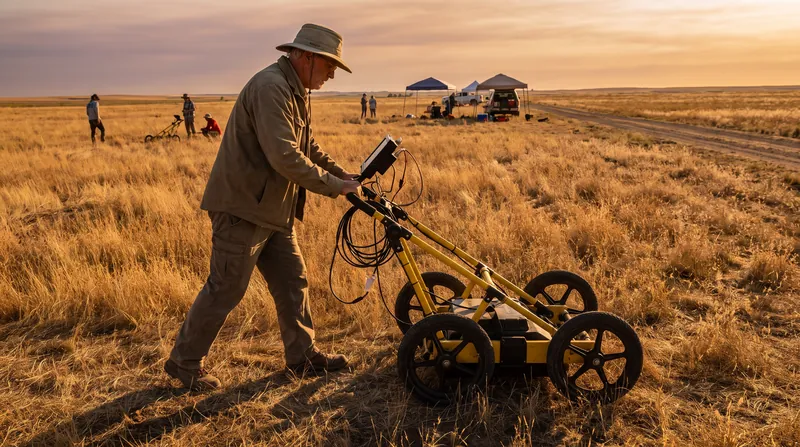
The evidence for the site's layout relies heavily on non-invasive geophysical surveys, including ground-penetrating radar. These scans have mapped the unexcavated portions of the 9-hectare mound, detecting at least 20 large enclosures buried beneath the surface, alongside smaller structures that fill the spaces between the monumental circles.[3][4]
Supporting the architectural data is a growing inventory of domestic artifacts. Recent analyses have cataloged extensive cereal processing tools, including grinding stones, mortars, and pestles. While early interpretations suggested these were used solely to brew beer for ritual feasts, the sheer volume of these tools points toward sustained, daily food preparation by a settled population.[4]
The academic groundwork for this shift has been building for years. Anthropological critiques have previously argued that the strict division between "sacred" and "profane" spaces is a modern ethnocentric bias. Researchers have long hypothesized that the buildings at Göbekli Tepe could actually be houses rich in symbolic content, rather than exclusive temples.[3]
However, the evidence for permanent habitation remains provisional and carries transparent uncertainty. Researchers are currently analyzing floor samples from the newly excavated rectangular buildings to confirm domestic activity. The definitive proof—unambiguous traces of indoor hearths, everyday plant remains, and household refuse—has not yet been fully published.
The presence of homes would solve several logistical mysteries that have long puzzled researchers. Quarrying, transporting, and erecting limestone pillars weighing up to 16 tons required a massive, coordinated labor force. A permanent or semi-permanent settlement would provide the necessary infrastructure to support such an ambitious, multi-generational construction project.[1][4]
The implications for human history are profound. The original interpretation of Göbekli Tepe popularized the idea that the urge to worship drove hunter-gatherers to invent agriculture and settle down. A residential Göbekli Tepe suggests a more intertwined reality where ritual architecture and ordinary village life developed side by side.[1][3]
As excavations continue, the boundary between the sacred and the profane at Göbekli Tepe is blurring. The site is no longer just a monument to ancient spirituality; the emerging evidence points to a vibrant, complex community where the earliest experiments in settled human life were forged in the shadow of towering stone giants.[2]
Viewpoints in depth
The 'Temple First' Traditionalists
The original interpretation that Göbekli Tepe was an isolated sanctuary built by nomadic hunter-gatherers.
Pioneered by the site's original excavator, Klaus Schmidt, this perspective argues that Göbekli Tepe lacks the definitive hallmarks of permanent Neolithic settlement, such as widespread hearths, trash pits, and domesticated agriculture. Proponents of this view maintain that the site was a regional pilgrimage center where disparate hunter-gatherer bands gathered to construct monuments, feast, and perform rituals before returning to a mobile lifestyle. In this framework, the sheer effort required to build the temples is what eventually forced the invention of agriculture.
The Settlement Advocates
The emerging consensus that Göbekli Tepe was a functioning residential community.
Driven by recent geophysical surveys and new excavations led by Necmi Karul, this camp points to the discovery of rectangular structures with domestic layouts, extensive water supply installations, and thousands of grinding stones. They argue that the strict division between 'temple' and 'house' is a modern bias, and that the monumental pillars likely stood at the center of a bustling, semi-permanent or permanent village. This perspective suggests that complex social organization and settled living evolved concurrently with ritual practices, rather than as a later consequence of them.
Key points
- New excavations at Göbekli Tepe have uncovered rectangular structures that archaeologists believe were used as domestic residences.
- Geophysical surveys reveal at least 20 large enclosures and numerous smaller buildings buried across the 9-hectare site.
- Extensive cereal processing tools and water installations support the theory of a settled population.
- The findings challenge the famous theory that the site was an isolated, ritual-only sanctuary built by nomads.
What we don’t know
- Whether the newly discovered rectangular structures contain definitive indoor hearths or household refuse.
- Exactly how many people lived at the site year-round versus gathering seasonally for construction.
- Whether the inhabitants relied entirely on wild foraging or had begun early forms of agricultural cultivation.
How we got here
1994
German archaeologist Klaus Schmidt begins excavations, identifying the site as a massive, ritual-only sanctuary.
2003–2012
Geophysical surveys detect dozens of unexcavated circular enclosures buried across the mound.
2018
Göbekli Tepe is designated a UNESCO World Heritage Site.
August 2026
Archaeologists announce the discovery of rectangular structures whose internal layouts suggest domestic housing.
- Settlement Advocates
- Argue that new architectural and tool evidence proves the site was a permanent residential village.
- Traditional Sanctuary Theorists
- Maintain that the site was primarily a ritual gathering place for nomadic hunter-gatherers, with limited permanent habitation.
Perspectives this story doesn't cover
- Local Turkish communities living near the site today
- Indigenous archaeo-astronomers studying the site's celestial alignments
Sources
Source coverage
4 outlets
2 viewpoints surfaced



- [1]The DebriefSettlement Advocates
A New Discovery at Göbekli Tepe Could Reshape Our Understanding of One of the Ancient World's Most Perplexing Sites
Read on The Debrief → - [2]Archaeology MagazineSettlement Advocates
Dwellings Detected Near Monuments at Göbekli Tepe
Read on Archaeology Magazine → - [3]Current AnthropologyTraditional Sanctuary Theorists
So Fair a House: Göbekli Tepe and the Identification of Temples in the Pre-Pottery Neolithic of the Near East
Read on Current Anthropology → - [4]WikipediaTraditional Sanctuary Theorists
Göbekli Tepe
Read on Wikipedia →

More in Science
See all →Zooarchaeology
The NISP and MNI Metrics: How Bone Fragment Counts and Minimum Individuals Reconstruct Ancient Diet and Economy
7 sources
Isotope Geochemistry
How Strontium Isotope Analysis of Tooth Enamel Reconstructs Ancient Human Migration
4 sources

Remote Sensing
Mapping the Unseen: How Lidar, Radar, and Magnetometry Detect Subsurface Archaeological Features
5 sources
Human Origins
The Evidence for the Peopling of the Americas: Comparing the Coastal Migration, Clovis First, and Pre-Clovis Models
10 sources

Comments
Every angle. Every day.
Get Science stories with full source coverage and perspective breakdowns, free every day.