
Football's New Era: IFAB Introduces Sweeping Rule Changes to Speed Up Play and Curb Time-Wasting
The International Football Association Board has rolled out landmark rule changes taking effect this week, introducing strict time limits on substitutions, expanded VAR powers, and new penalties for on-pitch confrontations.
By Factlen Editorial Team
- Governing Bodies
- Argue the changes are necessary to clean up the game, maximize effective playing time, and protect players from abuse.
- Broadcasters & Fans
- Welcome the crackdown on time-wasting and tactical timeouts, hoping for a more entertaining and continuous viewing experience.
- Tactical Analysts
- Focus on how the strict substitution and injury countdowns will force managers to adapt their late-game strategies.
What's not represented
- · Lower-League Clubs
- · Players' Unions
Why this matters
These changes fundamentally alter how the final minutes of a football match are played. By eliminating the 'dark arts' of time-wasting and tactical injuries, fans will see more continuous action, while strict new conduct rules aim to make the sport safer and more respectful.
Key points
- IFAB has introduced sweeping new rules taking effect globally on June 12, 2026.
- Substituted players now have exactly 10 seconds to leave the pitch, or their team will temporarily play a man down.
- Outfield players receiving medical treatment on the pitch must wait on the sideline for 60 seconds before returning.
- Referees will enforce a strict five-second countdown for throw-ins and goal kicks to prevent time-wasting.
- Players covering their mouths during confrontations to hide abusive language will receive an automatic red card.
- VAR powers have been expanded to review second yellow cards and incorrectly awarded corner kicks.
The way global football is played and officiated is undergoing a massive structural shift this week. The International Football Association Board (IFAB) has officially implemented a sweeping set of rule changes that take effect globally on June 12, 2026. Designed to maximize effective playing time and protect players from abuse, the new laws target the sport's most frustrating elements: time-wasting, tactical injuries, and abusive confrontations.[1][2][4]
One of the most dramatic changes targets the agonizingly slow substitution. Under the new framework, players now have exactly 10 seconds to leave the pitch once their number goes up on the board. They are required to exit via the nearest boundary line, eliminating the leisurely stroll across the entire field that has long been a staple of late-game clock management.[2][4]
If a player fails to cross the line within the 10-second window, play restarts without their replacement. The incoming substitute is forced to wait on the touchline until the next stoppage in play—provided at least one minute has elapsed—leaving their team to temporarily navigate the match with only 10 men. The rule has already been tested in international friendlies, with teams successfully capitalizing on the temporary numerical advantage.[3][4][5]

To combat "tactical timeouts"—where players feign injury to break an opponent's momentum or secure a rest—IFAB has introduced a strict medical protocol. Any outfield player requiring on-pitch treatment must now leave the field for a mandatory 60 seconds after play resumes. This ensures that genuine injuries receive proper sideline assessment while heavily disincentivizing players from using cramps to stall the game.[2][4][5]
There are common-sense exceptions to the injury rule to ensure player safety is not compromised. Goalkeepers, players suffering from severe collisions or head injuries, and the designated taker of an awarded penalty kick are exempt from the one-minute sideline wait. If an injury is caused by a foul that results in a yellow or red card, the injured player may also remain on the pitch.[1][3]
There are common-sense exceptions to the injury rule to ensure player safety is not compromised.
The urgency extends to standard restarts. Goalkeepers and throw-in takers are now officially on the clock. Referees will initiate a visible five-second countdown for throw-ins and goal kicks. If the player dawdles and the countdown expires, possession is immediately handed to the opposition, awarding a corner kick or an opposing throw-in.[2][4][5]

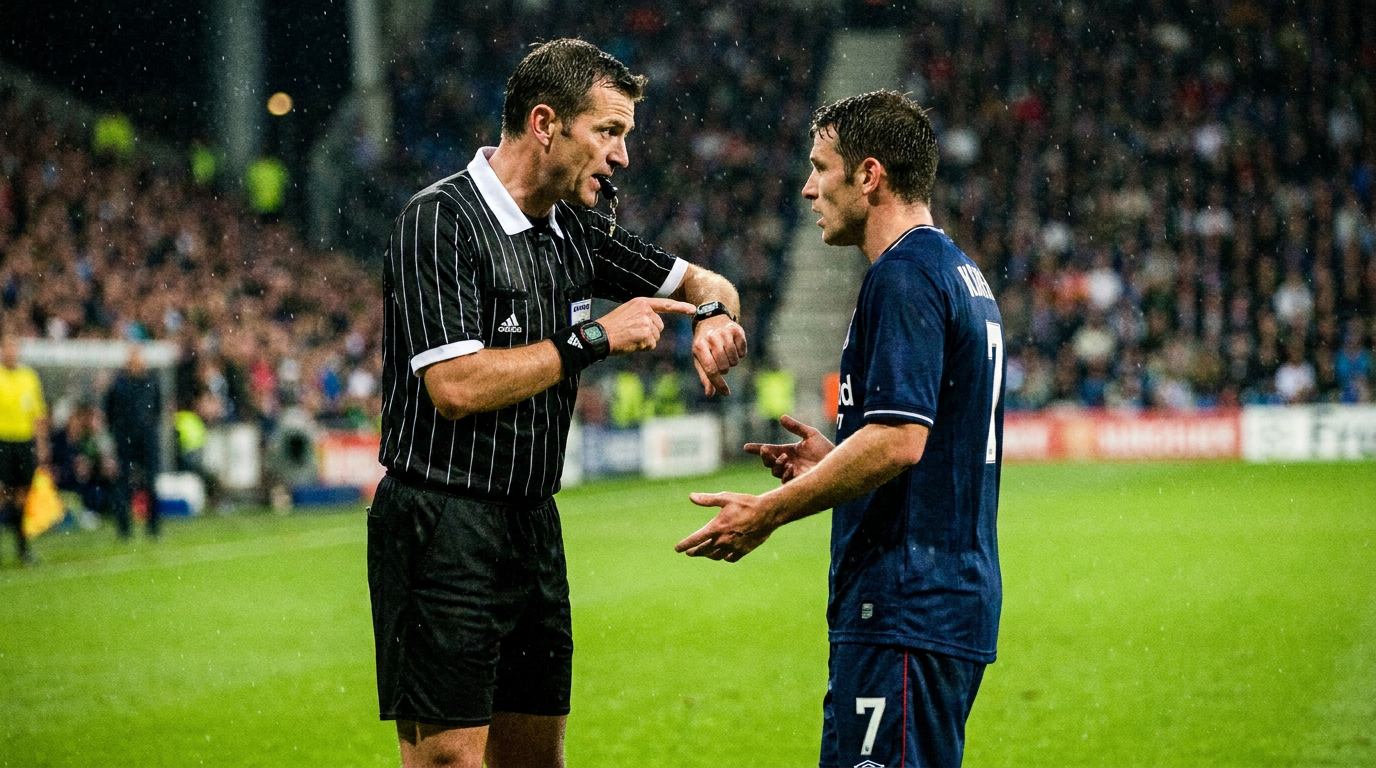
Beyond time management, IFAB is cracking down heavily on player behavior and toxic confrontations. In a direct response to recent high-profile racism incidents—including an altercation involving Real Madrid's Vinicius Junior—players who cover their mouths during an on-pitch confrontation will now be shown a straight red card.[1][2]
The logic behind the mouth-covering ban is straightforward: the tactic has increasingly been used by players to hide discriminatory language or abusive insults from lip-readers and broadcast cameras. While friendly conversations between teammates or opponents remain exempt, aggressive exchanges are now strictly monitored by the officiating crew.[1][2][5]

The new laws also address team-wide protests and walk-offs. Any player leaving the pitch in protest of a referee's decision will automatically receive a red card. Furthermore, if an entire team abandons the match—a scenario seen in recent international tournaments—the team responsible will automatically forfeit the game.[1][5][6]
Finally, the Video Assistant Referee (VAR) system is receiving a significant upgrade to its jurisdiction. VAR can now intervene to review and overturn incorrectly awarded second yellow cards, correct cases of mistaken identity, and review clearly incorrect corner kicks that lead directly to a goal or penalty.[1][2][5]
How we got here
March 2018
IFAB formally writes the Video Assistant Referee (VAR) system into the laws of international football.
January 2026
A controversial AFCON final sees a team temporarily walk off the pitch in protest, prompting IFAB to draft stricter forfeit rules.
March 2026
IFAB officially approves the new package of rules targeting time-wasting and player conduct.
June 11, 2026
The new rules officially take effect globally, coinciding with the start of the 2026-27 season.
Viewpoints in depth
Governing Bodies
Argue the changes are necessary to clean up the game, maximize effective playing time, and protect players from abuse.
Organizations like IFAB and FIFA view these rule changes as an existential necessity for the modern game. With effective playing time often dropping below 55 minutes per match due to tactical delays, governing bodies argue that strict countdowns are the only way to protect the product's entertainment value. Furthermore, the immediate red cards for mouth-covering and walk-offs represent a zero-tolerance shift toward protecting officials and players from toxic, unsporting behavior.
Broadcasters & Fans
Welcome the crackdown on time-wasting and tactical timeouts, hoping for a more entertaining and continuous viewing experience.
For years, fans and broadcasters have expressed intense frustration over the 'dark arts' of football—specifically the agonizingly slow substitutions and feigned injuries designed to kill momentum. This camp overwhelmingly supports the 10-second substitution rule and the 60-second injury sideline wait, viewing them as long-overdue mechanisms that will force teams to actually play football in the final 15 minutes of a tight match rather than managing the clock.
Tactical Analysts
Focus on how the strict substitution and injury countdowns will force managers to adapt their late-game strategies.
Analysts point out that these rules will fundamentally alter late-game management. Managers can no longer use a 90th-minute substitution purely to burn 45 seconds off the clock, as the 10-second limit neutralizes the delay. Additionally, the risk of playing with 10 men for a full minute if a player takes too long to exit, or if an outfield player requires treatment, means teams will have to be far more strategic about when and how they halt play.
What we don't know
- How strictly referees will enforce the five-second countdown for throw-ins during the chaotic final minutes of high-stakes matches.
- Whether the 10-second substitution rule will lead to an increase in players sprinting off the pitch and risking muscle strains.
- How quickly domestic leagues with fewer cameras will adapt to the expanded VAR responsibilities.
Key terms
- IFAB
- The International Football Association Board, the independent body that determines the Laws of the Game for association football globally.
- VAR
- Video Assistant Referee, an officiating system that reviews decisions made by the head referee using video footage.
- Tactical Timeout
- An unofficial delay in the game, often achieved by a player feigning injury, used to disrupt the opponent's momentum or allow a team to rest.
- Second Yellow Card
- A second caution given to a player in the same match, which automatically results in a red card and dismissal from the game.
Frequently asked
What happens if a substituted player takes longer than 10 seconds to leave?
The team must play with one fewer player for at least one minute, as the substitute cannot enter until the next stoppage in play.
Can VAR now overturn a second yellow card?
Yes, VAR has been granted expanded powers to review and recommend overturning incorrectly awarded second yellow cards.
Why are players banned from covering their mouths?
The rule aims to prevent players from hiding racist or abusive language from broadcast cameras and lip-readers during on-pitch confrontations.
Do injured players always have to leave the pitch for a minute?
No. Goalkeepers, players with severe or head injuries, and the designated taker of a penalty kick are exempt from the 60-second sideline wait.
Sources
Source coverage
6 outlets
3 viewpoints surfaced






[1]Sport ResolutionsGoverning Bodies
IFAB introduces rule changes ahead of the 2026 World Cup
Read on Sport Resolutions →[2]NBC SportsBroadcasters & Fans
Rule changes confirmed for 2026 World Cup as IFAB alters VAR, cracks down on subs and 'timeouts'
Read on NBC Sports →[3]League of IrelandGoverning Bodies
New IFAB changes to be implemented in LOI
Read on League of Ireland →[4]OneFootballTactical Analysts
IFAB confirms a raft of rule changes for the 2026 World Cup
Read on OneFootball →[5]On New JerseyTactical Analysts
Eight Rule Changes Coming to 2026 FIFA World Cup
Read on On New Jersey →[6]Sky SportsBroadcasters & Fans
IFAB confirms new red card and time-wasting rules for 2026
Read on Sky Sports →
More in sports
See all 394 stories →Pro Volleyball Boom
How Women's Professional Volleyball Finally Broke Through in America
6 sources
Women's Sports
How Women's Wrestling Became the Fastest-Growing Collegiate Sport in America
8 sources

Engine Regulations
The 2026 Formula 1 Engine Revolution: How Sustainable Fuel and a 50/50 Hybrid Split Are Changing the Sport
8 sources

MLB Milestones
Brewers' Jacob Misiorowski Throws Historic 15-Strikeout, One-Hit Shutout
7 sources

Every angle. Every day.
Get sports stories with full source coverage and perspective breakdowns delivered to your inbox.