
First Working Nuclear Clock Realized, Heralding a New Era in Precision Timekeeping
Physicists have successfully demonstrated the world's first fully working nuclear clock, utilizing the nucleus of thorium-229. The breakthrough promises unprecedented stability for deep-space navigation and fundamental physics research.
By Factlen Editorial Team
- Metrologists & Quantum Physicists
- Focus on the unprecedented fractional frequency uncertainty and the ability to probe fundamental constants.
- Aerospace & Defense Engineers
- Value the technology for its potential to enable autonomous deep-space navigation and resilient GPS-denied operations.
- Materials Scientists
- Emphasize the manufacturing breakthroughs, such as electroplating and crystal doping, that make the clock scalable and safe.
What's not represented
- · Commercial clock manufacturers who will need to adapt their supply chains to produce vacuum-ultraviolet lasers and frequency combs.
- · Regulatory bodies overseeing the transport and commercial deployment of devices containing even microscopic amounts of radioactive thorium-229.
Why this matters
Nuclear clocks are immune to the environmental disturbances that affect current atomic clocks. This leap in precision will enable autonomous deep-space navigation, protect critical infrastructure from GPS jamming, and allow physicists to test the fundamental laws of the universe.
Key points
- Physicists have successfully realized the world's first working nuclear clock, shifting precision timekeeping from the electron shell to the atomic nucleus.
- The clock utilizes a uniquely low-energy transition in the nucleus of thorium-229, excited by a specialized vacuum-ultraviolet laser.
- Recent tests demonstrate a fractional frequency uncertainty below 10^-18, meaning the clock would not lose a second in billions of years.
- A breakthrough in electroplating thorium onto steel has eliminated the need for complex, highly radioactive crystals, paving the way for miniaturization.
- The technology promises to revolutionize autonomous deep-space navigation and provide a hyper-sensitive probe for testing fundamental physics.
For over seventy years, the atomic clock has served as the undisputed gold standard of precision measurement, quietly dictating the rhythm of the modern world. From synchronizing global GPS networks to timestamping high-frequency financial trades, our infrastructure relies on the steady, predictable energy transitions of electrons. But on June 12, 2026, the scientific community announced the realization of a long-held ambition that fundamentally shifts this paradigm: the world's first fully working nuclear clock. This breakthrough moves the frontier of timekeeping away from the fragile outer electron shell and into the dense, heavily shielded heart of the atom itself, promising a leap in stability that could redefine both navigation and our understanding of the universe.[1][7]
To understand the magnitude of this shift, one must look at how time is currently measured. Traditional atomic clocks, such as those based on cesium or strontium, operate by measuring the energy jumps of electrons as they orbit an atom's nucleus. While incredibly precise, these electrons are exposed to the outside world, making them susceptible to external disturbances like stray magnetic fields, temperature fluctuations, and electromagnetic interference. A nuclear clock, by contrast, measures energy transitions deep within the nucleus. Because the nucleus is densely packed and naturally shielded by the surrounding electron cloud, its 'ticks' remain virtually immune to the environmental noise that limits the accuracy of atomic clocks.[1][5]
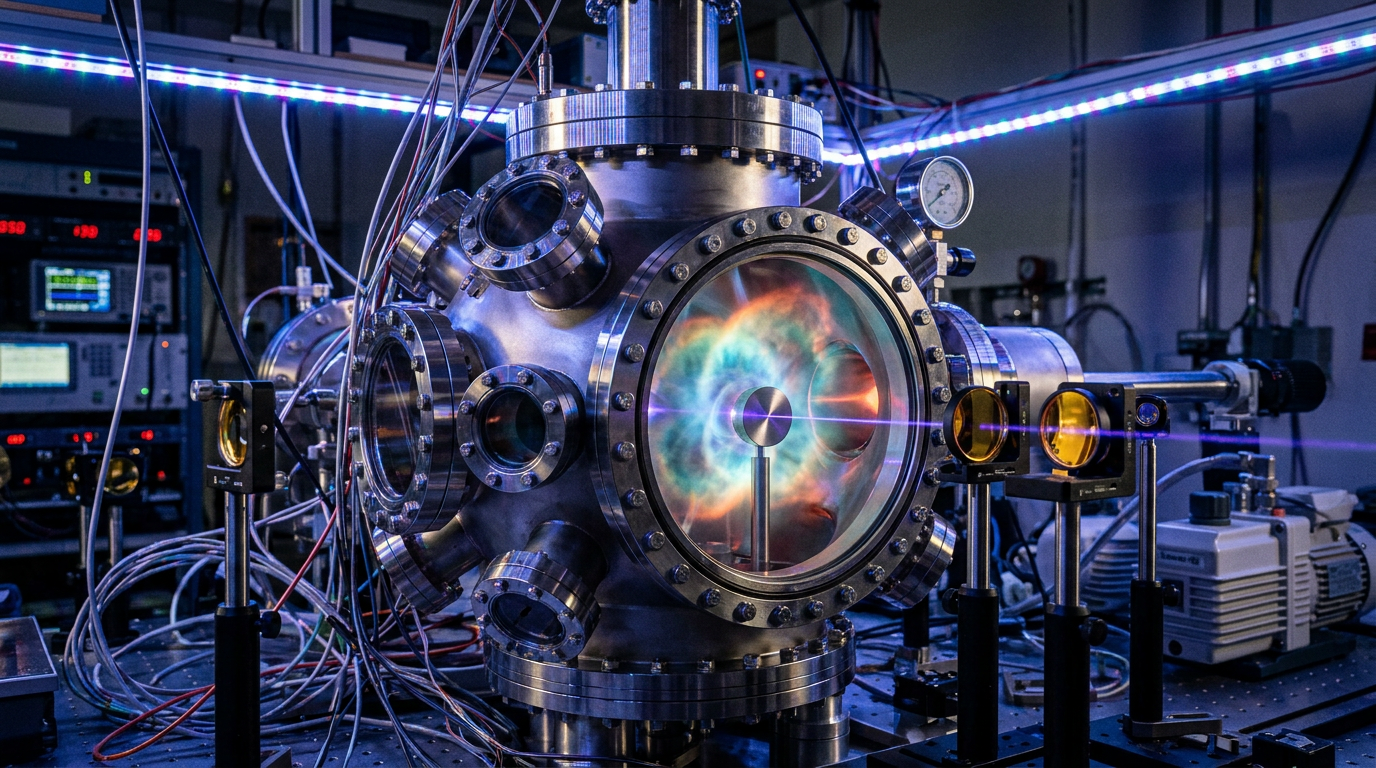
The foundation of this new technology rests entirely on a specific, exceptionally rare isotope known as thorium-229. For decades, theoretical physicists have known that thorium-229 possesses a uniquely low-energy nuclear transition—an 'isomeric state.' In almost all other known elements, exciting the nucleus requires bombardment with highly destructive, high-energy gamma rays, which is entirely impractical for a precision instrument. Thorium-229 is the sole known exception, featuring a nuclear transition energy so low that it can be triggered by ultraviolet laser light, bridging the gap between nuclear physics and precision optical metrology.[2][4]
However, isolating and controlling this precise transition proved to be one of modern physics' most stubborn experimental challenges. The energy required to trigger the 'tick' of the thorium nucleus is incredibly specific, corresponding to a vacuum-ultraviolet wavelength of approximately 148 nanometers. Because light at this wavelength is strongly absorbed by air, all experiments must be conducted in a high-vacuum environment. Furthermore, researchers had to develop entirely new classes of specialized lasers and optical frequency combs just to locate and measure this exact resonant frequency without destroying the delicate quantum state of the system.[2][5]

The definitive evidence for the working clock rests on a culmination of rapid, peer-reviewed advancements over the past two years. The critical turning point arrived in early 2026, when a joint research team from JILA, the National Institute of Standards and Technology (NIST), and TU Wien published a landmark paper in Nature. The team successfully demonstrated the long-term frequency reproducibility of a solid-state thorium nuclear clock, proving that the theoretical concept could be maintained reliably over extended periods in a physical medium.[2]
In their experimental setup, the JILA team embedded thorium-229 ions into the lattice of calcium fluoride (CaF2) crystals. By systematically testing the material, they discovered that cooling the system to an optimal working temperature of 196 Kelvin effectively eliminated the crystal's first-order thermal sensitivity. This meant that minor temperature fluctuations in the laboratory environment no longer caused the clock's frequency to drift, removing one of the most significant barriers to achieving ultra-precise, long-term stability in a solid-state device.[2][4]
The resulting stability metrics were staggering, far exceeding initial projections. The researchers reported a reproducibility of 220 hertz over a continuous seven-month testing period, which pushed the fractional frequency uncertainty of the system below the 10^-18 level. In practical, human terms, a clock operating at this level of precision is so stable that it would not lose or gain a single second even if it were left running continuously for billions of years—a duration roughly equivalent to the current age of the universe.[2][5]
Despite these record-breaking metrics, the calcium fluoride crystal approach carried significant practical drawbacks that threatened to limit the technology to highly specialized laboratories. Growing these specialized, thorium-doped crystals was an arduous process that took years of trial and error to perfect. More importantly, the process required substantial amounts of radioactive thorium-229, which is difficult to source and introduces complex radiation safety protocols and prohibitive costs for widespread commercial manufacturing.[3][7]

Growing these specialized, thorium-doped crystals was an arduous process that took years of trial and error to perfect.
A parallel breakthrough provided the crucial evidence that the technology could be scaled safely and economically. In January 2026, a team led by physicists at UCLA discovered that they could abandon the delicate, expensive fluoride crystals entirely. Looking for a more robust host material, the researchers turned to a technique akin to an old jeweler's trick, fundamentally altering the manufacturing pathway for nuclear timekeeping devices.[3]
Instead of growing a crystal lattice, the UCLA researchers successfully electroplated a microscopic layer of thorium directly onto a steel substrate. This remarkably simple method used only a tiny fraction of the radioactive material previously required, drastically reducing both the cost and the radiation hazard. Yet, when the electroplated thorium nucleus was excited by the vacuum-ultraviolet laser, it produced the exact same measurable electric current and stable 'ticks' as the complex crystal method.[3]
This manufacturing breakthrough is widely viewed as the key to moving nuclear clocks out of the laboratory. By demonstrating that the thorium transition can be reliably excited and measured on a simple steel surface, the electroplating method opens a clear engineering pathway to miniaturize the technology. Metrologists and aerospace engineers are now actively drafting blueprints to shrink the sprawling optical tables currently required into compact, portable devices that could eventually be deployed in field environments.[3][7]
Further evidence of the technology's maturation comes from recent advancements in the supply chain for the rare isotope itself. Because thorium-229m does not occur naturally in usable quantities, it must be synthesized. In February 2026, researchers at Fudan University demonstrated a novel production scheme utilizing storage rings and electron beam ion traps. This new indirect excitation pathway boosted the production rate of the elusive isotope by up to four orders of magnitude, ensuring that future commercial demand for the material can be met.[6]

The implications of a deployable nuclear clock extend far beyond simply keeping accurate time on Earth. Because the clock's 'ticks' are generated by the strong nuclear force holding the atom's core together—rather than the electromagnetic force governing the electron shell—the device acts as a hyper-sensitive probe for fundamental physics. It provides scientists with an entirely new lens through which to observe the foundational rules of the universe.[4][7]
Theoretical physicists plan to deploy these clocks to test whether the fundamental constants of nature, such as the fine-structure constant, are truly constant, or if they drift imperceptibly over cosmic timescales. Because the nuclear transition is so isolated, any unexpected shift in the clock's frequency that cannot be explained by environmental factors could provide the first direct, measurable evidence of dark matter interacting with ordinary matter, potentially solving one of the greatest mysteries in modern astrophysics.[2][4]
On a more immediate, practical level, the technology promises to revolutionize navigation in GPS-denied environments. Currently, deep-space probes rely heavily on timing signals beamed from Earth to calculate their trajectories. As a spacecraft travels further into the solar system, the latency of these signals increases massively, preventing the probe from navigating autonomously in real-time and requiring constant, delayed intervention from ground control.[3][7]
A portable nuclear clock would allow a spacecraft to carry its own primary, unshakeable time standard. The extreme stability of the 148-nanometer nuclear transition ensures that the probe could calculate its exact position and trajectory autonomously for decades without needing to sync with Earth. Similar resilient navigation applications are being aggressively pursued for deep-sea submarines and critical terrestrial power grids that currently depend on easily jammed or spoofed satellite signals.[3][7]

Despite the successful demonstration of the working clock, transparent uncertainties remain regarding the timeline for its commercialization. The transition from a highly controlled laboratory demonstrator to a rugged, field-deployable unit involves immense engineering challenges. The system still relies on complex, fragile vacuum-ultraviolet frequency combs and specialized lasers that must be miniaturized and hardened against the vibrations and thermal shocks of a rocket launch or a submarine dive.[1][5]
Furthermore, while the electroplated steel method drastically reduces the amount of radioactive material needed, the long-term durability of the device remains an open question. The degradation of the ultra-thin thorium films under continuous, high-intensity ultraviolet laser bombardment has not yet been fully characterized over multi-year lifespans. Researchers are currently running accelerated aging tests to determine if the electroplated surface will slowly ablate or lose its resonant properties over a decade of continuous operation.[3][7]
Nevertheless, the consensus among global metrologists is that the fundamental physics hurdles have now been definitively cleared. The realization of the first working nuclear clock marks the beginning of a new epoch in precision measurement. By successfully harnessing the energy buried deep within the atomic nucleus, scientists have not only built the ultimate timekeeper, but have also unlocked a powerful new tool for exploring the deepest mysteries of the physical universe.[1][7]
How we got here
2008
Scientists first propose a theoretical scheme to use a laser to excite the nucleus of thorium atoms for ultra-precise timekeeping.
September 2024
Researchers successfully demonstrate the key components of a nuclear clock, including the specialized vacuum-ultraviolet laser and frequency comb.
January 2026
UCLA physicists discover a method to electroplate thorium onto steel, bypassing the need for complex and highly radioactive fluoride crystals.
February 2026
JILA and TU Wien publish data proving the long-term frequency reproducibility of solid-state thorium clocks, achieving unprecedented stability.
June 2026
The scientific community announces the realization of the first fully working nuclear clock, heralding a new era in precision metrology.
Viewpoints in depth
Metrologists & Quantum Physicists
Focus on the unprecedented fractional frequency uncertainty and the ability to probe fundamental constants.
For the metrology community, the nuclear clock represents the holy grail of precision measurement. Because the energy transition occurs within the nucleus, it is shielded from the electromagnetic noise that limits optical lattice clocks. Physicists argue this isolation makes the clock the ultimate tool for testing the Standard Model, allowing them to measure whether fundamental constants drift over time or if dark matter subtly interacts with ordinary matter.
Aerospace & Defense Engineers
Value the technology for its potential to enable autonomous deep-space navigation and resilient GPS-denied operations.
Aerospace engineers view the nuclear clock primarily as a navigation revolution. Current deep-space missions suffer from massive latency because probes must rely on timing signals beamed from Earth to calculate their position. By equipping a spacecraft with a portable, ultra-stable nuclear clock, engineers argue that probes could navigate autonomously in real-time. Similarly, defense analysts emphasize the clock's potential to secure critical infrastructure and submarines against GPS jamming.
Materials Scientists
Emphasize the manufacturing breakthroughs, such as electroplating and crystal doping, that make the clock scalable and safe.
While physicists focus on the clock's precision, materials scientists highlight the manufacturing innovations that make it viable. Early prototypes required growing complex, highly radioactive thorium-doped calcium fluoride crystals. Materials researchers argue that the recent shift to electroplating microscopic layers of thorium onto steel substrates is the true breakthrough, as it drastically reduces radiation hazards, cuts costs, and provides a clear engineering pathway to mass-produce miniaturized clocks.
What we don't know
- How long the ultra-thin electroplated thorium films will remain stable under continuous vacuum-ultraviolet laser bombardment over multi-year lifespans.
- The exact engineering timeline required to miniaturize the sprawling laboratory optical frequency combs into rugged, field-deployable units.
- Whether the extreme precision of the nuclear clock will actually reveal drifts in fundamental constants, or simply confirm the Standard Model to a higher degree of accuracy.
Key terms
- Isomeric state
- A long-lived excited state of an atom's nucleus that has a higher energy than its standard ground state.
- Fractional frequency uncertainty
- A standard measure of a clock's precision, representing the potential error in timekeeping relative to the total time measured.
- Vacuum-ultraviolet (VUV)
- A band of the electromagnetic spectrum with very short wavelengths that are strongly absorbed by air, requiring experiments to be conducted in a vacuum chamber.
- Frequency comb
- A specialized laser tool that measures exact frequencies of light, acting as an ultra-precise ruler to count the 'ticks' of an optical or nuclear clock.
- Electroplating
- A manufacturing process that uses an electric current to deposit a microscopic, coherent metal coating onto a conductive surface.
Frequently asked
What is the difference between an atomic clock and a nuclear clock?
Atomic clocks measure the energy jumps of electrons orbiting the nucleus, which are susceptible to environmental noise. Nuclear clocks measure energy transitions deep within the nucleus itself, which is heavily shielded and vastly more stable.
Why is thorium-229 used instead of other elements?
Thorium-229 is the only known element with a nuclear energy transition low enough to be triggered by an ultraviolet laser. Other elements require highly destructive gamma rays, making them useless for precision clocks.
Will this replace the atomic clocks used in GPS satellites?
Eventually, yes. While currently confined to laboratories, engineers are working to miniaturize nuclear clocks. Once field-deployable, they will provide far more resilient and accurate timing for GPS and power grids.
Is the radioactive thorium dangerous in these clocks?
Early crystal-based prototypes required significant amounts of radioactive material. However, new electroplating techniques use only microscopic amounts of thorium, drastically reducing radiation hazards and making the devices safe for widespread use.
Sources
Source coverage
7 outlets
3 viewpoints surfaced






[1]New ScientistMetrologists & Quantum Physicists
First working nuclear clock heralds a new era in timekeeping
Read on New Scientist →[2]NatureMetrologists & Quantum Physicists
Frequency reproducibility of solid-state thorium-229 nuclear clocks
Read on Nature →[3]UCLA NewsroomMaterials Scientists
An old jeweler's trick could unlock next-generation nuclear clocks
Read on UCLA Newsroom →[4]JILAMetrologists & Quantum Physicists
Dialing in the Temperature Needed for Precise Nuclear Timekeeping
Read on JILA →[5]The DebriefAerospace & Defense Engineers
Scientists Demonstrate Key Technologies Behind Holy Grail of Timekeeping: The World's First Nuclear Clock
Read on The Debrief →[6]Quantum ZeitgeistMaterials Scientists
Thorium Breakthrough Paves Way For Ultra-Precise Atomic Clocks
Read on Quantum Zeitgeist →[7]Factlen Editorial TeamMetrologists & Quantum Physicists
Synthesis by Factlen editorial team
Read on Factlen Editorial Team →

Every angle. Every day.
Get science stories with full source coverage and perspective breakdowns delivered to your inbox.