
First Working Nuclear Clock Heralds a New Era in Precision Timekeeping
Scientists have successfully demonstrated the first operational nuclear clock, using laser-excited thorium-229 nuclei to achieve unprecedented timekeeping stability. The breakthrough paves the way for ultra-precise navigation, advanced quantum technologies, and new tests of fundamental physics.
By Factlen Editorial Team
- Quantum Metrologists
- Focusing on the unprecedented stability and precision the nuclear clock brings to measurement science.
- Fundamental Physicists
- Viewing the nuclear clock as a highly sensitive probe to test the foundational laws of the universe.
- Aerospace & Navigation Engineers
- Prioritizing the clock's potential for robust, portable, and autonomous navigation systems.
What's not represented
- · Telecommunications Infrastructure Providers
- · Satellite Network Operators
Why this matters
By moving the ultimate reference point for time from the fragile electron shell to the heavily shielded atomic nucleus, this technology promises to revolutionize deep-space navigation, create GPS systems immune to jamming, and provide physicists with a radically sensitive new tool to detect dark matter.
Key points
- Scientists have successfully demonstrated the first working nuclear clock, shifting timekeeping from the atom's electron shell to its core.
- The clock relies on Thorium-229, the only known isotope whose nucleus can be excited by ultraviolet lasers.
- Because the nucleus is heavily shielded, the clock is virtually immune to environmental interference like stray magnetic fields.
- Theoretical accuracy limits suggest the clock could lose less than a single second over 300 billion years.
- The technology paves the way for highly portable, ultra-precise navigation systems that do not rely on satellite GPS.
- Physicists plan to use the clock to test whether fundamental constants of nature are changing and to search for dark matter.
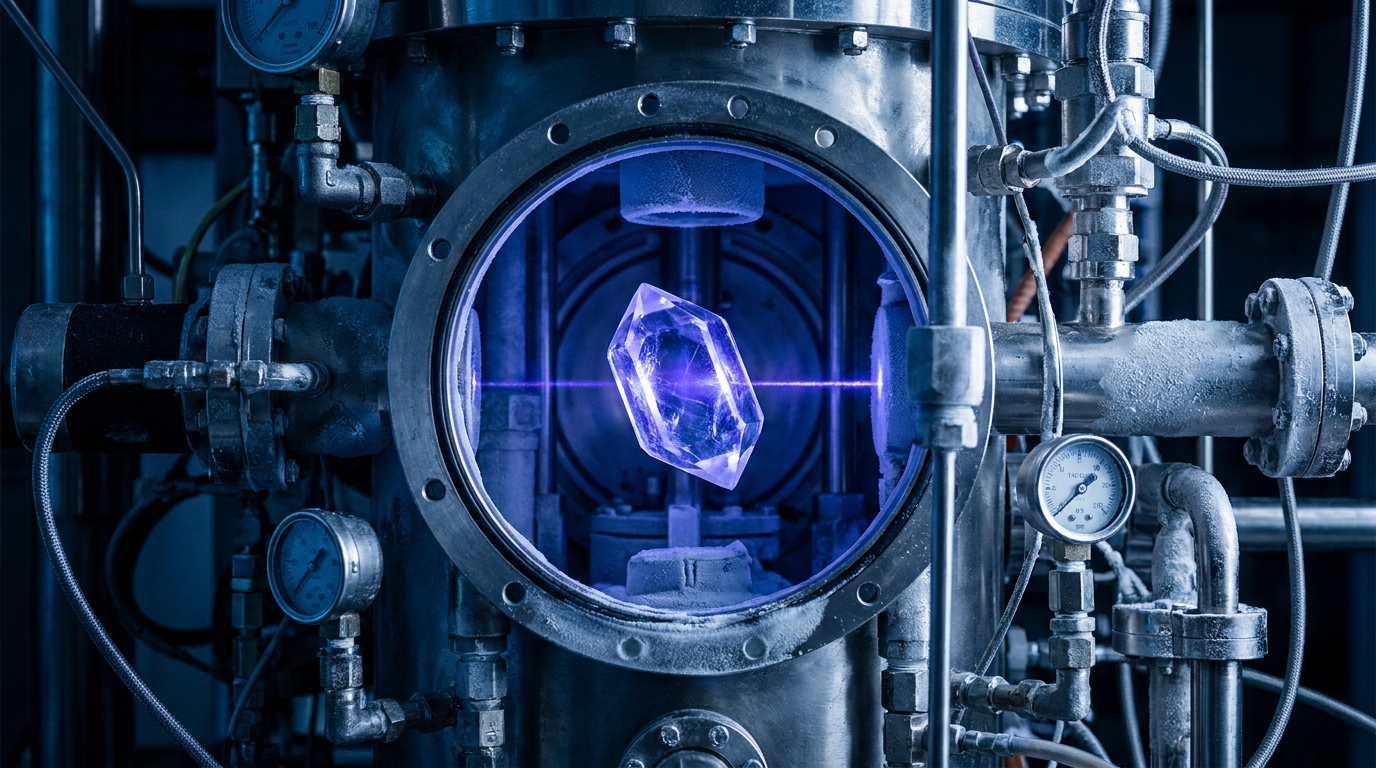
For decades, the gold standard of human timekeeping has been the atomic clock, a device so precise it underpins the global GPS network, deep-space navigation, and the synchronization of the entire internet. But the era of the atomic clock is now facing its long-anticipated successor. In a landmark achievement for quantum metrology, scientists have successfully demonstrated the world's first working nuclear clock, realizing a theoretical ambition that physicists have chased for nearly twenty years. This milestone represents a fundamental leap in measurement science, moving our ultimate reference point from the outer shell of the atom to its dense, heavily shielded core.[1][3]
The breakthrough, reported this week, marks a fundamental shift in how humanity measures the passage of time. While traditional atomic clocks rely on the behavior of electrons orbiting an atom, a nuclear clock looks inward, measuring the microscopic energy jumps within the atom's core—the nucleus itself. This shift from the electron shell to the nucleus promises to deliver a timekeeping device with an astonishing theoretical accuracy of 10⁻¹⁹. To put that number into perspective, a clock operating at this level of precision would lose or gain less than a single second over the course of 300 billion years—more than twenty times the current age of the universe.[1][6]
To understand why this is a monumental leap, one must understand the inherent vulnerabilities of current atomic clocks. The best modern optical lattice clocks use highly tuned lasers to measure the energy transitions of electrons in elements like strontium or ytterbium. However, because electrons reside on the outer edge of the atom, they are highly sensitive to environmental disturbances. Stray electromagnetic fields, blackbody radiation from the surrounding room, and minute temperature fluctuations can all subtly alter the electron's energy state. These environmental factors introduce tiny errors into the clock's 'ticks,' forcing scientists to build massive, complex vacuum chambers and cryogenic cooling systems just to keep the atoms isolated.[4]

The nucleus, by contrast, is an absolute fortress. It is roughly 100,000 times smaller than the overall atom and bound together by the strong nuclear force, the most powerful force in nature. Because the protons and neutrons are packed so tightly in the center, they are naturally shielded from the external electromagnetic noise that constantly plagues electrons. If scientists could use the energy transitions of the nucleus as a pendulum, the resulting clock would be virtually immune to environmental interference. This natural isolation allows for both unprecedented stability and the potential to build highly accurate, portable devices that do not require room-sized cooling infrastructure.[3][7]
But accessing the nucleus has historically been a massive technological hurdle, which is why nuclear clocks remained purely theoretical for so long. In almost all known elements, the energy required to force a nucleus to jump to a higher energy state is immense, typically requiring high-energy X-rays or gamma rays. We do not currently possess lasers capable of producing continuous, highly controlled X-rays to act as the clock's pendulum. Without a laser that can precisely trigger the nuclear transition, there is no way to read the 'ticks' of the clock, leaving the nucleus locked away from metrologists.[4]
Enter Thorium-229. This specific radioactive isotope possesses a freakish anomaly in its nuclear structure: an exceptionally low-energy excited state, known as a nuclear isomer. It is the only known atomic nucleus in the universe whose energy jump is small enough to be triggered by ultraviolet light rather than X-rays. This quirk of nature makes Thorium-229 the undisputed 'holy grail' of nuclear clock research, as it falls perfectly within the range of frequencies that human-engineered vacuum ultraviolet lasers can actually reach. Without Thorium-229, the concept of a nuclear clock would be practically impossible with current technology.[3][5]

The path to a working device has been paved by a rapid succession of recent milestones that accelerated the field. In 2024, a joint effort by researchers at JILA in the United States and the PTB in Germany achieved the first direct laser excitation of the Thorium-229 nucleus. They successfully embedded thorium atoms into a transparent calcium fluoride crystal and struck them with a specialized vacuum ultraviolet laser. By doing so, they measured the exact frequency of the nuclear transition and compared it directly to a strontium atomic clock, proving that the nucleus could be reliably manipulated.[2][4]
The path to a working device has been paved by a rapid succession of recent milestones that accelerated the field.
Building on that foundational proof-of-concept, international teams have spent the last two years solving the remaining engineering bottlenecks to create a fully operational system. In late 2025, researchers from UCLA, LMU Munich, and Johannes Gutenberg University Mainz successfully excited the thorium nucleus inside non-transparent host materials. This breakthrough drastically expanded the types of solid-state crystals that can be used to house the clock, moving the technology away from fragile, perfectly transparent mediums and toward more robust, practical materials that can withstand real-world deployment.[5][7]
Simultaneously, a Chinese research team recently announced the creation of the world's first continuous-wave ultra-narrow-linewidth laser operating at exactly 148 nanometers. This vacuum ultraviolet laser, generated through a complex process of four-wave mixing in metal vapor, provided the missing piece of the puzzle. It delivered the ultra-stable, continuous light source required to reliably 'tick' the thorium nucleus without the laser beam itself fluctuating. By reducing the laser's linewidth by nearly six orders of magnitude, they established the technical foundation necessary to drive the clock continuously.[6]
The fully realized nuclear clock operates as a symphony of these advanced technologies working in perfect unison. A solid crystal doped with Thorium-229 holds the nuclei perfectly stationary, eliminating the need to trap individual atoms in complex electromagnetic fields. The ultra-stable 148-nanometer vacuum ultraviolet laser is fired into the crystal, precisely tuned to the exact energy required to flip the nuclear 'switch.' When the nucleus absorbs the energy and subsequently drops back down to its ground state, it emits a photon, completing one microscopic cycle.[2][6]

To read the time from this quantum system, scientists use an 'optical frequency comb'—a specialized laser device that acts as an ultra-precise ruler for light. The frequency comb counts the exact number of ultraviolet wave cycles that correspond to the nuclear energy jump. By translating those microscopic, high-frequency quantum oscillations into a readable, macroscopic measurement of time, the system produces a steady, reliable output that can be used to synchronize external devices, officially bringing the nuclear clock online.[2][7]
Despite the triumph of a working prototype, the engineering phase is only just beginning, and researchers are quick to note that optimization will take time. Quantum metrologists must now systematically map and mitigate any residual frequency shifts. While the nucleus is highly shielded, the solid-state crystal housing the thorium atoms can still introduce minute perturbations—such as tiny magnetic interactions or structural stresses—that need to be accounted for before the clock can officially surpass the world's best optical atomic clocks in practical, everyday operation.[4][7]
The implications of this technology extend far beyond simply keeping better time in a laboratory. Because nuclear clocks can be built directly into solid crystals rather than requiring the massive, complex vacuum chambers used by optical atomic clocks, they are inherently more robust and portable. This portability could revolutionize autonomous navigation, allowing submarines, aircraft, and deep-space probes to maintain pinpoint positional accuracy without relying on vulnerable satellite GPS signals, which can be jammed or degraded in hostile environments.[2][3][6]

Furthermore, the nuclear clock offers physicists a radical new tool to probe the fundamental laws of the universe. Because the nucleus is governed by the strong nuclear force, while electron shells are governed by electromagnetism, comparing a nuclear clock to an atomic clock over time could reveal if the fundamental constants of nature are slowly changing. It could also provide unprecedented sensitivity in the search for ultralight dark matter, which theorizes that invisible particles might subtly alter nuclear frequencies as they pass through the Earth.[4][7]
As laboratories around the world race to refine these prototypes and package them into deployable devices, the successful operation of the first nuclear clock stands as a testament to decades of theoretical physics and materials science. Humanity has finally learned to read the time kept by the heavily armored heart of the atom, unlocking a level of precision that will shape the next century of scientific discovery, from the depths of the ocean to the furthest reaches of deep space.[1][3][7]
How we got here
2003
Physicists first propose the theoretical concept of a nuclear clock using the unique properties of Thorium-229.
April 2024
Researchers at JILA and PTB achieve the first direct laser excitation of the Thorium-229 nucleus, proving the concept is physically possible.
December 2025
International teams successfully excite the thorium nucleus inside non-transparent solid-state crystals, expanding the materials that can be used.
February 2026
A Chinese research team develops the world's first continuous-wave 148nm ultra-stable laser, providing the necessary light source to drive the clock continuously.
June 2026
Scientists demonstrate the first fully operational nuclear clock, successfully reading the time from the nuclear transitions.
Viewpoints in depth
Quantum Metrologists
Focusing on the unprecedented stability and precision the nuclear clock brings to measurement science.
For metrologists, the nuclear clock represents the ultimate triumph over environmental noise. By moving the timekeeping mechanism from the fragile electron shell to the heavily shielded nucleus, they argue that humanity can finally bypass the physical limits of atomic clocks. Their primary focus now is characterizing and eliminating the minute systematic shifts caused by the solid-state crystal lattice, ensuring the clock's ticks are perfectly uniform.
Fundamental Physicists
Viewing the nuclear clock as a highly sensitive probe to test the foundational laws of the universe.
Theoretical physicists are less interested in keeping time and more interested in what the clock can reveal about reality. Because the nucleus is governed by the strong nuclear force, comparing a nuclear clock's frequency to an electromagnetic atomic clock over several years could reveal if the fundamental constants of nature are slowly shifting. They also champion the clock as a novel detector for ultralight dark matter, which could theoretically cause microscopic fluctuations in the nuclear transition frequency.
Aerospace & Navigation Engineers
Prioritizing the clock's potential for robust, portable, and autonomous navigation systems.
Engineers emphasize the practical, real-world applications of a solid-state clock. Current optical atomic clocks require room-sized vacuum chambers and complex laser cooling arrays, making them impossible to deploy in the field. Because the thorium nuclear clock can operate within a simple, solid crystal, engineers envision a future where submarines, deep-space probes, and military aircraft carry their own ultra-precise timekeepers, rendering them immune to GPS jamming and satellite network failures.
What we don't know
- Exactly how much the solid-state crystal housing the thorium atoms will subtly alter the clock's frequency over long periods.
- How quickly the technology can be miniaturized from laboratory-scale optical tables into portable devices for aerospace use.
- Whether the clock will actually detect variations in fundamental constants or dark matter once it is running continuously for several years.
Key terms
- Nuclear Clock
- A timekeeping device that measures time by tracking energy transitions within an atom's nucleus, rather than its electron shell.
- Atomic Clock
- The current standard for precision timekeeping, which relies on the energy jumps of electrons orbiting an atom's nucleus.
- Thorium-229
- A specific radioactive isotope of thorium that possesses a uniquely low-energy nuclear transition, making it the only known nucleus excitable by lasers.
- Vacuum Ultraviolet (VUV) Laser
- A type of laser emitting light at very short wavelengths that are typically absorbed by air, requiring a vacuum environment to operate.
- Frequency Comb
- A specialized laser tool that acts as a ruler for light, allowing scientists to precisely count the electromagnetic oscillations of the clock's ticks.
Frequently asked
What is the difference between an atomic and a nuclear clock?
An atomic clock measures time using the energy jumps of electrons orbiting the outside of an atom. A nuclear clock measures time using the energy jumps of the protons and neutrons packed tightly inside the atom's core.
Why is Thorium-229 the only element used for this?
Thorium-229 has a unique, freakishly low-energy excited state. It is the only known atomic nucleus that can be triggered by ultraviolet lasers rather than requiring massive, uncontrollable X-rays.
How accurate is the new nuclear clock?
Theoretically, a fully optimized nuclear clock could reach an accuracy of 10⁻¹⁹, meaning it would not lose or gain a single second over 300 billion years.
Will this replace the clock in my phone or computer?
No. Nuclear clocks will be used for highly specialized applications like deep-space navigation, resilient military GPS, and advanced physics experiments, not consumer electronics.
Sources
Source coverage
7 outlets
3 viewpoints surfaced







[1]New ScientistQuantum Metrologists
First working nuclear clock heralds a new era in timekeeping
Read on New Scientist →[2]NatureQuantum Metrologists
Frequency ratio of the 229mTh nuclear isomeric transition and the 87Sr atomic clock
Read on Nature →[3]TU WienFundamental Physicists
Thorium-229 nuclear clock: Pioneering the future of precision timekeeping
Read on TU Wien →[4]Optica Publishing GroupQuantum Metrologists
Optical atomic clocks: defining the future of time and frequency metrology
Read on Optica Publishing Group →[5]EurekAlertAerospace & Navigation Engineers
Breakthrough on the path to optical nuclear clocks: laser-based excitation of Thorium-229 in non-transparent material
Read on EurekAlert →[6]TV BRICSAerospace & Navigation Engineers
China achieves breakthrough in nuclear clock research with world-first 148 nm ultra-stable laser
Read on TV BRICS →[7]Factlen Editorial TeamFundamental Physicists
Synthesis by Factlen editorial team
Read on Factlen Editorial Team →

Every angle. Every day.
Get science stories with full source coverage and perspective breakdowns delivered to your inbox.